
Odoo Implementation Services
One Odoo System Built Around Your Operations
Odoo implementation is the process of configuring Odoo ERP around your workflows, data, users, and reporting requirements. It covers module setup, data migration, integrations, testing, training, and go-live.
As an Odoo Gold Partner serving the US and Canada, Cudio implements connected solutions across accounting, inventory, sales, purchasing, manufacturing, CRM, e-commerce, and fulfillment.
Odoo Gold Partner | 70+ Successful Projects | 30+ Years of Experience | 98% Client Retention

Find Out What Your Current ERP Is Costing You
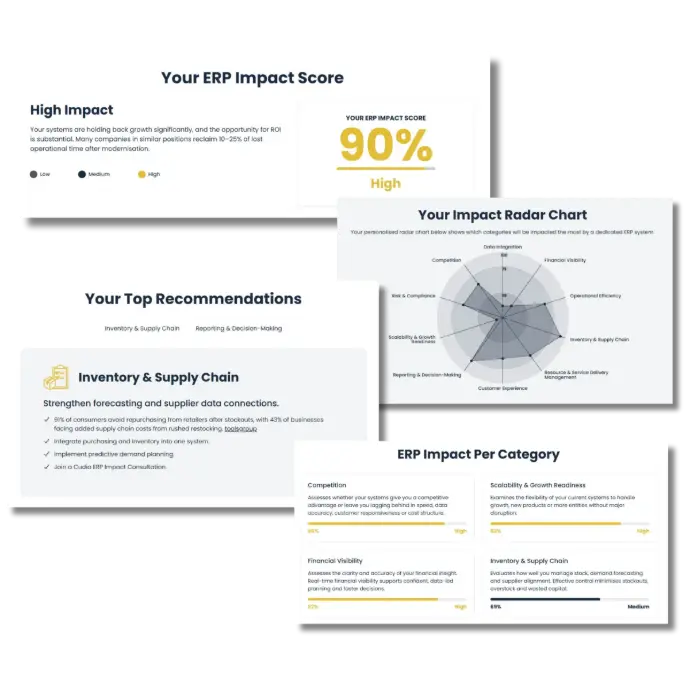
Disconnected applications, duplicate records, manual approvals, and limited reporting can quietly slow daily operations down, creating data silos and more manual tasks across teams. Cudio’s free three-minute ERP Impact Assessment reviews your current systems, workflows, and operational gaps.
You’ll receive a personalized Impact Report showing which processes Cudio’s Odoo ERP implementation services for Odoo software could connect across finance, sales, inventory, operations, and reporting, where implementation risks may exist, and which improvements should be prioritized.
Business Problems an Odoo Implementation Can Solve
A successful Odoo implementation starts by identifying the operational problem in your business processes, then configuring the right modules, workflows, and data structure to support operational excellence. Timelines also increase when a customized Odoo system includes more integrations, custom features, or Odoo migration from prior platforms.
Problem: Departments Work From Different Data
A successful implementation starts by identifying the business processes causing operational issues, such as sales, accounting, inventory, and purchasing relying on separate systems and disconnected existing systems, with the goal of operational excellence.
Cudio’s Solution
We configure connected Odoo modules around shared customer, product, order, inventory, and financial data for seamless integration so departments work from the same records.
Problem: Manual Work Slows Daily Operations
Spreadsheets, paper approvals, repeated data entry, and different existing systems used by departments delay order processing, purchasing, invoicing, and reporting.
Cudio’s Solution
We automate defined workflows to help teams automate processes, including order confirmation, replenishment, approvals, invoicing, notifications, and record updates, with seamless integration of shared records across connected modules and human review where it is required for cost savings.
Problem: Your ERP Cannot Support Growth
Legacy systems may struggle with additional companies, warehouses, users, sales channels, and more complex reporting requirements.
Cudio’s Solution
We configure Odoo’s modular, multi-company, and multi-warehouse capabilities around your current operation to help drive business growth, then add applications and configured workflows to automate order confirmation, replenishment, approvals, invoicing, notifications, and record updates as requirements expand so the odoo system runs smoothly. Reducing repetitive work can also create cost savings.
Problem: A Previous Implementation Failed
Poor requirements, excessive customization, weak data migration, and limited testing can leave Odoo incomplete or unreliable.
Cudio’s Solution
Cudio has rescued more than 32 failed implementations. We audit the database, configuration, custom modules, integrations, and unresolved workflows to redefine the project scope before building a controlled recovery plan. Our phased configuration helps the Odoo system run smoothly as new applications and workflows are added, supporting scalability that can drive business growth.
Why Complex Businesses Choose Cudio for Odoo Implementation

Firsthand Odoo Experience
Seven Cudio team members implemented and used Odoo in their own businesses before becoming Odoo consultants and implementation experts, so that experience informs how we approach workflow design, data migration, testing, training, and go-live with an eye on better operational decision-making. Clients work with certified Odoo experts focused on data accuracy, reporting, inventory, accounting, and fulfillment.
Business-Led Implementation Decisions
Our team includes former operators and executives who understand how ERP decisions affect cash flow, inventory accuracy, order processing, reporting, and employee workload. That experience is applied by certified Odoo experts across project planning, workflow design, data migration, testing, training, and go-live.


Direct Access to Senior Specialists
Cudio’s senior consultants and founders remain involved throughout discovery, configuration, development, testing, and launch, alongside a dedicated support team that also strengthens project planning. You work directly with the people responsible for your implementation decisions.
Real Results, Real Businesses
Our successful projects are our proof that the right Odoo implementation can transform challenges into measurable growth.
Global Operations, Unified in Odoo
"Reduced days to close by 50%, error rate slashed. Odoo now handles global complexity that our legacy system couldn't."
Operating across 30 countries, Lexington Medical struggled with complex BOMs and business structures. We migrated them to Odoo with custom modules built for global scale and manufacturing complexity.

QuickBooks, Fishbowl, and Shopify? Gone.
"$35K saved annually. 40-60 hours back each week. Full visibility achieved."
R&W Rope was juggling multiple disconnected systems. We unified everything into Odoo (ERP, e-commerce, and inventory), cutting costs and saving hundreds of hours monthly.

Disconnected No More
"40% business growth. 80% fewer inventory write-offs. We now ship within 24 hours."
Almac struggled with inefficiencies from siloed systems. We implemented a fully integrated B2B/B2C Odoo solution, streamlining operations and enabling rapid delivery at scale.

Manufacturing

Retail & Wholesale

Healthcare
Streamline Healthcare Manufacturing Now

E-commerce

Logistics

How Our Odoo Implementation Process Works
The timeline below represents a typical project and is adjusted after discovery.

1. Discovery and Analysis
Typical Timeline: Weeks 1–2
We treat this as an Odoo project, documenting how your business currently operates as the first stage of a structured Odoo ERP implementation managed with clear project management for long-term business success. The implementation process begins by assembling the right team to collaborate on the project.
Business process analysis: Map workflows across accounting, inventory, sales, purchasing, manufacturing, CRM, e-commerce, and fulfillment
System assessment: Review databases, applications, reports, integrations, and manual workarounds
Requirements documentation: Define functional requirements, data needs, user roles, and acceptance criteria
Stakeholder alignment: Confirm priorities, responsibilities, scope, and project governance

2. Solution Design and Configuration
Typical Timeline: Weeks 3–6
We translate approved requirements into a solution design for the Odoo platform.
Module selection: Choose the required Odoo apps for the approved scope, including any basic configuration needed to support long-term business success
Workflow configuration: Set permissions, approval rules, routes, replenishment, accounting, and operational settings
Data design: Define master records, required fields, company structures, warehouses, and reporting dimensions
Integration planning: Document connected systems, APIs, data ownership, project management responsibilities, governance, and synchronization requirements
3. Development, Migration, and Testing
Typical Timeline: Weeks 7–12
We build only what standard Odoo configuration cannot support, align the approved solution design on the Odoo platform, and validate the complete solution in a non-production environment.
Custom development: Complete necessary odoo development and create documented modules for approved business requirements
Module selection: Select the right Odoo apps for the approved scope
Workflow configuration: Configure the approved applications and settings, including basic workflows needed by the business
API integration: Connect required commerce, accounting, warehouse, payment, tax, and shipping platforms
Data migration: Clean, map, transform, and load approved records into the correct Odoo models while migrating data and preserving data integrity
System testing: Test permissions, workflows, calculations, reports, integrations, and exception handling
4. Training and Go-Live
Typical Timeline: Weeks 13–16
Your team validates the system before the production cutover.
User acceptance testing: Business users complete real tasks against agreed acceptance criteria
Role-based training: Users learn the Odoo modules and workflows required for their responsibilities, with user training focused on readiness and early odoo feature adoption
Cutover planning: Confirm the data freeze, final migration from source platforms into the correct Odoo models, validation steps that protect data integrity, launch sequence, responsibilities, and rollback plan
Go-live support: Monitor critical workflows and resolve launch issues during the stabilization period
5. Optimization and Support
Timeline: Ongoing
After launch, Cudio helps your team improve system use and address new operational requirements.
Performance monitoring: Review system behavior, scheduled jobs, integrations, and recurring issues
User support: Resolve configuration, workflow, and access questions
Continuous improvement: Prioritize approved enhancements based on operational value
Strategic guidance: Plan additional modules, companies, warehouses, users, and integrations
Results From Cudio Odoo Implementations
Verified Client Result | Operational Impact |
50% faster financial close | Lexington Medical reduced the time required to complete reporting and close activities |
80% fewer inventory write-offs | Almac improved inventory control and reduced avoidable losses |
40 to 60 administrative hours recovered weekly | R&W Rope reduced repetitive work across its operation |
$35,000 saved annually | R&W Rope replaced overlapping software and maintenance costs |
40% business growth | Almac expanded without adding staff |
Is Odoo the Right ERP for Your Business?
Odoo is a strong fit when a business needs accounting, inventory, sales, purchasing, manufacturing, CRM, e-commerce, or other functions to work from a shared system.
It may not be the right choice when the business only needs one lightweight tool, cannot assign internal process owners, or expects extensive custom development before validating standard Odoo workflows.
Cudio evaluates the fit based on five practical factors:
Operational complexity: The number of departments, entities, warehouses, and sales channels involved
Process readiness: Whether key workflows can be documented and approved
Data readiness: The condition, ownership, and availability of records that must move
Internal capacity: The time available for decisions, testing, training, and change management
Technical requirements: The custom features, integrations, security controls, and hosting needs involved
Businesses comparing enterprise platforms can also evaluate the operational differences between SAP ECC and Odoo before committing to a replacement.

Moving every record without first checking its quality can transfer duplicates, obsolete data, and incorrect balances into Odoo.
How Cudio Controls It
We profile the source data, define field mappings, remove approved duplicates, run trial migrations, and reconcile record counts, balances, and critical relationships before cutover.
New requests introduced during development can increase cost and delay testing.
How Cudio Controls It
We document the approved scope, acceptance criteria, assumptions, and exclusions. New requests go through change control or move into a later implementation phase.
Users may reject Odoo when workflows are configured without their input or training is delivered too late.
How Cudio Controls It
Process owners participate in design and user acceptance testing. Role-based training uses the workflows and records each team will handle after launch.
Missing ownership rules, undocumented mappings, API limits, and weak error handling can interrupt orders, inventory, payments, and fulfillment.
How Cudio Controls It
We document endpoints, authentication, field mappings, sync directions, rate limits, retry rules, and monitoring requirements before the integration goes live.
Launching without a data freeze, cutover sequence, rollback plan, or responsible owners can disrupt normal operations.
How Cudio Controls It
We prepare a cutover checklist covering the final data load, user access, integrations, business validation, rollback conditions, and post-launch support.

Frequently Asked Questions About Odoo Implementation Services

Odoo implementation is the end-to-end deployment of Odoo ERP around a business’s workflows. It includes requirements analysis, module configuration, data migration, integrations, testing, training, go-live, and post-launch support.
Odoo is an ERP platform that includes a native CRM application. In implementation, that means end-to-end deployment of Odoo ERP software around a business’s workflows across accounting, inventory, sales, purchasing, manufacturing, e-commerce, projects, human resources, employee management, task management, and other business functions within one connected environment.
Odoo can replace SAP, NetSuite, Microsoft Dynamics, QuickBooks, and custom systems when its wider suite covers projects, human resources, employee management, task management, accounting, inventory, sales, purchasing, manufacturing, e-commerce, and other connected functions. Cudio confirms suitability through process, data, integration, and technical assessments, including odoo migration planning, before recommending replacement.
Cudio audits the database, workflows, reports, integrations, and custom logic before designing the Odoo environment. Each requirement is then matched to standard configuration, Odoo Studio, a custom module, an integration, or a revised process.
Yes. Training is role-based, so users learn the applications, records, approvals, and workflows required for their responsibilities. Training is paired with user acceptance testing before go-live.
Cudio provides post-launch troubleshooting, user support, configuration assistance, integration monitoring, and ongoing optimization. The support plan is based on the implementation scope and the internal team’s needs.