
Odoo Integration Services
Connect Odoo With the Systems You Already Use
Odoo integration connects your Odoo ERP with ecommerce platforms such as Shopify, Amazon, QuickBooks, Salesforce, WooCommerce, payment processors, shipping providers, warehouse systems, and various third-party applications. Orders, inventory, products, customers, pricing, and financial records can then move between Odoo and each platform while reducing manual data entry and automating data flow.
As an Odoo Gold Partner serving businesses across the United States and Canada, Cudio builds custom Odoo integrations around your data ownership rules, transaction volumes, security requirements, operational workflows, business requirements, and business objectives.

Choose the Right Odoo Hosting for Your Integrations
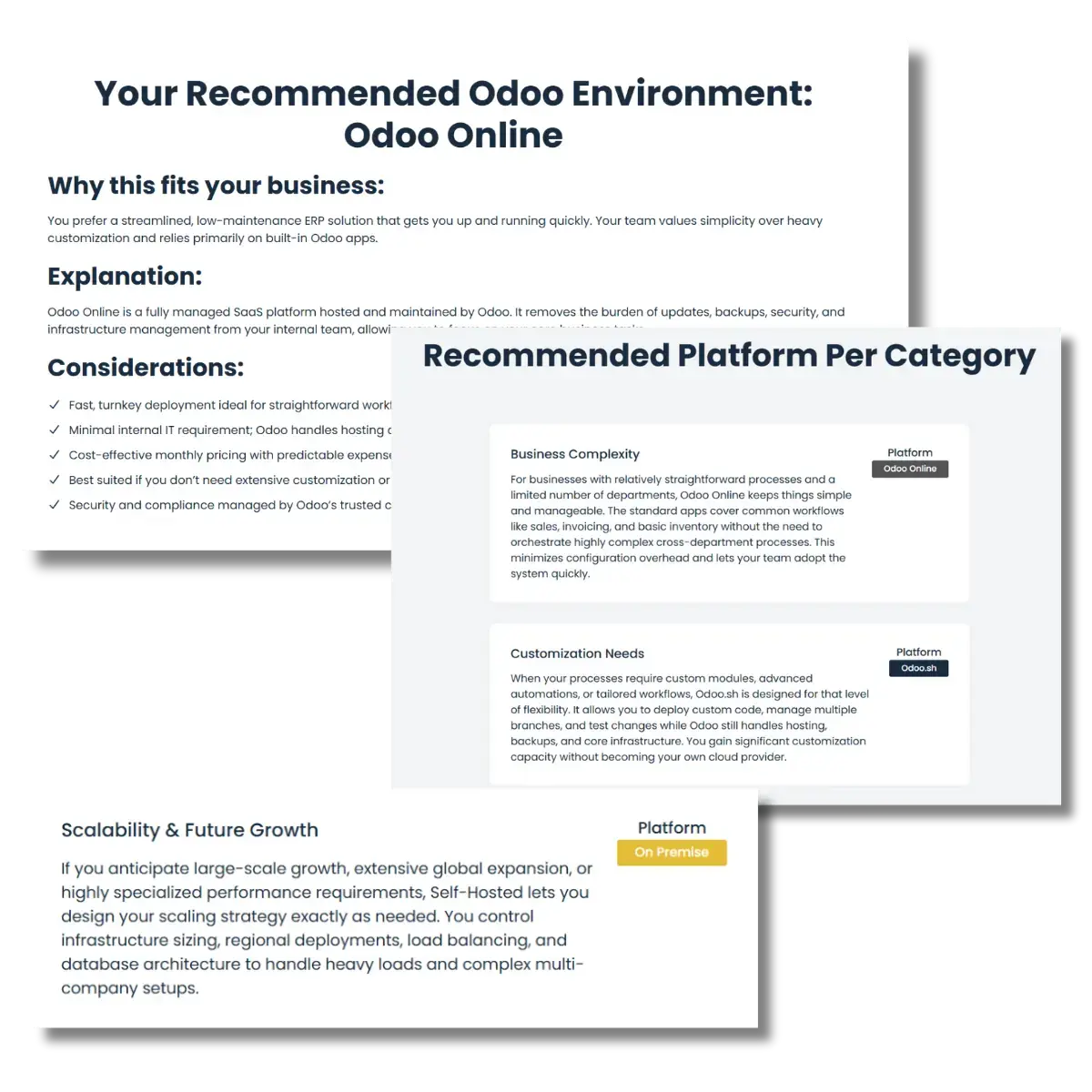
Your integration requirements and overall Odoo implementation can determine whether Odoo Online, Odoo.sh, or an on-premise deployment is the right fit for your business. The right setup also depends on your Odoo instance and the Odoo apps involved, along with custom modules, external APIs, security controls, update management, and internal IT resources.
Complete Cudio’s short assessment to compare each hosting option against your systems, technical requirements, and growth plans.
Why Businesses Choose Cudio for Odoo Integration

Experience With Complex Integrations
We’ve connected Odoo ERP with various e-commerce platforms, accounting software, crm systems, warehouse systems, shipping providers, EDI networks, and custom databases, including the complexity of working across disparate systems.
Custom Odoo Integration Services
Cudio builds API, EDI, middleware, and custom connector customized solutions for the odoo system based on each platform’s technical capabilities and your required data flow, with a focus on the business processes those integrations need to support.


Senior Integration Specialists
Experienced consultants and developers handle the architecture, data mapping, authentication, development, and testing of each connection.
Built for Easier Maintenance
Documented mappings, modular integration logic, error handling, logs, and monitoring make updates and troubleshooting easier to manage.

Our Odoo Integration Services
Cudio connects Odoo through odoo erp integration with the platforms supporting key business processes across sales, finance, inventory, fulfillment, and customer management. Each integration is designed around the data that must move to sync data across systems, how often it should synchronize, and which system owns each record for real time insights.
Popular Odoo Integrations We Build
Named-platform integrations support business operations across various third party applications, so they require more than connecting two APIs. Cudio defines the system of record, sync direction, field mappings for business data, timing, and exception rules for each workflow before development begins.

Odoo Shopify Integration
Synchronize products, variants, customers, orders, inventory levels, fulfillment updates, and refunds between Shopify, an e-commerce platform, and Odoo as part of e commerce integration. Webhooks or scheduled jobs can trigger updates based on Shopify’s available endpoints and your operating requirements, and syncing inventory levels supports inventory management and streamlined order processing.

Odoo Salesforce Integration
Synchronize leads, accounts, contacts, opportunities, quotations, and customer updates between Salesforce and Odoo with Odoo CRM integration to strengthen lead management for leads and opportunities. Ownership rules determine which platform can create or update each record, helping automate sales processes and improve customer interactions across platforms while keeping customer data aligned to support stronger customer relationships.
Odoo Amazon Integration
Connect marketplace orders, listings, inventory, pricing, and fulfillment data with Odoo through the appropriate connector architecture, including Rithum where it fits the channel strategy.
Odoo QuickBooks Integration
Transfer customers, suppliers, invoices, payments, taxes, and account data while defining whether Odoo or QuickBooks remains the financial system of record. Mapping and reconciliation rules help prevent duplicate or conflicting entries.
Odoo WooCommerce Integration
Connect products, customers, orders, stock availability, payments, refunds, and fulfillment updates between WooCommerce, an e-commerce platform connected to a single Odoo instance, to support order fulfillment and efficient order fulfillment across online sales workflows.
Odoo EDI Integration
Exchange purchase orders, acknowledgments, advance shipping notices, invoices, and other business documents between Odoo and trading partners for smoother document management. Cudio maps each EDI document to the correct Odoo model and workflow status.
Manufacturing

Retail & Wholesale

Healthcare
Streamline Healthcare Manufacturing Now

E-commerce

Logistics

Real Results, Real Integrations
See how our clients have transformed their operations with seamless Odoo integrations.
Global Operations, Unified in Odoo
"Reduced days to close by 50%, error rate slashed. Odoo now handles global complexity that our legacy system couldn't."
Operating across 30 countries, Lexington Medical struggled with complex BOMs and business structures. We migrated them to Odoo with custom modules built for global scale and manufacturing complexity.

QuickBooks, Fishbowl, and Shopify? Gone.
"$35K saved annually. 40-60 hours back each week. Full visibility achieved."
R&W Rope was juggling multiple disconnected systems. We unified everything into Odoo (ERP, e-commerce, and inventory), cutting costs and saving hundreds of hours monthly.

Disconnected No More
"40% business growth. 80% fewer inventory write-offs. We now ship within 24 hours."
Almac struggled with inefficiencies from siloed systems. We implemented a fully integrated B2B/B2C Odoo solution, streamlining operations and enabling rapid delivery at scale.

The Cost of Disconnected Systems
Disconnected Workflow | Daily Operational Impact | After Odoo Integration |
Orders entered manually from sales channels | Repeated entry, delayed processing, and transcription errors | Orders move into Odoo through an API, webhook, or scheduled job for streamlined order processing |
Inventory managed across separate platforms | Stock differences, overselling, and manual reconciliation | Inventory updates move between Odoo, warehouses, and sales channels |
Fulfillment updates entered by hand | Delayed shipment creation and customer notifications | Shipment status, shipment tracking, and order fulfillment process updates return to the relevant platform |
Pricing maintained on several channels | Outdated or inconsistent product prices | Approved pricing synchronizes from the defined system of record |
Failed synchronizations reviewed manually | Missing records remain unnoticed until operations are affected | Logs, retries, and alerts help teams identify failed transactions |
Applications perform overlapping work | Additional license costs and duplicate data | Redundant tools can be removed when Odoo supports the required workflow |
Cudio client R&W Rope replaced QuickBooks, Fishbowl, and Shopify with a connected Odoo environment, saving $35,000 annually, recovering 40 to 60 administrative hours per week, and improving operational efficiency. These results are specific to that project and will vary by business.
Common Odoo Integration Challenges We Solve
Odoo integration problems often come from unclear data ownership, limited APIs, changing endpoints, and missing error controls. Cudio addresses each issue within the technical limits of the connected platform.
Orders Must Be Entered From Multiple Platforms
We connect sales channels to Odoo using supported APIs, webhooks, or scheduled jobs. Orders can be created automatically to automate order fulfillment across connected sales channels, while failed or incomplete records move to an exception queue for review.
The Legacy System Has No API
When an API is unavailable, we assess alternatives such as EDI, SFTP, scheduled CSV or XML files, direct database access, or middleware. The method depends on the access and export options the legacy system supports
Platform Updates Break Existing Connections
API versions, authentication methods, and field structures can change. We document dependencies, isolate platform-specific logic, test updates in staging, and monitor failed requests after deployment.
Data Conflicts Across Multiple Systems
Cudio defines which platform owns each record and uses external IDs, timestamps, and validation rules to control updates. This helps prevent duplicate customers, overwritten inventory, and conflicting order statuses.
Integration Errors Are Difficult to Find
We add request and response logs, retry rules, exception queues, and alerts based on the integration architecture. Failed records can then be corrected without rerunning successful transactions.
Frequently Asked Questions About Odoo Integration Services

Odoo integration connects Odoo with an external platform, so approved records can move between them. The connection may use an API, webhook, EDI, middleware, file exchange, or another supported method, depending on the systems involved.
Odoo can connect with platforms that support APIs, webhooks, EDI, file exchange, or another accessible transfer method. Cudio builds integrations for Shopify, Amazon, QuickBooks, Salesforce, WooCommerce, warehouse systems, shipping providers, payment processors, custom databases, and communication tools such as Outlook, Gmail, WhatsApp, Facebook Messenger, and Skype.