Two weeks before renewal, the number hits your inbox, and it is not what you expected. NetSuite was supposed to simplify operations. Instead, costs have climbed, modules keep stacking, and every change still requires a consultant.
If that feels familiar, you are not alone. Research shows that 80% of ERP users are unhappy, and 41% fail to achieve even half of the expected benefits. That is not a software issue alone. It is a fit-and-execution problem.
At Cudio, we see this pattern constantly. Businesses come to us after a difficult first ERP experience, trying to avoid repeating it. We do not start with features. We start with how your operations actually run, where the friction is, and what needs to change for the system to finally support your team rather than slow it down.
This guide breaks down the 5 best NetSuite alternatives in 2026 and, more importantly, shows how to choose one without ending up in the same situation again. We will walk through pricing, implementation risk, and where each platform actually works in real business environments.
Get My Free ERP Fit Assessment
Key Takeaways
- Choosing from the 5 best NetSuite alternatives in 2026 is not about features. It is about aligning the ERP system to your actual business processes, operational complexity, and growth path.
- Many companies leave NetSuite due to rising total costs, rigid customization, and heavy reliance on consultants. In fact, 64% of ERP projects exceed budget by 25–40%, often due to poor scoping and partner execution.
- Sage Intacct leads in financial management for service-heavy organizations, while Microsoft Dynamics 365 Business Central fits companies deeply embedded in the Microsoft ecosystem.
- Acumatica and SAP Business One serve operations-intensive environments such as distribution and manufacturing companies, offering deeper supply chain and inventory management capabilities.
- Odoo stands out as a customizable ERP with a modular architecture that can consolidate multiple systems into a unified cloud ERP, reducing integration complexity and improving operational control.
- The real risk is not choosing the wrong software. It is repeating the same implementation mistakes with a different vendor.
Quick Answer: The 5 Best NetSuite Alternatives in 2026
If you need a fast answer, these are the strongest NetSuite alternatives for mid-market businesses in 2026:
- Sage Intacct for finance-led organizations focused on financial management, revenue recognition, and multi-entity consolidation
- Odoo for companies that want a full ERP with broad operational coverage and the ability to consolidate many tools into one platform
- Microsoft Dynamics 365 Business Central for companies already standardized on Microsoft Dynamics 365, Microsoft 365, Azure, and Power BI
- Acumatica for operations-heavy teams that need broad access across sales, field teams, and warehouse operations, without per-user pricing, creating budget pressure
- SAP Business One for manufacturers and distributors that need stronger resource planning and production depth
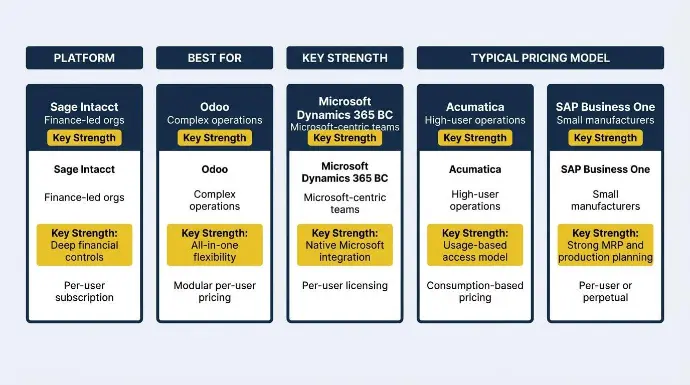
At a glance
Platform | Best For | Key Strength | Typical Pricing Model |
Sage Intacct | Finance-led orgs | Deep financial controls | Per-user subscription |
Odoo | Complex operations | All-in-one flexibility | Modular per-user pricing |
Microsoft Dynamics 365 Business Central | Microsoft-centric teams | Native Microsoft integration | Per-user licensing |
Acumatica | High-user operations | Usage-based access model | Consumption-based pricing |
SAP Business One | Small manufacturers | Strong MRP and production planning | Per-user or perpetual |
These NetSuite alternatives do not serve the same buyer in the same way. Some are finance-first. Some are operations-first. Some are closer to traditional ERP systems, while others reflect where the market is going with faster deployment, more automation, and more flexible commercial models.
What Is Actually Driving Companies Off NetSuite
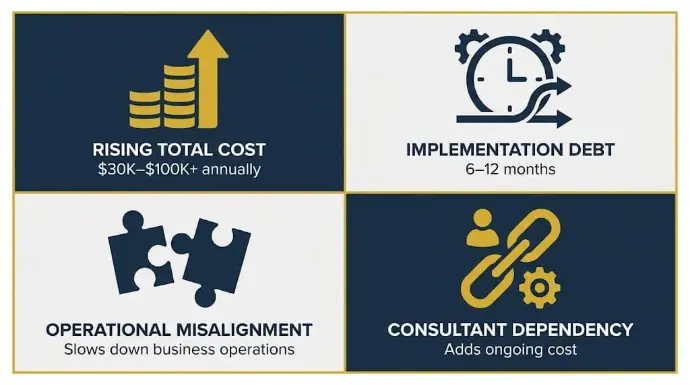
Before evaluating NetSuite alternatives, you need to be clear on what is actually pushing businesses away. In most cases, it comes down to a few consistent issues:
- Rising Total Cost: NetSuite starts around $999 per month, but the pricing model stacks quickly. User licenses, modules, SuiteApps, and services push many deployments into $30K–$100K+ annually. The platform lacks key features, yet the total cost keeps increasing without improving day-to-day flexibility.
- Implementation Debt: A typical mid-market NetSuite rollout takes 6–12 months, especially for complex global operations. During that time, teams run parallel systems, delay decisions, and accept workarounds. What was meant to be a unified cloud ERP often turns into a patchwork that requires ongoing consulting just to maintain.
- Operational Misalignment: Not every business fits NetSuite. Some need deeper financial management and cleaner financial reporting. Others need stronger inventory management, warehouse management, or supply chain processes. Some simply need a more flexible or cost-effective cloud ERP that better supports their core business processes.
- Consultant Dependency: Simple changes, such as custom reports, workflows, or fields, often require external consultants. This slows down business operations and adds ongoing cost, especially for finance teams that need agility in reporting and planning.
At Cudio, we see this shift happen when companies stop asking if NetSuite is “good” and start asking which NetSuite alternatives actually fit their operations. That is the real turning point.
How to Evaluate NetSuite Alternatives Without Repeating the Same Mistakes
Choosing among NetSuite alternatives is not about comparing marketing pages. Every serious ERP solution will show accounting, inventory, CRM, and reporting in a demo. The difference is whether those key features hold up in your real workflows.
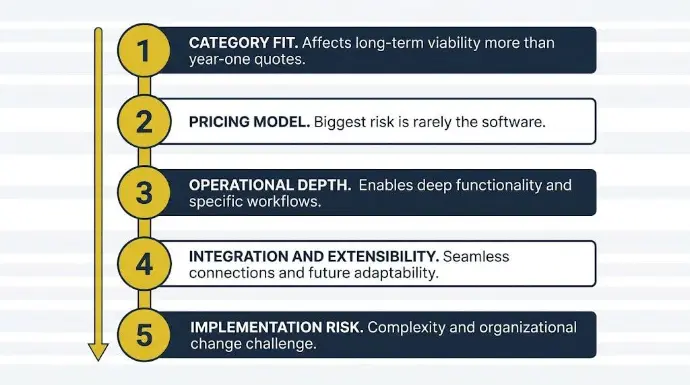
At Cudio, we push clients to evaluate five areas first.
1. Category Fit
Not all NetSuite alternatives are the same kind of software.
Sage Intacct is a financial system first. Odoo is a broader full ERP. Microsoft Dynamics 365 Business Central sits in the middle as a practical cloud ERP for mid-market teams already using Microsoft tools. SAP Business One is SAP's ERP offering for smaller companies that need stronger manufacturing depth. Acumatica is designed around product-centric business operations and usage-based growth
.
If you choose the wrong category, the project will eventually fail even if the implementation is clean.
2. Pricing Model
A platform’s pricing model affects long-term viability more than year-one quotes. Per-user models can work well for finance-heavy organizations with a smaller internal footprint. They become more expensive when many employees need system access across service, sales, and warehouse operations.
That is why the pricing model matters so much when comparing NetSuite alternatives. Some businesses need predictable user costs. Others benefit more from a usage-based structure.
3. Operational Depth
This is where feature lists become real.
Can the platform support:
- Multi-site inventory management
- Integrated warehouse management
- Project accounting and project management in the same environment
- Supply chain visibility across purchasing, stock, and fulfillment
- Financial management for multiple entities and currencies
If the software cannot handle your most complex workflows, the project will drift into costly customization or a second migration.
4. Integration and Extensibility
Modern ERP platforms need strong integration capabilities. This matters for payroll, tax engines, banking tools, ecommerce, and business intelligence. A well-documented API can speed implementation and reduce custom work. A weak one increases cost and delay.
This is especially important when comparing NetSuite alternatives because some systems depend heavily on add-ons, while others are built to replace more of the stack directly.
5. Implementation Risk
The biggest risk is rarely the software. It is how the project is scoped, who implements it, and how much change the business can absorb.
That is why we tell clients that even the best NetSuite alternatives can still fail if the partner does not understand operations, governance, and change management.
1. Sage Intacct: Best for Finance-Led Organizations
Sage Intacct remains one of the most credible NetSuite alternatives for organizations where finance is the center of the business.
It is not trying to be a broad operational ERP like Odoo or Acumatica. It is a cloud ERP focused on financial management, reporting, close processes, and control. That is why Sage Intacct is often favored by service-based firms, nonprofits, healthcare groups, and professional services organizations. It is particularly strong when the business values controller-level visibility more than deep inventory management.
Why Companies Choose It
Strong financial management requires more than invoices and ledgers. The core foundation should include a strong general ledger, accounts payable, accounts receivable, cash handling, fixed assets, approval routing, and auditability. Sage Intacct does this well.
It also supports:
- Advanced financial reporting
- multi-entity consolidation
- Intercompany eliminations
- Currency translation
- Revenue recognition aligned with standards such as ASC 606
For CFOs and controllers, those are not optional key features. They are the reason the platform gets shortlisted in the first place.
This is why Sage Intacct is often preferred by professional services firms and finance-led organizations. If the core problem is improving close cycles, reporting accuracy, and financial data quality, it is a strong candidate.
Where it Fits
Sage Intacct is usually a better fit when operations are relatively light or handled elsewhere. It can support service businesses, subscription models, and organizations that take financial controls seriously. It can also support project accounting, project management, and professional services automation scenarios when delivery tracking matters as much as billing.
Where it Falls Short
It is less compelling when the company needs native warehouse management, deeper manufacturing, or full supply chain management. This is where businesses often have to rely on integrations and external tools.
That is the trade-off. Sage Intacct is one of the strongest NetSuite alternatives for finance. It is not always the right answer for product-heavy operations.
2. Odoo: Best for Consolidating Multiple Systems Into One Platform
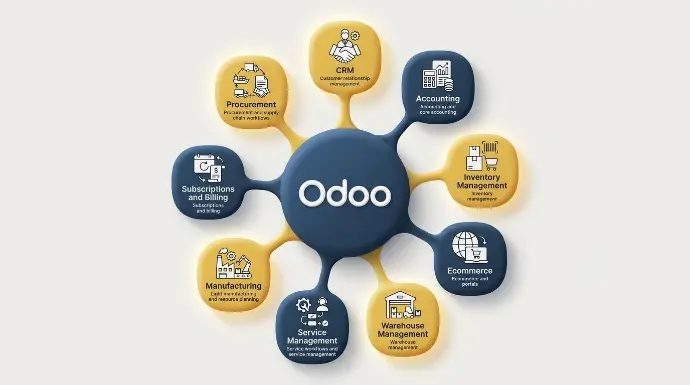
Among the strongest NetSuite alternatives, Odoo stands out for its approach to the problem.
Instead of acting like another finance-led platform, Odoo is designed as a full ERP with a modular architecture. Businesses can start with core modules and expand over time into CRM, accounting, inventory, ecommerce, help desk, HR, and manufacturing. Odoo offers a modular approach, allowing businesses to start with essential modules and add others later as needed.
That makes it especially useful for companies trying to replace not just NetSuite, but the wider system sprawl that grew around it.
Why Companies Choose It
Odoo can centralize:
- Customer relationship management
- Accounting and core accounting
- Inventory management
- Ecommerce and portals
- Warehouse management
- Service workflows and service management
- Light manufacturing and resource planning
- Subscriptions and billing
- Procurement and supply chain workflows
For many organizations, that means fewer disconnected apps and fewer points of failure across core business processes.
Odoo also supports:
- Configurable workflows
- Strong API and integration capabilities
- Automation capabilities across multiple apps
- Flexible deployment through SaaS,Odoo.sh, or self-hosting
This flexibility is why many businesses consider it one of the most compelling NetSuite alternatives on the market today.
Enterprise vs Community
Odoo has a free community edition and a paid enterprise product. In practice, serious mid-market replacements usually rely on the Odoo Enterprise version because it provides the broader operational feature set, support, and tooling companies need.
Why Implementation Matters So Much
Odoo is powerful but also highly flexible and customizable. That means poor scoping can create confusion, while strong governance can create exceptional results.
At Cudio, this is where we see the difference between a clean implementation and a messy one. The software itself is capable. The question is whether the implementation reflects real business processes.
Who It Is Best For
Odoo is one of the strongest NetSuite alternatives for businesses that:
- Run complex omnichannel commerce
- Need integrated inventory management and ecommerce
- Want one platform for finance, sales, operations, and support
- Need broad operational coverage without enterprise-level licensing pressure
For companies looking to simplify fragmented business operations, Odoo is often the most transformative NetSuite alternative.
3. Microsoft Dynamics 365 Business Central: Best for Microsoft-Centric Teams
Dynamics 365 Business Central is one of the most established NetSuite alternatives for organizations already committed to the Microsoft stack.
This is one reason Microsoft Dynamics remains so relevant in the mid-market. For finance and operations teams already using Excel, Teams, Outlook, Azure, and Power BI, the transition feels more natural than moving to a completely separate environment.
Why Companies Choose It
Microsoft Dynamics 365 Business Central offers:
- Core finance and operations capabilities
- A familiar user interface for many users
- Native reporting links into Power BI
- Embedded access across Microsoft Dynamics 365 apps
- Easier user adoption inside the wider Microsoft ecosystem
This matters because training and adoption are real costs. Many buyers choose Microsoft Dynamics 365 Business not just for its functionality, but also because it reduces friction for the finance team and adjacent users.
Core strengths
Business Central handles:
- Financial management and financial reporting
- Inventory management
- Basic supply chain and purchasing
- Light manufacturing
- Project accounting and project management
- Service workflows in the broader Microsoft Dynamics 365 suite
These key features make it a practical ERP solution for companies that want a single vendor relationship for collaboration, reporting, and operations.
Trade-offs
Where Dynamics 365 Business Central gets more complicated is the depth of its extensions. Some businesses find that advanced manufacturing, retail, or field service still require add-ons or related products within Microsoft Dynamics 365.
That is why partner selection matters so much. The software can work very well, but the final environment often depends on how the solution is designed.
Best Fit
Microsoft Dynamics, especially Microsoft Dynamics 365 Business Central, is a strong fit for companies that are standardized on Microsoft tools and want modern cloud ERP functionality without stepping outside the ecosystem.
4. Acumatica: Best for High-User, Operations-Heavy Businesses
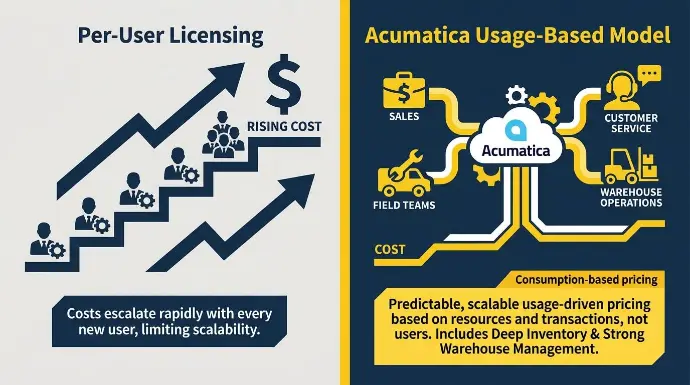
Acumatica is one of the most interesting NetSuite alternatives because it changes the conversation around access and scale.
Rather than charging strictly by named users, Acumatica uses a usage-driven pricing model tied to transactions and resources. That makes it attractive for operations-heavy businesses with broad internal access needs.
Why Companies Choose It
Acumatica supports:
- Deep inventory management
- Strong warehouse management
- Purchasing and order management
- Manufacturing workflows
- Distribution and supply chain management
- Open API and broad integration capabilities
For businesses with many employees touching the system across sales, field teams, customer service, and warehouse operations, that pricing model can be more sustainable than per-user licensing.
Operational strengths
This is where Acumatica stands apart from other NetSuite alternatives. It is not primarily a finance-led product. It is designed to provide stronger operational control over product movement, logistics, and execution.
That makes it especially relevant for:
- Distributors
- Field service businesses
- Product-centric firms
- Organizations with heavier supply chain processes
Trade-offs
The main trade-off is predictability. Because the pricing model is usage-based, long-term costs need careful modeling. It is also still heavily partner-driven, so implementation quality varies.
Best Fit
Acumatica is one of the best NetSuite alternatives for mid-market operations-heavy businesses that need broad user access, strong warehouse management, and more flexible economics than rigid seat-based models.
5. SAP Business One: Best for Small Manufacturers Needing Real MRP
SAP Business One is one of the most established NetSuite alternatives for smaller manufacturing and distribution companies.
If a business needs stronger production depth, better bills of materials, and more practical resource planning, SAP Business One deserves serious consideration.
Why Companies Choose It
SAP Business One gives more limited manufacturing companies access to capabilities often associated with larger ERP products, including:
- Production planning
- MRP-style resource planning
- Purchasing and stock control
- Stronger inventory management
- Quality and production visibility
That is why SAP Business One remains relevant. It is not flashy, but for the right buyer, it offers very real value.
Fit And Limitations
Compared with newer cloud ERP products, SAP Business One can feel more like an older traditional ERP system. The interface is less modern, and ecommerce usually requires more work.
Still, if the business is manufacturing-focused and does not need the broad digital commerce capabilities that Odoo provides, SAP Business One can be one of the most practical NetSuite alternatives.
Best Fit
SAP Business One is best for small manufacturers and distributors that need production depth more than modern omnichannel breadth.
What About SAP S/4HANA Public Cloud and Oracle ERP Cloud?
In 2026, many market discussions around NetSuite alternatives include Oracle ERP Cloud and SAP S/4HANA Public Cloud. Both can be credible options in the upper mid-market or enterprise space, especially for companies with larger international footprints, heavier compliance needs, or broader transformation agendas.
That said, they are not always the most practical replacement for the average mid-market NetSuite customer. Oracle ERP Cloud is powerful, but it often comes with a steeper cost structure, a heavier enterprise orientation, and a steep learning curve for teams expecting a more agile transition. SAP S/4HANA Public Cloud can be strong for global standardization, but many mid-market companies find it too heavy relative to their actual operational needs.
That is why this article centers on the five most practical NetSuite alternatives for mid-market decision makers. The shortlist focuses on systems that are more realistic for companies trying to improve fit, speed, and cost control without stepping into a much larger enterprise transformation than they need.
Implementation Risk: What Changes When You Leave NetSuite
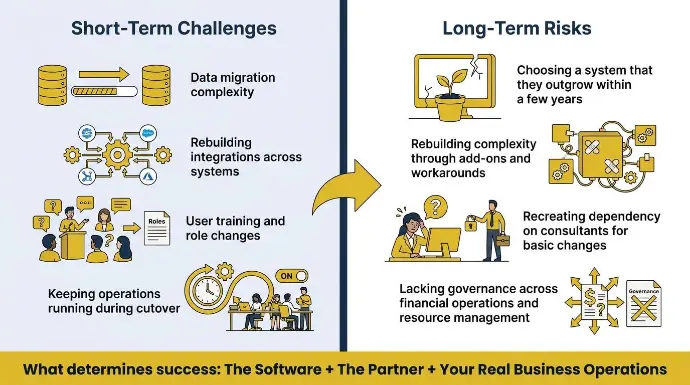
Switching from NetSuite is not just a software change. It is a shift in how your business actually operates day to day. That is where most ERP projects succeed or fail.
In the short term, the pressure shows up immediately. Most teams run into the same four challenges:
- Data migration complexity
- Rebuilding integrations across systems
- User training and role changes
- Keeping operations running during cutover
Data migration is usually the first real friction point. Financial operations, inventory data, and reporting structures rarely move cleanly into a new ERP system without careful validation.
At Cudio, we approach ERP transitions as a full operational reset, not a checklist. That means carefully structuring data migration, reducing unnecessary integrations by consolidating into a unified cloud ERP, and designing workflows that actually match how your teams work. The goal is simple: Protect your reporting, reduce complexity, and ensure the system is used, not worked around.
Get My ERP Transition Strategy Right
The long-term risks are less obvious, but more expensive.
Most businesses evaluating NetSuite alternatives fall into a few predictable traps:
- Choosing a system that they outgrow within a few years
- Rebuilding complexity through add-ons and workarounds
- Recreating dependency on consultants for basic changes
- Lacking governance across financial operations and resource management
These issues do not show up in demos. They show up later, when the system no longer supports growth.
At Cudio, we design ERP strategies around your future state, not just current pain. That means aligning the implementation scope, core business processes, and system capabilities from the start.
We also focus heavily on governance. ERP is not a one-time project. It affects financial operations, inventory management, and ongoing ownership across teams.
Without structure, even strong systems drift. With the right structure, they improve operational efficiency over time.
This is why implementation risk matters more than product comparisons.
Many NetSuite alternatives promote faster timelines. Some suggest going live in weeks. In reality, timelines depend entirely on complexity and readiness.
What actually determines success is alignment between:
- The software
- The partner
- And your real business operations
Decision Framework: Which NetSuite Alternative Fits Your Scenario?
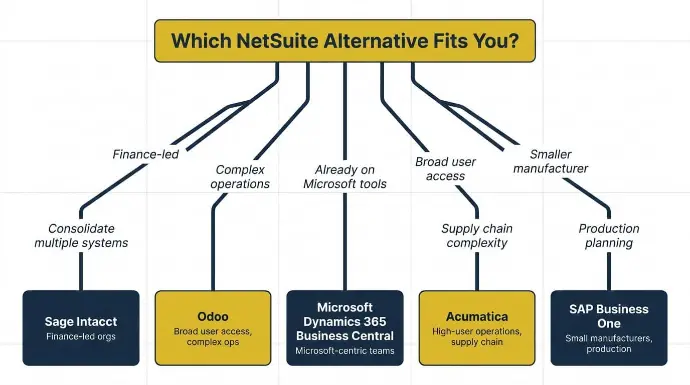
Use this practical filter when narrowing the list of NetSuite alternatives.
Choose Sage Intacct if:
- Your business is finance-led
- Financial management and close quality matter more than stock movement
- You need strong multi-entity consolidation and revenue recognition
- You run service-heavy or subscription-heavy models
Choose Odoo if:
- You want to consolidate multiple systems into one
- You need broad operational coverage across CRM, inventory, ecommerce, and support
- You want a cloud ERP that can scale with configuration rather than heavy module layering
- Your biggest problem is fragmented systems and duplicated work
Choose Microsoft Dynamics 365 Business Central if:
- Your team already runs on Microsoft tools
- The finance team wants better alignment with Excel and Power BI
- Your business would benefit from staying inside the Microsoft ecosystem
- You want a practical mid-market cloud ERP without changing collaboration habits
Choose Acumatica if:
- Your business needs broad internal access across operations
- You need stronger warehouse management and order management
- The business has real supply chain complexity
- A consumption-based pricing model is more attractive than per-user licensing
Choose SAP Business One if:
- You are a smaller manufacturer
- Production planning and resource planning matter more than digital commerce
- You need stronger manufacturing depth than lighter systems can provide
Conclusion
There are real NetSuite alternatives in 2026. The strongest options are Sage Intacct, Odoo, Microsoft Dynamics 365 Business Central, Acumatica, and SAP Business One. Some buyers may also evaluate Oracle ERP Cloud or SAP S/4HANA Public Cloud, but those are often better suited to a larger enterprise context.
The right choice depends on whether your business needs stronger financial management, better supply chain management, lower total cost, stronger warehouse management, or a more flexible ERP system overall.
At Cudio, we help companies make that decision by looking at real workflows, real costs, and real implementation risk. We do not treat ERP selection as a feature exercise. We treat it as an operating model decision.
If your current setup still feels too rigid, too expensive, or too dependent on outside consultants, the right next step is not to chase another shiny platform. It is to evaluate which NetSuite alternative actually aligns with how your business works and where it is going.
Get My Free ERP Assessment Today
FAQs
These answers address the practical questions buyers usually ask after shortlisting NetSuite alternatives.
What is the typical total cost of NetSuite in 2026?
NetSuite usually starts with a base subscription around $999 per month, then adds users, modules, and services. For many mid-market businesses, the long-term total cost ranges from $30,000 to $100,000+ per year, including implementation, add-ons, and support.
Can Sage Intacct replace NetSuite for product-based businesses?
It can replace NetSuite for finance-heavy organizations, but not always as a complete operational replacement. Sage Intacct is strongest in financial management, financial reporting, and multi-entity consolidation, not deep inventory management, manufacturing, or warehouse management.
Is Odoo only for small businesses with technical teams?
No. Odoo is often seen as one of the most flexible NetSuite alternatives because it can support complex mid-market operations when implemented well. While many small businesses use it, it also works for larger organizations that want a more configurable cloud ERP with a broader operational scope.
How long does a typical ERP migration from NetSuite take?
It depends on complexity and platform. Simpler finance-focused migrations may go faster, while larger programs involving multiple entities, integrations, and data migration usually take longer. Realistic implementation timelines vary, but businesses should expect several months, especially when replacing multiple systems at once.
What is the biggest risk when switching from NetSuite?
The biggest risk is poor implementation. Most ERP failures come from weak scoping, incomplete process design, and underestimating change management. That is true across all serious NetSuite alternatives.
Are AI-native platforms replacing traditional ERP competitors?
The market is moving in that direction. Many buyers now prefer cloud ERP products with built-in automation, rather than bolt-on tools. AI-native platforms are gaining attention because they reduce manual processes, improve reconciliation, and support faster decisions across business operations.
What features matter most in modern ERP alternatives?
The key features depend on the business, but common priorities include strong financial management, reliable inventory management, enhanced CRM capabilities, flexible order management, strong service management, and modern reporting. Buyers are also looking for stronger automation capabilities, transparent pricing, and deployment models that support global operations without unnecessary complexity.