
Odoo is a modular, open-source platform designed for startups and organizations under $10M in revenue that require flexible, app-based expansion, but it's important to understand the Odoo implementation costs before getting started.
Conversely, Acumatica is a cloud-native ERP engineered for mid-market companies ($10M–$100M) with complex, multi-entity operations requiring deep, industry-specific workflows for manufacturing and distribution.
Startups and organizations with sub-$10M revenues frequently select Odoo's open-source ecosystem to unify disparate workflows, leveraging its native CRM, e-commerce, and inventory modules within a single, low-upfront-cost database.
Acumatica is typically used by mid-market companies with more complex operations such as manufacturing, distribution, or multi-entity businesses.
This 2026 evaluation guide answers the most critical migration and architecture questions, including:
- Which business profiles are best suited for Acumatica vs Odoo?
- How do Acumatica and Odoo fit into the 2026 cloud ERP market?
- What are the core architectural differences between the platforms?
- How do their operational features and Total Cost of Ownership compare?
Key Takeaways
- Acumatica typically fits companies in the $10M–$100M revenue range with complex, multi-entity operations, while Odoo primarily serves startups and smaller businesses under $10M with simpler processes, so the “vs” question is often misplaced from the start.
- While Odoo offers a low initial per-user licensing fee, its open-source architecture frequently demands extensive third-party Python customizations that break during standard system upgrades. Consequently, these hidden maintenance requirements and mandatory code reworks cause Odoo implementations to exceed initial budgets by an average of 56%.
- Acumatica utilizes a resource-driven, consumption-based pricing model, meaning licensing costs scale based on monthly commercial transaction volume (e.g., total sales orders, invoices processed) rather than per-user seats. Based on Cudio's financial audits of mid-market deployments, scaling companies must accurately forecast their peak seasonal transaction volume prior to signing to prevent unexpected tier upgrades and mid-contract cost overruns.
- No independent, peer-reviewed 5-year TCO study exists comparing these two platforms as of early 2026, so buyers must piece together real costs from multiple sources and partner experiences.
Which Business Profiles Are Best Suited for Acumatica vs Odoo?
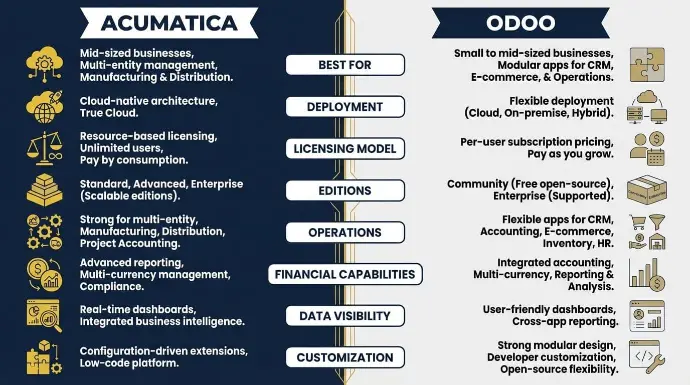
If you want the quick answer in the Acumatica vs Odoo decision, it usually comes down to operational complexity and how your business plans to scale.
Here at Cudio, we often explain that these two enterprise resource planning platforms solve different problems. Odoo focuses on flexibility, a per-user licensing model, and a broad ecosystem of apps built on its open source nature. Acumatica, built on a cloud native architecture, focuses on operational depth for companies managing multi-entity structures, distribution workflows, and more complex processes.
In simple terms:
- Choose Odoo if you want a flexible ERP with strong apps, easier entry pricing, and the ability to expand as your business scales.
- Choose Acumatica if your business runs multi-entity operations, complex inventory, or industry workflows that need deep operational coordination.
Dimension | Acumatica | Odoo |
Best for | Businesses with more complex needs and operational depth | Small to mid-size business environments need flexibility |
Deployment | Cloud native architecture, private cloud, or public cloud | Cloud, on-premise, or hosted |
Licensing model | Resource-based licensing with unlimited users | Per user subscription pricing |
Editions | Platform with industry-specific editions | Two editions: Enterprise and community version |
Operations | Strong for multi-entity, manufacturing, and distribution | Flexible apps for CRM, accounting, e-commerce, and operations |
Financial capabilities | Advanced reporting and multi-currency management | Integrated accounting with custom reports and add-ons |
Data visibility | Strong operational dashboards and real-time data | Integrated dashboards with cross-app data |
Customization | Configuration-driven extensions | Strong modular design and developer customization |
Both Acumatica and Odoo are powerful platforms. The right choice depends on how complex your operations are today and how quickly your business expects to grow.
ERP Market Context: Where Acumatica and Odoo Fit in 2025–2026
Before we get into the head-to-head, here's what you need to know about the market both platforms are competing in.
Cloud ERP Market Growth Drivers and Automation Demands
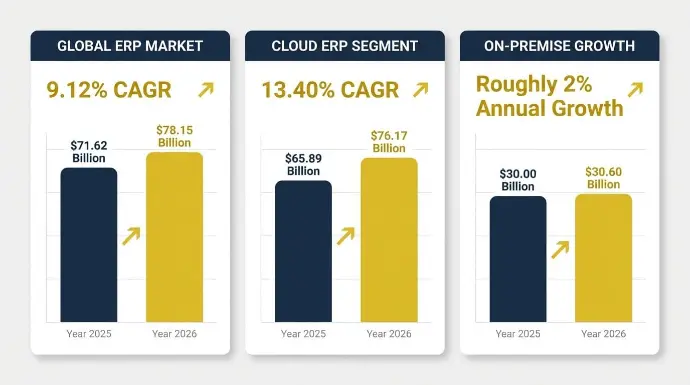
ERP is one of the stronger-performing segments in enterprise software right now. Mordor Intelligence puts the global market at $71.62 billion in 2025, reaching $78.15 billion in 2026 at a 9.12% CAGR through 2031. Cloud ERP is outpacing that, with Fortune Business Insights tracking the cloud segment at $65.89 billion in 2025, growing to $76.17 billion in 2026 at a 13.40% CAGR through 2034. On-premise sits at roughly 2% annual growth. The direction is settled.
According to a 2024 analysis by Mordor Intelligence, this rapid market expansion is directly driven by the enterprise necessity to adopt AI-enabled analytics and satisfy emerging compliance mandates, including mandatory e-invoicing and ESG (Environmental, Social, and Governance) reporting.
Companies still running on legacy systems aren't just behind on features. They're carrying real regulatory risk, and that's pushing the buying cycle faster than anything else.
Odoo as the Open-Source Standard for Companies Under 200 Employees
Odoo is open-source, modular, and built to be accessible. The pitch is full business coverage without enterprise pricing, and the scale it's reached shows the market is responding. Odoo's own figures show over 13 million users with 7,000 new clients added every month. At Odoo Experience 2025, the company reported €650 million in billing revenue and 42% ARR growth, aiming to reach €1 billion by 2027. Odoo A €500 million raise pushed the valuation to €5 billion, backed by CapitalG, Alphabet's independent growth fund.
The buyer Odoo is built for tends to look like this:
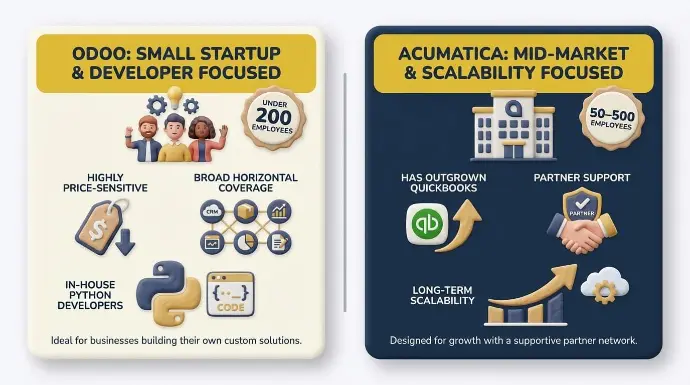
- Organizational Scale: Early-stage companies operating with fewer than 200 employees.
- Budget Strategy: Highly price-sensitive organizations prioritizing rapid deployment and low initial licensing costs."
- Functional Requirements: Businesses valuing broad, horizontal operational coverage over deep, industry-specific vertical workflows."
- Technical Resources: Teams possessing in-house Python developers capable of maintaining open-source custom code.
If that profile fits, Odoo is where most conversations should start.
Acumatica as the Industry-Specific Solution for Complex Supply Chains
Acumatica targets businesses where generic ERP starts to break down. Construction, distribution, manufacturing, professional services: companies with enough operational complexity that industry-specific functionality actually moves the needle.
Acumatica describes itself as a cloud-native solution designed explicitly for small and mid-market companies to thrive in the digital economy. The current roadmap is heavily AI-driven. Acumatica AI Studio lets business users build AI-driven workflows and automate processes without technical expertise.
The typical Acumatica buyer looks quite different from Odoo's:
- 50 to 500 employees, often in a defined vertical
- Has outgrown QuickBooks or a basic accounting system
- Needs a proper implementation, not a self-serve product
- Wants partner support and long-term scalability built in from day one
The Impact of Vista Equity Partners' $2 Billion Acumatica Acquisition
The biggest structural news around Acumatica in 2025 is the ownership change, and it's worth understanding what it signals.
Acumatica announced a definitive agreement to be acquired by Vista Equity Partners, a firm focused exclusively on enterprise software and technology businesses. Vista is buying from EQT, Acumatica's owner since 2019, at a reported valuation of $2 billion.
Vista currently manages over $100 billion in assets and has successfully scaled SaaS companies such as Smartsheet and Avalara.
Acumatica CEO John Case confirmed this capital injection is designed specifically to accelerate the platform's AI roadmap and expand its partner ecosystem, while ensuring the existing executive management structure remains intact.
For buyers evaluating long-term platform stability, that's a meaningful data point.
Acumatica vs Odoo: Core Platform Differences
When businesses compare Acumatica vs Odoo, the biggest differences are not just features. The real distinction is how each platform is designed to support operations as a company grows.
For instance, we often explain that these ERP platforms follow two very different approaches. Odoo focuses on flexibility and modular expansion through many apps. Acumatica ERP focuses on operational depth and industry-specific workflows built into a single platform.
Understanding this difference helps companies choose the right ERP system based on the complexity of their operations and their plans for scaling.
Odoo: Open Source and Modular ERP
Odoo is built around a modular ecosystem of business apps that companies can combine and expand over time.
The platform comes in two main versions:
- Odoo Community: open source edition with limited features and community support
- Enterprise version: adds advanced functionality and tools such as Odoo Studio
With Odoo Studio, teams can customize workflows, dashboards, and data fields without deep coding. This flexibility allows growing businesses to gradually expand their ERP and streamline operations as new needs appear.
Odoo also offers a user-friendly interface that helps teams transition from spreadsheets or basic tools. However, flexibility often requires additional technical expertise, especially when integrating third-party apps or customizing modules like inventory management.
For smaller companies or startups that want a flexible system with many apps, this modular approach can work very well.
Acumatica: Cloud Native ERP Built for the Mid Market
Acumatica ERP takes a more structured approach. Instead of relying on thousands of separate apps, it delivers a unified system designed for operational complexity.
The platform runs on a cloud-native architecture and can be deployed to a public cloud or private infrastructure. This allows companies to support higher transaction volumes and larger operational teams.
Acumatica also has a strong industry focus with dedicated editions for:
- manufacturing
- distribution
- construction
- retail and commerce
- field service
These editions include built-in tools for inventory management, warehouse workflows, and technologies like barcode scanning to improve operational visibility.
Acumatica vs Odoo Features: Operational Capabilities Compared
Once businesses move past the surface comparison of Acumatica vs Odoo, the real question becomes practical. How well does each platform handle the daily operations that keep a company running?
This is where we focus the conversation. Instead of comparing long feature lists, we look at how each ERP actually supports core operational workflows such as finance, inventory, manufacturing, and service delivery.
The differences are often clearer in practice than in marketing materials.
Financial Management and Accounting
Both platforms support core financial management, but they approach it differently.
Acumatica ERP delivers a structured financial system built for operational businesses. Financial data connects tightly with inventory, purchasing, and project costing. This makes it easier to manage complex processes, such as multi-warehouse accounting, cost tracking, and operational reporting, in a single environment.
Odoo also includes accounting tools, and for many organizations, they are sufficient. The platform integrates accounting with its broader business app ecosystem, allowing teams to manage invoicing, payments, and sales data in one place.
However, companies often expand reporting or financial workflows through Odoo Studio or external integrations as their requirements grow.
Inventory and Distribution
Operational visibility is often where the differences between Acumatica ERP and Odoo become very clear.
Acumatica provides advanced inventory management capabilities designed for real-world distribution environments. Companies can manage multi-warehouse operations, automate replenishment, and track inventory using tools like barcode scanning built directly into the system. These capabilities help operations teams maintain accurate stock levels and improve fulfillment processes.
Odoo also offers inventory management modules that connect purchasing, warehouse workflows, and sales. For many organizations, this setup works well, especially when the goal is to streamline operations and unify systems that previously lived in separate tools.
However, more advanced warehouse requirements may involve additional customization or integrations.
Manufacturing Capabilities
Manufacturing functionality is another area where the two platforms take different approaches.
Acumatica ERP provides built-in capabilities for production planning, materials requirements planning, and operational scheduling. These tools allow manufacturers to manage complex workflows while maintaining visibility across purchasing, inventory, and production.
Odoo includes manufacturing modules as part of its broader ecosystem of business apps. These tools can support product assembly, work orders, and basic production workflows.
For many companies, this flexibility works well, particularly when operations are still evolving. As processes become more structured, organizations sometimes expand their setup using Odoo Studio or additional modules.
CRM and Sales Management
Both systems support customer relationship management, but the design philosophies differ.
Odoo places strong emphasis on CRM within its modular platform. Sales teams can manage leads, opportunities, quotations, and invoicing through a user-friendly interface that integrates with marketing tools, ecommerce, and other business apps.
Acumatica ERP includes CRM capabilities, but its focus is often on operational coordination rather than marketing automation. Sales processes closely align with inventory availability, pricing, and financial data, enabling companies to maintain consistent operational workflows.
The result is a system that emphasizes operational accuracy over app-driven marketing features.
Project and Service Management
For companies managing projects or service operations, the systems also differ in emphasis.
Acumatica includes integrated project accounting, budgeting, and operational tracking that connects financial data with project execution. This structure helps organizations manage project costs, track revenue recognition, and coordinate operational teams within the same platform.
Odoo provides project management tools within its broader app ecosystem. Teams can track tasks, manage workflows, and coordinate collaboration across departments. Customizations through Odoo Studio can further tailor these processes when additional functionality is needed.
Both platforms can support project operations, but Acumatica focuses on financial control while Odoo focuses on flexible workflow management.
Pricing and Total Cost of Ownership
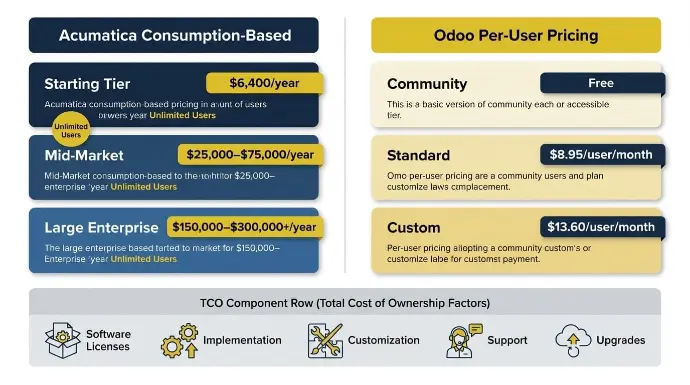
When businesses compare Acumatica vs Odoo, pricing can look simple at first glance. In reality, the total cost of ownership depends on more than the license fee. Companies also need to consider implementation, customization, integrations, ongoing support, and future upgrades.
At Cudio, we encourage companies to look at ERP pricing across the full lifecycle, including:
- software licenses
- implementation and setup
- customization and integrations
- Ongoing support services
- upgrade and maintenance costs
Looking at these factors together gives a much more realistic picture of what the system will actually cost over time.
Acumatica Pricing Model
Acumatica ERP uses a consumption-based pricing model, which means pricing is based on system resources and transaction volumes rather than individual user licenses.
Typical subscription ranges include:
- Starting tier: around $6,400 per year for smaller deployments
- Mid-market deployments: roughly $25,000 to $75,000 per year
- Large enterprise environments: can reach $150,000 to $300,000+ per year
One major advantage is that Acumatica supports unlimited users. This means warehouse staff, managers, and operational employees can access the system without increasing license counts.
Costs usually include:
- platform subscription
- industry modules (manufacturing, distribution, etc.)
- Implementation services are delivered through partners
Because of the consumption-based pricing model, companies should understand their expected transaction volume and growth plans before committing.
Odoo Pricing Model
Odoo follows a simpler per-user pricing model, but the final cost depends on the version and level of customization.
Current pricing typically includes:
- Odoo Community: free open source version with limited support
- Odoo Standard: about $8.95 per user per month
- Odoo Custom: about $13.60 per user per month
The Standard and Custom plans include access to many built-in business apps, such as CRM, accounting, ecommerce, HR, inventory, and project tools.
The Custom plan also includes features like:
- Odoo Studio for customization
- multi-company support
- external API access
While the base subscription may seem affordable, many companies eventually invest in customization, integrations, and professional services as their systems grow.
How Cudio Helps Businesses Evaluate ERP Costs
At Cudio, we work closely with companies evaluating Acumatica vs Odoo to understand the real financial impact of each platform. Instead of focusing only on license pricing, we review your operational workflows, integrations, and long-term growth plans to estimate the true cost of ownership.
Choosing Odoo over Acumatica means gaining access to a flexible, open-source platform — and working with certified Odoo Gold Partner implementation services ensures your deployment is handled by specialists with deep platform expertise.
Our team helps organizations compare ERP options, design implementation strategies, and ensure the system you choose can scale with your operations.
Get My Free ERP Assessment Today
Implementation Reality and ERP Project Risks
Choosing between Acumatica vs Odoo is only part of the decision. The bigger question is how the system is actually implemented and what risks arise during the process. At Cudio, we often remind companies that ERP success depends as much on planning and execution as on the software itself.
Both ERP platforms are capable cloud systems designed to support growth, but implementation projects can become complex if scope, integrations, or customization are underestimated.
Typical Implementation Timelines
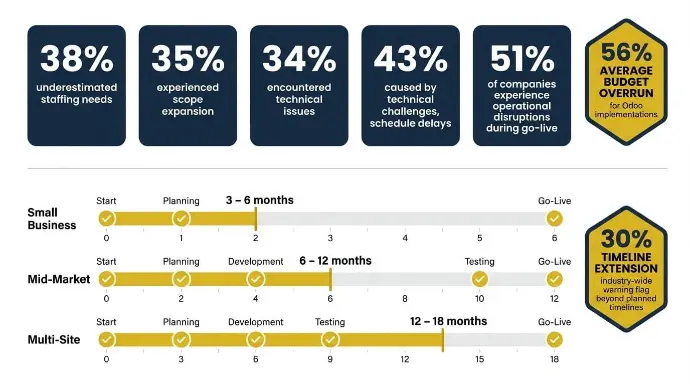
Industry research shows that most ERP systems for SMBs take 3 to 9 months to implement. Larger organizations with multi-department operations can take up to 18 months.
Cloud deployments usually move faster because there is no infrastructure to build. Both Acumatica ERP and Odoo benefit from this cloud native approach.
Typical timelines look like this:
- Small business with limited modules and minimal customization: 3 to 6 months
- Mid-market company with integrations and multiple departments: 6 to 12 months
- Multi-site operations or complex manufacturing environments: 12 to 18 months
In practice, Odoo implementations can move faster when companies start with a small set of apps, such as CRM, accounting, and inventory management. On the other hand, Acumatica ERP implementations typically take 6 to 12 months because they are designed to handle more complex distribution, manufacturing, and operational workflows.
Even after go-live, most companies spend another 3 to 6 months optimizing the system before it fully runs daily operations.
Common ERP Implementation Risks
ERP implementation projects carry real risk across all platforms. Research from NetSuite shows that when ERP projects exceed budget:
- 38% of companies underestimated staffing needs
- 35% experienced scope expansion
- 34% encountered technical issues
Schedule delays show similar patterns with 43% caused by technical challenges and 40% caused by expanding project scope.
Across the broader industry, ERP implementations can extend 30% beyond planned timelines, and 51% of companies experience operational disruptions during go-live.
In other words, implementation challenges are not rare exceptions. They are common realities of ERP projects.
Below is a simplified comparison of typical risks when implementing Acumatica ERP versus Odoo.
Risk Factor | Odoo | Acumatica |
Implementation speed | Faster for small scope deployments | Slower but more structured |
Customization complexity | High when many modules are added | Lower, configuration-first approach |
Upgrade risk | Custom code may break during upgrades | Managed through structured releases |
Partner dependency | Varies widely by developer or agency | Managed through certified partners |
Pricing surprises | Development and customization costs | Resource tier adjustments |
Scope creep | Common with modular builds | Common in complex verticals |
Odoo Implementation Risks
The biggest risks with Odoo come from its flexibility. The platform offers powerful open source flexibility, but that flexibility can introduce complexity as the system evolves.
Customization complexity
Odoo allows deep customization across modules. Over time, companies may add many apps, integrations, and workflow adjustments. What begins as a simple implementation can grow into a highly customized environment that requires ongoing developer support.
Upgrade breakage
Because Odoo is frequently updated, upgrades may affect customized modules. Odoo documentation explains that custom code is not automatically upgraded. Businesses must migrate and adapt their customizations during each version upgrade.
Developer dependency
Heavy customization often creates reliance on specific developers or implementation partners. If those developers leave the project, onboarding new experts can be difficult. This dependency is a common challenge for companies running heavily customized Odoo environments.
None of these risks makes Odoo a poor system. Many customers have successfully run Odoo for years. But companies should understand that flexibility often requires ongoing technical oversight.
Acumatica Implementation Risks
Acumatica ERP carries different risks. The platform is more structured, but projects can still face challenges during planning and deployment.
Pricing opacity
Acumatica uses a consumption-based licensing model, which means pricing depends on usage levels, applications, and deployment choices. If transaction volume grows faster than expected, long-term costs may increase.
Scoping errors
Acumatica implementations are typically partner-led. This ensures industry expertise, but also means project quality depends heavily on the implementation partner. In distribution, manufacturing, or service organizations, underestimating operational complexity can lead to scope expansion.
Resource tier changes
Because pricing is based on resource usage in the cloud, rapidly growing companies may move into higher resource tiers as data volume increases. This is normal, but should be modeled during project planning.
At Cudio, our advice is consistent across both platforms. The biggest ERP risk is rarely the software itself. It is poor project planning and unclear scope definition.
Get My Free ERP Assessment Today
Manufacturing, Distribution, and Field Service Use Cases
The differences between Acumatica ERP and Odoo become most obvious in real operational environments. Feature lists matter less than how the system performs in day-to-day workflows.
Industries such as manufacturing, distribution, and field service often require deeper operational coordination among inventory management, scheduling, and accounting.
Acumatica for Industrial Businesses
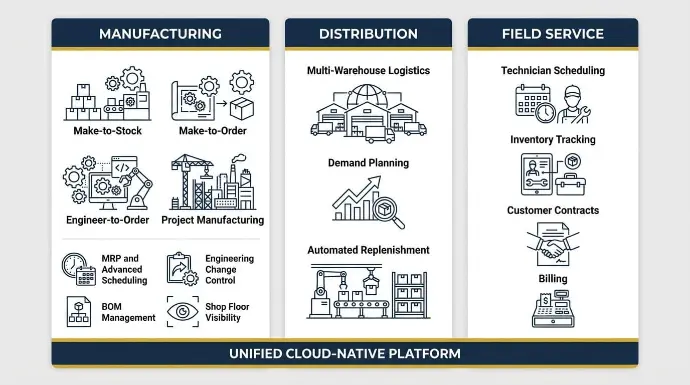
Acumatica ERP was built with strong industry specialization in mind. It includes vertical editions for manufacturing, distribution, retail commerce, and service organizations.
For manufacturing, the platform supports multiple production models, including:
- make-to-stock
- make-to-order
- engineer-to-order
- project manufacturing
These workflows operate inside a cloud native platform with integrated planning tools such as:
- MRP and advanced scheduling
- engineering change control
- BOM management
- shop floor visibility
In distribution, Acumatica supports multi-warehouse logistics, demand planning, and automated replenishment. A distributor managing inventory across several warehouses can track stock levels in real time while coordinating purchasing, shipping, and customer orders.
Field services are another strength. Companies running installation or maintenance operations can manage technician scheduling, inventory, and customer contracts in a single system.
For example, an HVAC equipment provider can schedule service technicians, track replacement parts inventory, manage service contracts, and process billing inside the same platform.
Acumatica’s cloud-native design helps these operational systems scale without introducing additional tools.
Odoo for Smaller Industrial Operations
Odoo can also work well in industrial environments, particularly for companies with simpler workflows.
A small manufacturer producing standardized products can run Odoo’s manufacturing module effectively. The platform supports production orders, bills of materials, and supply chain workflows.
A smaller distribution company with one warehouse can combine:
- CRM
- inventory management
- purchasing
- accounting
Into a unified system.
Because Odoo offers many modular solutions, companies can start small and add additional functionality as they grow. The platform’s open source flexibility also allows organizations to tailor workflows to specific operational needs.
However, as operational complexity increases, the number of modules and customizations may grow quickly. Manufacturers with multi-site production or advanced scheduling requirements often need deeper system configuration or additional development work.
At Cudio, we typically see this dividing line:
- Companies with simple manufacturing or distribution workflows can run Odoo effectively.
- Organizations managing complex supply chains or field operations often benefit from the operational depth built into Acumatica ERP.
Both systems can support business growth, but they are optimized for different levels of operational complexity.
Get My Free ERP Assessment Today
Scalability and Long-Term Growth
When comparing Acumatica vs Odoo, scalability is less about the number of users and more about how the system handles growing operational complexity.
Odoo scales through a modular approach. Companies can start with a few apps such as CRM, accounting, and inventory management, then add more modules as their needs expand. This flexibility works well for organizations that want to gradually evolve their systems while keeping initial costs low.
However, as workflows become more interconnected across departments, customization and integrations can increase system complexity. Some companies eventually reach a point where maintaining many customized modules becomes harder to manage.
Acumatica ERP, by contrast, was designed from the start for operational scalability. Its cloud-native architecture supports higher transaction volumes, multi-entity environments, and complex operational workflows within a single platform.
In practice, companies often outgrow Odoo when operational complexity increases significantly. This may happen when organizations add multiple warehouses, expand manufacturing operations, or require deeper coordination between finance, inventory, and service teams.
How to Choose the Right ERP for Your Business
Selecting the right ERP system is rarely about features alone. The best decision usually depends on how well the system aligns with your company’s growth plans and operational needs.
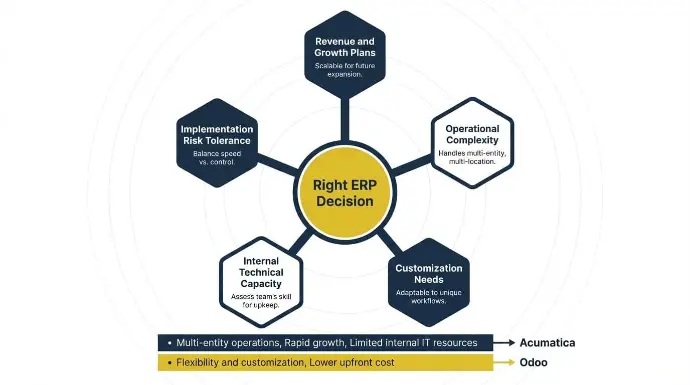
Our team typically guides companies through several key decision criteria.
- Revenue and growth plans: Companies expecting steady operational expansion should consider how their ERP will handle future scale. Rapid growth, acquisitions, or multi-entity operations often require deeper operational systems.
- Operational complexity: Businesses with complex manufacturing, distribution, or service workflows may benefit from platforms designed for those environments. Simpler operational structures may not require that level of depth.
- Customization needs: Some companies prefer flexible platforms that allow heavy customization. Others prefer structured systems with more built-in workflows to reduce technical maintenance.
- Internal technical capacity: Organizations with strong technical teams may be comfortable managing customization and integrations. Companies with limited internal IT resources often benefit from more structured ERP environments.
- Implementation risk tolerance: ERP projects require time, planning, and organizational change. Companies should consider how much complexity they are prepared to manage during implementation and long-term system maintenance.
The right ERP decision typically emerges when these factors are evaluated together rather than looking at features alone.
Conclusion: Choosing Between Acumatica and Odoo
The Acumatica vs Odoo comparison ultimately comes down to how your company operates today and where it plans to grow.
Acumatica ERP offers deeper operational capabilities for organizations managing complex processes across manufacturing, distribution, and service operations. Its architecture is designed to support structured workflows and long-term operational scale.
Odoo, on the other hand, provides flexibility and cost efficiency through a modular ecosystem of business apps. For many companies, this approach allows them to unify sales, accounting, inventory, and operations in a single platform without heavy upfront investment.
At Cudio, we help businesses evaluate both platforms and determine which ERP aligns best with their operational needs and growth trajectory.
Get My Free ERP Assessment Today
FAQs
The following questions address common concerns that arise when companies compare Acumatica and Odoo.
Is it realistic to start on Odoo and later migrate to Acumatica?
Yes, it is realistic to start on Odoo and later migrate to Acumatica ERP. Many companies use Odoo early on and move to a mid-market ERP once operations become more complex. The key risk is heavy customization, which can make migration harder. Keeping your data clean and limiting the use of custom modules makes the transition much easier.
Can Odoo really stay “free” with the Community edition for a growing business?
No, Odoo Community rarely stays free for growing businesses. While the license costs nothing, companies usually need hosting, developer support, and implementation services. Many organizations move to Odoo Enterprise within a few years. For businesses relying on ERP for core operations, the Enterprise version is usually the practical option.
Which platform is better for a multi-country, multi-currency business?
For global operations, Odoo Enterprise natively integrates comprehensive multi-currency ledgers and broad international tax localizations directly out of the box.
Conversely, Acumatica's unified architecture excels at consolidated financial reporting for multi-entity corporations, but intentionally restricts its native, deep tax compliance localizations primarily to the United States and United Kingdom markets.
The best choice often depends on the countries where your company operates. Local implementation partners also play a major role in the program's success.
How do upgrade cycles differ between Acumatica and Odoo?
Upgrade cycles differ mainly because of customization. Odoo upgrades can require additional work if the system includes custom modules or third-party apps. Acumatica upgrades are usually more controlled and less likely to break existing configurations. However, both platforms still require planning, testing, and maintenance during upgrades.
What if my company sits right between the typical Odoo and Acumatica size ranges?
If your company falls within the typical range, both Odoo and Acumatica ERP can work. Companies expecting rapid operational growth often lean toward Acumatica for deeper operational capabilities. Businesses prioritizing flexibility, customization, and lower upfront cost may choose Odoo. The best decision usually comes from testing real workflows during the ERP evaluation process.