



Choosing the best ERP system for a small business is a $175,000 to $340,000 decision over five years. Yet 55-75% of ERP projects fail to meet key performance indicators.
This guide uses insights from over 110 sources to help you avoid costly mistakes. We compare leading enterprise resource planning platforms like Odoo, Acumatica, and SAP Business One, with a focus on warehouse management, order processing, and reducing manual data entry.
Key Takeaways
- Small businesses that implement ERP see decisions made 36% faster and operating costs cut by up to 35%. Success depends on choosing the right system and implementation partner.
- Odoo, when implemented by Cudio, offers the best balance of cost, flexibility, and results. It's a smart choice for growing businesses with limited budgets.
- Avoid heavy customization. Most companies can meet 80% of their needs through configuration, reducing costs, complexity, and long-term risk.
What Should Small Businesses Look For in an ERP System?
Before comparing platforms, it's important to understand what separates a smart ERP investment from an expensive mistake when implementing Odoo ERP.
Start by mapping your current business processes and identifying areas for improvement. This step ensures that any ERP system you choose will support and optimize your work.
Most small businesses don't need the thousands of features packed into enterprise software. What they do need is a cloud-based ERP solution that handles core business functions like finance, sales, inventory management, and procurement, without forcing them to change how they operate. For expert guidance, consider Odoo consulting.
Choosing ERP software begins with identifying which features are most important to your business needs.
Core Capabilities That Drive ROI
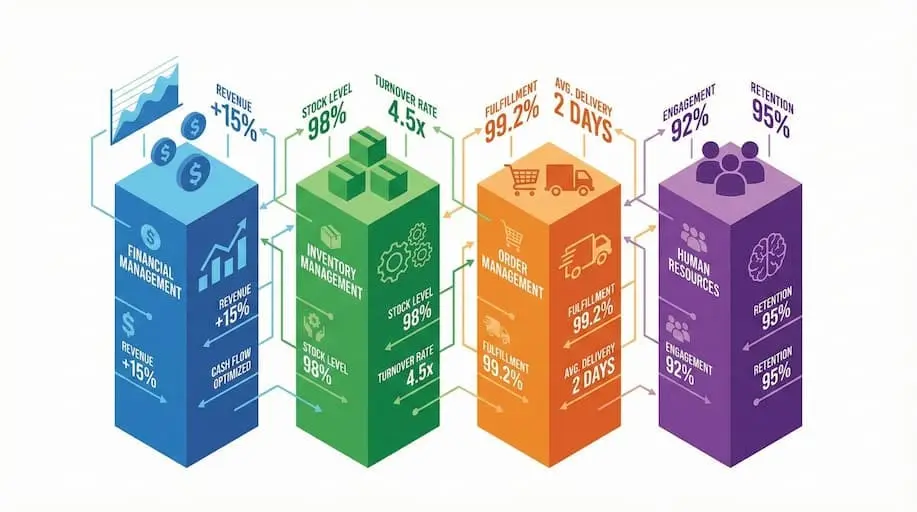
These essential features form the backbone of ERP software for small businesses:
- Financial Management: Real-time accounting can reduce monthly close cycles from 12 days to just 3. It supports multi-entity consolidation, automated reconciliation, and seamless integration with accounting software and other tools, such as CRM and inventory systems.
- Inventory Management: Real-time visibility helps reduce inventory variance from 18% to 3%. ERP systems automate reordering, provide traceability of lot and serial numbers, and track inventory across multiple locations.
- Order Management: A streamlined order-to-cash process can reduce order processing from 2.3 days to 0.6 days. Customer relationship management tools built into ERP software improve customer data accuracy and engagement.
- Human Resources: Centralized HR systems streamline employee data, payroll, and leave tracking, improving how you manage key business functions.
ERP software solutions bring together accounting, inventory, HR, and CRM into a single platform to streamline operations and improve overall business performance.
The Implementation Reality Check
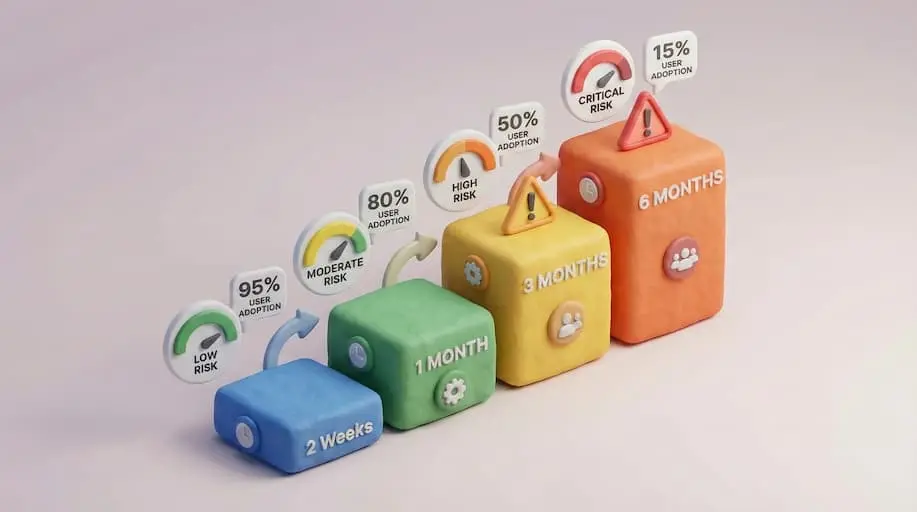
Here’s what ERP vendors don’t always say upfront:
Only 26% of employees actively use ERP systems after go-live. You could spend $50,000 to $150,000 on an ERP solution, only for most of your team to avoid it. The main reason is poor user adoption. In fact, 82% of CIOs say employee resistance is the top reason ERP projects fail.
That’s why speed matters. A small business needs a 2 to 12-week rollout, not a six-month enterprise project. The longer the timeline, the higher the risk of team disengagement. Accurate data migration from legacy systems is also critical to avoid delays and post-launch issues.
Customization can become a hidden cost trap. While configuration typically adds 5%-10% to implementation costs, customization can add 40%-100% and create long-term technical debt.
The 80/20 rule applies: handle 80% of your needs through standard configuration, and reserve customization for areas that give you a real competitive edge.
A phased deployment reduces implementation risk and improves adoption rates.
ERP Cost Reality: What You'll Actually Pay
When evaluating ERP software for small businesses, consider both upfront costs and long-term subscription fees. These ongoing expenses affect your total cost of ownership over time. Subscription fees for cloud based ERP software typically range from $40 to $150 per user per month in 2026.
Sample ERP Pricing (Over 5 Years)
ERP System | Upfront Cost | Monthly Subscription | Total 5-Year Cost |
ERP A | $2,000 | $60/user | $20,000 |
ERP B | $0 | $100/user | $24,000 |
ERP C | $1,500 | $50/user | $16,500 |
When comparing ERP software solutions, balance upfront costs with total value. A cost-effective solution gives you flexibility and efficiency without bloated features you won’t use.
5-Year Total Cost of Ownership (TCO)
Platform | 5-Year TCO | Monthly Cost | Implementation |
Odoo (via Cudio) | $60,000–$130,000 | $24–47/user | $5,000–$30,000 (1–4 weeks) |
Business Central | $85,000–$170,000 | $70–175/user | $25,000–$50,000 (2–6 weeks) |
Acumatica | $115,000–$235,000 | $1,800 base (unlimited) | $35,000–$75,000 (6–12 weeks) |
NetSuite | $235,000–$470,000 | $999 base + $99–199/user | $75,000–$150,000+ (2–6 months) |
A small business with $5M in revenue choosing NetSuite over Odoo could end up paying $175,000 to $340,000 more for a limited additional benefit.
Proven ROI Benchmarks
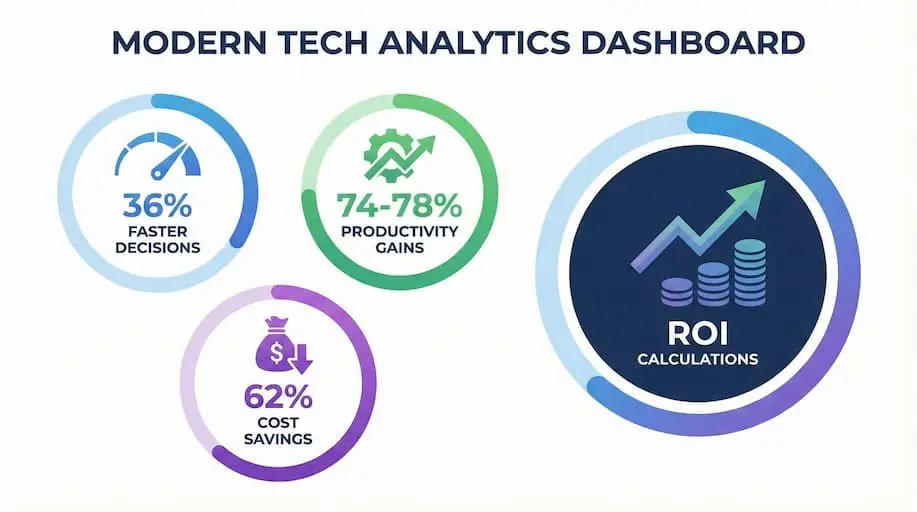
Here’s what successful small businesses see after ERP implementation:
- Faster decisions: 36% faster thanks to real-time data and business intelligence tools
- Improved productivity: Also, as mentioned in the guide above, 74% to 78% of businesses report measurable gains
- Cost savings: 62% achieve significant cost savings, with 20% to 35% lower operating costs
- Faster close cycles: Monthly financial close times drop from 12 days to 3 days on average
- Strong ROI: One Odoo project showed a $19,000 investment paid back in just 4.5 months, delivering a 480% annual ROI
When selecting the best ERP system for a small business, always look beyond features. Focus on implementation speed, data migration quality, and expected ROI. The right ERP solution should streamline operations, integrate core business functions, and support long-term growth.
1. Microsoft Dynamics 365 Business Central

Microsoft Dynamics 365 Business Central is a cloud-based ERP solution designed specifically for small businesses that rely on Microsoft tools like Outlook, Teams, Excel, and SharePoint.
Embedding ERP workflows into familiar platforms removes the friction that often slows adoption. With 60–75 percent user adoption within the first 90 days, Business Central makes ERP implementation approachable for lean teams looking to streamline operations and improve business performance.
As a comprehensive solution, it handles everything from inventory management and financial forecasting tools to project accounting and customer relationship management, all within a familiar UI backed by Microsoft’s ecosystem.
- Best For: Microsoft 365 users, cloud-based ERP seekers, small business service teams
- Pricing: $70–$175/user/month | 5-Year TCO: $85,000–$170,000 |
- Implementation: 2–6 weeks
Why Choose Business Central
For companies already invested in the Microsoft stack, Business Central offers immediate alignment with existing business processes and cloud ERP workflows:
- Deep native integration with Teams, Excel, Outlook, and SharePoint
- Built-in low-code tools (Power Platform) to automate and customize processes without a developer
- Fast, phased deployments in just 2–6 weeks
- Seamless biannual updates — no upgrade projects required
- Higher user adoption due to intuitive, familiar interfaces
Core Strengths
Business Central delivers a solid mix of cloud based ERP software capabilities to optimize daily business operations:
- Multi-currency support, fixed asset tracking, and advanced job costing
- Inventory management with bin tracking, automated replenishment, and lot/serial control
- Time tracking, profitability analysis, and project-based accounting for services firms
- Embedded business intelligence tools via Power BI for live reporting
- Over 1,000 integrations available through Microsoft AppSource for extending functionality
Proven Results
The platform’s tight Microsoft integration and scalability lead to measurable outcomes:
- 88%+ implementation success rate
- 60–75% user adoption within 90 days (industry avg: 26%)
- G2 rating: 4.0/5
- Accelerated customer relationships and collaboration with real-time, in-app ERP data
When NOT to Choose
Despite its advantages, Business Central isn’t ideal for every use case:
- SaaS companies or subscription-based models needing advanced revenue recognition (look to NetSuite or SAP Business)
- Businesses with highly complex manufacturing processes, like multi-level BOMs or custom scheduling
- Global operations managing dozens of subsidiaries across regions
- Companies outside the Microsoft ecosystem, cloud-based ERP systems like Odo,o may offer more flexibility and significant cost savings
2. Acumatica
Acumatica is a modern cloud-based ERP system known for its unlimited user model, making it especially attractive for small businesses with large teams or complex warehouse management needs. Instead of per-user pricing, Acumatica uses consumption-based billing, offering significant cost savings for organizations with 30+ users.
Its cloud-native architecture, industry-specific editions, and browser-based mobile access make it one of the best ERP systems for businesses focused on growth, scalability, and operational visibility.
According to recent benchmarks, Acumatica delivers a 12–18 month payback for manufacturers and achieves 55–65 percent user adoption within 90 days.
- Best For: unlimited users, manufacturing operations, distribution-heavy small businesses
- Pricing: $1,800/month base (unlimited users) | 5-Year TCO: $115,000–$235,000 |
- Implementation: 6–12 weeks
Why Choose Acumatica
For growing businesses, Acumatica delivers enterprise-grade capability without per-user licensing constraints:
- Fixed monthly pricing enables unlimited user access, saving $30,000–$60,000 per year for larger teams
- Seamless mobile access through browser-based design supports remote work and field operations
- Robust manufacturing support, including MRP, shop floor visibility, and quality control tools
- Open APIs simplify third-party integration and eliminate reliance on expensive middleware
Core Strengths
Acumatica brings end-to-end support across various business functions, especially where inventory control, manufacturing, and project management intersect:
- Advanced multi-level BOMs, engineering change orders, and capacity scheduling
- Regulatory support through lot/serial tracking for FDA and ISO compliance
- Comprehensive warehouse management, including RF scanning, wave planning, and directed put-away
- Inter-company accounting with full multi-entity consolidation
- Dedicated vertical solutions for construction, retail, manufacturing, and distribution
Proven Results
Real-world case studies validate Acumatica’s ability to enhance operational efficiency and streamline complex workflows:
- 32% reduction in production lead time (electronics manufacturer)
- 47% faster order processing through automated fulfillment (wholesale distributor)
- Real-time inventory and manual data entry reduction across 12 retail locations (specialty retailer)
- User Ratings: G2 – 4.0/5, Capterra – 4.2/5
When NOT to Choose
Despite its strengths, Acumatica may not be the right ERP system for every organization:
- Small businesses with fewer than 10 users may find the $1,800 base pricing excessive
- Companies deeply embedded in Microsoft 365 may prefer tighter integration (e.g., Business Central)
- Businesses with complex subscription billing or advanced financial consolidation needs may benefit more from SAP Business One or NetSuite
- Organizations prioritizing built-in financial reporting or deep business intelligence may require additional setup or third-party tools
3. Odoo (via Cudio Implementation)
Odoo is a modular, cloud based ERP software platform built for flexibility, customization, and affordability. Ideal for small businesses across industries, it allows teams to start with just a few core applications, such as CRM or accounting software, and then expand into inventory management, manufacturing, or eCommerce as their needs evolve.
Its open-source foundation provides 80 to 90 percent of enterprise ERP functionality at 20 to 30 percent of the cost.
Odoo delivers a 95 percent success rate, 50-60 percent user adoption within 90 days, and a 4.5-month payback on a $19,000 investment.
- Best For: cost-conscious SMBs, customizable ERP needs, omnichannel retailers
- Pricing: $24 to $47 per user per month
- 5-Year TCO: $60,000 to $130,000
- Implementation Timeline: 1 to 4 weeks (simple), 8 to 12 weeks (complex)
Why Choose Odoo
For businesses that need agility, scalability, and control, Odoo offers a rare combination of enterprise-grade capability and SMB-friendly cost:
- The modular pricing model lets you pay only for the apps you use
- Open-source flexibility allows full customization without vendor lock-in
- Faster implementation cycles compared to enterprise ERPs
- Saves $175,000 to $340,000 over five years compared to NetSuite
- Built-in support for customer relationship management, project management, and inventory control
Core Strengths
Odoo supports a wide range of business functions through its robust app ecosystem:
- Inventory management with multi-location tracking, barcode scanning, and automated replenishment
- Manufacturing with unlimited BOM levels, work orders, scheduling, and quality control
- CRM features for managing customer relationships, pipeline tracking, and client portals
- eCommerce integrations with Shopify, WooCommerce, and Magento to reduce manual data entry
- Financial tools, including multi-currency support, inter-company accounting, and analytic dimensions
Proven Results
When implemented by a certified partner like Cudio, Odoo consistently delivers measurable outcomes:
- 50 percent reduction in days-to-close (Lexington Medical)
- Increased vendor transparency and profitability (New Morning Market)
- Successful ERP replacement after 12+ system evaluations (R&W Rope)
- 480 percent annual ROI with 95 percent implementation success rate
Cudio Partner Advantage
Cudio combines technical expertise with real-world business leadership. With over 30 years of experience, the Cudio team includes former operators who scaled their own omnichannel business using Odoo. As a trusted ERP vendor, Cudio ensures each deployment is built for long-term impact, not just technical completion.
Cudio services include:
- Transparent fixed-price ERP implementations
- Failed project rescue and recovery
- Preconfigured trial databases tailored to your industry
- Strategic integrations with partners like Rithum and Avalara
- Support for data migration, business process mapping, and post-launch optimization
Cudio brings clarity and accountability to ERP software selection and delivers results when other partners fall short.
When NOT to Choose
Despite its flexibility, Odoo may not be ideal in certain scenarios:
- Businesses relying on the free Community edition without internal developers
- Global enterprises with highly complex multi-subsidiary structures
- Companies that require deep Microsoft 365 integration, including Teams and Outlook
- DIY implementers without access to a certified partner (success rates decline without expert support)
4. Oracle NetSuite
NetSuite is a powerful, cloud-based ERP platform built for fast-scaling companies with complex needs and substantial IT budgets.
As one of the most mature cloud-based solutions on the market, it supports inventory, finance, order management, and subscription billing on a single platform. NetSuite serves the upper tier of the ERP systems for small and medium-sized businesses, especially those preparing for future growth or replacing fragmented legacy systems.
- Best For: fast-growing companies, SaaS and subscription businesses, multi-subsidiary global firm
- Pricing: $999 per month base + $99 to $199 per user
- 5-Year TCO: $235,000 to $470,000
- Implementation Timeline: 2 to 6 months (custom quote required)
Why Choose NetSuite
For complex companies with high transaction volumes and subscription models, NetSuite offers a comprehensive enterprise resource planning ERP system:
- Advanced revenue recognition supporting ASC 606 and IFRS 15 compliance for SaaS
- OneWorld global consolidation with automated inter-company eliminations and multi-currency reporting
- Subscription billing with automated renewals, upgrades, proration, churn tracking, and dunning
- Enterprise-grade scalability that supports growth from $10 million to $500 million in revenue
- Suitable for replacing current systems or legacy systems and centralizing data silos into a single platform
Core Strengths
NetSuite provides deep functionality across financials, logistics, and operations, enabling businesses to reduce operational costs and increase efficiency:
- Multi-location inventory management with bin tracking and demand planning
- Unified order management including quoting, fulfillment, invoicing, and returns
- SuiteScript customization framework allowing tailored workflows and automation
- 500+ pre-built integrations through the SuiteApp marketplace
- Real-time data analysis and business intelligence for faster, more informed decisions
Proven Results
NetSuite is widely adopted among enterprise-grade and mid-market firms with complex back-office needs:
- 88 percent of customers reach technical go-live
- G2 rating: 4.1 out of 5
- Trusted by leaders in SaaS, wholesale distribution, and global software companies
- Enables long-term operational efficiency and improved customer satisfaction through integrated processes
When NOT to Choose
While NetSuite is feature-rich, it may not be the right ERP system for every business:
- Smaller companies with limited budgets may find ongoing costs and subscription fees too high
- Teams lacking technical resources may struggle with SuiteScript customization and maintenance
- Companies needing fast implementation may face delays due to longer 2 to 6-month timelines
- Firms requiring transparent pricing may prefer more cost-effective solutions like Microsoft Dynamics or Odoo
- Simple operations that do not require enterprise-grade consolidation, billing, or complex supply chain management
Side-by-Side Comparison
Not sure which ERP is right for you? This quick-glance table highlights pricing, features, and best-fit use cases to help you choose the right solution faster.
Criteria | Business Central | Acumatica | Odoo (via Cudio) | NetSuite |
5-Year TCO | $85K-$170K | $115K-$235K | $60K-$130K | $235K-$470K |
Implementation | 2-6 weeks | 6-12 weeks | 1-4 weeks (simple) | 2-6 months |
Best For | Microsoft ecosystem | Unlimited users, manufacturing | Cost-conscious, flexible needs | Well-funded, global |
Customization | Low-code (Power Platform) | Open APIs | Unlimited (open-source) | SuiteScript (JavaScript) |
Success Rate | 88%+ | 88% | 95% (certified partners) | 55-75% meet objectives |
User Adoption | High (familiar UI) | High (modern UI) | High (intuitive UI) | Moderate (complex) |
Ideal Revenue | $5M-$50M | $10M-$50M | $1M-$20M | $10M-$100M+ |
Popular ERPs for small businesses include Microsoft Dynamics 365 Business Central, NetSuite, Odoo, and SAP Business One.
Critical Success Factors
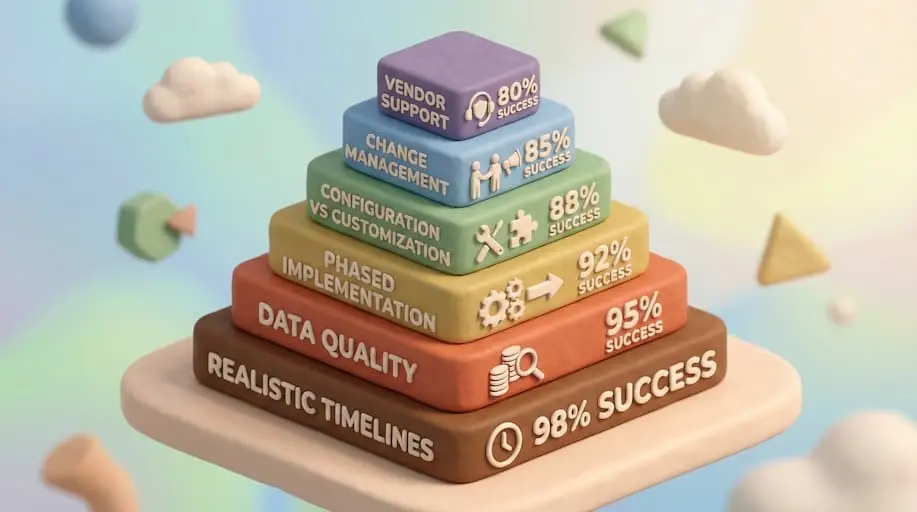
Implementing an ERP system is a big step for any small business. While 88% to 93% of ERP projects go live, only 25% to 45% actually meet their business goals. That gap is usually caused by poor planning, lack of support, or skipping key steps.
Here are six proven factors that increase your chances of ERP success, based on a study of 159 small and medium-sized businesses:
Strong Vendor Support
The partner you choose to implement your ERP software matters more than the software itself. Certified partners with a good track record make a huge difference. Always:
- Choose certified vendors (like Gold/Silver for Odoo or Microsoft Partners)
- Ask for 3 client references from similar businesses
- Check their success rates and reviews
- Get a fixed-price contract to avoid budget overruns (64% of projects go over budget)
Effective Change Management
Resistance to change is the biggest barrier. You need to:
- Set aside 10% to 15% of your budget for training and change management
- Appoint a C-level sponsor to guide the project
- Communicate early and often so everyone knows what’s changing and why
- Offer different types of training (on-the-job, classroom, role-based)
Prioritize Configuration Over Customization
80% of your business needs can be handled with basic ERP configuration. Customization should only cover the 20% that gives you a real edge. Why?
- Configuration only adds 5% to 10% in cost
- Customization can double your costs and create technical debt
- Avoid vendors that push heavy custom work early in the process
Phased Implementation Works Best
Start with the most critical operations like accounting or inventory management. Then expand. A phased rollout:
- Lowers risk
- Keeps your team engaged
- Helps you fix issues early before scaling up
Clean, Accurate Data
A successful ERP solution depends on good data. That means:
- Cleaning up existing systems before migration
- Removing duplicates and outdated info
- One company saved over $50,000 in errors by spending $15,000 on a data audit
Realistic Timelines with Flexibility
ERP projects take time. Most run 20% to 30% longer than planned. So:
- Build in buffer time
- Focus on 3 to 5 core business goals
- Avoid trying to launch every module at once
- Be careful with vendors promising 4-week deployments for complex needs
Industry-Specific ERP Recommendations
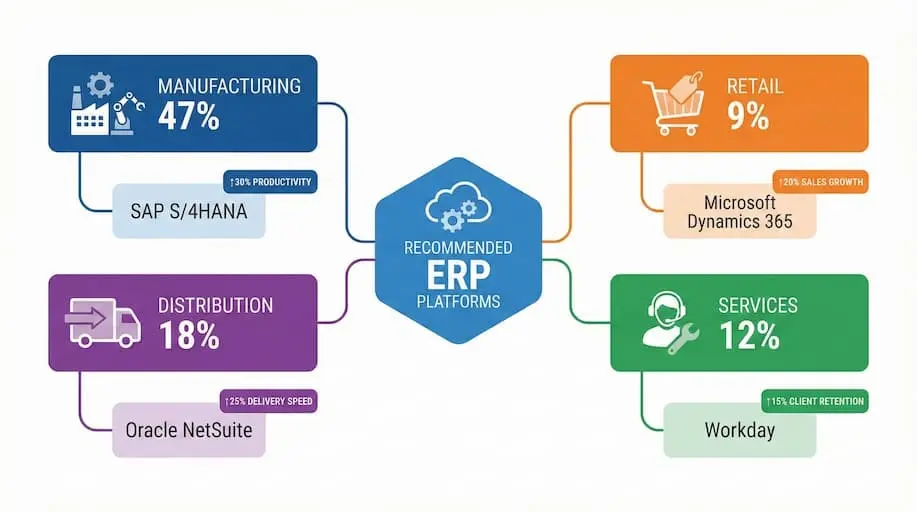
Different industries have different needs. Here’s what works best by sector:
Manufacturing (47% of ERP Use)
Best Options: Odoo via Cudio, Acumatica
Manufacturers need strong production planning, inventory tracking, and supply chain management. Odoo's manufacturing tools offer full support for complex BOMs and workflows at a lower cost. SAP Business One is also a solid choice for growing manufacturers.
Cudio Case Study: A manufacturer invested $35K-$45K and went live in 8 weeks. They cut overhead by 35% and reached full ROI in under 12 months.
Distribution & Wholesale (18%)
Best Options: Business Central, Odoo via Cudio
Key features include multi-location inventory, automated order management, and vendor tracking. The right ERP system can streamline operations and reduce manual work.
Results: Inventory variance dropped from 18% to 3%. Order cycles went from 2.3 days to just 0.6 days.
Retail & Omnichannel (9%)
Best Option: Odoo via Cudio
Retailers need integrated eCommerce, POS, and back-end inventory. Cudio's partnership with Rithum helps unify retail, wholesale, and marketplace sales in real time.
Case Study: A grocery chain unified 5 stores, improved vendor transparency, and gained clear P&L tracking for each department. This led to smoother business operations and better customer satisfaction.
Professional Services (12%)
Best Options: Business Central, Odoo
These teams need project management, job costing, and time tracking. Business Central offers strong financial forecasting tools and project insights. Odoo gives flexibility with timesheets and task tracking.
Making the Right ERP Choice
Not every small business needs the most expensive or complex ERP system. Your best choice depends on your company’s size, growth stage, budget, and operational complexity.
The table below breaks down which ERP solution makes the most sense for different scenarios, from early-stage small businesses to scaling manufacturers with complex supply chain needs.
Scenario | Recommended ERP | Year 1 Budget | Ongoing Costs | Timeline | Key Benefit | Notes |
Small Business (<$10M revenue) | Odoo via Cudio or Business Central | $20K–$50K | $10K–$20K/year | 4–12 weeks | Designed for core business needs and scalable for future growth | 95%+ success rate with certified partners |
Growing Business ($10M–$50M revenue) | Odoo (flexibility) Acumatica (unlimited users) NetSuite (complexity, large budgets) | $50K–$150K | Varies by platform | 8–16 weeks | Supports moderate complexity and scaling | Choose based on user volume and IT capacity |
Manufacturing or Distribution | Odoo via Cudio | Varies by scope | Varies by usage | Typically 6–12 weeks | Advanced BOMs, production, inventory at lower cost | SAP Business also supports manufacturing workflows |
Tight Budget / ROI-Focused | Odoo via Cudio | As low as $20K | Lower long-term TCO | 2–8 weeks | Save $175K–$340K vs. NetSuite over 5 years | 95% success rate with partner-led deployments |
For most small businesses, Odoo via Cudio strikes the ideal balance between cost, flexibility, and implementation success. It delivers 80–90% of enterprise-grade ERP features at a fraction of the cost, with a 95% success rate when implemented by certified partners.
Unless you have deep Microsoft integration needs or advanced global complexity, Odoo is likely the right ERP system to future-proof your operations without draining your budget.
Common ERP Myths (and Truths)
Many small businesses still hesitate to adopt ERP software because of outdated beliefs. But ERP systems have come a long way. They are now more affordable, flexible, and easier to implement. Before dismissing an ERP solution, it’s important to separate fact from fiction.
"We’re Too Small For ERP."
Wrong. Small businesses using ERP software make decisions 36% faster. Over 74% see better productivity. Sticking with spreadsheets can cost you $200K+ per year in errors and delays.
"Erp Projects Always Fail."
Wrong. With proper planning and a certified ERP vendor, success rates are now over 88%. ERP software solutions are easier to implement today than in the past.
"We Need Tons Of Customization."
Probably not. 80% of business needs can be solved with built-in features. Customization adds 40% to 100% in cost and often causes future issues.
Conclusion
The right ERP system does more than just replace spreadsheets. It helps you reduce errors, speed up order processing, improve inventory control, and make better business decisions based on real-time data. Whether you’re a small business just starting to scale or an established company seeking more control, investing in the right ERP software is one of the most impactful decisions you can make.
If you're looking for a partner that understands both the technology and the operational realities of growing a business, Cudio is here to help. With 30+ years of combined experience and a proven track record across industries, our team specializes in implementing Odoo to fit your exact needs, without unnecessary complexity or bloated costs.
Frequently Asked Questions
Still unsure if ERP is right for your business? Here are straight answers to the most common questions small business owners ask.
Are ERP systems good for small businesses?
Yes, ERP systems are good for small businesses. They help manage accounting, inventory, sales, and operations in one place, reducing errors and saving time. Cloud-based ERP software also makes it affordable and scalable as your business grows.
Is Excel an ERP tool?
No, Excel is not an ERP tool. It’s a spreadsheet program, not a system designed to manage end-to-end business processes. While useful for tracking, it lacks automation, data integrity, and real-time visibility.
What is the best free ERP for small business?
The best free ERP for small businesses is Odoo Community Edition. It's open-source, flexible, and offers strong core features such as inventory, CRM, and accounting. However, you’ll need technical resources or a partner to set it up and maintain it.
What is the cheapest ERP system?
The cheapest ERP system with full features is Odoo when implemented by a partner like Cudio. Licensing starts at $24/month per user, with the lowest total cost of ownership over 5 years among leading platforms. It’s ideal for cost-conscious businesses that still want real results.