
If you’re weighing whether to implement Odoo without a partner, you’re asking the right question.
Most of the answers you’ll find online are written by people who are trying to sell you one outcome or the other. This guide is not that.
We built Cudio after scaling our own omnichannel business on Odoo. We’ve made the same configuration calls, data migration decisions, and go-live tradeoffs you are facing right now. That experience, not a sales pitch, is what shapes everything in this article.
The honest answer is this: DIY Odoo implementation works for some businesses. For others, it becomes one of the most expensive decisions they make. The cost does not always show up immediately. It surfaces six months later in rework, lost productivity, and data problems that are hard to unwind.
This guide walks you through the criteria that actually determine which category you fall into, where DIY implementations most commonly break down, and what your real options are before you commit.
Key Takeaways
- DIY implementation is viable for small teams with narrow scope and at least one person with prior Odoo experience. It is not viable for multi-department rollouts without that foundation.
- Data cleanup is the single most underestimated phase. Skipping it doesn’t save time. It moves the problem into a live system where it costs significantly more to fix.
- According to Panorama Consulting, 62% of organizations cite data migration as their top ERP implementation challenge. Most did not see it coming.
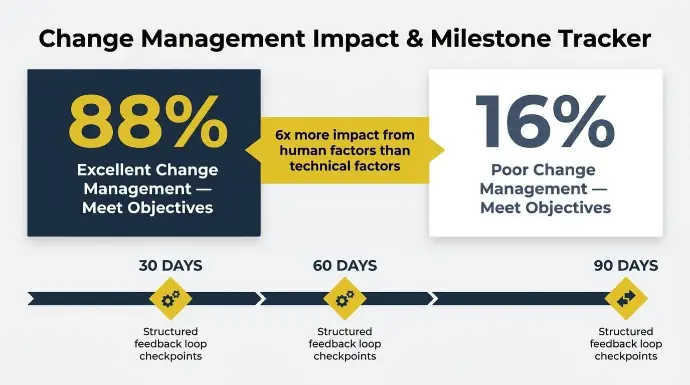
- Prosci research shows that projects with excellent change management meet objectives at an 88% rate. Projects with poor change management meet objectives at just 16%. Most DIY plans treat adoption as an afterthought.
- A hybrid path exists. Handle your internal build work yourself and bring in expert support only for the phases where the risk of irreversible mistakes is highest.
When DIY Odoo Implementation Actually Makes Sense
DIY implementation is not inherently reckless.
Under the right conditions, it’s a reasonable choice. The problem is that most teams assess their readiness based on confidence rather than actual criteria. That gap is where the cost gets buried.
Before committing to any path, run yourself through both of the following lists honestly. Not aspirationally.
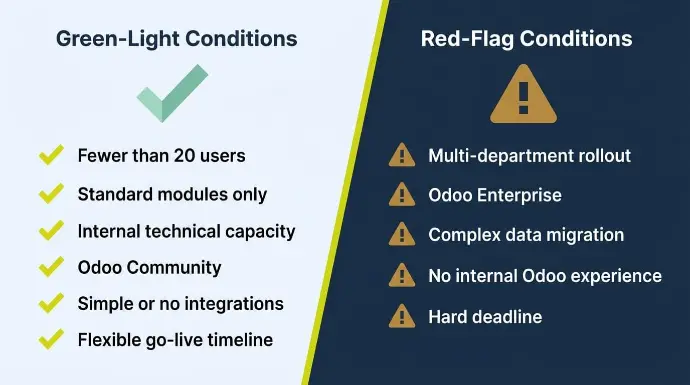
Green-Light Conditions: When DIY Is Defensible
The following conditions collectively make a self-managed implementation a reasonable call. The more of these you can check off, the lower your execution risk.
- Small, contained scope: Fewer than 20 users going live in a single department or function.
- Standard modules only: Staying close to Odoo’s out-of-the-box standard features with minimal configuration changes.
- Internal technical capacity: At least one team member with prior Odoo or ERP implementation experience to support an in-house implementation.
- Odoo Community: The open-source version, which carries lower complexity than Odoo Enterprise.
- Simple or no integrations: No third-party platforms requiring custom connectors.
- Flexible go-live timeline: A realistic project timeline with room to absorb learning curves without disrupting the business.
DIY works best when business requirements are simple and well understood before configuration starts.
Red-Flag Conditions: When the Risk Goes Up Considerably
The following conditions raise the cost of getting it wrong. If more than two of these apply to your situation, the case for bringing in expert support becomes difficult to argue against.
- Multi-department rollout: Multiple business processes going live at the same time across finance, inventory, and sales.
- Odoo Enterprise: The licensed version adds configuration depth and complexity that raises the DIY bar considerably.
- Complex data migration: Historical records, product catalogs, or customer data that requires transformation when migrating data from existing tools before import.
- No internal Odoo experience: Relying entirely on documentation and community forums is especially risky when implementing Odoo ERP without prior experience.
- Hard deadline: A fixed go-live date with real business consequences if it slips.
These risks rise further on larger projects with multiple dependencies.
The Odoo Community versus Odoo Enterprise distinction matters more than most teams initially realize. The community is more forgiving for a self-managed build. Enterprise adds more moving parts, and mistakes there compound faster.
What DIY Odoo Implementation Actually Involves
Most teams underestimate implementation scope not because they lack intelligence, but because the phases look manageable on a project plan.
In practice, each one carries hidden complexity that compounds quickly when skipped or rushed.
Every Odoo implementation, DIY or partner-led, moves through the same core phases. The difference is who catches the mistakes at each stage. Odoo ERP is an enterprise resource planning platform with over 30 integrated business applications.
The table below maps each phase to what it involves and where DIY complexity is highest, especially since the erp system spans multiple functions and complexity compounds across phases.
Phase | What It Involves | DIY Complexity |
Requirements Gathering | Documenting business analysis, business requirements, key workflows, module scope, and user roles | Low to Medium |
Process Mapping | Mapping current workflows, reviewing sales flow and other important processes, to Odoo's logic before any configuration | Medium to High |
Data Cleanup | Auditing, deduplicating, and formatting legacy data for migration | High |
System Configuration | Setting up modules, workflows, rules, and access controls based on system design decisions as teams configure Odoo to match workflows | High |
Sandbox Testing | Building and testing in a staging environment before touching live data | Medium |
User Acceptance Testing | Structured UAT with real users validating real workflows | Medium |
Go-Live | Phased rollout or full cutover with contingency planning | High |
Post-Go-Live Support | Fixing issues, retraining users, and adjusting configuration | Medium to High |
Process mapping before system configuration is what separates teams that succeed from teams that rebuild.
Configuring Odoo around broken or undocumented processes locks the problem in rather than solving it.
Sandbox testing before go-live is non-negotiable. User acceptance testing is not a formality. It is the last real checkpoint before errors become operational problems.
The Data Cleanup Phase Most Teams Skip
Data cleanup is consistently the most underestimated phase in DIY Odoo projects. Teams treat it as a quick export-and-import step, when the priority should be cleaning and moving only essential data and verifying that current data is accurate. In reality, it’s far from that. 62% of organizations name data migration as their #1 ERP implementation challenge.
Dirty data imported into Odoo creates cascading errors across reporting, inventory valuation, financials, and inventory management. Duplicate vendors corrupt purchase history. Inconsistent product codes break inventory tracking. Incomplete customer records cause invoicing failures at go-live.
Data migration requires a structured audit before a single record moves. That means identifying duplicates, standardizing formats, mapping legacy fields from existing systems to Odoo's data model, and validating completeness. For businesses with multiple years of transactional history, this phase alone can take weeks.
Skipping it does not save time. It relocates the problem into a live system where it costs significantly more to fix.
Where DIY Odoo Projects Break Down
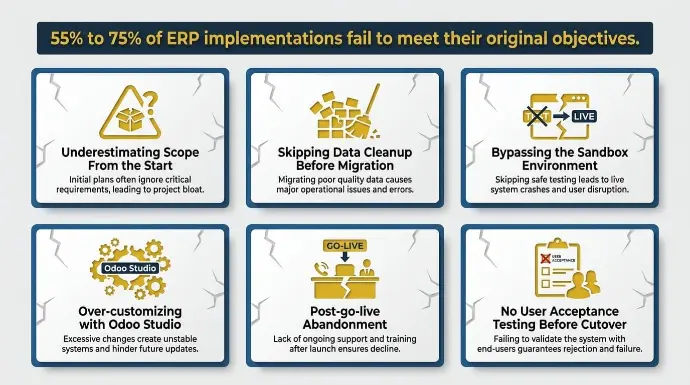
Most DIY Odoo projects do not fail because the team lacks effort. They failed because the scope was larger than it looked from the outside, and the gaps only became visible after go-live. In a market where 81% of organizations are implementing or have implemented ERP software, that makes disciplined execution more important, not less. 55% to 75% of ERP implementations fail to meet their original objectives.
The following failure points appear most consistently across self-managed ERP implementations. These are not edge cases. They are the pattern.
Here’s where things go wrong, and why:
- Underestimating scope from the start. Teams configure what they already understand and leave critical workflows unaddressed. The gaps surface at the worst possible moment.
- Skipping data cleanup before migration. Importing legacy data without a structured audit creates cascading errors across reporting, inventory, and financials. It’s one of the hardest problems to fix after the fact.
- Bypassing the sandbox environment. Skipping structured testing before go-live means errors surface in production, where they cannot be quietly contained.
- Over-customizing with Odoo Studio. Studio makes customization accessible, but changes made without understanding upgrade implications create technical debt that complicates every future version migration.
- Post-go-live abandonment. Many DIY teams treat go-live as the finish line. Without a plan for continuous support and issue escalation, small problems compound into larger ones.
- No user acceptance testing before cutover. Skipping structured UAT removes the last real checkpoint before errors become operational problems, even though better planning is what makes all the difference once teams reach cutover.
At Cudio, we’ve rescued 35 stalled or failed Odoo implementations. Across those projects, skipping at least one of the phases above is the common thread. It is rarely a single catastrophic decision. It is a chain of small ones.
DIY vs. Odoo Direct vs. Certified Partner: What Each Path Actually Means
Not every business needs the same implementation approach.
The right path depends on your team's actual capacity, the complexity of your scope, how much timeline pressure you are carrying, and how much a failed go-live would actually cost you.
Below is an honest breakdown of each option:
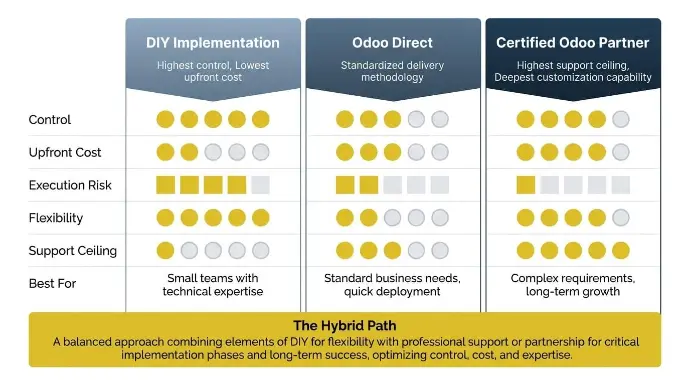
DIY Implementation
Highest control. Lowest upfront cost. Highest execution risk. It is the true in-house option, offering maximum control but only when scope is narrow, the team has prior Odoo experience, and the business has real internal capacity to absorb a learning curve. Odoo Community is more forgiving here than Enterprise, which adds configuration depth that raises the bar considerably. This path is best for straightforward business operations, not custom or multi-entity complexity.
Odoo Direct
Odoo's own implementation service is built around a standardized delivery methodology. It offers more support than going fully solo, but it is designed for a repeatable process. Businesses with complex workflows, multi-entity structures, or deep integration requirements often find it less flexible than their situation requires.
Certified Odoo Partner
Highest support ceiling. Deepest customization capability. Highest upfront investment. An implementation partner brings implementation experience across industries, handles Odoo Enterprise configurations that DIY teams routinely underestimate, and provides accountability through the full project lifecycle.
A good partner also brings structured rollout ownership and ongoing accountability. A certified partner is usually the safer choice when the scope carries real operational risk.
No path is universally right. A capable internal team with the right resources can succeed on a contained scope. The same team will not successfully execute a multi-department rollout with hard deadlines and no prior Odoo experience. That is also where complex projects and custom development are typically best handled by an experienced Odoo partner.
The Hybrid Path Worth Knowing About
A middle option exists that many teams overlook: a structured approach for teams that want to keep ownership while reducing risk.
You handle configuration, module setup, and day-to-day build work internally, while expert support comes in during the initial setup, high-risk phases like data migration and integration setup, and post-live work.
You keep control of the project without carrying the full exposure of going it alone. For medium sized businesses with some internal Odoo familiarity, this is often the most cost-efficient and risk-managed path available.
We offer exactly this kind of targeted engagement at Cudio. Our implementation process starts with a 140-point diagnostic that maps every operational workflow before any custom modules are approved or a single line of configuration is written. We price on a fixed-fee basis so there are no surprise invoices after go-live. If you want to pressure-test your readiness before committing to a direction, that diagnostic is the right starting point.
Get My Free ERP Readiness Assessment
The Hidden Costs of Going It Alone
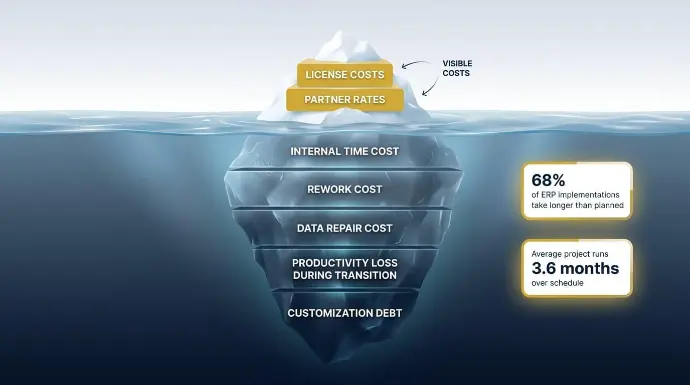
The financial case for DIY implementation usually starts with license costs and partner rates. Those are the visible numbers.
The ones that actually erode the business case sit underneath them. 68% of ERP implementations take longer than planned. The average project runs 3.6 months over schedule.
Internal Time Cost
ERP implementation consistently takes longer than projected. Every hour your finance lead, operations manager, or IT resource spends troubleshooting Odoo is an hour not spent running the business. That opportunity cost is real, even when it doesn’t appear on an invoice.
Rework Cost
Getting system configuration wrong and correcting it after go-live is almost always more expensive than getting qualified input upfront. Post-go-live fixes happen under pressure, with live data at risk, and they pull the same internal resources back into implementation work they thought was finished.
Data Repair Cost
Data migration done without a structured audit imports the mess directly into Odoo. Duplicate records, mismatched field mappings, and incomplete histories create reporting errors and operational failures that take significant time to unwind. Panorama Consulting found that roughly half of organizations significantly underestimate migration costs during planning.
Productivity Loss During Transition
Teams operating below capacity during and after a poorly managed go-live absorb real costs across every department involved, while a planned approach to go-live reduces disruption and supports a smooth transition. This is harder to quantify but consistently underestimated.
Customization Debt
Over-customizing early using Odoo Studio, especially when teams add custom workflows before core modules are stable and without understanding how those changes interact with future upgrades, creates maintenance obligations that grow with every version migration.
None of these costs appear in the initial DIY comparison. Most of them appear six months later. For Almac Imports, a structured implementation with us translated directly into 40% business growth and an 80% reduction in inventory write-offs. That outcome was not possible with the DIY approach their scope required.
Show Me Cudio's Implementation Process
Change Management: The Part DIY Plans Almost Always Miss
Training teaches people how to click through Odoo, but role-based user training is what supports real adoption.
A structured adoption program changes how people actually work. That distinction is what most DIY teams miss, and it’s where implementations quietly fall apart after go-live. Projects with excellent change management meet objectives at an 88% rate. Projects with poor change management meet objectives at just 16%.
A structured adoption program is built around more than a training session. The following components are what actually drive long-term adoption after go-live.
Here’s what a real adoption program looks like:
- Internal champions assigned by department before go-live
- Phased rollout sequenced by workflow complexity, not by convenience
- Documented process mapping reviewed with end users, not just project leads
- Structured feedback loops during the first 30, 60, and 90 days after launch
- Scheduled post-go-live check-ins tied to measurable adoption benchmarks and ongoing support, not a one-time handoff
- Escalation paths for issues that require configuration changes
Post implementation is not the finish line. For most DIY teams, it’s where the plan ends, and that’s the problem. The first 90 days after go-live determines whether Odoo becomes the system people trust or the system people work around.
Prosci research also found that human factors matter six times more than technical factors in determining ERP outcomes. Technology is rarely what fails; the people's side of the transition is.
At Cudio, we do not hand you a system and walk away. Our post-go-live support covers bug fixes, module updates, user retraining, configuration changes, and long term support as your business evolves. We have a 100% client retention rate, not because we advertise it, but because we protect it.
I Want My Team to Actually Use This System
So, Should You Implement Odoo Yourself?
DIY Odoo implementation is a real, viable path for the right teams. It’s also one of the more expensive mistakes a business can make when the conditions are wrong.
The factors that determine which category you fall into are scope, internal skill, data readiness, and a genuine commitment to change management. The decision is not just whether to choose Odoo, but whether your team can support the implementation path it requires. Get those right, and self-managed ERP implementation is defensible. Get them wrong, and the costs show up six months later.
How Odoo is deployed matters as much as the software choice itself. At Cudio, we’ve seen both outcomes firsthand, as operators who scaled on Odoo ourselves and as implementation partners across 62 completed projects. If you’re ready to get an honest read on your situation before committing to a direction, that’s exactly what we’re here to provide.
The questions below are what most operators are working through when they reach this decision. Even if your situation isn’t covered here, our team is easy to reach.
Frequently Asked Questions
Thinking about a DIY Odoo implementation or running one without external help? Here are quick answers to the most common questions teams run into during setup, migration, and early adoption.
How long does a DIY Odoo implementation typically take for a team with no prior ERP experience?
For a small team implementing a single department with standard modules, expect around 3 to 6 months end-to-end, though the timeline depends on the size of the Odoo project as much as on prior ERP experience.
That includes data cleanup, testing, and user acceptance. Teams with no ERP background usually land on the longer end of that range due to learning curves and iteration cycles. Industry research also shows ERP projects often take longer than expected once real-world complexity sets in.
Can Odoo Community handle the same workflows as Odoo Enterprise without customization?
Not fully. Odoo Community can support many core workflows, but it lacks several advanced features such as multi-company accounting, certain manufacturing tools, and enterprise-level helpdesk functionality. Whether it is enough depends entirely on your operational needs. Once SLAs, advanced reporting, or complex structures are required, Enterprise is usually the more practical option.
What Odoo modules are generally safe for DIY configuration versus those that need expert support?
CRM, customer management, basic project management, and simple inventory setups are generally manageable for DIY implementation.
Accounting, multi-warehouse inventory, manufacturing, human resources, and integrations carry much higher risk and are where configuration mistakes tend to become expensive. As a rule, the closer a module is to financial data or multi-entity operations, the more expert oversight it typically needs.
How do you migrate data from QuickBooks or Excel into Odoo without disrupting your chart of accounts?
Start by mapping your existing chart of accounts to Odoo’s structure before importing anything. Clean and normalize data first, then run test imports in a sandbox environment. After migration, reconcile balances against the source system to confirm accuracy. Skipping structured validation is one of the most common causes of reporting issues after go-live.
What should a post-go-live optimization plan include for a small team running Odoo independently?
A strong post-go-live plan includes 30-, 60-, and 90-day review checkpoints to track adoption, support customer relationships when customer-facing teams use Odoo, and fix workflow issues early. This matters even more when no official Odoo partner is involved, because support ownership has to be explicit from the start.
It should also define clear escalation paths for problems the internal team cannot resolve and assign internal owners per department. Just as important, document every workaround, since untracked workarounds quickly become permanent shadow processes that reduce system efficiency over time.