
ERP implementation failure is when an enterprise resource planning deployment exceeds its budget, misses go-live deadlines, or fails to deliver the operational outcomes it was selected for — and research from Panorama Consulting and the Standish Group confirms that 50-75% of ERP projects meet at least one of those criteria.
Cudio has completed 62+ Odoo implementations and rescued 35+ failed deployments across manufacturing, distribution, and ecommerce. This guide breaks down why ERP projects fail, which warning signs appear earliest, and how mid-market teams can prevent — or recover from — implementation collapse.
That hands-on experience drives everything in this article: what actually causes enterprise resource planning ERP projects to collapse, how to spot it early, and what a real recovery looks like.
Key Takeaways
- 55 to 75% of ERP projects fail to meet objectives according to Gartner 2024; 68% overall ERP failure rate per Panorama Consulting 2025
- Average implementation costs run 189% over budget across industries, reaching 215% cost overruns in manufacturing
- 35% of ERP implementation failures involve inexperienced project teams, typically the partner's staff, not yours
- Only 23 to 32% of ERP implementations are considered fully successful by any reasonable measure
- Most ERP implementation failures are recoverable if caught early. We will show you the warning signs and what to do about them.
What ERP Failure Really Looks Like in 2026
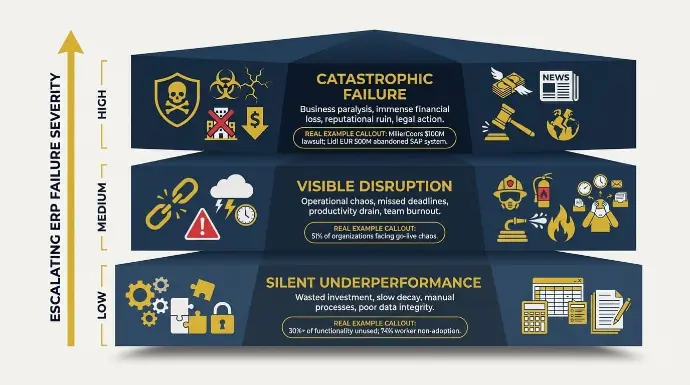
For a multi-location SMB or mid-market firm, ERP failure does not look like a headline lawsuit. It looks like a missed shipment because the inventory data doesn't sync across warehouses. It looks like frozen invoicing when the order-to-cash workflow breaks in the new system. It looks like finance is closing the books a week late because nobody ran a month-end close test before go-live.
Panorama Consulting's 2024 ERP Report found that only 32% of ERP implementations were completed on time, and 49% reported operational disruption post-go-live:
- 55 to 75% of ERP projects fail to meet stated objectives
- 73% failure rate in discrete manufacturing, exceeding the already-high cross-industry average
- Average 189% implementation cost overrun across industries; 215% in manufacturing
- Only 23 to 32% of ERP implementations are considered successful by any reasonable definition
Consider SPAR Group's approximately $100M in lost sales and remediation costs when a botched SAP implementation shut down distribution at a key warehouse, or Revlon's $70.3M net loss in Q4 2018 when their new ERP paralyzed a North Carolina manufacturing plant. These are sophisticated businesses paralyzed by operations. The system implementation was handled incorrectly from the start.
ERP project failure typically falls into three tiers — budget overruns (averaging 189% of plan), timeline delays (17+ months vs. 12 planned), and operational disruption (affecting 51% of go-lives):
Tier | What It Looks Like | Real Example |
Silent Underperformance | 30%+ of functionality unused; 74% worker non-adoption; teams building workarounds in Excel instead of using the new ERP | Any ERP rollout where the system becomes a glorified data entry tool |
Visible Disruption | Ongoing outages, manual workarounds, 51% of organizations facing go-live chaos; daily firefighting with the implementation partner | National Grid post-Sandy payroll disaster: $8M overpayments |
Catastrophic Failure | Legal disputes, nine-figure write-offs, fully scrapped ERP solutions | MillerCoors $100M lawsuit; Lidl's EUR 500M abandoned SAP system |
Root Causes of ERP Implementation Failure: What the Data Shows
Most articles about why ERP projects fail blame the client exclusively. Poor planning. Weak sponsorship. Insufficient testing.
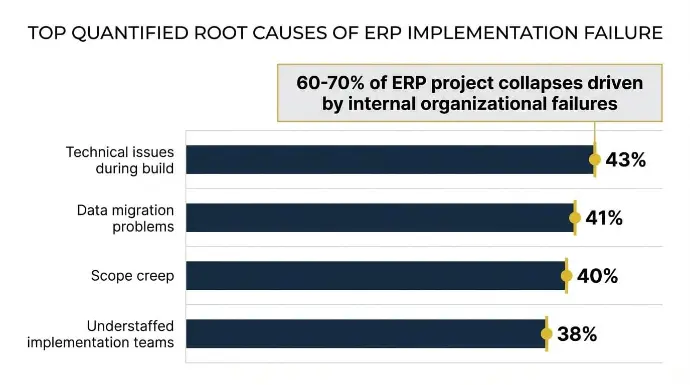
Internal organizational failures drive 60-70% of ERP project collapses, according to Panorama Consulting — poor requirements definition, insufficient change management, and executive disengagement appear in nearly every post-mortem.
But data from large-scale ERP research tell a more complete story, one that includes the implementation partner's role in ways rarely discussed.
At Cudio, we built our methodology around every failure factor on this list.
Organizational Failures That Trigger ERP Collapse
- 43% of timeline overruns trace back to technical issues during build. Cudio assigns certified Odoo developers, not generalist consultants, to every implementation.
- 41% of projects run over schedule due to data migration problems. We treat data discovery as a phase zero deliverable, not an afterthought.
- 40% of timeline overruns are caused by scope creep. Every Cudio engagement starts with a fixed-scope blueprint before a single line of configuration is written.
- 38% of budget overruns stem from understaffed implementation teams. We staff projects to completion, not to close the sale (Panorama/NetSuite).
- Lack of executive sponsorship, insufficient testing, over-customization, and weak vendor support round out the picture. All are identified as primary failure factors in a 2024 peer-reviewed study, and all are addressed inside Cudio's implementation framework (IJCRT).
The data is consistent: Most ERP failures are predictable and preventable. The difference is whether your partner has a process designed to prevent them, or a contract designed to protect themselves when they don't.
Internal Factors: What Many Organizations Get Wrong
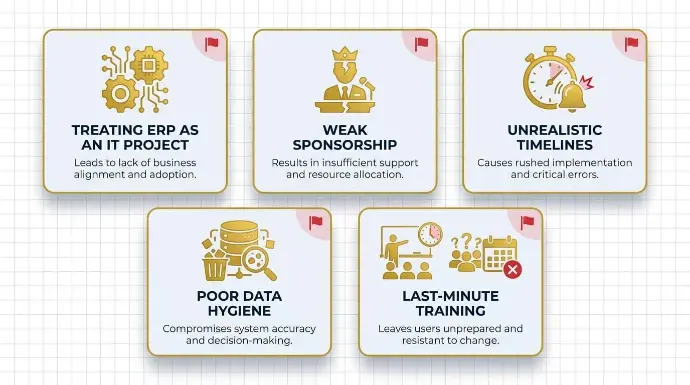
Many organizations contribute to their own ERP project failure. Implementing ERP is a business transformation, not an IT upgrade, but many companies treat it like one.
These projects are under-resourced, squeezed around normal business operations, and launched on timelines driven by vendor sales cycles rather than reality. We say so directly in every engagement.
Common internal contributors that we find in struggling ERP implementations:
- Treating ERP as an IT project rather than a business transformation, sidelining supply chain, production, and finance leaders until it is too late
- Weak sponsorship fails ERP projects: passive buy-in without real budget authority or involvement in key design decisions, despite Prosci research showing projects with strong sponsor access succeed at a 72% rate
- Unrealistic timelines derail implementations, such as a CFO insisting on a 90-day timeline because the vendor said it was possible — the same pattern that turned Hershey's compressed schedule into a $100M order failure
- Poor data hygiene causes project failure: migrating years of records from legacy systems over a single cutover weekend with no validation, when around 49% of organizations already struggle with data migration challenges
- Last-minute training undermines go-live success: cramming user training into the final two weeks before go-live, when research shows organizations with structured change management are six times more likely to meet project objectives
A strong implementation partner prevents most of these issues. At Cudio, we push back on unrealistic timelines, insist on proper data migration protocols, and have seen firsthand what happens when these steps are skipped. We have been called in to rescue the implementations that skipped them.
Change Management and User Adoption
51% of organizations see their ERP go-live disrupt daily operations — shipping delays, inventory mismatches, and financial reporting gaps that persist for months after launch.
The cost is not just operational efficiency losses, but real revenue impact from delayed orders and billing errors.
Successful ERP implementations start with change management planning 6 to 12 months before go-live. They build super-user programs. They run role-based training sessions in test environments with real data subsets. Failed ERP implementations cram everything into the final two to three weeks.
A useful readiness test: Can at least 80% of your core users complete their day-to-day tasks in the test system right now? If you are 60 days from go-live and the answer is no, you have a serious problem that needs to be addressed before the ERP rollout happens.
One mid-market distributor ran parallel systems for three months before cutover. User adoption was solid. Go-live was smooth. A comparable company gave users a half-day session two weeks before go-live. They are still recovering 18 months later.
Data Migration and Process Design Mistakes
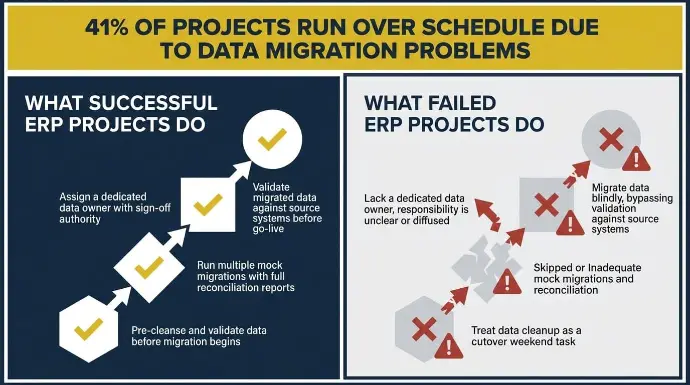
41% of ERP projects run over schedule due to data migration problems, according to Panorama Consulting. This happens when data cleanup is treated as a cutover weekend task rather than a phase-one priority in the implementation plan.
Concrete examples of what we find in failed implementations:
- Duplicate supplier records in legacy systems are creating duplicate payments from day one in the new ERP
- Incorrect units of measure are causing immediate inventory management write-offs at go-live
- Open sales orders not migrated during cutover, losing weeks of customer commitments
- An unmapped chart of accounts is preventing financial close in the new system
What Successful ERP Projects Do | What Failed ERP Projects Do |
Pre-cleanse and validate data across all existing systems before migration begins | Treat data cleanup as a cutover weekend task |
Run multiple mock migrations with full reconciliation reports across testing phases | Run one migration with no reconciliation check |
Assign a dedicated data owner with sign-off authority in the implementation phase | Assume someone will handle it |
Validate migrated data against source systems before go-live | Discover data errors after go-live under live pressure |
Process design mistakes compound the issue. Lifting broken workflows from existing systems into a new ERP solution without questioning whether they should exist amplifies chaos. We always map current business processes first and ask: Does this need to exist before we build it into Odoo?
Partner-Driven Failure: The Blind Spot That Never Makes It to Page One
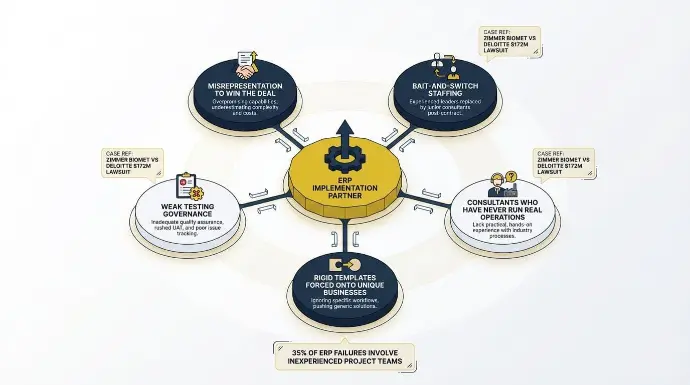
Search "why do ERP implementations fail," and almost every result blames the client. But court records and public post-mortems tell a different story.
Marin County vs Deloitte: Deloitte was alleged to have staffed the project with inexperienced consultants who lacked even a basic understanding of SAP.
ScanSource vs Avanade: Project cost grew four times the original amount, and the timeline tripled after an alleged bait-and-switch.
Zimmer Biomet vs Deloitte (2024): A $172M lawsuit alleging incompetent personnel, misrepresented capabilities, and concealed system defects that left the company barely operational for an entire quarter. In each case, the implementation partner was central to the failure.
Partner-driven issues that cause ERP implementations to fail:
- Bait-and-switch staffing: Senior consultants sell the project; junior or offshore teams deliver it
- Consultants who have never run real operations: They have configured ERP solutions but have never managed a warehouse, processed vendor bills, or closed a month-end in a live business
- Rigid templates forced onto unique businesses: Generic processes that do not match how your floor actually operates
- Weak testing governance: No conference-room pilots, no stress testing at peak transaction volumes, no full mock cutover before the real one
- Misrepresentation to win the deal: Timelines compressed to close the contract, scope gaps hidden until after signing
For mid-market firms, partner failure shows up as a quiet mess: missed requirements, partial integrations that break under load, and support that evaporates after the software invoice is paid. This is exactly how ERP implementations fail without making headlines. We have cleaned this up more than 35 times.
Bait-and-Switch Staffing: A Pattern We See Constantly
Senior sales engineers who run the pre-sales demos have already mapped your warehouse workflows, integration points, and data migration complexity before the first proposal lands.
They ask sharp questions about your warehouse, intercompany transactions, and BOM structure. They build confidence.
Then the contract gets signed. Suddenly, you are working with junior developers asking basic questions about your industry, or an offshore team running from a template they use for every client, regardless of complexity. Panorama 2025 found that 35% of ERP project failures involve inexperienced project teams. That is the partner's responsibility, not yours.
At Cudio, we are direct about our model: no junior staff on your project without senior supervision, and the same operators who run your discovery own your go-live. Our 100% customer retention rate is due to not rotating teams after contracts are signed.
Questions every business department should ask any implementation partner before signing:
- "How many ERP implementations have you personally led in our specific industry?"
- "Who will be on our project week to week, by name and background?"
- "Have you ever run a warehouse, processed vendor bills, or closed a month-end inside a live business?"
- "What happens when your named project managers get reassigned to another client?"
Inadequate Testing, Governance, and Vendor Support
Hershey's $150M order fulfillment failure in 1999 was caused by rushing a compressed go-live during peak Halloween season — the company skipped integrated testing, and its shipping, inventory, and order processing modules failed simultaneously.
National Grid's rushed go-live left payroll cycles untested, resulting in $8M in overpayments and $30M in monthly remediation costs. Insufficient testing is not a minor gap. It is a direct cause of catastrophic ERP failure.
Robust testing in a real ERP implementation looks like:
- Multiple conference-room pilots with actual operational users, not just consultants running scripted demos
- Integrated end-to-end scenario runs covering order-to-cash, procure-to-pay, and manufacturing workflows as testing phases
- User acceptance testing (UAT) sign-off by department leads in every business department, not just IT
- Performance stress tests at your actual peak transaction volumes, not average daily loads
- At least one full mock cutover before the real go-live date
At Cudio, we have delivered 75+ Odoo ERP implementations globally with a 100% customer retention rate. If your current ERP implementation is showing warning signs, our team of former COOs and General Managers can assess where things stand and what the right path forward looks like.
How to Spot an ERP Implementation Going Off the Rails
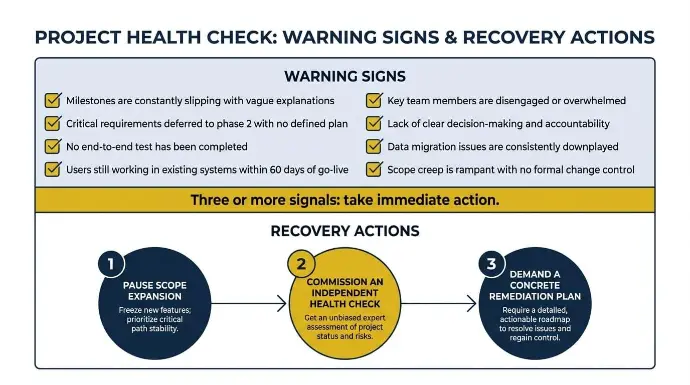
If you are mid-implementation and sensing drift, here is what we look for when running an independent health check on a troubled ERP project:
- Milestones are constantly slipping with vague explanations and no concrete recovery plan
- Ownership of decisions is unclear: "we are waiting on your team" and "we are waiting on the partner" happen at the same time
- Critical requirements deferred to "phase 2" with no defined plan or financial resources allocated
- Mounting change requests that should have been identified during the design implementation phase
- Your implementation partner avoids specific answers about testing readiness or go-live criteria
- User acceptance testing has been repeatedly postponed without clear reasons
- No end-to-end test has been completed covering your core ERP processes
- Users are still working entirely in existing systems within 60 days of planned go-live
If you are seeing three or more of these signals, take immediate action:
- Pause scope expansion. Stop adding requirements. Focus entirely on core functionality that must work on day one of the new ERP.
- Commission an independent health check. Bring in an external party to assess the ERP implementation project status honestly, independent of what your current partner is reporting.
- Demand a concrete remediation plan. Specific milestone dates, named owners, and measurable success criteria. Vague reassurances are not an ERP strategy.
Evaluating or Replacing Your ERP Implementation Partner
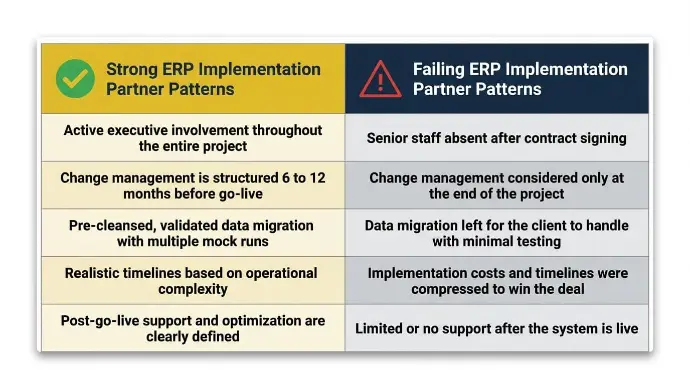
The quality of your implementation partner is the single highest-leverage variable in whether an ERP system implementation succeeds or fails, more than the software itself or your internal team structure. Thirty-five rescue projects have confirmed this for us.
Criteria for evaluating an implementation partner honestly:
- Direct operational experience: Have they run real business operations, or only configured ERP solutions? Can they speak fluently about supply chain management, intercompany transactions, or warehouse operations?
- Track record in your specific complexity profile: Engineer-to-order at 92/100 complexity is a fundamentally different ERP implementation project than make-to-stock at 65/100
- Staffing model transparency: Who will work on your project week to week? Are they the same people who sold you the project, or will you meet a new team after signing?
- Willingness to push back: A system integrator who agrees with every timeline and scope decision you propose is not protecting your investment
- Post-go-live support commitment: Does the partner stay engaged through stabilization, or do they disappear once project costs are settled?
Strong ERP Implementation Partner Patterns | Failing ERP Implementation Partner Patterns |
Active executive involvement throughout the entire project | Senior staff absent after contract signing |
Change management is structured 6 to 12 months before go-live | Reactive, last-minute user training in the final weeks |
Pre-cleansed, validated data migration with multiple mock runs | Single cutover weekend with no reconciliation check |
Realistic timelines based on operational complexity | Implementation costs and timelines were compressed to win the deal |
Role-based, ongoing user training tied to real workflows | One-time generic training sessions with no follow-up |
Partner Interview Questions That Reveal Real Quality
- "Tell us about a failed ERP implementation you were involved in. What happened and what did you change?"
- "How do you handle it when our leadership's ERP implementation timeline is unrealistic?"
- "Who will be our day-to-day contact, and what is their operational background outside of ERP consulting?"
- "What does vendor support look like beyond go-live? How long does your team stay engaged?"
Rescuing a Failed or Failing ERP Implementation
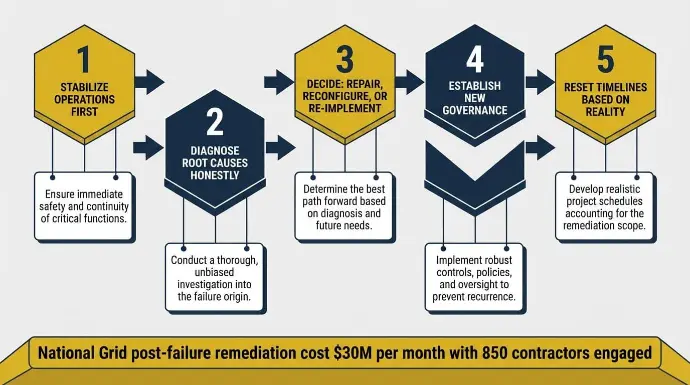
Failed ERP implementations can often be recovered. We have done it 35+ times at Cudio. But the cost and approach depend entirely on how early the issues are addressed. The longer organizations focus on workarounds rather than resolution, the more expensive the remediation becomes.
Our structured rescue framework for failing ERP projects:
- Stabilize operations first. Stop the bleeding. Implement workarounds that keep the business running while we diagnose what actually broke and why in the new ERP system.
- Diagnose root causes honestly. Separate internal issues from partner-driven problems. We review system architecture, integration logs, test documentation, and user feedback against the original requirements.
- Decide: repair, reconfigure, or re-implement. If core data models are fundamentally flawed, restarting specific modules may be cheaper than patching endlessly. We give you a straight answer, not a path that maximizes our project costs.
- Establish new governance. Clear decision rights, steering committee meetings, transparent risk tracking, and project leaders with actual authority to make calls and escalate issues.
- Reset timelines based on reality. Not on what your board expected or what the ERP market told you was standard. On what the actual work requires.
National Grid's post-failure remediation cost $30M per month with 850 contractors engaged. Endless patching is almost always more expensive than a structured rescue. We help you make that calculation before we start.
What rescue looks like in practice
Refreshed Tech, an ITAD company in Indiana, came to us after a previous ERP implementation left them with disconnected existing systems and no real-time inventory management visibility.
We implemented Odoo across Inventory, Accounting, Manufacturing, Sales, CRM, and Project modules, deployed our Rithum connector, and built custom inventory workflows.
The result: Automated billing, real-time inventory visibility, device-level margin reporting, and new ERP software positioned to scale to 15+ marketplaces within a year.
See How Odoo Helped Refreshed Tech After a Failing Implementation
Preventing ERP Implementation Failure: A Practical Playbook
Here is the framework we apply at Cudio for every ERP engagement. Use it to hold your implementation partner accountable.
Pre-Project: How to Vet Partners and Set Realistic Expectations
- Build timelines based on operational complexity scores, not ERP vendor promises. Add 20 to 25% contingency to every estimate you receive.
- Vet partners for operational experience, not just software certifications. Ask specifically for cloud-based ERP solutions they have delivered in your industry and what outcomes those clients achieved.
- Establish executive sponsorship with real budget authority and financial resources, not just nominal sign-off.
- Define success metrics tied to business outcomes: order-to-cash cycle time, inventory management accuracy, and days to close. Not just "we went live on schedule."
Design and Implementation Phase
- Validate requirements against your actual current business processes, including every exception and edge case your operation handles regularly.
- Map data migration scope early. Source systems, years of history, data owners, and what reconciliation looks like. Include this in the ERP strategy from day one.
- Identify new processes that need to be designed from scratch, rather than migrating existing workflows from legacy systems.
Build and Testing Phases
- Run iterative user acceptance testing with actual operational users across every business department, not just the project team.
- Complete a minimum of two full mock data migrations with reconciliation reports across all testing phases before the real cutover.
- Run end-to-end scenario tests covering the full order-to-cash cycle, procure-to-pay, and at least one complete month-end close in the test environment.
- Stress test at peak transaction volumes to expose performance issues before they become go-live emergencies.
Go-Live and Post-Go-Live
- Plan for a 90-day stabilization period with dedicated senior support from your implementation partner. This is not optional.
- Track user adoption metrics weekly: percentage of transactions processed in the new ERP versus workarounds, support ticket volume, and super-user utilization.
- Schedule structured process reviews at 30, 60, and 90 days post-go-live to streamline workflows and catch issues before they compound.
Final Words
ERP implementation failure is common, but it is not inevitable. Most projects collapse for the same reasons: poor planning, compressed timelines, undertrained users, and partners who disappear after the contract is signed.
Every one of those failure factors is preventable. The difference almost always comes down to who is running your project and whether they have actually lived the problems you are trying to solve.
If you are evaluating your options, starting fresh, or trying to salvage something that has gone off track, we would love to have an honest conversation about where things stand.
FAQs: Common Questions About ERP Implementation Failure
These FAQs address practical concerns that may not have been fully covered above.
How do I know if my ERP project should be rescued or completely restarted?
The decision depends on the quality of the current design, the health of the data structure, and the system's flexibility. If core data models and processes are flawed, restarting can be more cost-effective than fixing workarounds. Run a 4–6 week independent assessment before deciding.
What is a realistic ERP implementation timeline for a mid-market company?
A realistic ERP implementation timeline for a mid-market company is 9–18 months. More complex industries, such as engineer-to-order or regulated sectors, take longer. Timelines must include testing, mock cutovers, and user training.
Can a partially failed ERP still deliver value, or should we consider it a total loss?
A partially failed ERP can still deliver value in areas such as finance or basic inventory management. Use a process heat map to identify what works and what needs fixing. It is rarely a total loss unless the data model is broken or the vendor relationship fails.
How should I talk to my board or investors about ERP implementation problems?
You should explain ERP implementation problems in terms of risk, impact, and a clear recovery plan. Be transparent about what went wrong and what will change moving forward. Include the cost of fixing the issue versus the cost of doing nothing.
What single step has the biggest impact on preventing ERP failure?
The single biggest step in preventing ERP failure is choosing the right implementation partner. A strong partner enforces proper timelines, testing, and change management. This decision improves data quality, system design, and overall project success.