An ERP implementation timeline typically runs 3 to 12 months for mid-market businesses, depending on scope, data quality, and integration complexity — though enterprise-scale deployments with multi-country compliance can extend to 24 months or more.
At Cudio, we have completed 62+ Odoo implementations across manufacturing, retail, healthcare, logistics, and ecommerce, and seven members of our founding team implemented ERP systems inside their own companies as COOs, General Managers, and Operations Directors before building Cudio.
This guide breaks down realistic timelines by company profile, walks through our 5-phase implementation methodology with week-by-week ranges, and shows you how to evaluate whether the timeline a partner quotes you is a real commitment or optimistic selling.
Key Takeaways
- Most ERP projects take 9–18 months overall, but focused Odoo rollouts with senior-only teams can achieve a 16-week core go-live
- 64% of ERP implementations exceed 6 months; the cross-industry average is 14.1 months according to Panorama Consulting’s 2023 report
- SMBs typically fall in the 3–9 month range, large enterprises 6–18 months, and multinationals 12–36 months
- Timeline variance is driven less by company size and more by controllable factors: scope discipline, data quality, integration complexity, and your implementation partner’s team structure
- Cudio’s 5-phase Odoo implementation follows a predictable arc: Weeks 1–2 discovery, 3–6 design/configuration, 7–12 build and testing, 13–16 training and go-live, plus a post-go-live optimization window
What Is an ERP Implementation Timeline (And Why Generic Ranges Don’t Help)?
An ERP implementation timeline covers the full sequence from project kickoff through discovery, system design, development, data migration, testing, user training, go-live, and post-launch stabilization — a process that takes 15 to 18 months on average across industries, according to Panorama Consulting and Statista research.
The timeline ends not when you flip the switch, but when the system reaches operational stability and delivers measurable ROI: faster month-end close, accurate inventory, and automated workflows replacing manual processes.
The cross-industry median ERP implementation timeline is 15.5 months, according to Statista. Of those projects, 64% meet their revised schedule — the timeline adjusted after scope changes and mid-project realities — but only 49% hit their original timeline as planned at kickoff. The gap between those two numbers is almost entirely explained by scope discipline: projects that lock requirements early and defer non-essential features consistently finish closer to their original estimates.
The ranges you see published, "3 to 6 months for SMBs, 12 to 18 for enterprises", are starting points, not answers.
A 50-person company with three warehouses, 10,000+ SKUs, and four marketplace feeds typically requires 5 to 8 months for a core ERP go-live, while a 200-person single-location business with clean financial data can reach the same milestone in 3 to 5 months — the difference is integration depth and data volume, not headcount.
Typical ERP Implementation Durations by Company Profile
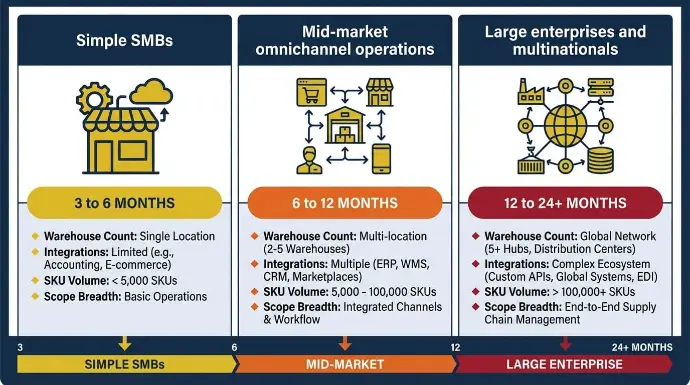
Across 62+ completed Odoo implementations, our timelines cluster into predictable ranges based on three variables: number of integrations, data volume, and scope breadth. Here is what each company profile typically looks like:
- Simple SMBs (single warehouse, basic accounting, one or two sales channels): 3 to 6 months for core ERP implementation. Limited integrations and straightforward inventory management keep these timelines short and predictable.
- Mid-market omnichannel operations (multi-warehouse, Shopify plus Amazon plus B2B portal, 10k+ SKUs, complex pricing): 6 to 12 months. Integration depth and data volume drive the schedule in these ERP projects more than anything else.
- Large enterprises and multinationals (multi-country, complex compliance, advanced manufacturing ERP requirements): 12 to 24+ months with meaningful change management scope.
A UK fashion retailer with 3 Shopify storefronts went live in under 5 months by limiting phase one to finance and inventory, deferring CRM to phase two — a scope decision that compressed their timeline by an estimated 40%.
A US electronics manufacturer operating across 10 warehouses took 14 months due to compliance requirements and custom inventory logic across multiple jurisdictions.
The difference was not company size. It was scope discipline at the design phase, which is why we run a formal scope-lock workshop in every Phase 1 engagement.
Every Cudio engagement starts with a scope-lock workshop in Phase 1, where we separate day-one requirements from phase-two deferrals — because the single biggest timeline risk is building everything at once.
Our implementation team brings 30+ years of combined technology experience, a 100% customer retention rate, and leadership by CTO Julie Kossivas (25+ years, McGill University) and CFO Amy Kossivas (CPA-CA, ex-KPMG), who bring both technical depth and financial discipline to every project scope decision.
Cudio’s 5-Phase Odoo Implementation Timeline (16-Week Core Plan)
When the people running your ERP implementation have actually done it before in their own operations, there is no ramp-up time, no mid-project consultant rotation, and no learning your business model on your dime.
At Cudio, the same senior operators who run your discovery own your go-live — and that continuity typically compresses the discovery-to-design transition from 4 to 6 weeks down to 2 to 3 weeks, because the team asking the questions already knows which answers matter.
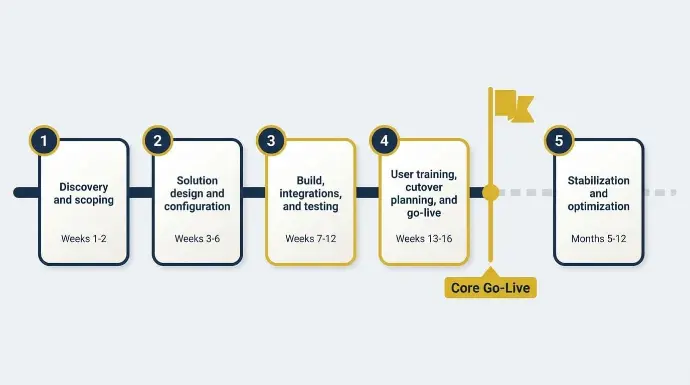
Here are the ERP implementation phases we use for mid-market Odoo projects, with a 16-week core go-live target:
- Weeks 1 to 2: Discovery and scoping
- Weeks 3 to 6: Solution design and configuration
- Weeks 7 to 12: Build, integrations, and testing
- Weeks 13 to 16: User training, cutover planning, and go-live
- Months 5 to 12: Stabilization and optimization
This ERP implementation plan assumes cloud ERP deployment on Odoo, a focused phase-one project scope (order-to-cash, procure-to-pay, inventory), and weekly access to your key stakeholders. Advanced features, WMS, custom reporting, and marketplace automations are layered in during or after the initial 16 weeks.

Phase 1: Discovery & Scoping (Weeks 1–2)
We move fast here because we know what we are looking for. Our senior consultants run focused workshops with your founders, operations leads, and finance team to map current business processes, identify pain points, and lock "day-one" versus "phase-two" project scope.
What our implementation team delivers at the end of Phase 1:
- Prioritized requirements list, separating must-haves from deferred items
- Integration map covering all connections to existing tools: Shopify, Amazon, carriers, and accounting platforms
- Data migration scope, defining which years of transaction history to bring over
- Locked baseline ERP implementation timeline with documented risks and contingencies
Phase 1 discovery catches the timeline killers before they become expensive surprises: business processes owned by one person who was not in the room, undocumented edge cases, and departments skipped in planning.
Identifying a scope gap in week one costs roughly 10x less to resolve than discovering it in week ten, when configuration, integrations, and testing cycles must be reworked.
Phase 2: Solution Design & Configuration (Weeks 3–6)
Our implementation team configures Odoo to mirror and improve your key business processes:
- sales order management
- purchasing
- inventory movements
- manufacturing or kitting workflows
- financial posting rules.
We are not building something theoretical. We are building what you actually run every day.
Concrete configuration work in this phase includes:
- Warehouse and location setup matched to your physical business operations
- Product categories, units of measure, and variant structures
- Price list configuration for all customer segments and sales channels
- Approval workflows with role-based access permissions
- Journal and account mapping aligned to your existing chart of accounts
We default to out-of-the-box Odoo configuration over custom code during the design phase because over-customization is one of the most predictable timeline risks.
Across our 62+ implementations, we have seen custom development requests during design add 25-30% to the original project schedule when they bypass standard module capabilities. Standard configuration keeps your ERP project on schedule and your future Odoo upgrades straightforward.
By the end of week 6, your core processes run in a sandbox using sample data. You see working demos and give structured feedback before we start building.
Phase 3: Build, Integrations & Testing (Weeks 7–12)
This is where we connect your new ERP system to your entire operational ecosystem: sales channels (Shopify, Amazon, B2B portals), shipping carriers, and niche systems via APIs or certified connectors such as Rithum, Avalara, and Crossfire EDI. This is also where integration capabilities get stress-tested against your real data volumes.
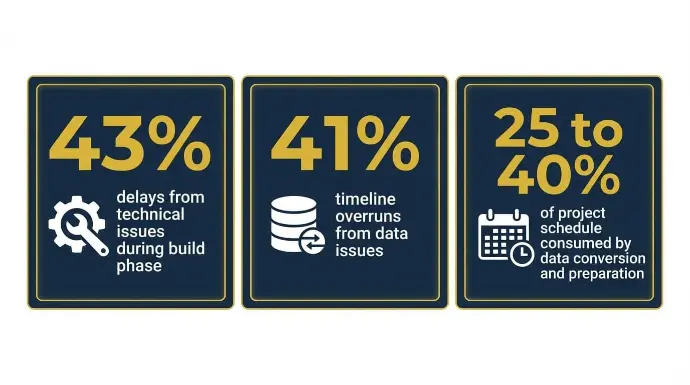
Phase 3 is where most ERP projects hit turbulence. 43% of ERP implementation delays originate from technical issues during the build phase, according to NetSuite's research, and the risk multiplies when integrations touch legacy systems without modern APIs.
Data quality is the second major risk: 41% of project timeline overruns trace directly to data issues, per Panorama Consulting. If your existing data is spread across QuickBooks, spreadsheets, Shopify, and a standalone WMS, data conversion and preparation work alone can consume 25 to 40% of the project schedule — which is why we begin data cleansing and validation in Phase 1, not Phase 3.
Our testing cycle runs iteratively:
- Configure a module
- Import real data
- Run end-to-end scenarios from quote through shipment
- Invoice and payment
- Identify issues, adjust, and re-test
User acceptance testing involves your operational staff, not just executives, walking through real orders, purchase runs, and period-close simulations. Data accuracy is validated at every stage before we move forward.
Phase 4: Training, Cutover Planning & Go-Live (Weeks 13–16)
We do not run generic system tours. User training in our ERP implementation projects is role-based and hands-on. Warehouse pickers learn their specific workflows. Purchasing staff learn theirs. Customer service and finance each receive training tailored to what they actually do every day.
Cutover planning covers:
- Final data loads: open orders, current inventory counts, AR/AP balances
- Legacy system freeze dates and parallel-run decisions
- Big-bang versus phased approach selection based on your risk tolerance and seasonal calendar
Most of our mid-market clients choose a big-bang cutover at the start of a fiscal period or on a low-volume Monday because it simplifies reconciliation and avoids the complexity of running two systems simultaneously.
This go-live window is critical: 51% of companies that experience post-go-live disruptions either recover within the first two weeks or spiral into extended stabilization, according to NetSuite's ERP statistics.
Our senior implementation team stays on-call for the full first two to three weeks, and across 62+ implementations, none of our clients have experienced an unrecoverable go-live disruption.
Phase 5: Stabilization & Optimization (Months 5–12)
Core go-live at month four is the beginning of a successful ERP implementation, not the finish line.
Stabilization and active refinement typically take 3 to 4 additional months for single-warehouse operations with straightforward workflows, and 6 to 8 months for multi-location businesses with complex integrations, advanced manufacturing modules, and cross-subsidiary reporting.
We stay engaged through the full stabilization period because this is when ROI becomes measurable.
What we focus on during stabilization:
- Odoo dashboards and report tuning based on how your project team members and end users actually use the system
- Automating manual processes: purchase order triggers, invoice generation, reorder rules
- Rolling out deferred modules, MRP, advanced WMS, subscription billing, on a stable ERP platform
- Resolving edge-case workflows that only surface at real production volumes
This is when ROI becomes tangible: reduced manual processes, faster month-end close, cleaner inventory accuracy, and fewer stockouts. We think one reason only 15% of projects succeed without a dedicated implementation partner is that too many partners walk away after go-live. We do not. A successful ERP implementation means the system is actually driving business growth, and we stay engaged until it does.
What this looks like in practice: Lexington Medical, operating across 30 countries and 5 subsidiaries, partnered with us to implement Odoo with advanced custom financial reporting and automated intercompany transactions. We reduced their days to close by over 50%, achieved full multi-level BoM traceability across manufacturing and inventory, and built an ERP solution that has scaled with their rapid global growth without requiring additional software.
See How Odoo Helped Lexington Medical Scale Globally
Factors That Stretch or Compress Your ERP Timeline
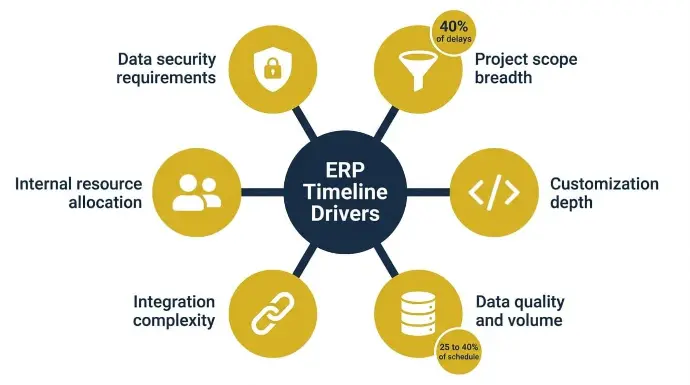
After 75+ ERP implementations, we can tell you with confidence: your implementation timeline is not something that happens to you. The variables that matter most are within your control.
- Project scope breadth: Scope creep accounts for approximately 40% of ERP project delays. We help every client ruthlessly limit the ERP implementation plan to phase-one must-haves. Every deferred feature is a direct investment in hitting your go-live date.
- Customization depth: Every custom feature adds development cycles, regression testing, and long-term maintenance overhead. We favor standard Odoo ERP software configurations wherever they fit your specific business processes. It is faster to implement and simpler to upgrade.
- Data quality and volume: Fragmented, dirty existing data across multiple systems can consume 25 to 40% of the project schedule. We recommend migrating 2 to 3 years of detailed transaction history and beginning data cleansing and migrating data validation before kickoff.
- Integration complexity: Connecting to modern platforms with standard APIs takes weeks. Legacy systems without modern API infrastructure can add months to development. We map all integration requirements in Phase 1 to avoid surprises in Phase 3.
- Internal resource allocation: ERP projects stall when decision-makers are hard to reach. We need consistent access to key stakeholders who can approve design decisions without two-week delays. We are direct about this at kickoff because it protects your timeline more than anything we do.
- Data security requirements: Organizations with strict data security policies, compliance obligations, or regulated supply chain management environments may need additional validation steps that extend the build and testing phase.
One practical example: limiting phase one to order-to-cash while deferring advanced manufacturing process features can pull a 12-month implementation plan down to 6 to 8 months without sacrificing future capability. We help you make that call.
Why Your Implementation Partner’s Team Structure Changes the Timeline
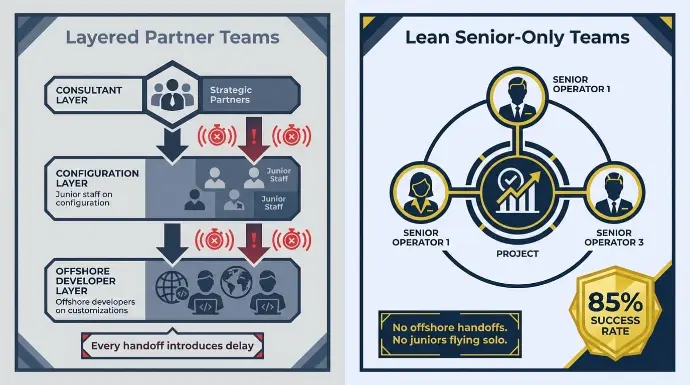
We have seen the other model up close, and we have rescued more than 35 ERP projects that started with it. Here is the difference:
- Layered implementation partner teams: Junior staff on configuration, offshore developers on customizations, rotating consultants learning your business model mid-project. Every handoff introduces delay. Every new face requires ramp-up time on your schedule.
- Our model, lean, senior-only implementation teams: Operators who have implemented ERP inside their own companies. No offshore handoffs. No juniors flying solo. The same people who ran your discovery own your go-live. This is the right ERP implementation partner structure.
This compression is real. Our senior-operator model means targeted discovery questions, fewer design mistakes from inexperience, and zero handoff delays. Organizations using specialized, experienced implementation consultants report approximately 85% success rates in ERP implementations. We believe that number reflects what happens when your ERP project team has skin in the game.
Questions we encourage you to ask any ERP vendor or potential implementation partner:
- "What is the average number of years of ERP experience on the specific project team working on our implementation?"
- "What percentage of configuration and development is done by junior or offshore resources?"
- "How many concurrent projects does our lead project manager handle?"
- "Who makes design decisions, and are they in our meetings?"
We are happy to answer all of these questions about our team. Our 100% customer retention rate and 35+ rescued ERP implementation projects are proof of our answers.
Sample ERP Implementation Timeline Scenarios
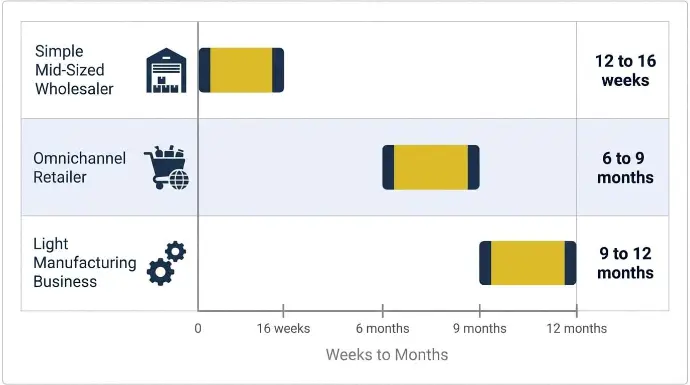
We want you to see how our 5-phase ERP implementation process actually applies to businesses like yours, not just abstract ranges.
Scenario 1: Simple Mid-Sized Wholesaler
Single warehouse, one primary sales channel, basic accounting, clean data.
Our typical implementation timeline: 12 to 16 weeks for core go-live.
Limited integrations, straightforward inventory management, and minimal customizations mean standard Odoo ERP software modules map directly to your business operations. This is our cleanest, fastest ERP implementation project profile.
Scenario 2: Omnichannel Retailer
Three warehouses, Shopify, Amazon, and additional marketplaces, 10k+ SKUs, complex pricing rules.
Our typical implementation timeline: 6 to 9 months.
The schedule expands from phased channel rollouts, heavier multi-channel inventory management, and more complex pricing and fulfillment configurations in the ERP implementation plan. We have done this profile many times, including with Simons Shoes. Strategic channel sequencing planning is critical for this profile.
Scenario 3: Light Manufacturing Business
Bills of materials, work orders, quality control checkpoints, and customer relationship management are tied to project delivery.
Our typical implementation timeline: 9 to 12 months.
MRP configuration and manufacturing process routing, shop-floor change management, human resources coordination for new workflows, and user training across varied roles add meaningful schedule. Our manufacturing clients, including Lexington Medical and Aeromist, can speak to what this looks like in practice.
What this looks like in practice: R&W Rope came to us running Shopify, Fishbowl, and QuickBooks as separate systems. We consolidated everything onto a single new ERP platform, rebuilt their e-commerce on Odoo's native e-commerce module, and automated 40-60 hours of weekly manual processes. They now save $33,000+ annually in ERP software costs and have real-time data across every sales channel and product category.
See How Odoo Helped R&W Rope Save $33K Annually
How to Set a Realistic ERP Timeline for Your Own Business
We recommend doing this work before speaking with any implementation partner, including us. It puts you in a far stronger position to evaluate what you are being told and to protect your business objectives throughout the project.
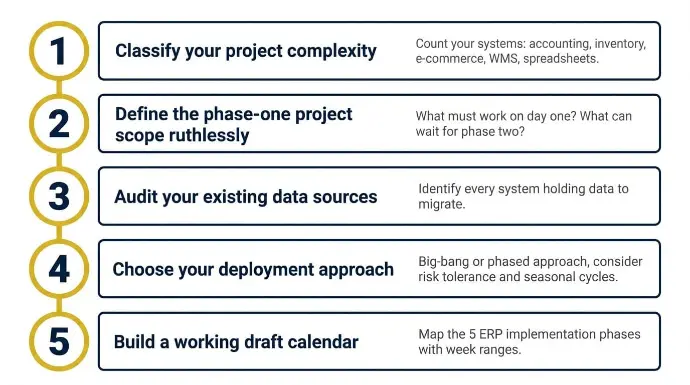
- Classify your project complexity. Count your systems: accounting, inventory, e-commerce, WMS, spreadsheets. Count sales channels. Estimate active SKUs. List locations. This classification determines your realistic ERP implementation timeline, not your employee count.
- Define the phase-one project scope ruthlessly. What must work on day one? What can wait for phase two? Every deferred feature is a gift to your go-live date and your implementation budget.
- Audit your existing data sources. Identify every system holding data to migrate: accounting records, inventory counts, customer files, and open orders. Assign owners to clean and deduplicate. Starting data conversion work before kickoff significantly compresses your project schedule.
- Choose your deployment approach. Big-bang or phased approach? Consider your risk tolerance, seasonal cycles, and internal resource allocation capacity. Phased approaches show higher ERP implementation success rates but extend total duration.
- Build a working draft calendar. Map the 5 ERP implementation phases, discovery, design, build/test, user training/go-live, optimization, with week ranges based on your complexity classification. This becomes your baseline implementation strategy for evaluating any partner proposal.
Conclusion
ERP timelines are not fixed ranges but outcomes shaped by your scope, data, integrations, and implementation partner. While most projects stretch to 9–18 months, a focused approach with the right team can deliver a stable go-live much faster.
At Cudio, we run senior-led Odoo implementations built around clear phases, tight scope control, and real operational experience. The result is a predictable timeline, fewer delays, and faster ROI. If you want an ERP rollout that stays on schedule and actually works in practice, we help you get there.
FAQs
Got more questions? Here are clear, direct answers to the ERP timeline questions businesses ask most.
How fast can an ERP implementation realistically go if we’re in a hurry?
An ERP implementation can go live in 8–12 weeks for simple SMB setups with clean data and a tight scope. This usually covers only core flows, such as order-to-cash and procure-to-pay. Faster timelines often mean cutting testing or training, which creates issues later. Speed should not come at the cost of stability.
What’s the difference between “go-live” and “full implementation” on the timeline?
Go-live is when you start using the ERP for real transactions. Full implementation includes stabilization, optimization, and broader feature rollout after go-live. This phase can take another 6–12 months, depending on complexity. Many projects succeed at go-live but fail in adoption during this stage.
How much does data migration actually affect the ERP timeline?
Data migration can take up 25–40% of the total timeline. Poor data quality or scattered systems significantly slow down implementation. Cleaning and structuring data before kickoff reduces delays. Limiting migration to recent, relevant data also helps keep the timeline on track.
Can we shorten the timeline by choosing cloud ERP instead of on-premise?
Cloud ERP can reduce setup time by removing hardware and infrastructure requirements. It also encourages standard configurations, which are faster to implement. Most SMBs can reach go-live in 3–6 months with cloud ERP. On-premise setups usually take longer due to customization and setup complexity.
What’s the biggest red flag that our ERP timeline is unrealistic?
An unrealistic ERP timeline usually promises fast delivery with a large, undefined scope. Lack of clear phases, responsibilities, and testing time is another warning sign. Overreliance on your internal team, without adequate capacity planning, also causes delays. If the timeline feels vague, it likely is not achievable.