



ERP project management is a risk-governance discipline that synchronizes software configuration with business process engineering to ensure predictable go-lives.
In 2025, 73% of manufacturing projects fail due to poor governance, yet structured discovery reduces change orders by an average of 30%. A well-managed ERP project requires both technical depth and structured delivery — get structured Odoo project management support from a team that has guided complex, multi-entity rollouts from kickoff to go-live.
At Cudio, we’ve seen firsthand how often ERP timelines collapse not because of poor software, but because of poor risk governance. When ERP success depends on a clean cutover, well-sequenced integrations, and multi-team coordination, “just tracking tasks” isn’t enough.
Help Me Fix My ERP Project - Get Free Assessment
This article shows you how ERP project management really works when it’s done right, with a focus on risk, accountability, and executive alignment. You’ll learn:
- What separates good governance from failed go-lives
- How ERP systems expose risk early (if you let them)
- Why discovery phases save time, not waste it
- The core capabilities and planning steps that prevent disaster
- How Cudio drives risk-managed ERP implementations that actually deliver
Get the strategies that turn ERP into a business advantage, not an expensive postmortem.
Key Takeaways
- ERP project management is fundamentally about risk governance, not task tracking—the goal is a predictable, “boring” go-live rather than a fast, chaotic one.
- In 2025, 73% of discrete manufacturing ERP projects fail to meet objectives, with average cost overruns reaching 215%, making disciplined project management non-negotiable.
- Discovery is insurance: investing 6–12 weeks upfront in detailed scoping, data assessment, and integration mapping dramatically reduces change orders and timeline explosions later.
- Phased rollouts are now the default for serious buyers—only 21% of organizations still attempt high-risk “Big Bang” launches.
- Effective ERP project management requires senior delivery team ownership, documented integration runbooks, and tight risk controls from day one—not optimism and Gantt charts.
How Does Effective Project Management Impact ERP Success?
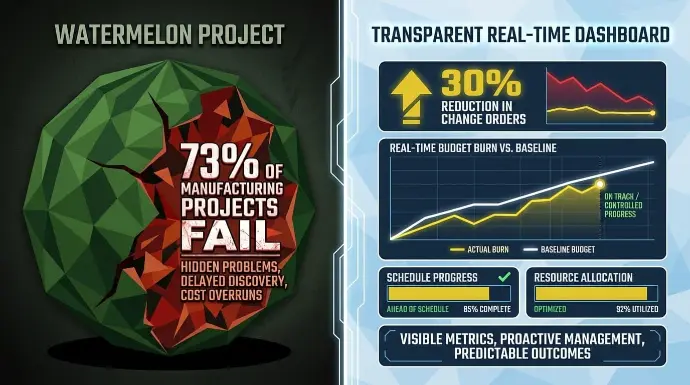
Most ERP failures do not come from the software. They happen because leadership discovers problems far too late.
You have likely seen the “watermelon project” before. Status reports look green on the outside and red on the inside. Milestones appear on track. The vendor says they are 90 percent complete. Then, just before launch, the cracks show. Timelines slip. Budgets expand. No one can clearly explain what went wrong.
Systemic ERP failure occurs when project oversight relies on static slide decks rather than live operational data.
At Cudio, we design ERP programs around visibility and control. Our clients do not rely on static reports or disconnected project management tools. We configure Odoo as a unified platform that brings together project execution, financial tracking, and operational data.
That means leadership can see:
- Real-time budget burn compared to baseline
- Cross-team resource allocation and bottlenecks
- Active risks and issues with defined owners and escalation paths
- Milestone progress across sites, departments, and business units
Because Odoo connects finance, inventory, HR, and operations, project reporting reflects actual system activity. When a workstream falls behind or costs begin trending upward, it becomes immediately visible.
With Cudio, ERP project management becomes a discipline grounded in real data. The goal is not to produce better-looking reports. The goal is to eliminate surprises and create a controlled path to go-live.
Help Me Fix My ERP Project - Get Free Assessment
From Task Tracking to Risk Governance: Why ERP Projects Fail
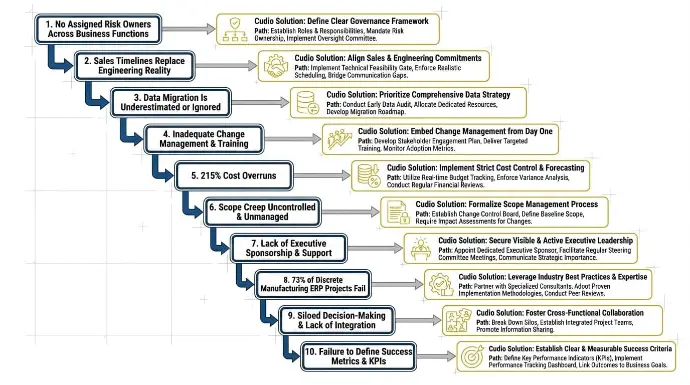
ERP project management isn’t just about logging tasks and ticking off milestones. It’s about governing risk across every workstream, from data to cutover. When governance fails, projects fail. And the industry numbers prove it.
At Cudio, we approach ERP delivery with an engineering mindset: build plans based on real data, not assumptions. That means mapping integrations, validating data quality, and managing regulatory constraints upfront. Our project management team is composed of real operators, people who’ve delivered ERP in the field, not just in slide decks.
Help Me Fix My ERP Project - Get Free Assessment
Here’s where traditional ERP project delivery breaks down and what Cudio does differently.
1. No Assigned Risk Owners Across Business Functions
Risks around data, integrations, change management, and cutover often float unassigned. Cudio establishes explicit ownership for each workstream and embeds risk checkpoints into our governance framework.
2. Sales Timelines Replace Engineering Reality
Plans created to win the deal rarely survive contact with real systems. Cudio re-baselines every project during discovery based on integration depth, compliance needs, and business complexity.
3. Data Migration Is Underestimated or Ignored
Data migration teams must utilize automated cleansing tools to remediate corrupt master records, preventing the 215% cost overruns common in 2025 manufacturing rollouts.
4. Integrations Are Missing or Poorly Documented
Unknown system dependencies derail timelines. Cudio conducts full-system audits and builds detailed interface inventories to close these gaps before testing begins.
5. Change Management Is an Afterthought
The omission of structured change management results in low user adoption rates, which directly degrades the ROI of the integrated Odoo platform.
6. No Cutover or Rollback Strategy
Go-live without a tested plan is a risk few businesses can afford. We document runbooks, stage cutover rehearsals, and ensure every deployment includes rollback protocols and phase gates.
7. Failure to Catch Divergence in Real Time
This is where most ERP projects fall apart. Reports arrive too late, issues compound, and leadership finds out when it’s already too late to pivot.
In fact, 73% of discrete manufacturing ERP projects fail to meet their objectives, and average cost overruns exceed 215%. These aren’t technical failures—they’re governance failures.
Cudio prevents this with real-time project-tracking dashboards in Odoo, surfacing budget variances, risk logs, and resource bottlenecks early enough to act.
8. ERP Tools Used Only for Tasks, Not Governance
Enterprise resource planning ERP platforms like Odoo can provide full project visibility, but most implementations only use them to manage to-do lists. Cudio configures dashboards that monitor risk signals, scope change volume, test readiness, and budget health across functions.
9. Teams Without Delivery Experience
ERP is too complex to leave to junior teams. Cudio’s senior consultants are former operators, CFOs, COOs, and heads of supply chain management, who’ve delivered real systems under pressure.
10. Optimism Bias Masks Project Costs
When everyone assumes the best, budgets melt down. Cudio’s approach to effective project management includes risk-adjusted forecasting, phase-based budgeting, and ongoing reviews that keep project costs and project performance aligned.
Help Me Fix My ERP Project - Get Free Assessment
Project Management Pain Points ERP Is Supposed to Solve (And Often Doesn’t)
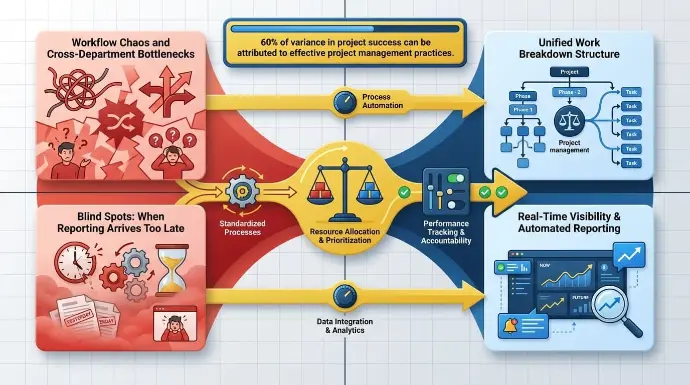
ERP implementations are sold as the cure for operational chaos. They promise to eliminate scope creep, end the endless “90% done” cycle, align stakeholders, and ensure that data is ready when systems go live.
In reality, ERP does not automatically fix these issues. It exposes them. If the project is not governed with discipline, the platform simply makes dysfunction more visible. Real-time dashboards showing failure are still failure.
The following pain points appear in almost every troubled ERP program. Addressing them requires structured governance, not optimism.
Workflow Chaos and Cross-Department Bottlenecks
When ownership is unclear and teams rely on disconnected spreadsheets, ERP implementation turns into a coordination failure. Requirements are misunderstood. Decisions are revisited. Downstream teams, such as warehouse operations or production, are surprised by upstream delays in finance or procurement.
Effective project management prevents this by enforcing structure:
- A unified work breakdown structure that defines every task, owner, and dependency across IT, finance, and operations
- Standardized workflows for design, build, test, and deployment
- Real-time task tracking and dependency monitoring
- Defined SLAs for approval cycles, such as procure-to-pay and order-to-cash
The objective is simple. Eliminate surprises. When workload, ownership, and dependencies are visible, bottlenecks surface early enough to correct.
Blind Spots: When Reporting Arrives Too Late
In many ERP projects, leadership receives updates weeks after deviations begin. By the time the Steering Committee reviews performance, the recovery window has closed.
Modern ERP project governance requires live KPIs such as:
- Earned value and schedule variance are updated daily
- Open defect counts and closure rates during testing
- Weekly change request volume to detect scope creep
- Training completion percentages by role and region
When defect density rises in UAT or when change requests spike unexpectedly, intervention must happen immediately.
According to 2024 research in the IJFMR, communication quality is the primary factor impacting all ERP implementation phases. It is governance infrastructure.
Misallocating People and Capital
ERP programs frequently overcommit key personnel. Subject matter experts, planners, and finance leads are expected to maintain daily responsibilities while supporting the implementation. Burnout follows. Knowledge gaps emerge.
Strong project management integrates capacity planning directly into the ERP:
- Model available hours against project demands
- Identify overloaded architects or analysts before delays occur
- Flag underfunded workstreams, such as data cleansing
- Track resource allocation in real time
Academic research from 2024 shows that training, culture, and people management account for over 60% of variance in project success. Resource planning is not optional. It directly influences outcomes.
Budgets That Melt Down Under Real-World Change
ERP budgets commonly underestimate data migration, integrations, and change management by 50–100%. The original estimate secures approval. Execution reveals reality.
This leads to incremental change orders that appear manageable individually but collectively destroy the business case.
Disciplined governance requires:
- Detailed cost baselines by workstream
- Weekly tracking of actuals versus plan inside the ERP financial module
- Formal change control boards evaluating impact before approval
- Monthly Steering Committee budget reviews with quarterly reforecasting
Budget control is not about rejecting change. It is about making trade-offs visible before commitments are made.
Core ERP Project Management Capabilities You Actually Need
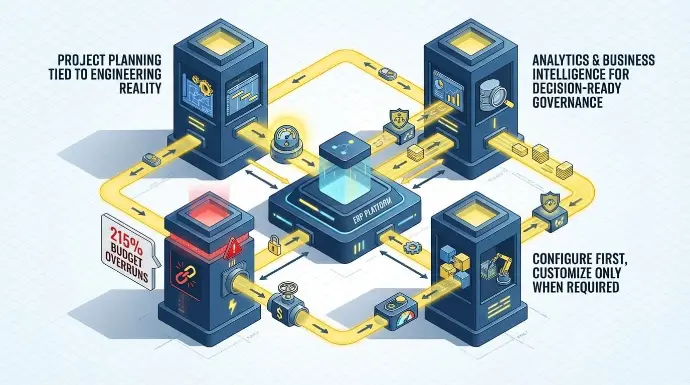
Solving these pain points requires structural capability. Every control mechanism should map to a specific risk category: data risk, integration risk, adoption risk, and budget risk.
Project Planning Tied to Engineering Reality
Planning must begin with discovery. That includes:
- Documented process maps for all in-scope business functions
- A complete integration inventory covering upstream and downstream systems
- A data quality assessment of master and transactional records
- Regulatory constraints mapped by geography and industry
There is a difference between sales timelines and engineering timelines. Sales timelines are optimistic and designed to win approval. Engineering timelines include buffers for testing, remediation, and validation.
Practical controls include:
- Scope freeze milestones
- Formal baseline sign-off
- Risk-based phasing, such as finance first, then manufacturing, then CRM
Planning in ERP is not about producing attractive Gantt charts. It is about preventing timeline collapse.
Budgeting and Cost Control as Continuous Risk Checks
ERP governance uses the financial engine itself to manage project economics. Budgets, commitments, actuals, and forecasts should live in the same environment.
Real-time tracking must include:
- Consulting hours and internal labor by workstream
- License and subscription costs
- Infrastructure and environment expenses
Threshold alerts should escalate automatically. For example, if a workstream consumes 80% of its budget while only 60% of milestones are complete, escalation is triggered.
This level of discipline is essential in 2025, when ERP programs routinely exceed budgets by 215% without structured cost controls.
Analytics and Business Intelligence for Decision-Ready Governance
Embedded business intelligence converts raw logs into executive-level oversight. Core dashboards typically include:
- Schedule health indicators
- Defect trends during testing
- Change request throughput
- Training completion metrics
- Migration readiness scoring
These insights tie directly to governance events such as monthly executive reviews and phase gate approvals. Panorama’s 2025 research confirms a broad consensus on the value of real-time data for project governance.
The objective is not data volume. It is decision clarity.
Controlled Customization and Order-Specific Complexity
Uncontrolled customization increases delivery risk and long-term maintenance costs. Each custom field, workflow, or report introduces technical debt.
Governance mechanisms should include:
- A formal customization registry
- Defined business cases and risk ratings for every change
- Mandatory testing plans before approval
- Automated downstream updates when order specifications change
Necessary customization examples include:
- Customer-specific pricing models
- Region-specific tax logic
- Industry compliance fields
The guiding principle remains clear: configure first, customize only when required. This is especially important for SaaS ERP platforms where vendor updates can break unmanaged customizations.
Phased ERP Project Lifecycle: From Discovery to Predictable Go-Live
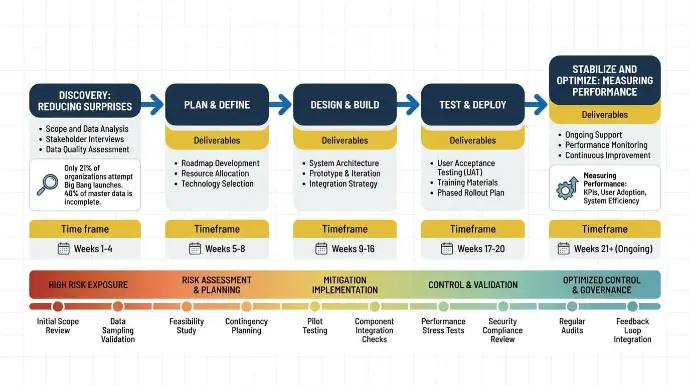
An effective ERP lifecycle is not a checklist. It is a structured series of phases designed to reduce risk and align the system with business goals. Each stage concludes with a formal review, where stakeholders make informed decisions to proceed, pause, or adjust based on real-time data, not assumptions.
Only 21% of organizations still attempt Big Bang ERP launches. Most now favor phased rollouts to improve collaboration, reduce disruption, and ensure projects stay aligned with reality.
Discovery: Reducing Surprises in Scope and Data
The Discovery Phase serves as a risk-insurance mechanism that defines the total project scope. This 6–12 week audit typically uncovers that 40% of master data is incomplete and identifies an average of 30 undocumented integrations.
It uncovers the real-world state of the business environment before design or configuration begins. This protects projects from becoming reactive or misaligned.
Key features of the discovery phase include:
- Documented process maps for all in-scope workflows
- An integration catalog that maps upstream and downstream systems
- A data quality report identifying gaps in master data
- A regulatory matrix tailored to geography and compliance obligations
- A preliminary cutover plan for review
Typical findings during discovery include:
- 40% of master data is incomplete or inaccurate
- 30 undocumented integrations were not captured in early planning
- Regulatory requirements that extend timelines by 8 to 12 weeks
Discovery gives a complete view of the ERP environment. It allows the management team to adjust scope and timelines before committing resources. The outcome is a realistic plan supported by evidence, not optimism.
Planning and Design: Aligning Architecture and Governance
This 4 to 8-week phase turns discovery outputs into a project blueprint. The project management team defines architecture, assigns responsibilities, and establishes control structures to manage risk.
Core deliverables include:
- Integration Architecture: Mapping all upstream/downstream APIs to prevent data silos.
- Governance Model: Defining escalation paths and Steering Committee cadence.
- Role Matrix: Assigning accountability to CIO sponsors and process owners.
By 2025, 60% of ERP estates will be cloud-hosted. Planning must account for hybrid complexity, especially in supply chain management, shop floor systems, and compliance.
This stage ensures projects stay focused and proactive. It enables organizations to make informed decisions before execution begins.
Build and Test: Structured Execution With Real-Time Visibility
This phase translates plans into action. Configuration, development, data cleansing, and documentation must pass acceptance criteria at every stage. Testing is not an afterthought; it is a multi-stage gatekeeping process.
Test Stage | Purpose | Exit Criteria |
Unit Testing | Validate individual configurations | 100% of configuration items pass |
System Testing | Validate process flows | All critical paths execute correctly |
Integration Testing | Validate connected systems | Data flows consistently across all APIs |
Performance Testing | Validate load handling | Response times meet SLA standards |
Security Testing | Validate access and protection | No critical vulnerabilities remain |
User Acceptance Testing | Confirm business readiness | Business owners approve functionality |
One in five enterprises experiences data integrity issues during ERP cloud migrations. To avoid failures, rehearsal cutovers must be planned deliberately with clearly defined pass/fail metrics.
Key testing indicators include:
- Defect closure rates across modules
- Pass/fail trends by workstream
- Open critical defects at phase gates
This is where early optimism meets execution reality. Strong ERP project management protects the business from moving forward before the system is truly ready.
Deploy: Structured Rollouts That Limit Risk
ERP deployment is most effective when phased by geography, process area, or business unit. This limits exposure and gives teams time to adapt without risking the entire system.
Approach | Risk Profile | Time to Value | Best Fit |
Phased Rollout | Lower and contained | Slower but safer | Complex businesses, high compliance |
Big Bang | High and critical | Fast if successful | Simple scope, high tolerance for risk |
Cutover is guided by structured runbooks that coordinate teams across IT, operations, and finance. These include:
- Final data loads with validation checkpoints
- Freeze windows for legacy platforms
- Parallel run schedules comparing legacy and ERP results
- Contingency rollback protocols in case of failure
Example: a manufacturer may go live with finance in Q3 2025, followed by production in Q1 2026, reducing risk through staged deployment.
The deployment goal is quite successful. When the team's workload is balanced and no one panics during cutover, the system is launched correctly.
Stabilize and Optimize: Measuring Performance and Capturing Value
Once deployed, ERP projects enter the stabilization phase. Here, the focus shifts to performance tracking, end-user support, and confirming ROI.
Key KPIs tracked during the first 90 days include:
- Support ticket volumes and average resolution times
- Transaction error rates across key modules
- SLA adherence for mission-critical workflows
- User satisfaction scores by role and function
Final project closure includes:
- A benefits realization review comparing projections to outcomes
- A lessons-learned session with the project management team and stakeholders
- Handover to a Center of Excellence or a continuous improvement program
This phase ensures that projects don’t just go live but deliver long-term business impact. The goal is not to check a box; it is to reduce repetitive tasks, improve collaboration across business functions, and confirm that the ERP system delivers measurable results.
Governance, People, and Change: Where ERP Project Management Succeeds or Fails
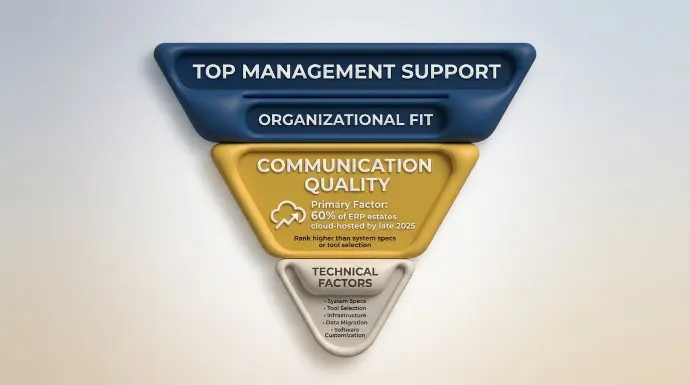
Methodology alone does not ensure ERP success. 2024 research using the Analytic Hierarchy Process (AHP) confirms that top management support and organizational fit are the two most critical factors in any ERP implementation. These rank higher than system specs or tool selection.
We’ve seen firsthand that the real drivers of ERP project success are governance structures, stakeholder alignment, and change management programs that go beyond task tracking.
Stakeholder Alignment and Leadership Sponsorship
ERP systems only work when leadership drives adoption. That means visible, ongoing commitment, not just executive sign-off.
Cudio ensures top-down alignment through structured governance practices, including:
- Steering Committees chaired by client-side CFOs or COOs with Cudio’s senior advisors facilitating scope, budget, and trade-off decisions
- Cudio’s playbooks that clarify decision rights across business units
- ERP roadmap sessions that align project objectives with daily work across finance, supply chain, operations, and the shop floor
Our delivery team includes former COOs and Operations VPs who know what it takes to gain alignment in fast-moving businesses with complex tech environments.
Help Me Fix My ERP Project - Get Free Assessment
Communication as a Project Control System
Communication is not a side effort; it’s a control mechanism that determines whether teams work in sync or fall into siloed chaos.
Cudio builds formal communication plans into every ERP project, including:
- Weekly cross-functional stand-ups led by Cudio’s project management team
- Targeted updates for high-impact groups like finance, close team, and shop floor supervisors
- Structured pilot feedback loops are built into our UAT strategy
- Real-time dashboards configured in Odoo to provide stakeholders with project KPIs, issue tracking, and milestone progress
This ensures everyone, from executives to end users, stays on the same page with consistent, real-time data.
Change Management and User Adoption
Cudio treats change management as a first-class workstream, not an afterthought. Our approach includes:
- Role-based training paths tailored by department, built into Odoo’s native learning modules
- Super-user programs to foster peer adoption and reduce support burden
- Business readiness checkpoints with clear pass/fail criteria before each deployment phase
- KPI tracking for training completion and user engagement through Cudio’s preconfigured ERP dashboards
With 60 percent of ERP estates projected to be cloud-hosted by late 2025, our training also covers data stewardship, security hygiene, and how to adapt to continuous system updates.
We’ve learned that without structured change enablement, even the most powerful ERP tools become underused. Our goal is to turn repetitive tasks into streamlined workflows and build real adoption from day one.
Where Cudio Ensures Projects Stay on Track
Cudio’s project success rate is rooted in these fundamentals:
- We configure ERP systems to reduce project complexity, not just digitize it
- We deliver real-time insights so stakeholders can make informed decisions
- We manage resource capacity to protect the team’s workload and avoid burnout
- We act as trusted advisors, not just software vendors, bringing operational experience into every phase
- We provide clients with a complete view of business performance, project progress, and ROI
By combining structured governance, proven communication plans, and hands-on change management, Cudio helps clients go live with confidence and stay successful long after.
See How We Keep ERP Projects on Track from Day One
Choosing and Running ERP Projects for Control, Not Speed
The best ERP implementations don’t chase speed. They prioritize control. When evaluating ERP vendors or consulting partners, look beyond quick timelines and flashy demos. Focus on how well the partner manages risk, plans for complexity, and supports your team after the system is live.
What to Look For in a Real Implementation Partner
The difference between success and failure often comes down to five critical criteria:
- Senior Ownership: Are experienced professionals leading your project from the start, or is the work being done by junior staff learning on your budget?
- Operational Runbooks: Does your partner provide detailed integration architecture and operational playbooks, or just presentations with no real execution guidance?
- Transparent Risk Logs: Will they identify and share risks early, with clear mitigation plans, or wait until problems escalate?
- Post-Go-Live Support: Are there defined SLAs and a stabilization period included, or are you left unsupported after go-live?
- Proven Track Record: Can they show success with similar complex projects, and connect you with real references who can speak to their delivery?
These signals reveal whether your partner is committed to risk governance or just moving fast.
Common ERP Myths That Lead to Failure
Most failed ERP projects start with unrealistic assumptions. These are the myths to watch for:
- “SaaS ERP is plug and play.” It is not. While cloud deployment shortens infrastructure setup, core work like data migration, integration, and change management still requires time and planning.
- “AI will fix our planning problems.” In practice, it won’t. Although 72 percent of organizations report adopting AI, most use cases are limited to demand forecasting. Critical business processes in ERP still depend on sound planning.
- “We’ll figure it out as we go.”This mindset is costly. It directly leads to the 73 percent failure rate and average cost overruns of 215 percent seen in ERP projects.
What Actually Drives ERP Success
Organizations that succeed invest early in:
- Discovery to uncover actual integration points, data quality issues, and regulatory constraints
- Documentation to prevent scope drift and align teams from the start
- Governance to structure each phase with clear ownership, decision gates, and accountability
They do not treat configuration as the beginning. They treat it as the outcome of well-informed planning.
The real goal is not to go live fast. It is to go live right. A quiet, uneventful go-live is not luck. It is the result of structured project management, thoughtful preparation, and a partner who focuses on long-term success instead of quick wins.
Final Thoughts
ERP success doesn’t come from moving fast; it comes from managing risk with clarity, discipline, and experience. When every phase of your project is grounded in governance, visibility, and accountability, go-live becomes predictable rather than painful.
At Cudio, we help project-based businesses turn complex ERP programs into calm, confident execution. Whether you're starting fresh or course-correcting a struggling rollout, our team brings real-world experience and proven tools to get your ERP working for the business, not against it.
Help Me Fix My ERP Project - Get Free Assessment
FAQs
Got more questions about ERP success? We’ve answered the most common ones below to help you plan with clarity and confidence.
What is the biggest risk in ERP project management today?
The biggest risk in ERP project management today is unrealistic planning during ERP implementation. Compressed timelines, weak risk management, and poor visibility into project data lead directly to cost overruns and failed project milestones. Without effective project management, teams lose control of project budgets, resource allocation, and scope. Strong governance, structured discovery, and disciplined project management practices are what prevent budget control failures and drive successful implementation.
How long should a modern ERP implementation really take?
A modern ERP implementation typically takes 6 to 9 months for focused deployments and 18 to 24 months for complex projects involving multiple departments and supply chain management. Duration depends on project scope, data readiness, resource planning, and integration density. ERP systems excel when timelines are built around real project data rather than optimistic sales estimates. Effective project management ensures project milestones are realistic and resource allocation supports stable business operations.
Is a Big Bang ERP go-live ever a good idea?
A Big Bang ERP implementation can work, but only in tightly controlled environments with a clear project scope and strong executive sponsorship. Because all business operations switch at once, the risk of cost overruns and disruption across supply chain management and financial management is high. Managing projects this way requires strict budget control, mature risk management, and fully dedicated resources. For most complex projects, phased ERP solutions provide stronger protection and a higher chance of successful implementation.
How does cloud ERP change project management compared to on-premise?
Cloud ERP reduces infrastructure setup time, but ERP implementation complexity persists. Data migration, integration security, and continuous updates require disciplined resource planning and active oversight of projects. Cloud ERP software shifts focus toward project data integrity, financial management controls, and cross-functional coordination. Effective project management ensures task progress and project milestones stay aligned, preventing cost overruns despite faster deployment cycles.
Where does AI realistically fit into ERP project management in 2025?
AI in ERP implementation currently supports forecasting, anomaly detection, and limited supply chain management optimization. It does not replace effective project management or human oversight. AI can enhance project data analysis, improve resource allocation, and support better budget control decisions, especially for project-based businesses and future projects. However, successful implementation still depends on structured governance, strong consulting firms, and disciplined execution across every project stage.