
ERP selection criteria are the weighted evaluation factors businesses use to compare both ERP platforms and implementation partners before committing.
This is not rare. It is common for mid-market businesses. The ERP selection process looked solid. The ERP software ticked the boxes. But the evaluation stopped at the platform and missed the real question: who will build the ERP system, and do they understand your business?
The gap between platform evaluation and partner evaluation is why 55–75% of ERP projects miss their objectives, according to Panorama Consulting's 2024 ERP Report. Only half the decision was made.
At Cudio, we have helped businesses navigate both platform and partner selection. Those that succeed treat partner evaluation with the same rigor as platform selection. The rest come back months later.
Here is what this guide covers:
- The ERP selection criteria that matter in 2025–2026
- Why partner selection drives implementation success or failure
- How to build a weighted ERP selection criteria checklist
- A realistic ERP selection process timeline
- The ERP selection traps that derail teams
Show Me How to Build a Two-Layer ERP Selection Framework
Key Takeaways
- ERP selection in 2025-2026 is a two-part decision. Evaluating ERP software without equal weight on the ERP implementation partner is the most common reason selection processes produce good contracts and bad outcomes.
- The ERP project failure rate is high, and the root causes are known. 55-75% of enterprise resource planning (ERP) implementations miss objectives, and 43% of those failures trace to incomplete ERP requirements before the RFP goes out.
- Executive sponsorship is not optional. 77% of companies identify executive involvement as the single most critical success factor. Signing the budget is not the same as actively participating in ERP selection team workshops.
- AI-readiness and API-first architecture are now baseline ERP selection criteria. More than 30% of companies will deploy AI agents within ERP systems by 2026. If the ERP software cannot support event-driven architecture and clean data models, AI promises will not materialize.
- The ERP selection process timeline is longer than most teams plan for. Mid-market ERP selection cycles realistically take 4-6 months. Rushing is a documented risk factor that directly increases ERP implementation overruns.
Why Your Last ERP Selection Criteria Were Not Enough
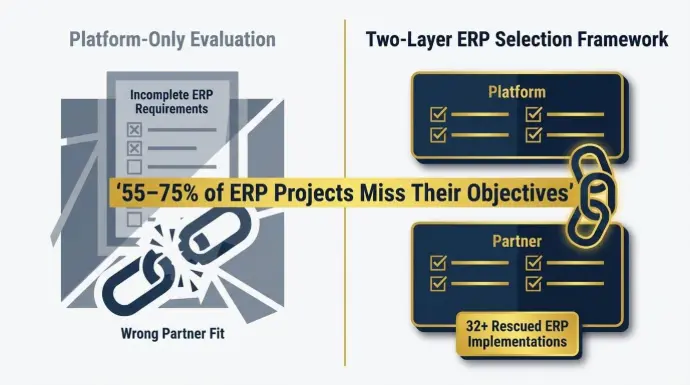
Most ERP selection criteria guides focus entirely on ERP software options and ignore the partner. Research from 2023-2024 shows vendor-organization mismatch, integration failures, and planning gaps are the primary causes of post-go-live pain points. Those issues come from the ERP consultants delivering your ERP project, not the ERP software itself.
The Two-Layer ERP Selection Framework is built for mid-size omnichannel businesses consolidating multiple existing systems: Shopify, Amazon, QuickBooks, a WMS, and other systems running in parallel.
At Cudio, we have rescued 32+ failed ERP implementations. Seven members of our team ran Odoo in their own businesses before becoming ERP consultants.
When we tell you the diagnosis is the same — incomplete ERP requirements, wrong partner fit, and custom code that was never properly scoped — we are speaking from the inside. That is what separates an ERP selection framework that works from one that just looks good on paper.
Show Me How to Build a Two-Layer ERP Selection Framework
Layer 1: ERP Platform Selection Criteria
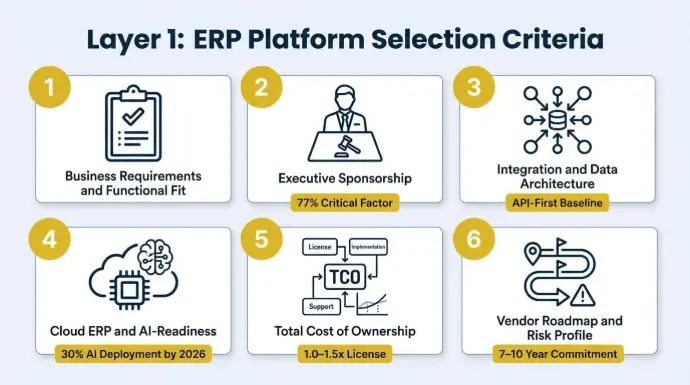
This layer covers the ERP selection criteria most ERP selection criteria checklist articles address, updated for 2025-2026 realities. For each criterion, we cover why it matters for your new ERP system, what to ask ERP vendors, and what red flags to watch for.
1. Business Requirements and Functional Fit
Misaligned functional requirements remain the top platform-side reason ERP implementations disappoint. Build your business requirements cross-functionally. Operations, finance, warehouse, e-commerce, customer relationship management, and customer service all need a seat at the table. Not just IT.
Tier | Functional Requirements Examples | Validation Method |
Must-haves | Omnichannel inventory management, multi-entity consolidations, returns management, accounts payable automation | Test with real transactions in vendor demos |
Nice-to-haves | Advanced forecasting, mobile warehouse apps, and human resources workflows | Confirm roadmap availability and delivery timeline |
Future phase | AI-driven demand planning, advanced B2B portal, customer relationship management AI | Evaluate API architecture and future budgets now |
2. Executive Sponsorship and ERP Selection Team
77% of companies identify executive involvement as the most critical factor in ERP system success. Real sponsorship means your CEO, COO, or CFO actively participates in key ERP selection team workshops and owns business outcomes, not just signs the budget.
Create a written selection charter before the RFP goes out. Cover business goals, scope boundaries, decision-making rules, and conflict resolution between departments. Unresolved misalignment at the ERP selection process stage resurfaces as resistance during actual implementation.
3. Integration, Data Architecture, and Existing Systems
Mid-size businesses do not run an ERP system in isolation. You need to integrate with Shopify, Amazon, 3PLs, customer relationship management, WMS, and legacy systems. API-first architecture with REST, web services, GraphQL, event streaming, and webhooks is now a baseline for ERP selection. Not differentiators.
Evaluate these specific functional requirements in vendor demos:
- Syncing orders from existing systems and marketplaces without batch delays
- Connecting 3PLs for fulfillment and inventory management updates
- Integrating customer relationship management for B2B quoting with live stock visibility
Watch for vendor lock-in. Proprietary data models and closed web services create lock-in costs of $200K-$1M or more when you try to migrate data or exit. Ask every ERP vendor directly: what does it cost to extract our existing data if we leave?
4. Cloud ERP Solutions, Scalability, and AI-Readiness
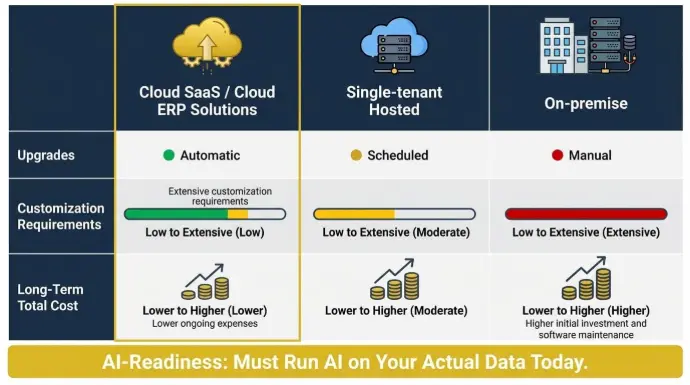
Cloud ERP solutions now dominate new ERP deployments. Treat a robust cloud offering as the default, unless regulatory requirements around language, currency, or data residency say otherwise.
Deployment Model | Upgrades | Customization Requirements | Long-Term Total Cost |
Multi-tenant SaaS / Cloud ERP solutions | Automatic | Limited | Lower ongoing expenses |
Single-tenant hosted | Scheduled | Moderate | Medium |
On-premise | Manual | Extensive customization requirements | Higher initial investment and software maintenance |
AI-readiness in ERP selection means the system can run AI on your actual data today — not which vendor has the best slides.
Ask for live demonstrations of demand forecasting, anomaly detection, and financial reports automation on realistic existing data.
If an ERP vendor cannot show AI working on data like yours today, their roadmap promises are not part of your ERP system cost calculation yet.
5. Total Cost of Ownership and ERP System Cost
Most ERP selection teams fixate on license price and underestimate the total cost of ownership over 5-7 years. Build the full total cost model for subscription fees, ERP implementation services (1.0-1.5x the annual license as an initial investment), data migration from existing systems, add-on apps, user support, support services, user training, and ongoing expenses.
Build an ROI model tied to measurable outcomes. Across Cudio's 32+ ERP rescue projects, disconnected existing systems consume 40-60 hours of manual processes per week in duplicate data entry and manual reconciliation.
Faster financial reports close and better inventory management accuracy are quantifiable. Model future budgets over a 3-5 year horizon. Test what happens as the business grows: added channels, new company size milestones, and acquisitions.
6. ERP Vendor Roadmap, Support Services, and Risk Profile
Your ERP system is a 7-10 year commitment. Ask about the ERP vendor's financial health, release cadence, and clarity of its roadmap for your industry. Verify through reference calls with companies of similar company size, not marketing materials.
Ask how the ERP vendor handled their last major security incident and what their support services escalation looks like for a P1 issue at 11 pm before a peak sales day. That conversation separates the right ERP software from regrettable ERP options.
Get My Free ERP Selection Criteria Checklist
Layer 2: Implementation Partner Selection Criteria
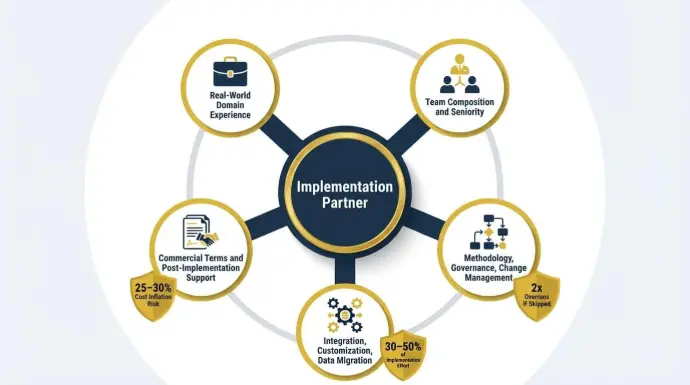
For most mid-market buyers, several ERP software options could work. The ERP selection lives or dies on the implementation partner's capability and alignment with your business needs. This is especially true for Oracle NetSuite, Dynamics, and SAP, where multiple ERP consultants can implement the same platform.
Research from 2023-2026 consistently flags vendor support gaps, integration pain points, and planning breakdowns as root causes of failed ERP projects. All trace back to the implementation team. This is the layer that most ERP selection teams underweight until they are burned.
Businesses like Refreshed Tech and Simons Shoes came to Cudio after struggling with fragmented systems and partners who could not deliver. Both achieved clean go-lives because we evaluate the implementation team with the same rigour we apply to the ERP software itself.
Our 100% client retention rate is due to our policy of not assigning projects to junior staff after the contract is signed. The ERP consultants you meet in the selection process are the ones who deliver your ERP project.
Get My Free ERP Selection Criteria Checklist
1. Real-World Domain Experience
Your ERP selection team needs partners who understand channel complexity, not just ERP software configuration. Ask for concrete case studies from 2020 to 2025 in industries similar to yours. Require metrics on go-live timelines, reductions in manual processes, and post-go-live issue counts.
Ask these in your ERP selection process:
- Describe a time you rescued a failed ERP implementation. What were the pain points, and how did you fix them?
- Show us before-and-after process maps from a business with business needs like ours.
Differentiate between ERP consultants who have operated businesses and career implementers who only know software configurations. You need the former leading your ERP project.
2. Team Composition, Seniority, and Delivery Model
Many ERP selection teams select a firm based on senior pre-sales ERP consultants and discover post-contract that their ERP project is staffed with juniors and offshore teams. Lock these in before signing:
- Named ERP consultants committed to the contract, not just role descriptions
- Ratio of senior to junior ERP consultants on your specific ERP project
- What happens if a key ERP consultant leaves mid-implementation
3. Methodology, Governance, and Change Management
Poor planning during the ERP selection process directly increases cost overruns during actual implementation.
Organizations that skip structured RFPs see 2x higher ERP implementation overruns. A mature methodology includes clear phases: discovery, design, build, test, user training, deploy, and stabilize, each with documented deliverables and decision gates.
Ask every partner: What does your user adoption approach look like 90 days post-go-live? Generic answers mean they do not have a real answer.
4. Integration, Customization, and Data Migration Capability
Integration complexity, customization requirements, and messy existing data are where ERP implementations stall. Evaluate partner-specific capability here, not just ERP software capability.
- Depth of experience with Shopify, Amazon, 3PLs, Oracle NetSuite, or Dynamics connectors
- Use of modern APIs versus brittle web services and CSV import jobs
- Philosophy on customization requirements versus reworking the business process
- Data migration consumes 30-50% of the total ERP implementation effort. A strong partner profiles your existing data early. A weak partner discovers data problems two weeks before go-live. The timing of data profiling directly affects your ERP system cost and total cost of ownership.
5. Commercial Terms, Scope, and Post Implementation Support
Contracts should align with your business goals and incentives. Incomplete ERP requirements add 25-30% to the average ERP implementation cost. Before signing, confirm clear deliverables with explicit exclusions, separate fixed- and time-and-materials components, a scope freeze and change approval process, and post-implementation support for 30-60 days with defined user support SLAs.
Send Me a Sample ERP Partner Contract Review
Building a Two-Layer ERP Selection Criteria Scorecard
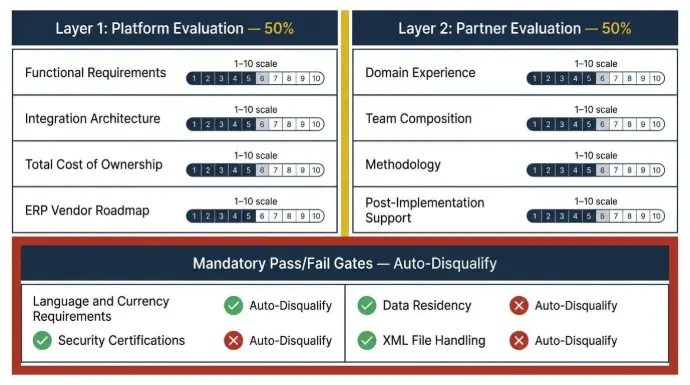
Split the scorecard 50/50:
- platform evaluation criteria covering functional requirements, integration architecture, total cost of ownership, and ERP vendor roadmap;
- and partner evaluation criteria covering domain experience, team composition, methodology, and post-implementation support.
Use a 1-10 scale with mandatory pass/fail gates for non-negotiables. Language and currency requirements, data residency, security certifications, and XML file handling disqualify ERP software options regardless of their scores elsewhere.
What a Successful ERP Selection Looks Like in Practice
Two shortlisted vendors score similarly on platform evaluation criteria. But Partner B demonstrates rescue experience, commits named senior ERP consultants to the contract, and includes a structured user training plan. Partner A offers only generic references. The right ERP system decision becomes obvious. Without the scorecard, that clarity takes weeks longer.
Cudio brings 30+ years of operational experience to every ERP selection scorecard we facilitate. Our senior ERP consultants and founders work directly with clients at every step. No handoffs. No junior staff assigned after the kickoff call.
Book My Free ERP Selection Discovery Call with Cudio
When the scorecard reveals that a platform with weaker ERP software features has a stronger partner ecosystem for your specific business needs, that insight comes from consultants who have made that exact call in their own businesses, not just in client engagements.
A Realistic ERP Selection Process Timeline for 2025-2026
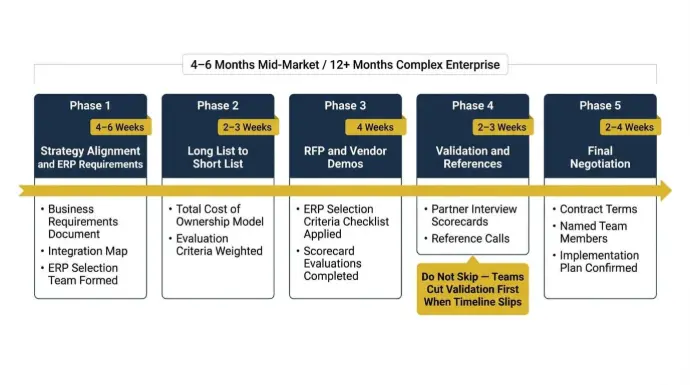
Mid-market erp selection process takes 4-6 months. Complex enterprise resource planning (ERP) RFPs run 12 months or more. Rushing is a known risk factor. Here is a realistic phase structure:
Phase | Duration | Key Steps and Deliverables |
Strategy alignment and ERP requirements | 4-6 weeks | Business requirements document, integration map, ERP selection team formed |
Long list to short list | 2-3 weeks | Preliminary total cost of ownership model, evaluation criteria weighted |
RFP and vendor demos | 4 weeks | ERP selection criteria checklist applied, scorecard evaluations completed |
Validation and references | 2-3 weeks | Partner interview scorecards, reference calls with existing systems peers |
Final negotiation | 2-4 weeks | Contract terms, named team members, and ERP implementation plan confirmed |
Keep momentum across phases. Multi-month gaps erode engagement among ERP selection team members. If the timeline slips, teams cut validation and reference checks first. Those are the key steps you cannot afford to skip.
ERP Selection Traps to Avoid
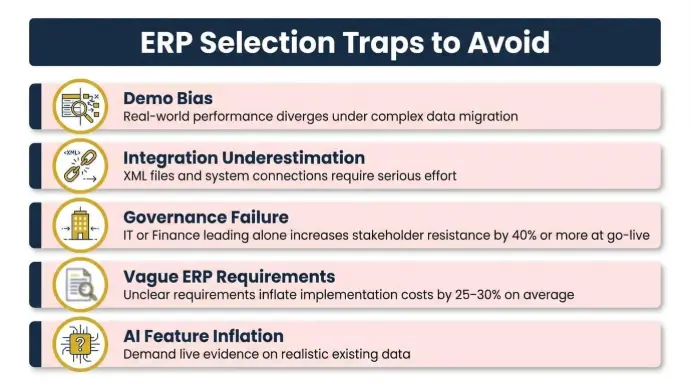
Even with good ERP selection criteria and a solid scorecard, these recurring mistakes still derail outcomes.
- Demo bias. Vendor demos use clean data. Real-world ERP system performance diverges under complex data migration and under the load of existing systems. Always test ERP software options with your own existing data.
- Integration underestimation. Web services, XML files, and other system connections in multi-system environments require serious effort. Treating these as simple is how ERP projects blow their budgets early.
- Governance failure. IT or Finance leading the ERP selection process alone increases stakeholder resistance by 40% or more at go-live. Enterprise resource planning is a cross-functional business transformation that needs cross-functional ownership.
- Vague ERP requirements. Unclear functional requirements and business processes inflate ERP implementation costs by 25-30% on average. Time spent on ERP requirements before the RFP is the cheapest time you will spend on this ERP project.
- AI feature inflation. Demand live evidence on realistic existing data. If ERP software options cannot demo AI working on data like yours today, they are selling you a roadmap, not a product.
Final Words
Platform ERP selection criteria ensure your new ERP system has the capabilities and future growth potential your business needs. Partner selection criteria ensure those capabilities become operational realities in your business.
At Cudio, we help businesses build their ERP selection criteria, facilitate the scorecard process, and evaluate partners with the same rigor they apply to ERP software.
With a 100% client retention rate, 32+ rescued ERP projects, and senior ERP consultants who have run Odoo in their own businesses, we do not just help you pick the right ERP. We help you avoid the mistakes that make the right ERP feel like the wrong decision. That is the kind of work we do.
Book My Free ERP Selection Discovery Call with Cudio
FAQs
Here are the questions that come up most often after ERP selection teams have built their initial ERP selection criteria.
How many ERP vendors and partners should we evaluate before deciding?
Start with 6-10 ERP software options, narrow to 3-4 based on functional requirements, then run vendor demos with 2-3 shortlisted vendors while evaluating partners in parallel. For Oracle NetSuite or Dynamics, comparing 2-3 ERP consultants for the same ERP system is a revealing exercise that most ERP selection processes skip entirely.
How do we balance speed of selection with enough due diligence?
Target a 4-6 month ERP selection process with time-boxed key steps: 4-6 weeks for ERP requirements, 4 weeks for vendor demos and scoring, 2-4 weeks for references and negotiations. Running business requirements and integration mapping in parallel with demo scheduling saves 2-3 weeks without cutting rigor. Skipping ERP requirements or partner interviews to move faster trades 3 weeks of ERP selection process time for 3 months of ERP implementation delay.
How much weight should we give AI features when choosing an ERP system in 2025-2026?
Treat AI-readiness as a mandatory baseline for ERP selection: the ERP software must have a clean API, a robust data model, and a credible AI roadmap.
Treat specific AI features as secondary to core functional requirements and existing data quality. Demand live demonstrations on realistic existing data, not roadmap slides.
A solid API and clean data foundation deliver more competitive advantage than any single AI feature in your new ERP system.
What if our internal stakeholders cannot agree on ERP priorities?
Use a structured, weighted ERP selection criteria scorecard and a selection charter defined before the ERP selection process starts to depersonalize the decision. Set clear decision rights upfront: the COO as final arbiter after input from finance, human resources, operations, and IT. Unresolved stakeholder misalignment at ERP selection resurfaces as resistance during actual implementation.
When is the right time to bring in external ERP consultants for selection support?
External ERP consultants add the most value at three points: clarifying ERP requirements before the RFP, evaluating integration architecture and other systems compatibility, and reviewing commercial terms before signing. Retain decision ownership and use ERP consultants as facilitators rather than substitutes for internal alignment on business goals.