



When comparing ERP vs CRM, it might seem like they touch on the same processes, and in some cases, they do. But they support very different parts of your business.
ERP systems are designed to streamline internal operations like finance, HR, and supply chain. CRM software focuses on managing customer interactions, sales pipelines, and support workflows.
One of Odoo's key advantages is that CRM lives inside the same platform as your operations — explore Cudio's Odoo CRM automation and sales pipeline management services to see how the two can work as one.
These tools serve distinct functions but are not mutually exclusive. Many modern ERP platforms, such as Odoo, include built-in CRM capabilities, allowing businesses to unify both internal processes and customer engagement within a single system.
This guide explains how ERP and CRM software work, what sets them apart, and how using both together can improve the way your business runs every day.
Key Takeaways
- ERP (Enterprise Resource Planning) focuses on streamlining internal operations such as finance, supply chain, HR, and inventory, while CRM (Customer Relationship Management) supports sales, marketing, and customer support teams by improving customer relationships and engagement.
- While traditionally implemented as separate systems, modern platforms like Odoo offer both ERP and CRM in a single, unified solution, eliminating the need for third-party integrations and reducing overall cost and complexity.
- Choosing between ERP, CRM, or an integrated system depends on your business goals. For many growing businesses, using a platform like Odoo allows you to scale without having to switch tools later.
What Is Customer Relationship Management (CRM)?
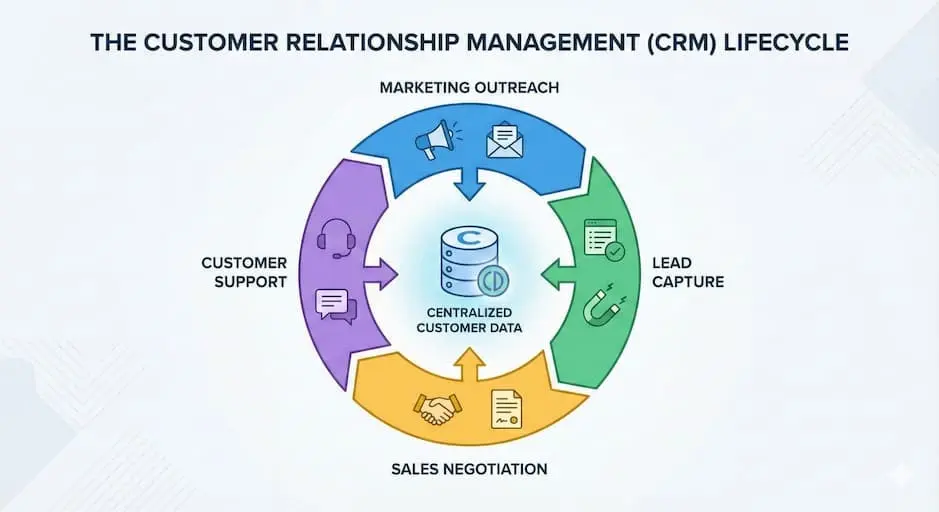
Customer Relationship Management (CRM) software is a growth engine that centralizes all external interactions with prospects and clients. By consolidating contact information, deal history, and support tickets into a single dashboard, sales and marketing teams can automate outreach and track the entire customer lifecycle. This centralization directly supports revenue growth by ensuring no leads are lost and that every customer receives personalized service.
The primary focus of CRM is customer engagement. It enables teams to track every interaction, personalize communication, and automate outreach, such as email campaigns or lead assignments. This helps businesses close more deals, improve service, and build long-term loyalty.
CRM’s rapid adoption reflects its importance. In 2024, the global market is valued at $101.41 billion and is projected to reach $262.74 billion by 2032, growing at 12.8% annually. North America holds the largest share (32.3%), with banking and financial services (BFSI) leading adoption. Meanwhile, retail is the fastest-growing segment as brands invest in digital customer experiences.
Designers specifically exclude internal operations like accounting or production scheduling from CRM architectures. Those functions belong to ERP systems.
While CRM and ERP can work together, the most effective solutions are fully integrated. A built-in CRM within an ERP platform allows customer-facing teams to sell smarter, market more effectively, and deliver better service, all while staying connected to operations, finance, and inventory. This is especially useful for small and medium businesses looking to scale without managing disconnected tools.
What Is Enterprise Resource Planning (ERP)?
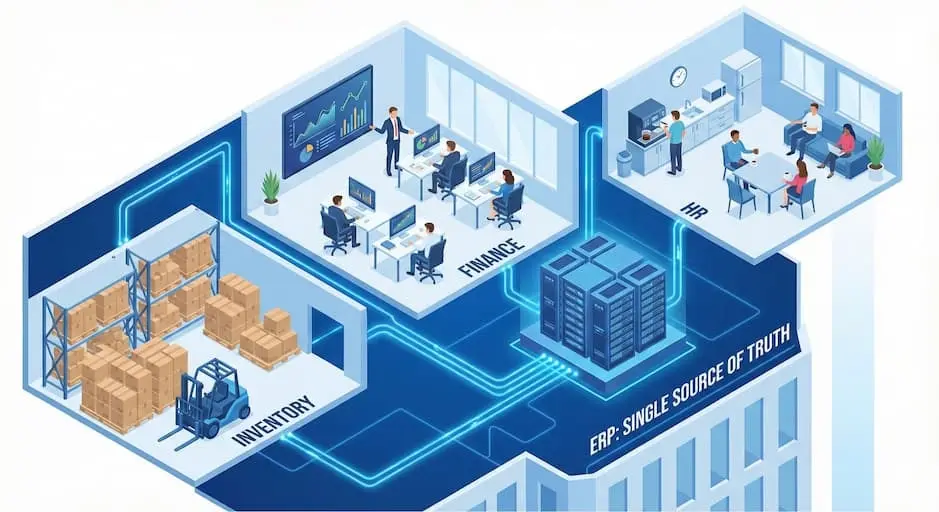
Enterprise Resource Planning (ERP) software helps businesses manage their internal operations efficiently.
ERP software unifies disjointed internal processes into a single source of truth, covering:
- Financial Management: Automating payroll, ledgers, and billing.
- Inventory Tracking: Monitoring stock levels in real-time.
- Procurement: Managing vendor orders and supply chains.
- Human Resources: tracking employee performance and benefits.
The core goal of ERP is to optimize internal workflows, not customer communication. It automates routine tasks, reduces errors, and ensures that everyone from finance to operations is working from the same playbook. Whether you're reconciling payroll or managing logistics, ERP keeps your organization aligned behind the scenes.
ERP adoption is accelerating. The market was valued at $48 billion in 2022, and it’s expected to double to $96 billion by 2032. This growth is fueled by companies modernizing their operations: 62% of IT leaders prioritize digital transformation, and 84% are investing in composable ERP, modular, adaptable solutions that scale as needs evolve. At present, 50% of companies are either upgrading or adopting ERP systems.
ERP is especially prevalent in industries with complex logistics. Manufacturing leads adoption at 47%, followed by distribution (18%), services (12%), and construction (4%). While large enterprises make up 39% of ERP users, adoption among SMEs is growing at 7% annually through 2025.
How Do ERP and CRM Systems Differ?
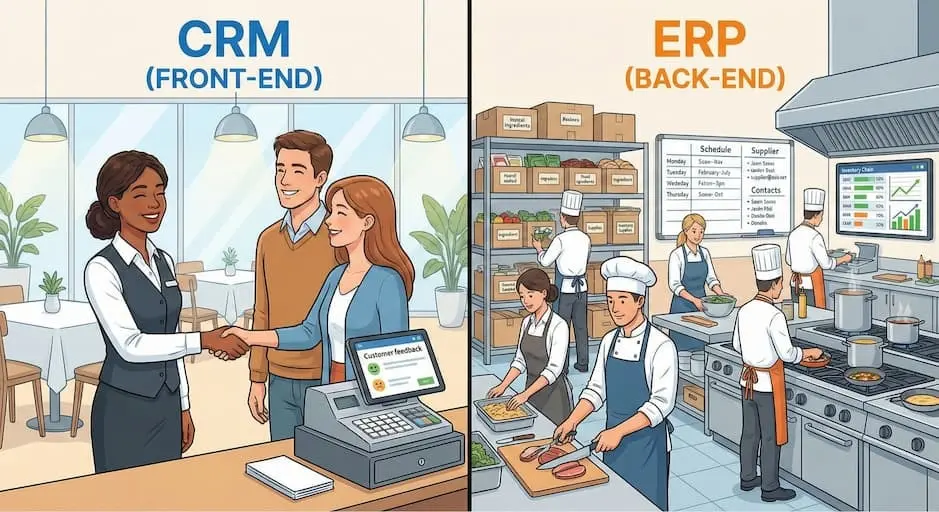
CRM and ERP systems both drive business efficiency, but they serve fundamentally different purposes.
CRM is about growing revenue through external relationships. It helps sales, marketing, and support teams improve their customer connections, boosting satisfaction, loyalty, and growth.
ERP is about managing internal operations. It supports back-office functions like finance, HR, inventory, procurement, and sales, ensuring teams stay coordinated and informed.
A helpful way to think about it:
- CRM = front-end growth.
- ERP = back-end control.
Their adoption also differs by business type:
CRM sees the fastest growth among SMEs, thanks to its accessibility and impact on sales performance. BFSI leads usage, while retail is the fastest-growing sector.
ERP is most common in manufacturing and logistics-heavy industries, where internal coordination is crucial. It's also being adopted rapidly by smaller businesses seeking operational efficiency.
Some companies begin with CRM to improve customer engagement and add ERP later as operations grow. Others invest in integrated platforms that combine both from the outset.
Ultimately, choosing CRM, ERP, or both depends on your current priorities:
- Need to improve customer outreach and drive sales? Start with CRM.
- Need to streamline your internal processes and reduce complexity? ERP is your answer.
How Do ERP and CRM Features Compare?
Here’s a quick breakdown of what CRM and ERP software typically include. While traditional ERP systems focused solely on internal operations, modern integrated ERP platforms often include CRM functionality within a unified system.
This table compares a typical standalone CRM with both legacy and modern ERP systems, highlighting where their capabilities overlap and where they differ.
Feature | CRM | ERP (Legacy) | ERP (Modern Integrated) |
Lead Management | Yes | No | Yes |
Sales Pipeline Tracking | Yes | No | Yes |
Marketing Automation | Yes | No | Yes (basic or add-on) |
Customer Service Tools | Yes | No | Yes (varies) |
Customer Data Management | Yes | Limited | Yes |
Financial Management | No | Yes | Yes |
Inventory Management | No | Yes | Yes |
Human Resources | No | Yes | Yes |
Procurement | No | Yes | Yes |
Supply Chain Management | No | Yes | Yes |
Reporting & Forecasting | Yes (customer-focused) | Yes (operations-focused) | Yes (unified) |
Integration with Other Tools | Yes | Yes (limited) | Yes (native + third-party) |
The old way was picking between ERP and CRM. But the best platforms today combine both. Separating them creates silos, slows teams down, and leads to bad data. If you're still managing ERP and CRM on different systems, you're already behind.
How Are ERP and CRM Used in Real-World Scenarios?
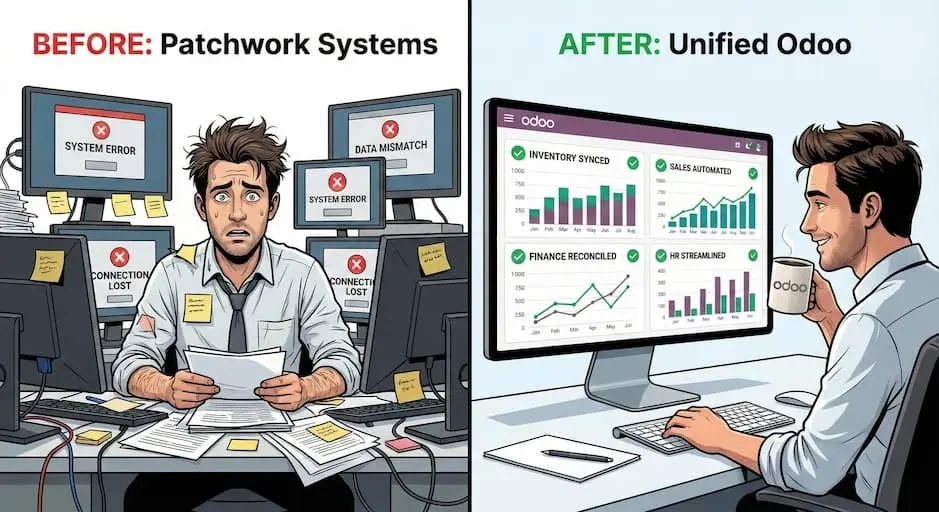
Understanding the difference between ERP and CRM becomes easier when you look at how businesses use them in the real world.
Here are a few examples:
1. Retail Business Starting with CRM
Retail businesses often start with CRM to drive sales, but require ERP once order volume exceeds manual capacity. For example, an eCommerce brand using a CRM to send marketing emails will eventually face stockouts if inventory isn't synced with sales.
Implementing an ERP automates this, instantly updating inventory levels across all channels (Amazon, Shopify) whenever a sale occurs. This transition from manual spreadsheets to automated ERP logistics is often the critical step for scaling beyond $1M in revenue.
2. Manufacturing Company Scaling with ERP
A manufacturing firm begins by implementing an ERP system to manage production, the supply chain, and human resources. Later, they added a CRM tool to help their sales team manage accounts and improve customer interactions.
3. Service Business Running on CRM
A consulting agency uses a CRM to track client communication, schedule meetings, and run sales campaigns. Since their operations are less complex, a standalone CRM is all they need to stay organized and responsive.
In our experience managing over 50 ERP migrations, we have found that businesses relying on 'patchwork' tools face a 30% higher operational overhead due to manual data entry errors
We specialize in Odoo ERP services, helping clients move from disconnected systems to a single platform that supports their entire operation. Our team has real-world leadership experience, with seven consultants who previously served as COOs, General Managers, or Operations Managers. We’ve been in your shoes, and that’s what shapes our approach.
Here’s how we support complex businesses:
- Full Odoo ERP Implementation: From discovery and system design to development, testing, deployment, and support.
- Clean Migrations: Move off legacy systems with no data loss and minimal disruption.
- Customization and Development: Tailor your ERP to match how your business actually works.
- Integration Expertise: Connect Odoo with third-party tools like Rithum for seamless operations.
We serve industries like manufacturing, retail, eCommerce, logistics, and healthcare, helping teams align and scale with confidence.
If you're dealing with disconnected tools, manual work, and slow processes, you're not alone. At Cudio, we help businesses like yours unify their workflows and gain absolute control over their operations.
Start Your ERP Journey With Cudio Today!
Can ERP and CRM Work Together?
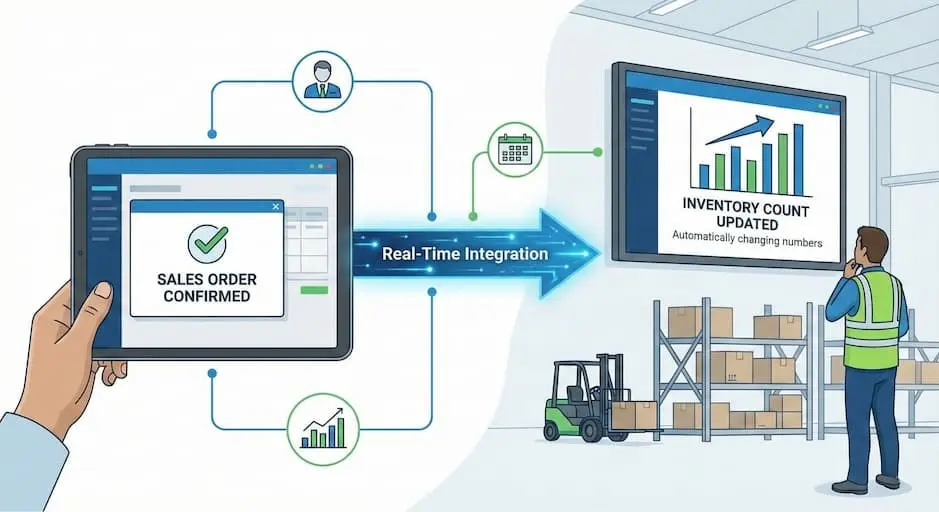
Yes, they can, and for many businesses, that’s the most brilliant move.
CRM and ERP systems focus on different things. CRM helps you manage customer interactions, while ERP takes care of your internal operations like finance, inventory, and HR. When they’re connected, your whole business runs better.
Instead of jumping between tools or manually updating data in two places, everything flows together. Your sales team can see what’s in stock, your finance team gets customer info instantly, and leadership has one clear view of what’s going on.
It saves time, avoids errors, and helps teams work more efficiently.
Getting two systems to talk to each other sounds simple, but in practice, it takes careful planning. That’s where we come in.
At Cudio, we help businesses connect their ERP and CRM systems in a way that actually works. We assess the tools you're using, identify the gaps, and build a setup that keeps everything in sync.
In some cases, that means integrating a standalone CRM into your ERP. In others, it means migrating those functions into a unified platform like Odoo's built-in CRM module. Either way, we ensure your data flows properly, your team can use the system confidently, and no insights get lost along the way.
Whether you're keeping systems separate or going fully integrated, we make the transition smooth and low-stress.
Start Your ERP Journey With Cudio Today!
Do You Need ERP, CRM, or Both?
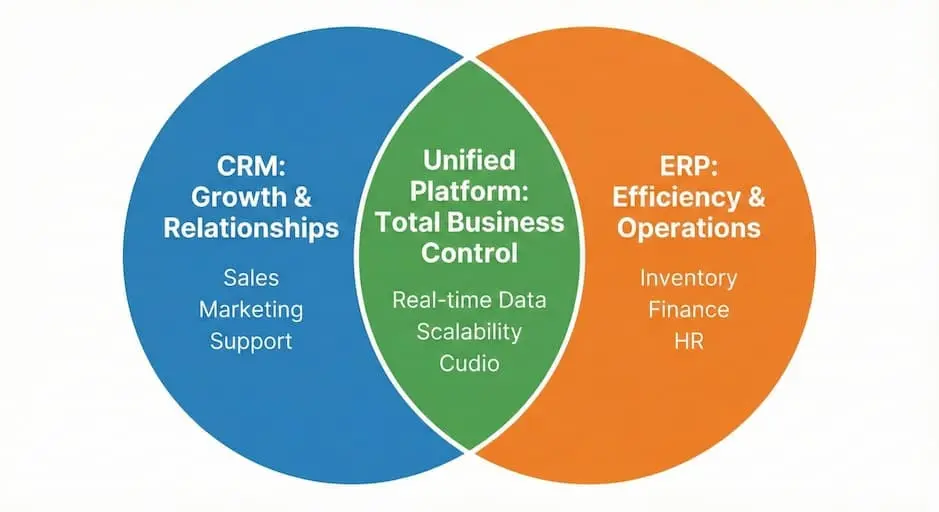
Now that you know what CRM and ERP do, the next step is figuring out what your business actually needs. The answer depends on your current challenges, priorities, and goals.
Choose CRM If:
CRM software is best for businesses that rely on relationships to grow. It supports sales processes, keeps communication organized, and helps deliver a better customer experience.
- You want to improve customer relationship management (CRM) and build better customer connections
- Your sales teams need tools to track leads, manage deals, and improve sales forecasting
- You're investing in marketing automation to boost outreach and simplify marketing tasks
- You’re focused on organizing customer communications across departments
- You want to save time by automating repetitive tasks and centralizing customer data management
Choose ERP If:
ERP helps you manage and connect the core of your business, not just the back office. Modern ERP platforms like Odoo extend beyond finance and operations to support marketing, websites, sales, and customer engagement.
- Your business needs to improve how it manages inventory, finance, staffing, or marketing
- You want real-time access to data across departments to make smarter, faster decisions
- You are handling complex projects or cross-functional workflows
- You want to centralize resource management, reduce manual tasks, and stay agile as you grow
- You are looking for an all-in-one, scalable platform that supports both internal operations and customer-facing activities
Choose Both If:
Using CRM and ERP software together gives you a complete view of your business. You can manage everything from lead tracking to payroll without bouncing between tools.
- You’ve reached a point where disconnected systems are slowing you down
- Your team is constantly entering the same data in different places
- You want to improve both your customer service processes and your internal operations
- You’re ready for a connected platform that offers complete CRM and ERP integration
Not Sure What to Choose?
It can be hard to decide which system to invest in, especially with so many software solutions on the market. Whether you’re considering a standalone CRM solution, a complete enterprise resource planning (ERP) platform, or something that combines both, we’re here to help.
At Cudio, we guide businesses through this process with a clear focus on what works in the real world. No guesswork, no cookie-cutter setups.
Talk to our team today and get a personalized plan that fits your business needs.
Start Your ERP Journey With Cudio Today!
How Much Do ERP and CRM Systems Cost?
Understanding the cost of a CRM or ERP system is about more than just the software price. It’s also about time, implementation, and the long-term value it brings to your business.
Let’s break down what you can expect from both.
CRM Costs: Lower Barrier to Entry
CRM software is often seen as more budget-friendly at first, especially with entry-level plans aimed at small teams. Many platforms offer free trials or tiered subscriptions, which can make adoption easier for businesses just starting out.
However, that’s not always the case. Leading CRMs like Salesforce and HubSpot come with higher price tags, and offer narrower functionality compared to solutions like Odoo, which includes CRM as part of a full ERP suite. In many cases, the all-in-one approach ends up being more cost-effective in the long run.
ERP Costs: A Bigger Investment with Bigger Impact
ERP systems are more comprehensive, so they naturally cost more. These systems touch multiple parts of your organization, from finance and payroll to procurement and resource management.
Industry data from Top10ERP’s 2025 Pricing Guide suggests that small businesses typically invest between $10,000 and $150,000 for a basic implementation, while mid-market costs range from $20,000 to $125,000 in the first year.
The timeline also varies. For small and midsize businesses, ERP implementation typically takes 3 to 9 months. For large enterprises, it may take 6 to 18 months, depending on complexity.
That investment supports long-term benefits such as process standardization, improved financial reporting accuracy, and time savings across departments. ERP platforms also reduce manual data entry, enhance cross-team communication, and support real-time decisions through a central database.
What If You Need Both?
When you need tools that support both front-end and back-end operations, combining CRM and ERP software can be the right move. Some companies integrate existing tools. Others choose platforms that offer built-in CRM and ERP integration to simplify things.
This setup gives your sales teams access to real-time stock and billing data, while leadership can track full-funnel performance, from acquisition to fulfillment, all in one place. That alignment can help streamline operations, improve customer service, and reduce waste across your business functions.
Summary
ERP and CRM systems each bring powerful benefits to modern businesses. ERP focuses on internal operations like finance, HR, and supply chain, while CRM improves how you manage customer relationships, sales, and support.
Whether you choose one or both depends on your goals. If your priority is improving internal efficiency, ERP might be the way forward. If you're focused on driving sales and customer loyalty, CRM could be your best fit. For many growing businesses, combining both systems delivers the best of both worlds.
If you're exploring ERP, CRM, or both, Cudio can help. Our team makes ERP implementation simple, tailored, and aligned with your growth goals.
Start Your ERP Journey With Cudio Today!
Frequently Asked Questions
If you have questions, our team at Cudio is happy to help!
What is the primary difference between ERP and CRM systems?
The primary difference between ERP and CRM systems is that ERP systems streamline back-office operations, whereas CRM systems enhance front-office functions such as sales and customer service. This distinction is crucial for understanding how each system contributes to overall business efficiency.
How long does it typically take to implement a CRM system?
Implementing a CRM system typically takes between 1 to 6 months, with an average time of 3 to 4 months. This timeframe allows for thorough planning and integration for practical use.
What are the benefits of integrating ERP and CRM systems?
Integrating ERP and CRM systems enhances efficiency and data management, and improves customer satisfaction by providing a cohesive approach to both operational and customer-facing activities. This unified integration streamlines processes and fosters better decision-making across the organization.
What factors influence the cost of ERP implementation?
The cost of ERP implementation is primarily influenced by the number of users, the specific features required, and the extent of system customization. Each of these factors can significantly impact the overall investment required for successful implementation.
How does AI enhance CRM systems?
AI enhances CRM systems by enabling personalized customer interactions and automating routine tasks, thereby improving efficiency and deepening insights into customer behavior.