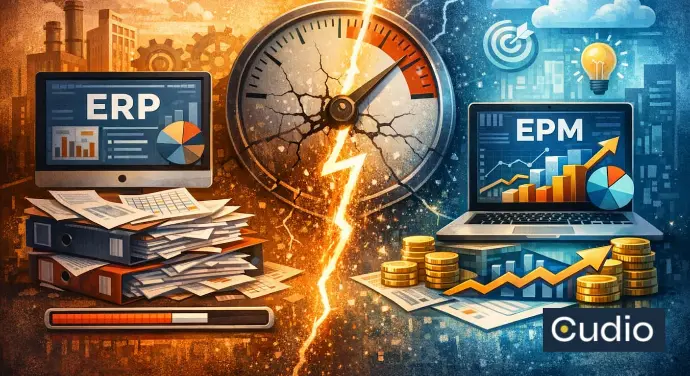
Enterprise Resource Planning (ERP) systems act as the transactional backbone of a business, recording daily operations. In contrast, Enterprise Performance Management (EPM) governs financial consolidation, budgeting, and scenario modeling.
As mid-market companies scale past 10-12 entities, integrating an EPM layer prevents the month-end close from degrading into manual, error-prone Excel reconciliations.
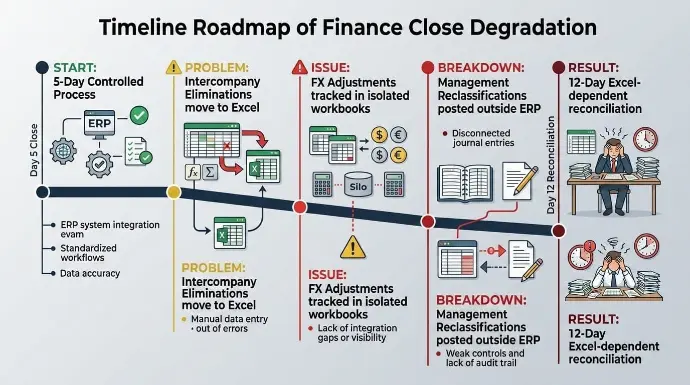
In our experience auditing over 50 mid-market finance architectures, we consistently see this failure pattern: as a company scales from five entities to fifteen, intercompany eliminations slowly migrate into manual Excel files, stretching the close by an average of 4 to 7 days.
A company scales from five entities to fifteen. It expands into multiple currencies. Acquisitions introduce a second ERP. Intercompany eliminations and FX adjustments slowly migrate into Excel.
What was once a clean five-day close becomes an exhausting twelve-day reconciliation exercise.
The real risk is not choosing between ERP and EPM. It allows spreadsheets to become a shadow consolidation system without governance, an audit trail, or controls.
This article will help you determine:
- When ERP-only is still appropriate
- When EPM becomes necessary
- And how to architect both together for one trusted version of financial truth
Key Takeaways
- In 2020, Sarah, a Controller at a growing manufacturing group, closed the books in five days. By 2025, with fifteen entities across three countries, that same close now takes eleven or twelve days—because intercompany eliminations, FX translation, and top-side adjustments now live in Excel files outside the ERP, maintained through email threads and hope.
- At its core, ERP runs day-to-day transactions while EPM governs consolidation, planning, and performance management on top of ERP and other data sources. They serve fundamentally different purposes in the finance architecture.
- Most mid-market groups hit a breaking point at roughly 10-12 entities, multi-currency operations, or multi-ERP environments where ERP consolidation alone no longer works, and an EPM layer becomes an architectural necessity rather than a nice-to-have.
- The real risk isn’t determining which tool is better—it’s maintaining two conflicting sources of truth (the ERP versus spreadsheets) that erode trust in your numbers with auditors, boards, and lenders.
- This article serves as a practical guide for finance leaders on when to stay ERP-only, when to add EPM, and how to architect them together into a single, governed version of financial truth.
Why Does the Month-End Close Get Slower as Mid-Market Companies Scale?
Five years ago, your close took five days. It felt controlled. Predictable.
Now it takes ten. Sometimes twelve. And no one can point to a single failure.
The pressure builds quietly. Auditors ask more questions. Boards want faster reporting. Controllers spend evenings reconciling “Why the ERP trial balance does not match the management P&L.” Trust in the numbers begins to feel fragile.
If you are feeling this tension, you are not behind. You are likely outgrowing your original finance architecture.
Excel Shadow Creep: The Quiet Shift Outside the ERP
Finance teams rarely make a formal administrative decision to abandon ERP consolidation; instead, the transition to a shadow system begins with isolated manual workarounds.
It starts small:
- Intercompany Eliminations: Calculating multi-entity transactions manually in Excel rather than through automated ERP logic.
- FX Adjustments: Tracking foreign currency translations in isolated workbooks outside the general ledger.
- Management Reclassifications: Posting top-side journals directly to presentation layers without underlying subledger support.
Over time, those exceptions become the system.
Entity roll-ups live in a master spreadsheet.
FX tables update outside the ERP.
Eliminations are calculated offline and uploaded manually.
Now your close depends on spreadsheets, email approvals, and one or two individuals who “know how it all ties together.”
This is Excel shadow creep. It feels temporary. It becomes permanent.
Architecture Mismatch: ERP Is Doing a Job It Wasn’t Designed For
ERP is built to record transactions at a granular level. It excels at general ledger postings, subledger detail, and statutory reporting.
But complex multi-entity consolidation, FX translation logic, partial ownership accounting, and structured close workflow were never its primary design focus.
As an organization scales its entity count and regulatory exposure, a structural gap emerges in the finance architecture.
Because ERPs are not natively designed for complex multi-entity consolidation or FX translation logic, finance teams are forced to export data and execute performance management logic manually.
This reliance on Excel to fill architectural gaps creates a fragile 'shadow system' that compromises audit trails and extends the month-end close.
Until the structure changes, your close will continue to stretch.
What Is ERP? Enterprise Resource Planning Explained
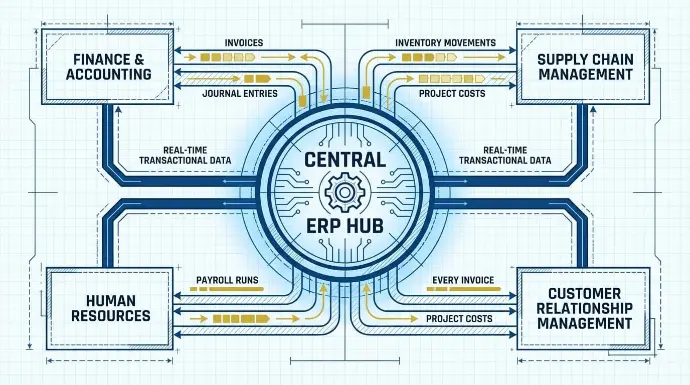
ERP software is the system that runs your company’s core operations and records your financial data.
An ERP system captures transactional data across the organization in real time, ensuring every invoice, journal entry, and inventory movement flows into one controlled environment.
Every invoice, journal entry, inventory movement, payroll run, and project cost flows into one controlled environment. That is what makes ERP the backbone of financial management.
At a practical level, ERP brings structure to your business processes. It connects:
- Finance and accounting
- Supply chain management
- Human resources
- Customer relationship management
Instead of separate tools and spreadsheets, you get a single, governed system that produces consistent operational data.
This is why most organizations implement ERP before anything else. It creates discipline around business processes and provides reliable transactional data for audits and reporting.
According to the 2024 ERP Report published by Panorama Consulting Group, the median ERP implementation costs approximately $450,000 and requires 15.5 months for mid-size organizations. US SMB projects often range from $60,000 to $300,000 over 3 to 9 months. It is a significant investment because it touches the entire organization.
Where ERP begins to strain is not in daily accounting. It is in financial consolidation and forward-looking performance management. ERP is built to record what happened. It is not designed to model complex multi-entity consolidation logic or advanced planning scenarios.
That is where ERP and EPM architectures diverge. ERP remains the system of record for transactional data and financial management. EPM systems and epm solutions sit on top of that foundation, transforming operational data into governed consolidation, forecasting, and strategic insight.
Understanding that boundary prevents you from forcing ERP to do work it was never designed to handle.
What Is EPM? Enterprise Performance Management Explained
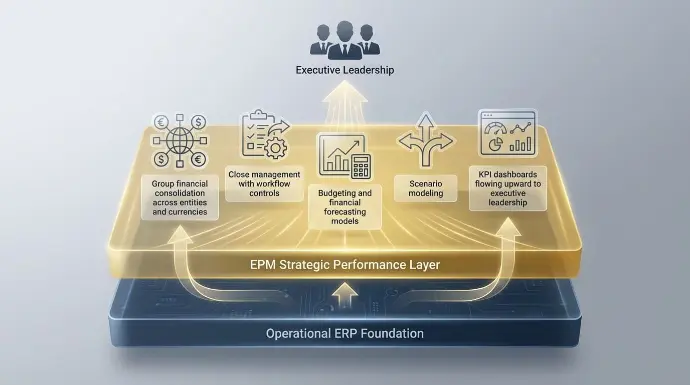
If ERP records what happened, EPM focuses on what it means and what happens next.
Enterprise performance management is the layer that sits on top of your ERP and other systems. It pulls together financial and operational data from ERP, CRM, HR, and more, then turns it into structured financial consolidation, forecasting, and strategic insight.
For finance teams, EPM typically supports:
- Group financial consolidation across entities and currencies
- Close management with workflow controls and audit trails
- Budgeting and financial forecasting using driver-based models
- Scenario modeling for acquisitions, cost changes, or growth plans
- KPI dashboards for executives and boards
In simple terms, ERP balances the books. EPM helps decide where to invest next.
The EPM market reflects the criticality of this layer. It was valued at roughly $7 billion in 2024 and is projected to reach about $9.4 billion by 2029, growing at a 5.9% CAGR. Oracle leads with 20.3% market share, followed by SAP, Anaplan, BlackLine, and OneStream. The top ten vendors control nearly 78% of the market.
Modern cloud-based EPM solutions such as OneStream, Planful, Vena, Prophix, and IBM Planning Analytics are replacing complex Excel consolidation files. These EPM tools manage versions, enforce workflows, and embed audit trails directly into the process. What used to live in fragile spreadsheets becomes a governed, repeatable system.
Unlike ERP, EPM is usually finance-led. Implementations often take 2 to 6 months rather than a year or more. That shorter timeline means faster time to value and less disruption, especially when your close is already under pressure.
When spreadsheets start driving consolidation and forecasting, you are already doing EPM informally. The real question is whether you want it governed or improvised.
ERP vs EPM: Core Differences and How They Work Together
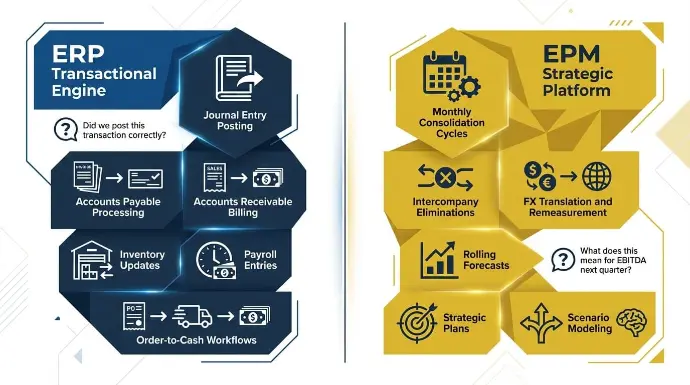
When finance leaders say, “Our close keeps getting longer,” the issue is rarely effort. It is architecture.
ERP and EPM serve different technical purposes. When those boundaries are unclear, you see Excel-based eliminations, manual FX files, and top-side adjustments floating outside the system.
Let’s break down the differences clearly.
Focus and Time Horizon: Operational Processing vs Planning Cycles
ERP systems such as SAP S/4HANA, Oracle NetSuite, Microsoft Dynamics 365, and Workday Financials are transactional engines.
They handle:
- Journal entry posting to the general ledger
- Accounts payable invoice processing and 3-way PO matching
- Accounts receivable billing and cash application
- Inventory subledger updates
- Payroll and human resources entries
- Order-to-cash and procure-to-pay workflows
Everything is transaction-based and time-stamped. ERP is built to support daily operational execution and financial compliance.
EPM platforms such as OneStream, Oracle FCCS, SAP Group Reporting, Planful, or Vena operate at a different layer.
They manage:
- Monthly group consolidation cycles
- Intercompany eliminations
- FX translation and remeasurement under ASC 830 or IAS 21
- Rolling forecasts across 12–18 months
- Long-range strategic plans
- Scenario modeling for M&A or capital allocation
ERP answers: Did we post this transaction correctly?
EPM answers: What does this mean for EBITDA next quarter?
We have worked with multi-entity groups where the ERP handled local-entity accounting perfectly, but group-level consolidation across 15+ entities in 3 currencies was maintained in Excel. That is where EPM becomes structurally necessary.
Data Structure: Subledger Detail vs Consolidation Model
ERP operates at subledger level granularity.
For example:
- Inventory movements update item-level perpetual inventory records
- Each AP invoice is linked to vendor master data and GL accounts
- Revenue entries tie back to sales orders and customer records
- Cost accounting entries flow through cost centers and profit centers
This detailed structure supports audit trails and statutory financial reporting.
EPM systems build a consolidated data model on top of that structure.
They introduce:
- Entity hierarchies with ownership percentages
- Consolidation methods such as full consolidation, the equity method, or proportional consolidation
- Chart of accounts mapping across multiple ERPs
- Intercompany matching and elimination logic
- Automated FX rate application using average and closing rates
For example, if a US entity invoices a UK subsidiary, ERP records the transaction locally. EPM identifies the intercompany pair, eliminates revenue and expense at the group level, and translates balances using proper FX rates.
Without EPM, that logic often sits in Excel pivot tables and manual elimination journals.
Reporting Scope: Statutory Books vs Multi-Layer Reporting
ERP reporting is primarily statutory and operational.
Examples include:
- Trial balance reports
- AR aging schedules
- Inventory valuation reports
- GL detail exports
- Standard financial statements per entity
These reports are necessary for compliance and audits.
EPM expands the reporting scope significantly.
It supports:
- Consolidated financial statements across 10–50 entities
- Parallel reporting frameworks such as US GAAP and IFRS
- Management P&L structures are different from statutory COA
- Driver-based planning models tied to revenue drivers or headcount
- Board-ready dashboards with KPIs and variance commentary
In one engagement, the ERP produced accurate entity-level financials. But management reporting required reclassifications and segment reporting adjustments outside the system. EPM formalized that logic and eliminated 40+ recurring top-side journals.
Architectural Role: System of Record vs Performance Layer
ERP remains the system of record. It owns:
- Transaction posting
- Subledger detail
- Audit trail integrity
- Financial compliance
EPM becomes the governed performance layer. It owns:
- Consolidation workflow
- Close task management
- Budget and forecast versions
- Scenario modeling
- Board-level reporting
When ERP and EPM are properly integrated through APIs or flat-file connectors:
- GL balances flow automatically from ERP to EPM
- Master data, such as entities and cost centers, synchronize
- FX rates are updated centrally
- Intercompany transactions are matched systematically
In several ERP and EPM rescue projects we have led, the biggest risk was not software capability. It was the presence of dual systems of truth: ERP versus consolidation spreadsheets. That creates audit exposure and lender distrust.
High-performing finance organizations design ERP and EPM as complementary layers. ERP captures transactions with precision. EPM governs performance management with structure and transparency.
That architectural clarity is what prevents the Excel shadow system from taking over your close.
Book My Free ERP Impact Assessment with Cudio
The Excel Shadow System Trap: Why ERP Alone Stops Working
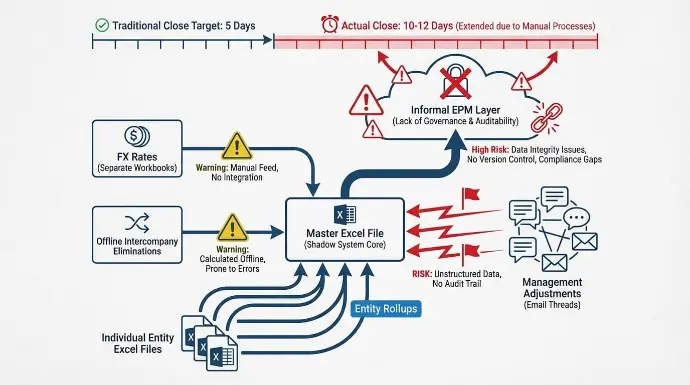
When we step into consolidation diagnostics, we rarely see a failing finance team. We see a team that has outgrown its architecture.
It usually starts during a growth phase. The company expands from five entities to fifteen across the US, UK, and EU. Intercompany transactions increase. FX translation under ASC 830 or IAS 21 becomes more layered. Partial ownership structures require more sophisticated eliminations. The ERP’s built-in consolidation module begins to strain.
No one makes a formal decision to leave the ERP. It happens gradually.
- Entity rollups move into a master Excel file
- FX rates are maintained in separate workbooks
- Intercompany eliminations are calculated offline and posted as top-side journals
- Management adjustments live in email threads
At first, it feels manageable. Then the close stretches from five days to ten or twelve. Reconciliation meetings increase because the ERP trial balance does not tie to the management P&L. Auditors request deeper support for manual journals. Statutory and management views slowly drift apart.
Now there are two versions of truth: the ERP ledger and the consolidation spreadsheet.
We have helped multiple mid-market groups unwind this Excel Shadow System before it became a material control issue. The realization is always the same. The team already built an informal EPM layer inside Excel. It just lacks governance, workflow control, and auditability.
At that point, the question is no longer whether ERP works. It is whether the architecture still does.
Architectural Trigger Points: When You Need EPM in Addition to ERP
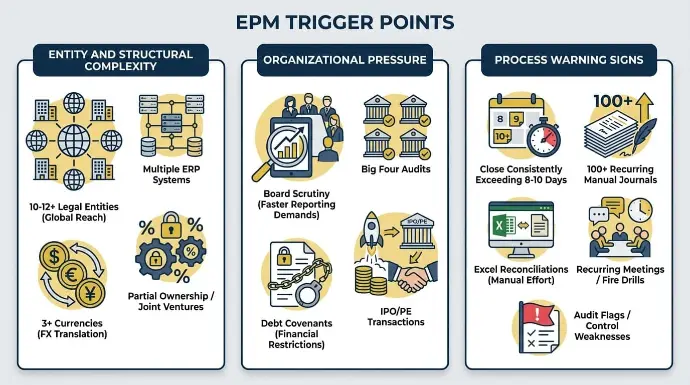
From our experience working with mid-market finance teams, the ERP vs EPM discussion is rarely about features. It is about thresholds. At a certain point, growth creates structural pressure that ERP alone was never designed to absorb.
We typically see three categories of triggers.
Entity and Structural Complexity
Architecture strain becomes visible when:
- You are consolidating more than 10–12 legal entities
- You inherit multiple ERP systems after acquisitions with inconsistent charts of accounts
- You operate in 3+ currencies with recurring FX translation and remeasurement adjustments
- You manage partial ownership, joint ventures, or minority interests
At this stage, consolidation logic becomes increasingly manual, even if the ERP technically “supports” it.
Organizational Pressure
The urgency increases when:
- Board scrutiny demands faster, cleaner reporting
- A first Big Four audit introduces higher documentation standards
- Debt covenants require certified consolidated financials
- An IPO, PE transaction, or strategic sale is on the horizon
Governance expectations rise faster than ERP consolidation modules can adapt.
Process Warning Signs
We advise leaders to watch for these operational indicators:
- Close consistently exceeding 8–10 days
- More than 100 recurring manual consolidation or allocation journals each month
- Intercompany and FX reconciliations are handled primarily in Excel
- Recurring “numbers don’t match” meetings
- Auditors flagging manual journals as control weaknesses
When these signals appear together, you are not evaluating whether to add EPM. You are formalizing the shadow system already running in spreadsheets.
Book My Free ERP Impact Assessment with Cudio
ERP vs EPM: Focus, Implementation, and Reporting Compared
After working across complex ERP environments and rescuing failed finance system projects, we’ve seen this confusion firsthand. ERP and EPM are not competing systems — they sit at different layers of the finance architecture.
Here’s the side-by-side reality:
Dimension | ERP (Enterprise Resource Planning) | EPM (Enterprise Performance Management) |
Primary Purpose | Execute and record daily business operations | Govern consolidation, planning, and performance management |
Core Focus | Transaction processing and operational control | Financial consolidation, forecasting, and executive insight |
Time Orientation | Backward-looking (what happened) | Forward-looking (what will happen) |
Data Level | Detailed transactional data (invoice lines, journal entries, inventory movements) | Aggregated financial data structured by entity, segment, cost center |
Users | Finance, procurement, warehouse, HR, operations | CFO, Controller, FP&A, executive leadership |
Ownership | IT + Finance partnership | Finance-led initiative |
Typical Timeline | 6–18+ months | 2–6 months |
Mid-Market Cost Range (US) | $60,000–$300,000 (SMB); $450,000+ median for larger rollouts (Panorama 2024) | Lower upfront investment; faster ROI through reduced close time |
Reporting Scope | Trial balance, AR/AP aging, inventory, and statutory financials | Consolidated financials, board packs, rolling forecasts, scenario modeling |
Architectural Role | System of record | System of reference for performance |
What This Means in Practice
ERP keeps the books clean.
EPM keeps the story coherent.
When both are properly aligned, finance operates with a single, governing version of the truth. When they are not, spreadsheets fill the gap, and that’s when close timelines stretch, audit risk increases, and confidence erodes.
If your architecture feels strained, that’s not a failure. It’s usually a growth signal.
How ERP and EPM Integrate in a Modern Finance Stack
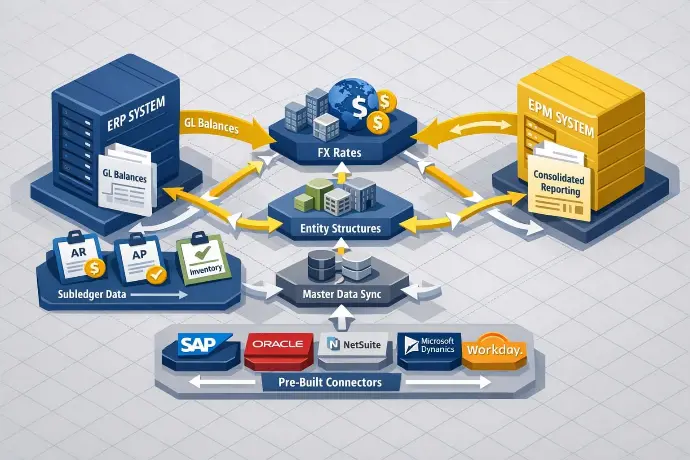
In a well-designed finance architecture, ERP and EPM systems are not competing platforms. They are layered deliberately. ERP captures detailed operational data across core business processes. EPM software transforms ERP data into governed consolidation, financial, and strategic planning models that support business performance.
Think of it as flow, not duplication.
How the Data Moves
In practice, integration typically looks like this:
- GL balances flow from ERP into EPM for multi-entity consolidation
- Subledger data, such as AR, AP, and inventory management, supports cash flow forecasting and operational modeling
- FX rates, entity structures, and master data synchronize across ERP and EPM systems
- ERP data is mapped into standardized hierarchies inside EPM for consistent board and management reporting
Modern EPM software platforms provide pre-built connectors for SAP, Oracle NetSuite, Microsoft Dynamics, and Workday Financials. That reduces integration complexity and shortens the timeline compared to a full ERP implementation.
Why This Architecture Matters
When ERP and EPM systems are structured correctly:
- ERP continues running daily transactions across finance, supply chain, and human resources
- EPM governs consolidation, forecasting, and strategic planning
- Finance operates from one aligned reporting layer
The biggest advantage appears during change. If you acquire a company running a different ERP, the EPM layer absorbs and standardizes the new ERP data without forcing an immediate reimplementation. Historical comparability survives. Business strategy stays intact.
2026 Scenario Example
Consider a manufacturing group running SAP in Europe and NetSuite in North America after a 2024 acquisition. Instead of launching a multi-year global ERP implementation, they deploy OneStream as the EPM layer.
The result:
- Both ERPs continue to support local operations
- EPM consolidates global financials
- A unified budget and forecast spans all regions
- Strategic planning happens from one governing source
ERP vs EPM: Cost, Risk, and Value Compared
When evaluating architecture, clarity helps. Below is a side-by-side comparison focused on what actually matters to finance leaders.
Dimension | ERP | EPM |
Typical Investment (US Mid-Market) | $60,000–$300,000 for SMB; ~$450,000+ median for larger rollouts | Lower upfront investment; typically finance-led deployment |
Implementation Timeline | 6–18 months, sometimes longer for global rollouts | 2–6 months with phased delivery |
Primary Cost Driver | Enterprise-wide process redesign and system configuration | Consolidation logic, planning models, and reporting frameworks |
Hidden Cost Risk | Spreadsheet shadow systems if consolidation outgrows ERP | Poor data mapping or rushed model design |
Customization Risk | Over-customization can block upgrades and increase long-term maintenance | Rebuilding messy Excel logic without rationalizing processes first |
Operational Risk at Scale | Manual reconciliations, key-person dependency, upgrade complexity | Change management challenges for finance teams transitioning from Excel |
Primary Value Delivered | Clean transactional backbone and operational control | Faster close, governed consolidation, structured forecasting |
Strategic Impact | Enables daily execution across departments | Strengthens board reporting, scenario modeling, and long-range planning |
Best Used For | Recording and managing transactions across the enterprise | Consolidation, performance management, and forward-looking analysis |
ERP protects operational integrity. EPM protects financial credibility. The strongest finance organizations design both intentionally, rather than stretching one tool beyond its architectural limits.
Choosing ERP, EPM, or Both: A Finance-First Decision
The decision is rarely ERP or EPM. It is about understanding where your complexity sits today and where it will be in three to five years.
If you operate a single entity in a single currency with a clean close within 5 days, a well-structured ERP may be enough for now. But once you move into multi-entity consolidation, multi-currency reporting, board-level forecasting, or recurring Excel-based eliminations, an EPM layer becomes structural rather than optional.
The key is to design the architecture intentionally before the spreadsheet shadow system becomes your real system of record.
At Cudio, we help finance leaders assess close timelines, consolidation complexity, and reporting risk to determine whether ERP optimization, EPM implementation, or an integrated architecture makes the most sense. With 30+ years of combined technology and finance experience and 35+ failing projects rescued, our team focuses on governance, clean data design, and phased rollout strategies that reduce risk.
If your close is stretching or your numbers require monthly reconciliation meetings, it may be time to deliberately architect the right layer rather than reactively.
Book My Free ERP Impact Assessment with Cudio
Conclusion
ERP and EPM are not competing tools. They serve different layers of performance management. ERP helps streamline operations across core processes such as accounts receivable, accounts payable, inventory, and operational reporting. EPM strengthens reporting capabilities, supports accurate forecasting, and helps leadership evaluate performance across entities, currencies, and business units.
As the operating scope expands, relying on separate systems and spreadsheets creates risk. Integrating ERP with EPM creates a unified system in which transactional data feeds into a governed performance management framework, aligning financial and operational results with strategy and future growth.
The real question is not ERP or EPM. It is whether your architecture supports the complexity you already have.
If you are reassessing your close process or considering integrating ERP into a broader performance management framework, our team at Cudio can help you evaluate the right path. We focus on practical, phased strategies that protect data integrity while positioning your finance function for scalable growth.
Book My Free ERP Impact Assessment with Cudio
FAQs
Got more questions about ERP, EPM, or your close process? Here are clear answers to the questions finance leaders ask most.
Can EPM replace ERP entirely?
No, EPM cannot replace ERP entirely. ERP runs your transactional engine: journal entries, accounts payable and receivable, inventory, payroll, and order-to-cash. EPM relies on that ERP data for consolidation, planning, and analysis. EPM enhances performance management; it does not replace the system of record.
Which should we implement first: ERP or EPM?
Which you implement first depends on your current pain. Most organizations implement ERP first to stabilize core processes and ensure clean transactional data. However, if you operate multiple ERPs or are mid-upgrade, deploying EPM first can centralize consolidation and reporting. The right sequence depends on architectural risk, not vendor preference.
Can a small or mid-sized business benefit from EPM, or is it only for large enterprises?
Yes, a small or mid-sized business can benefit from EPM, but only when complexity justifies it. If you have 5–12 entities, multiple currencies, or heavy Excel-based consolidation, EPM often delivers fast ROI. Single-entity companies with simple reporting typically do not need it yet. Complexity, not company size alone, is the trigger.
How long does it typically take to integrate ERP and EPM?
Integrating ERP and EPM typically takes weeks for basic GL data connections and 2–6 months for full consolidation and planning rollout. Pre-built connectors to systems like NetSuite, SAP, and Dynamics accelerate the process. The timeline depends on entity count, currencies, and reporting requirements. It is generally much faster than a full ERP implementation.
What does an ideal ERP + EPM architecture look like by 2026?
An ideal ERP + EPM architecture keeps ERP as the transactional backbone and EPM as the governed performance layer. ERP manages daily operations; EPM handles consolidation, budgeting, forecasting, and scenario modeling. Excel becomes supplemental, not structural. The result is one trusted, auditable version of financial truth across the organization.