



Odoo is the superior choice for growing mid-to-large enterprises requiring a polished, modular SaaS solution with extensive local support, while ERPNext is the best fit for cost-conscious SMEs or tech-savvy teams. Before making a decision, you may also want to review a Dolibarr vs Odoo comparison to see how Odoo stacks up against other open-source ERPs.
Both platforms are popular open-source ERP systems that offer flexibility, modularity, and robust features for businesses of all sizes. However, when it comes to customization, inventory management, affordable pricing, and long-term scalability, the differences matter.
This comparison guide on Odoo vs ERPNext delivers the clarity you need to choose the best-fit ERP solution for your goals, team, and growth trajectory. You may also want to compare Odoo and Microsoft Dynamics 365.
Key Takeaways
- ERPNext is tailored for small and medium-sized businesses, offering simplicity and cost-effectiveness, while Odoo is more comprehensive with advanced features suitable for larger enterprises. According to Appvizer's 2025 comparison, Odoo dominates in functional depth and user experience, making it the preferred choice for larger enterprises with complex workflows.
- Odoo enables extensive no-code changes via Odoo Studio, whereas ERPNext requires developers to modify the underlying Python and JavaScript code.
- Pricing models vary: ERPNext is more predictable and cost-effective for small businesses, while Odoo’s user-based pricing can lead to higher costs but offers greater scalability and a broader feature set.
How Do ERPNext and Odoo Compare at a Glance?
Before diving deeper, here’s a side-by-side snapshot of how Odoo and ERPNext stack up across key ERP decision factors. This table highlights pricing, deployment, customization, and support differences to help you quickly gauge which system fits your business needs best.
The right choice depends heavily on your specific workflows, scale, and growth plans — talk to an Odoo expert before committing to a platform to get an honest assessment of which system fits your business.
Feature | Odoo | ERPNext |
Best For | SMEs to large enterprises with complex workflows and a need for third-party integrations. These are often the same businesses that have outgrown spreadsheets and need an ERP. | Small to medium-sized businesses looking for a free, developer-friendly, open source ERP |
Deployment Options | SaaS (Odoo Online), Odoo.sh (PaaS), On-premise | Frappe Cloud (SaaS), Self-hosted, On-premise |
Licensing Model | Per user pricing (Standard & Custom plans) | Free for Community, paid for support/hosting |
Starting Price | $10.90/user/month (Custom Plan) | $5/month (Shared Hosting) or free (self-hosted) |
Implementation Time | 2–12 weeks | 4–16 weeks (varies by complexity and team size) |
Customization Flexibility | High, via Odoo Studio and open-source modules | High, but requires developer skill (Python, JS) |
Built-in Modules | 40+ apps (CRM, MRP, HR, POS, Accounting, etc.) | 20+ modules (HR, Accounting, Projects, Stock, etc.) |
Third-Party Integrations | Moderate (via Odoo App Store + APIs) | Moderate to high (API-first, developer-friendly) |
Support Model | Paid support through Odoo partners or plans | Community support, Frappe Support (paid tiers) |
TCO (3 Years) | $20k–$250k+ | $5k–$80k+ depending on hosting and support |
Still unsure which platform fits your workflow? Speak with an Odoo vs ERPNext specialist to get a side-by-side analysis based on your actual business processes.
What Is Odoo?
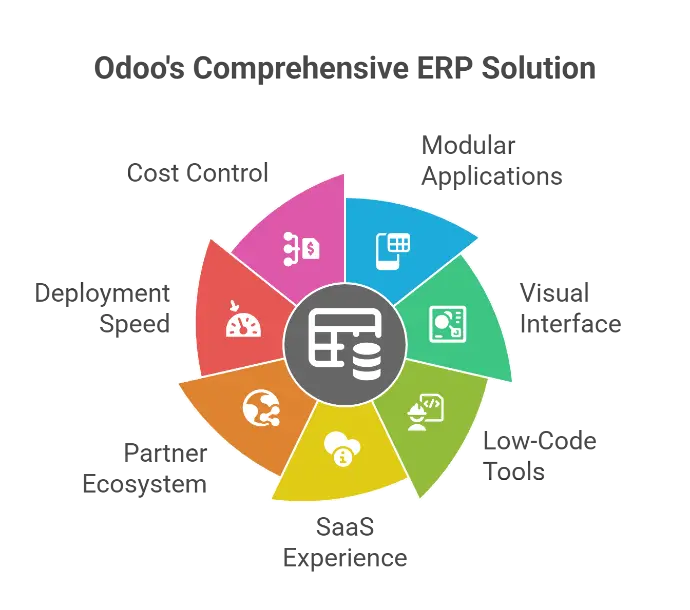
Odoo is a comprehensive, modular open-source ERP designed to support rapid scaling across all industries. With over 40 built-in applications, it streamlines operations ranging from accounting and CRM to inventory and manufacturing within a unified framework. Its defining feature is its polished visual interface and 'Odoo Studio' tools, which empower non-technical users to customize workflows without writing code.
In the market, Odoo positions itself as a business-ready alternative to complex enterprise systems, balancing usability with power. Unlike ERPNext's developer-centric approach, Odoo offers a polished SaaS experience similar to Apple's ecosystem, backed by a global network of certified partners. This makes it the ideal choice for companies prioritizing quick deployment and user adoption over total code control.
Key advantages over ERPNext include:
- A larger ecosystem of certified implementation partners, like Cudio, is making it easier to deploy and maintain
- Visual low-code tools that reduce reliance on developers
- A polished user interface and smoother learning curve
- Access to both free Community Edition and paid Enterprise Edition with advanced features
Ideal for companies that want quick deployment, modular scalability, and integrated business tools out of the box, Odoo suits those prioritizing efficiency, cost control, and usability. This is particularly true when compared to ERPNext's more hands-on approach.
Schedule A FREE Consultation Today!
What Is ERPNext?
ERPNext is an open-source ERP platform developed by Frappe, designed for simplicity, transparency, and control. It supports a wide range of industries through deep, domain-specific modules and is especially attractive to businesses with strong internal technical teams. ERPNext enables companies to self-host or run their systems on Frappe Cloud, with no per-user pricing and complete access to the source code.
While Odoo appeals to users seeking polished interfaces and out-of-the-box integrations, ERPNext caters to businesses that value open governance, cost transparency, and engineering-driven flexibility. The system is built on Python and JavaScript, offering developers a clean and predictable foundation for building complex ERP environments without vendor lock-in.
How ERPNext differs from Odoo:
- More straightforward UI and a more developer-oriented customization model, making it ideal for teams with in-house technical expertise
- No per-user licensing, unlike Odoo’s user-based pricing model, which can grow costs with scale
- Strong focus on industry-specific modules, such as education, non-profit, and agriculture
- Hosted and supported via Frappe Cloud, or fully self-managed, depending on the organization’s needs
In contrast to Odoo’s approach of rapid deployment through a partner ecosystem, ERPNext expects users to either manage deployment internally or engage directly with Frappe. This gives teams full ownership and lower long-term costs, but can add complexity during the setup phase.
How Do the Key Features of ERPNext and Odoo Differ?
Odoo Offers Superior Hosting Flexibility
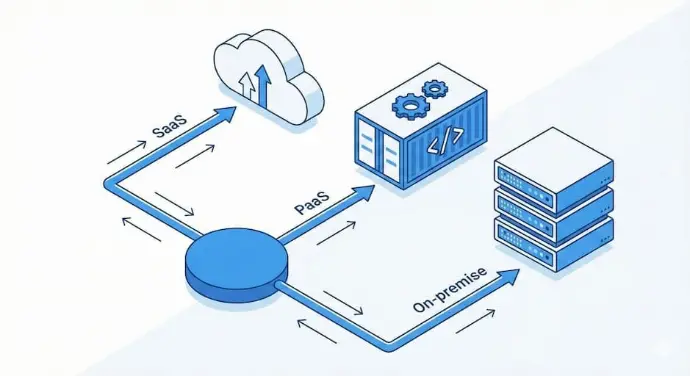
When it comes to hosting flexibility, Odoo clearly comes out on top. It supports on-premise installations, fully managed cloud hosting via Odoo Online, and a hybrid option with Odoo.sh. This setup lets businesses choose what best fits their internal resources, compliance needs, or technical preferences.
ERPNext is more limited. Self-hosting is an option, but it puts the burden of setup, maintenance, and upgrades on your internal team. Frappe Cloud makes things easier. Still, it is mostly geared toward smaller teams or basic implementations. For more advanced infrastructure or enterprise-level reliability, options are thin.
Our analysis of 50+ ERP implementations confirms that Odoo offers superior deployment flexibility. It provides three distinct paths: strict SaaS (Odoo Online), PaaS for custom Odoo development services, and full on-premise hosting.
Odoo Leads in Low-Code Customization
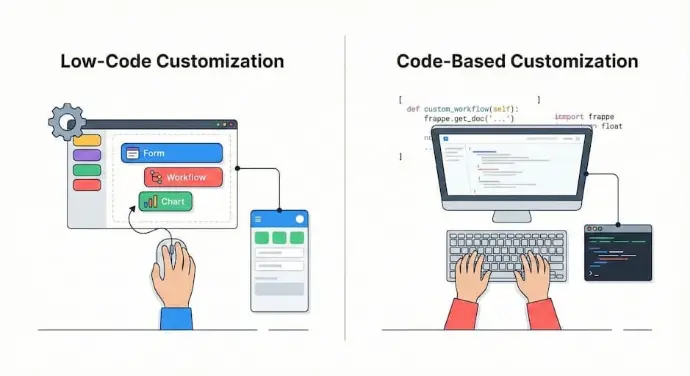
Odoo leads the market in customization flexibility thanks to its low-code 'Odoo Studio' architecture. This tool allows users to tweak workflows, modify fields, and build entirely new applications using a drag-and-drop interface, requiring zero knowledge of Python or XML. This capability significantly reduces reliance on expensive developer hours for routine modifications.
For developers, Odoo’s large ecosystem and extensive documentation make it even more versatile.
ERPNext is fully open source and also highly customizable, but the catch is you’ll need strong Python and Frappe framework knowledge to get anything meaningful done. There’s no built-in low-code tool like Odoo Studio, and while the backend is flexible, the learning curve is steeper unless you have a technical team in place.
Both platforms support custom modules and third-party integrations, but Odoo’s App Store is far more active, with thousands of ready-to-use extensions that reduce deployment time. ERPNext has a growing community, but the ecosystem is smaller, and updates can lag.
Odoo wins again for offering both low-code flexibility and deep dev control. ERPNext has power under the hood, but requires much more technical lift to get there.
Odoo Provides Deeper Accounting Capabilities
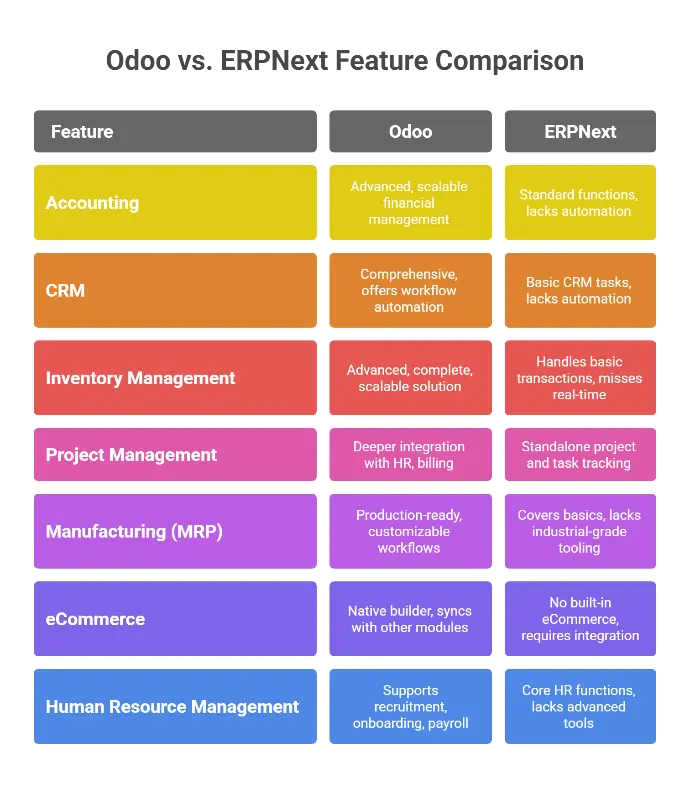
Odoo and ERPNext both offer a wide array of built-in ERP modules, but their depth, maturity, and business-readiness vary across categories. This section breaks down the major functional areas to help you assess which ERP aligns better with your operational needs.
Accounting
Odoo delivers more advanced accounting capabilities. It supports multi-currency and multi-company setups, real-time bank reconciliation, analytical accounting, and automated tax handling. These features integrate smoothly with sales, purchase, and inventory modules. ERPNext covers standard functions like journals, invoicing, and basic tax rules, but it lacks advanced automation and requires more manual input.
For businesses that need robust, scalable financial management, Odoo stands out as the more complete solution. ERPNext remains a solid option for smaller operations with simpler accounting workflows.
CRM
Odoo’s CRM module is more comprehensive. It offers drag-and-drop pipelines, lead scoring, activity tracking, and seamless integration with email, marketing, and quotations. Automation features allow non-technical users to build custom flows. ERPNext handles basic CRM tasks such as lead tracking and opportunity stages, but lacks workflow automation and broader integration.
If CRM is a growth lever in your business, Odoo’s features offer more control and visibility. ERPNext works well for foundational sales tracking but lacks deeper sales engagement tools.
Inventory Management
Odoo leads here by a wide margin. It supports advanced inventory operations like barcode scanning, batch and serial tracking, multi-warehouse transfers, dropshipping, and expiration dates. Everything is linked directly to purchasing and sales. ERPNext handles multi-warehouse and stock ledger transactions well, but it misses real-time tracking tools and complex fulfillment logic.
For inventory-intensive businesses like retail, wholesale, or manufacturing, Odoo provides a much more complete and scalable solution.
Project Management
Both platforms provide project modules with task assignments, timelines, and timesheet logging. However, Odoo allows deeper integration with HR, billing, and sales, turning projects into client revenue engines. You can invoice timesheets, track project profitability, and connect everything to payroll. ERPNext is simpler, offering standalone project and task tracking without strong links to other areas.
Odoo is better suited for businesses that need financial accountability tied to projects. ERPNext is sufficient for internal task management or teams with basic needs.
Manufacturing (MRP)
Odoo’s manufacturing module is production-ready. It supports routings, work centers, subcontracting, maintenance, and quality checks. With Odoo Studio, workflows can be customized without development. ERPNext covers the basics, such as Bill of Materials and work orders, but lacks the industrial-grade tooling needed for high-volume production or compliance-heavy sectors.
Odoo is clearly the stronger choice for manufacturers needing flexibility and depth. ERPNext may work for small batch producers or workshops, but it scales with difficulty.
eCommerce
Odoo includes a native eCommerce builder that syncs directly with inventory, accounting, CRM, and shipping. You can launch a storefront without third-party plugins, accept payments, manage products, and track orders end-to-end. ERPNext does not offer built-in eCommerce. Integrating with platforms like Shopify or WooCommerce is possible, but it requires configuration and adds points of failure.
For businesses selling online, Odoo offers a clear advantage through native integration and simplicity. ERPNext requires more setup and maintenance to achieve the same outcomes.
Human Resource Management
Odoo’s HR module supports recruitment, onboarding, attendance tracking, time off, payroll, and performance evaluations. You can automate payslip generation, create appraisal cycles, and track employee documents in one place. ERPNext provides core HR functions like employee records, payroll, and leave management, but lacks advanced tools for performance or recruitment out of the box.
Odoo is the better option for businesses with growing teams and structured HR processes. ERPNext handles basic needs but often requires extensions or customization for anything beyond that.
Ease of Use
Choosing an ERP that’s easy to learn and pleasant to use can make or break user adoption. Here’s how Odoo and ERPNext compare when it comes to usability.
Odoo feels like a modern SaaS tool. The interface is clean, intuitive, and well-designed for non-technical users.
- Visual dashboards and drag-and-drop tools make navigation simple
- Odoo Studio allows workflow tweaks without needing code
- In-app prompts help guide users through key processes
- The mobile app is full-featured and works out of the box
It’s a strong choice for teams that want to get up and running fast without relying heavily on IT.
ERPNext keeps things lean, but that comes at the cost of a smoother onboarding experience.
- The interface is simple, but not as refined
- Few in-app tips or guided walkthroughs
- Mobile experience is limited and may require third-party workarounds
- Some customizations need developer support
It works well for teams with in-house tech skills or those willing to spend time learning the system.
Odoo takes the win here. It’s simply more user-friendly, especially for small to medium teams who want to move fast and minimize friction.
Integration Capabilities
Integration capabilities are critical for any ERP solution. Both ERPNext and Odoo integrate various core business functions, facilitating efficient operations and data flow. ERPNext supports integration with third-party systems via an API-first approach, enabling seamless connectivity with a wide range of applications — and if you're evaluating Odoo on this front, exploring Odoo integration services and API connectivity can clarify how it handles those same connections.
Odoo natively integrates with major global platforms to centralize data flow:
- E-commerce: Seamless connectors for Amazon, eBay, and Shopify.
- Payments: Native support for PayPal, Stripe, and regional gateways.
- Productivity: Bi-directional sync with Google Workspace.
The platform’s official support for third-party applications and third-party services further enhances its versatility, making it a robust choice for businesses with complex operations.
Implementation Time & Complexity
ERP systems aren't plug-and-play. But how quickly you can go live and how much hassle it takes vary a lot between Odoo and ERPNext.
Odoo is known for relatively fast implementations, especially if you're working with the Standard or Online plans and avoiding deep customizations.
- Average implementation time: 2 to 12 weeks for small to mid-sized projects
- Many official partners, such as our team at Cudio, offer ready-made implementation packages
- Extensive documentation and prebuilt templates speed things up
- The risk of complexity increases if you go heavy on custom modules or onOdoo.sh deployment
Odoo also supports phased rollouts, which helps medium businesses start small and scale over time.
ERPNext can be fast if you're self-hosting and keeping things simple. But enterprise-level deployments tend to stretch timelines.
- Typical timeline: 3 to 9 months for larger, customized setups
- Requires more technical hands-on work, especially if you're not using Frappe Cloud
- Fewer certified partners mean DIY or freelance-led implementations are more common
- More likely to experience scope creep if your business needs shift mid-project
ERPNext favors teams that have in-house tech support or time to gradually figure things out.
Odoo wins on speed and structure. While ERPNext is flexible, Odoo offers a more straightforward launch path with more support, especially for businesses that want to avoid surprises.
Schedule A FREE Consultation Today!
Community and Support Services
A platform’s community and support services significantly affect its usability and long-term success. ERPNext’s large and active community comprises over 30,000 customers and 20,000 developers, indicating strong community support and engagement. The platform offers a support portal with a knowledge base and customer service features for managing support tickets.
Odoo’s community and support ecosystem includes:
- A larger Odoo community with more active contributors compared to ERPNext’s community.
- Community support and paid support services through Odoo SA, catering to diverse user support needs.
- An extensive network of developers and partners offering custom modules, extensions, and integrations, enhancing the support ecosystem.
While ERPNext’s community is active, Odoo’s larger and more engaged community provides a broader range of resources and support options. This difference can be crucial for businesses seeking extensive customization and third-party services.
Pricing & Licensing
When it comes to pricing, ERPNext and Odoo follow very different models, and those differences matter depending on your company size and how you scale.
Let’s start with Odoo. It offers an obvious per-user pricing model: $7.25/month for the Standard plan and $10.90/month for the Custom plan. Both plans include all apps, with unlimited features and usage. There’s even a One App Free plan that's actually usable for basic setups like accounting or CRM, especially for startups.
In contrast, ERPNext is technically free and open-source if you host it yourself. But most businesses opt for Frappe Cloud, which starts around $5/month for shared hosting. Dedicated hosting or enterprise-grade support plans can push it to $200 to $400+ per month, depending on compute power and SLAs.
Here’s a quick breakdown to compare:
Pricing Element | Odoo | ERPNext |
Base License | $10.90/user/month (Custom) | Free (Community Edition) |
$7.25/user/month (Standard) | $5+/month (Frappe Cloud, Shared) | |
Pricing Model | Per-user, flat fee for all apps | Per-site/server, not user-based |
One App Free Plan | Yes, for unlimited users | Not available |
Hosting | Odoo Online (included) orOdoo.sh (extra) | Frappe Cloud or self-hosted |
Implementation Services | $5,000 to $100,000+ | DIY to $50,000+ (via partners) |
Custom Development & Add-ons | Pay-as-you-go via partners | Case-by-case with freelancers or in-house |
Support Costs | Partner or Odoo team | Frappe or official support tier |
3-Year Total Cost | $20,000 to $250,000+ | $20,000 to $180,000+ |
ERPNext tends to be more cost-effective for small teams, especially when tech-savvy staff can handle self-hosting and updates. There are no per-user charges, which helps keep costs stable as your team grows. But that comes at the expense of added maintenance, dev time, and overhead.
Odoo, on the other hand, excels in providing a plug-and-play ERP experience. It may become pricier at scale due to its user-based billing, but its value increases when you factor in its modular architecture, included support, and full access to all modules out of the box.
For teams with in-house developers and a tight budget, ERPNext might be a better fit. But for those who want fewer moving parts, professional support, and a predictable deployment path, Odoo’s pricing model makes sense, especially for medium to large teams. It’s easier to manage, easier to budget for, and faster to scale without surprises.
Support & Community
Odoo has built an impressive global ecosystem. With over 3,000 official partners, support is easily accessible whether you're using Odoo Online,Odoo.sh, or hosting it yourself. Businesses can choose between Odoo's official support team or work with vetted Odoo partners like Cudio to handle everything from implementation to ongoing maintenance.
Community-wise, Odoo benefits from a massive user and developer base. Its App Store has thousands of third-party modules and tools, many of which are built by the community. That kind of resource pool makes it easier to troubleshoot, find plug-ins, or hire experts fast.
Odoo offers email-based support, free eLearning, and partner-managed services. Most commercial plans include official support, but if you're using the Community edition, support is mostly community-driven or partner-led.
ERPNext has a smaller but passionate community, mostly centered around Frappe and GitHub. The team behind ERPNext also maintains Frappe Cloud, offering paid support tiers and enterprise SLAs for clients who need help beyond the forums.
The community forum is active and helpful, but less extensive than Odoo’s. There are fewer implementation partners globally, which can be a limitation if you need hands-on, local assistance.
That said, ERPNext is open source and developer-friendly, so if you have in-house tech talent, you can often get away without needing formal support. But for non-technical teams, the steep learning curve and limited partner support in some regions might be a dealbreaker.
Schedule A FREE Consultation Today!
Summary
ERPNext appeals to smaller teams seeking a lean, open-source solution that’s highly customizable and developer-friendly. Its open-source nature offers complete control but may require more profound technical know-how.
Odoo, in contrast, suits growing or large businesses that prioritize core features, a modern UI, and faster deployment. With more native apps and polished integrations, Odoo supports complex workflows with less lift. Its broader customization options and scalable design make it a strategic pick for those needing flexibility and long-term agility.
If your ERP selection journey involves scaling, automation, or cross-team alignment, Odoo may help you improve efficiency more quickly with structured support and shorter time-to-value.
Need expert help navigating the choice between Odoo and ERPNext or implementing a solution that fits? Cudio specializes in ERP consulting and implementation, helping businesses deploy the right tools with lower risk and better ROI.
Schedule A FREE Consultation Today!
Frequently Asked Questions
Why is ERPNext better than Odoo?
ERPNext is often considered better than Odoo due to its user-friendly design and affordability, particularly for small and medium-sized businesses. Additionally, ERPNext allows unlimited users at no extra cost, making it a more cost-effective solution than Odoo's user-based pricing model.
What are the key differences between ERPNext and Odoo?
ERPNext and Odoo differ significantly in customization, user interface, pricing, and target markets. Odoo provides extensive customization and a modern design, while ERPNext is more straightforward and more cost-effective, making it particularly appealing for small businesses.
How do ERPNext and Odoo compare in terms of financial management?
Both ERPNext and Odoo enhance financial management, but ERPNext focuses on effective transaction and invoice management, while Odoo offers more advanced features for complex financial processes. Your choice should align with your specific business requirements.
What are the deployment and hosting options for ERPNext and Odoo?
Both ERPNext and Odoo provide versatile deployment and hosting options. ERPNext is best suited for cloud hosting, while Odoo offers a range of options, including Odoo Online, Odoo.sh, and on-premises deployments, providing flexibility and enhanced security.
How do ERPNext and Odoo support scalability for medium-sized businesses?
Both ERPNext and Odoo offer scalable solutions for medium-sized businesses through their modular architectures, allowing for customization and expansion as needs evolve. Odoo further enhances scalability through its extensive ecosystem of third-party applications, offering flexibility for diverse growth strategies.