



The hidden costs of technical debt in your wholesale distribution ERP rarely show up overnight. They creep in slowly through outdated workflows, fragile integrations, and systems that feel harder to maintain every year.
As legacy systems pile up, tech debt grows quietly. What once worked now creates delays, manual fixes, and rising support needs. The hidden costs add up fast, reducing operational efficiency and stretching teams thin.
Maintaining legacy systems often means spending more time fixing issues than improving performance. Addressing technical debt early helps control risk, reduce long term expenses, and restore flexibility before small problems turn into major roadblocks.
Key Takeaways
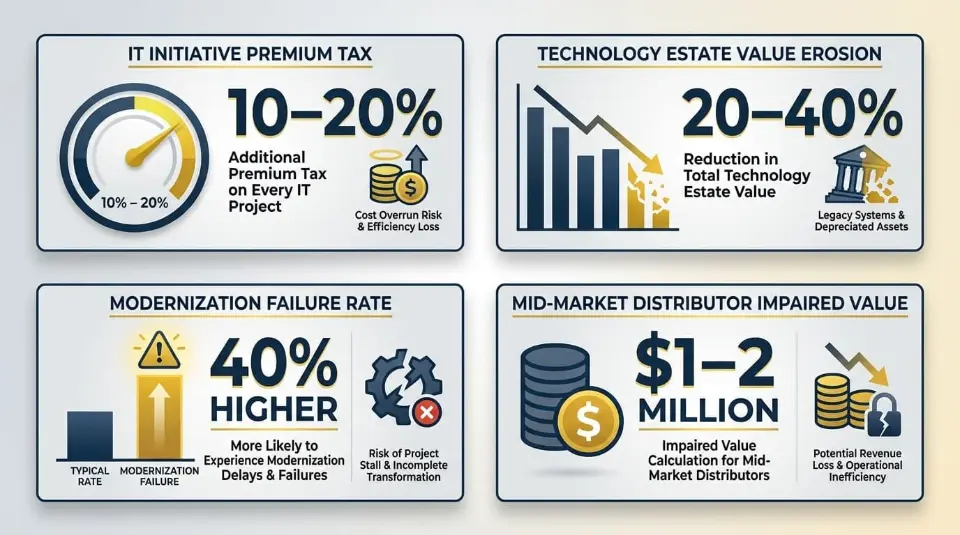
- McKinsey research shows that companies pay an extra 10–20% on every IT project just to work around technical debt, and CIOs estimate that total technical debt accounts for 20–40% of their technology estate's value.
- In wholesale distribution, ERP technical debt quietly inflates costs through manual order processing, brittle EDI and 3PL integrations, and expensive workarounds during seasonal peaks.
- Heavy ERP customization and poorly documented integrations make upgrades risky and slow, increasing downtime risk and blocking digital transformation efforts.
- Organizations with severe tech debt are 40% more likely to have incomplete or canceled modernization initiatives.
- A structured debt reduction roadmap, combining clean-core ERP principles, integration strategy, and phased remediation, can convert hidden ERP costs into measurable ROI within 6–18 months.
How Does ERP Technical Debt Impact Financial Performance?
ERP technical debt is not an abstract IT issue. It behaves much like financial debt, quietly adding interest to every system change your business makes.
A Built-In Cost Tax on Every Project
Technical debt functions as a permanent surcharge on innovation. McKinsey analysis (2024) confirms that organizations pay an additional 10–20% premium on every IT initiative solely to navigate legacy code and brittle dependencies.
For wholesale distributors operating on thin margins, this 'debt tax' directly erodes net profitability, turning routine ERP upgrades into capital-intensive overhaul projects.
Switching to a purpose-built platform can eliminate many of these hidden expenses — explore Odoo ERP solutions for wholesale distributors designed to unify purchasing, inventory, and sales in one system.
ERP upgrades, integrations, and enhancements often begin over budget before new value is even delivered. Over time, this recurring tax compounds, turning routine improvements into expensive undertakings.
Hidden Value Erosion Inside Your Technology Estate
The same McKinsey report shows that CIOs estimate that technical debt accounts for 20–40% of an organization’s technology estate. In many wholesale environments, a large portion of ERP investment no longer generates meaningful returns. Instead, capital remains tied up in outdated architecture and fragile system dependencies.
For a mid-market wholesale distributor with a $5 million ERP and IT footprint, that equals $1–2 million in impaired value tied up in outdated architecture and fragile dependencies that no longer support growth.
Why Modernization Efforts Stall
According to that same McKinsey analysis, organizations with the highest levels of tech debt are 40% more likely to experience delayed, scaled-back, or canceled modernization initiatives. As debt accumulates, the ERP shifts from an enabler of innovation into a structural barrier to future growth.
When Debt Turns Into Governance and Security Risk
Cost and speed are not the only concerns. The ISACA 2024 Emerging Tech Risk Report classifies technical debt as a governance failure that results in inefficient processes and reduced scalability.
In ERP environments, this often creates audit gaps, documentation weaknesses, and increased exposure to security vulnerabilities that surface during compliance reviews or investor due diligence.
Why ERP Debt Compounds Faster Than Expected
ERP systems are especially vulnerable because they are long-lived and deeply interconnected. SAP highlights that extensive customization, poorly documented integrations, and redundant data structures accelerate debt accumulation. These conditions increase future costs, slow upgrades, and limit the ability to adopt modern platforms without major remediation.
The Failure Risk Most Teams Underestimate
The combined effect of rising costs and structural complexity shows up in delivery outcomes. According to the 2023 Standish Group CHAOS Report, only 31% of IT projects achieve success, while 19% fail completely due to complexity overload.
ERP environments burdened by technical debt face even higher risk because every change interacts with fragile components.
What Are the Primary Symptoms of Technical Debt in Wholesale ERPs?
Technical debt rarely appears as a single broken feature. In wholesale ERP environments, it manifests as friction in daily operations. Tasks take longer. Changes feel risky. Teams avoid touching parts of the system because something unexpected often breaks.
These symptoms are not isolated problems. They are signals that the ERP has accumulated years of shortcuts, layered fixes, and aging structures that were never designed to scale together.
Below are the most common ways technical debt surfaces inside wholesale distribution systems.
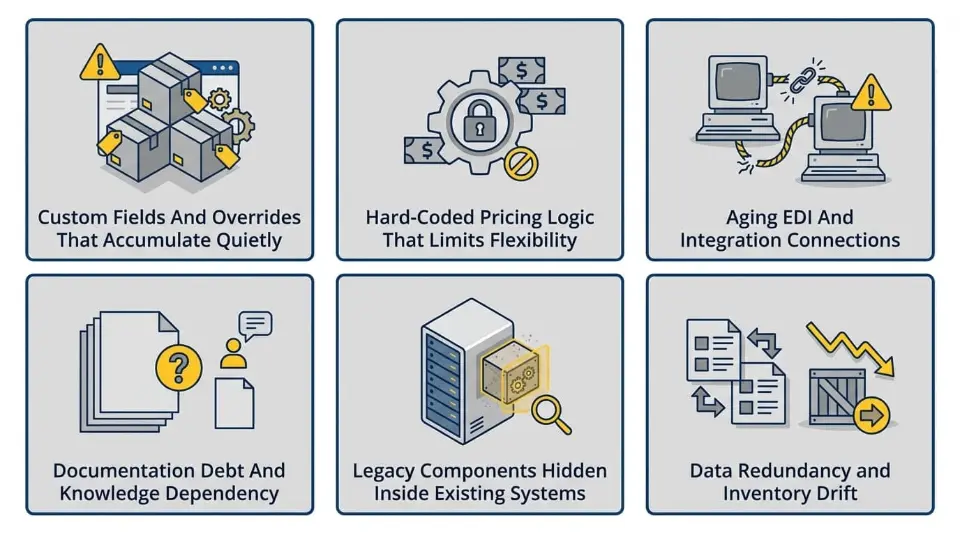
Custom Fields And Overrides That Accumulate Quietly
Unmanaged custom fields create 'Database Bloat,' a primary driver of system latency. While initially solving a gap, these fields multiply across Sales Orders and Inventory tables, often exceeding 100+ unused columns in legacy environments.
This accumulation breaks standard API connectors and forces expensive manual regression testing during every vendor patch cycle.
Over time, those fields multiply across sales orders, inventory screens, and financial workflows. Many are no longer actively used, yet they remain connected to reports, integrations, and validations.
As this grows, business users struggle to understand which fields actually matter. Changes require thorough investigation, and even simple updates can cause unexpected side effects because the customization's original purpose is no longer clear.
Hard-Coded Pricing Logic That Limits Flexibility
Wholesale pricing frequently includes customer-specific agreements, tiered pricing, freight adjustments, and rebates. Problems arise when these rules are embedded directly into code rather than configured through standard pricing tools.
Hard-coded pricing logic creates long-term rigidity. Small pricing updates require technical intervention. Business users cannot safely test changes. Over time, pricing models become fragile and difficult to explain.
Hard-coded pricing logic transforms dynamic margin management into a static bottleneck, preventing sales teams from reacting to market shifts.
Aging EDI And Integration Connections
Wholesale operations depend on constant data movement between systems. EDI trading partners, carriers, ecommerce platforms, and warehouse management tools all rely on stable integration flows.
As integrations age, many lack monitoring, error visibility, or consistent version control. Some rely on obsolete technology or undocumented middleware logic.
Silent integration failures, such as dropped EDI 850 documents, often go undetected by IT teams until a customer complains about a missing shipment. Orders may partially sync. Inventory updates lag. Manual data entry becomes the fallback, leading to increased errors and slower fulfillment.
These brittle connections often function until volume spikes or partners update their systems.
Documentation Debt And Knowledge Dependency
Documentation debt forms when system changes outpace recordkeeping.
Integration maps become outdated. Custom logic is added without explanation. Business rules live only in conversations or ticket history.
As a result, teams rely on institutional memory rather than proper documentation. Troubleshooting requires a few individuals with a deep understanding of how things were built years earlier.
When those individuals leave or shift roles, entire sections of the ERP become risky to modify.
Legacy Components Hidden Inside Existing Systems
Many wholesale ERPs still run on obsolete technology embedded deep within their system stacks. These may include outdated connectors, unsupported modules, or aging backup systems that were never fully replaced.
Because these components often operate in the background, they go unnoticed until upgrades, audits, or incidents expose them.
These legacy elements reduce system performance, complicate cloud migration efforts, and increase the risk of system failures when changes are introduced.
Operational Symptoms Business Teams Notice First
While technical debt lives in the system, its impact is felt most by frontline teams.
Common signs include:
- Data Redundancy: Frequent manual data entry required to bypass system validation errors.
- Inventory Drift: Discrepancies between Warehouse Management Systems (WMS) and ERP stock counts.
- Latency: Slow order processing and screen loading times during seasonal peak volumes.
- Reporting Silos: Inconsistent financial reporting caused by disparate data sources.
When business users begin working around the ERP instead of through it, debt has already taken hold.
Strategic Customization Versus Harmful Customization
Not all customization creates problems.
Strategic customization supports how your business competes. It is intentional, documented, and designed to evolve. Harmful customization simply recreates old processes inside new software.
The difference lies in structure.
Strategic extensions align with clean architecture principles and allow upgrades without disruption. Harmful customization modifies core logic, lacks proper documentation, and increases inter-module dependencies.
Understanding this distinction is critical before pursuing debt reduction.
Where Cudio Helps Uncover Hidden ERP Debt
In our analysis of 50+ wholesale ERP environments, Cudio has found that 30% of active custom code is redundant or obsolete.
Our structured system review isolates these inefficiencies, allowing distributors to retire unused integrations and reclaim system performance without a full reimplementation.
Through structured system reviews, Cudio analyzes custom fields, integrations, documentation gaps, and workflow dependencies across sales, inventory management, and warehouse management processes. This visibility helps separate high-value customization from architecture debt that slows performance and increases risk.
By pinpointing exactly where friction originates, Cudio enables targeted debt reduction instead of costly system overhauls.
If your ERP feels difficult to change or overly dependent on workarounds, a focused review can quickly clarify what should be fixed and what should be preserved.
Where Do Hidden Operational Costs Surface in ERP Workflows?
Technical debt rarely shows up as a single line item in the budget. Instead, the real cost spreads quietly across projects, labor, and missed opportunities. What looks manageable at first slowly becomes embedded in everyday operations.
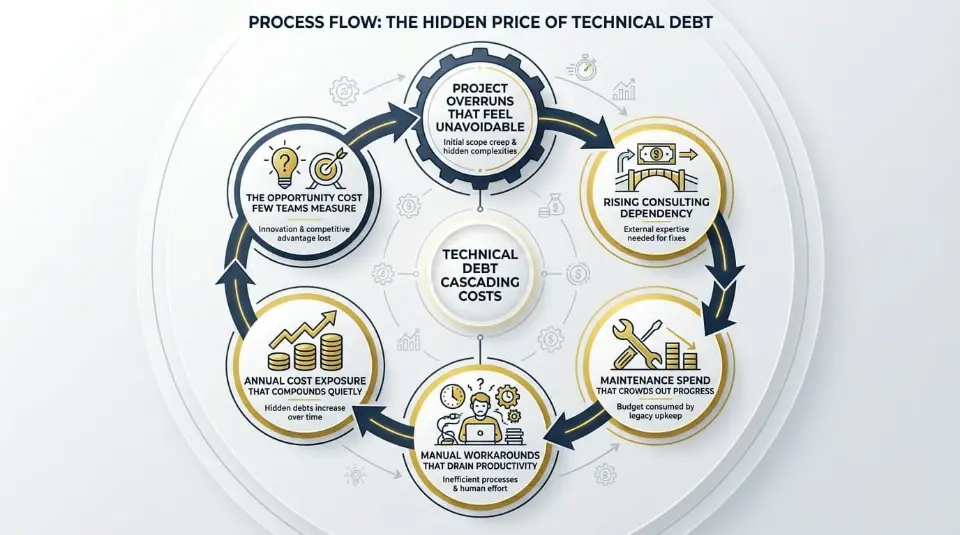
Project Overruns That Feel Unavoidable
As ERP environments grow more complex, every IT project carries extra friction. Custom business rules, undocumented dependencies, and fragile integrations expand scope before development even begins.
McKinsey notes that organizations with high technical debt experience longer delivery cycles and repeated rework, increasing the total cost of each IT project even when the request itself is small. What should be a configuration change turns into weeks of review, testing, and approval.
Rising Consulting Dependency
When internal teams lack confidence in complex integrations or legacy custom code, outside help becomes the default option.
Consultants are often required to interpret existing systems, validate API access, or trace dependencies no one internally understands. Over time, this creates reliance on external specialists just to keep systems stable, increasing ongoing support needs and limiting internal ownership.
Instead of investing in innovation, teams spend time maintaining what already exists.
Maintenance Spend That Crowds Out Progress
As ERP complexity grows, more budget is allocated to keeping systems running. Support tickets increase. Fixes require comprehensive testing. Initial training for new hires becomes longer and more expensive because processes are difficult to explain.
This maintenance burden steadily raises the total cost of ownership while reducing the return on ERP investment.
IT teams find themselves diverting resources away from optimization, analytics, and automation just to preserve core operations.
Manual Workarounds That Drain Productivity
One of the clearest indicators of technical debt is persistent manual work.
Disconnected modules force repeated data entry. Inventory corrections happen offline. Reports require reconciliation across multiple tools due to data silos.
These processes are not only time-consuming, but they also degrade data quality. Errors multiply when systems no longer share a single source of truth, and critical issues surface late rather than early.
Annual Cost Exposure That Compounds Quietly
None of these expenses feels catastrophic on their own. Together, they create a steady annual drain.
Extra consulting hours. Delayed enhancements. Repeated fixes. Internal overtime during peak periods. Each year, these costs reappear because the underlying causes were never addressed.
What makes this particularly risky is that most organizations underestimate how much they are spending simply to maintain momentum.
The Opportunity Cost Few Teams Measure
The largest loss is often invisible.
While teams focus on stabilizing existing systems, innovation slows. New channels are postponed. Process improvements remain on hold. Competitive advantage erodes as faster-moving competitors deploy modern capabilities first.
According to McKinsey, organizations with severe technical debt are far more likely to stall modernization efforts entirely, leaving growth initiatives perpetually “planned” but never delivered.
Where Cudio Helps Control Cost Exposure
Cudio helps wholesale distributors identify exactly where ERP spending is being absorbed by inefficiencies.
By analyzing integrations, workflows, and recurring support patterns, Cudio highlights which issues are driving repeated rework and inflated maintenance effort. This allows teams to reduce unnecessary complexity, lower long-term total cost, and redirect budget toward successful implementations that deliver measurable value.
A focused review often reveals cost savings opportunities long before a full system overhaul is required.
Operational Impact on Wholesale Distribution
While financial pressure builds quietly, operational strain shows up every day across the business.
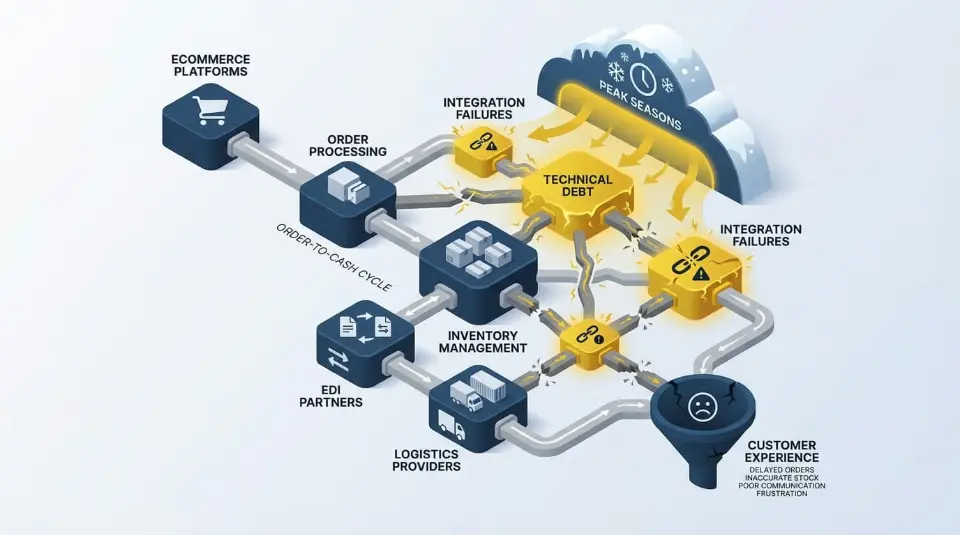
Order processing is often the first area affected. Complex workflows and outdated pricing logic introduce friction into the order-to-cash cycle. Customer service teams rely on overrides, and approvals stall when rules no longer align with current processes.
Inventory management also suffers as systems drift out of sync. Manual adjustments become routine. Warehouse teams lose confidence in reported stock levels, leading to conservative ordering or unexpected shortages.
Integration failures add further instability. Wholesale distributors depend on complex integrations across EDI partners, ecommerce platforms, and logistics providers. When those connections weaken, failures appear in multiple forms:
- Delayed order updates
- Missing shipping details
- Mismatched order status information
DORA research highlights that fragile integrations significantly increase downtime risk, especially during periods of high transaction volume.
Peak seasons amplify these issues. Systems that function under normal load struggle during surges. Manual processes increase. Errors multiply. Temporary fixes are applied quickly, creating new layers of technical debt that persist long after volume returns to normal.
Customer experience is often the final casualty. Inconsistent fulfillment timelines, invoice discrepancies, and incomplete customer history undermine trust. Even when teams work harder, the system itself limits performance.
Cudio supports operational stability by simplifying integrations, improving data flow, and strengthening governance across ERP environments. This reduces disruption during peak periods, lowers the risk of critical issues, and helps systems support growth rather than restrict it.
How Does Technical Debt Increase Security and Compliance Risk?
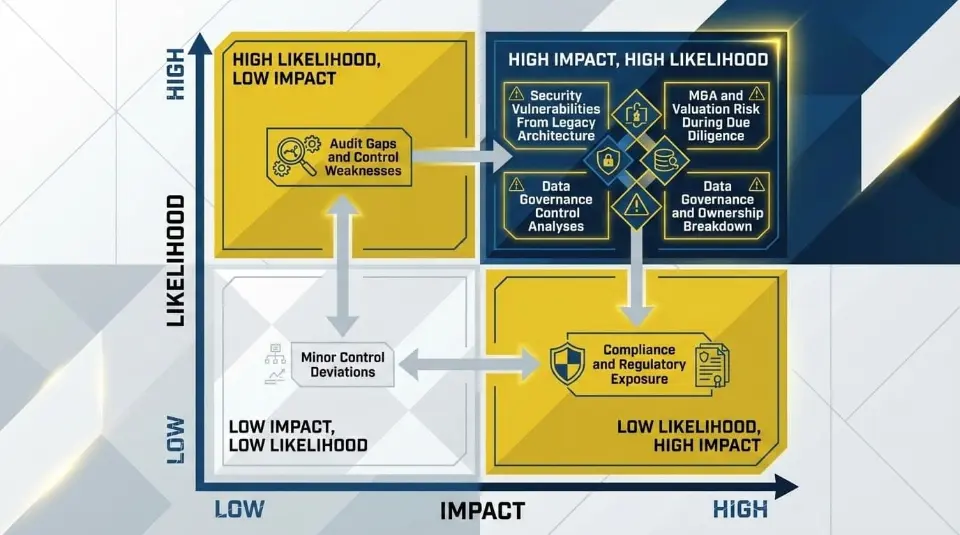
ERP technical debt does not stay confined to system performance. As complexity increases, unresolved debt directly impacts security posture, regulatory compliance, and enterprise risk. For executive leadership, these exposures often surface only during audits, incidents, or transaction due diligence.
Security Vulnerabilities From Legacy Architecture
Technical debt frequently leaves unsupported components embedded in the ERP stack. This includes obsolete technology, unpatched libraries, outdated middleware, and custom extensions that are not covered by vendor security updates.
As systems age:
- Security patches are delayed or skipped due to upgrade risk
- Legacy integrations rely on outdated encryption standards
- API access lacks modern authentication controls
- Backup systems remain misaligned with current recovery requirements
These security gaps directly expose sensitive pricing and contract data to ransomware attacks, particularly when legacy middleware lacks modern OAuth 2.0 authentication.
Audit Gaps and Control Weaknesses
ERP environments burdened by technical debt struggle to maintain verifiable internal controls. Manual workarounds and undocumented configurations weaken audit trails and increase compliance risk.
Common audit issues include:
- Business rules embedded in custom code without approval documentation
- Transactions modified outside standard workflows
- Inconsistent segregation of duties caused by legacy role structures
- Limited traceability across historical system changes
When auditors cannot clearly validate how data flows through the ERP, organizations face longer audits, higher remediation costs, and recurring control findings.
Data Governance and Ownership Breakdown
As technical debt grows, data governance across the ERP landscape deteriorates. Information that should exist in a single system of record becomes distributed across multiple tables, extensions, and external tools.
This often results in:
- Customer history stored across disparate systems
- Inconsistent master data ownership
- Conflicting versions of pricing and contract data
- Unclear responsibility for data quality enforcement
Without proper documentation and governance, even small system changes introduce data inconsistencies that affect reporting accuracy and decision-making.
Compliance and Regulatory Exposure
ERP technical debt complicates compliance with financial, privacy, and industry regulations. Legacy systems make it difficult to demonstrate that controls are functioning as designed.
Risk areas include:
- Manual data corrections that bypass approval logic
- Limited visibility into who modified records and why
- Incomplete audit logs are retained outside the required timeframes
- Difficulty proving “in-control” status during inspections
As regulatory scrutiny increases, these weaknesses raise compliance costs and disrupt operations.
M&A and Valuation Risk During Due Diligence
Technology risk is now a standard component of acquisition reviews. During mergers or private equity transactions, ERP technical debt is often treated as a balance-sheet liability.
Due diligence teams typically flag:
- Heavy customizations that block upgrades
- Poor documentation of integrations and workflows
- Dependency on a small number of system experts
- Unclear remediation cost estimates
These findings frequently lead to valuation discounts, escrow holdbacks, or mandatory modernization programs prior to deal completion.
Executive-Level Warning Signs
Leadership teams should view the following as early indicators of escalating risk:
- Security updates postponed due to fear of breaking integrations
- Recurring audit issues tied to manual processes
- ERP upgrades delayed for multiple years
- Knowledge concentration among a few technical staff
- Limited confidence in data accuracy during reporting cycles
When these conditions exist, ERP technical debt has moved beyond an IT problem and into an enterprise governance issue.
Why Technical Debt Slows Every ERP Change
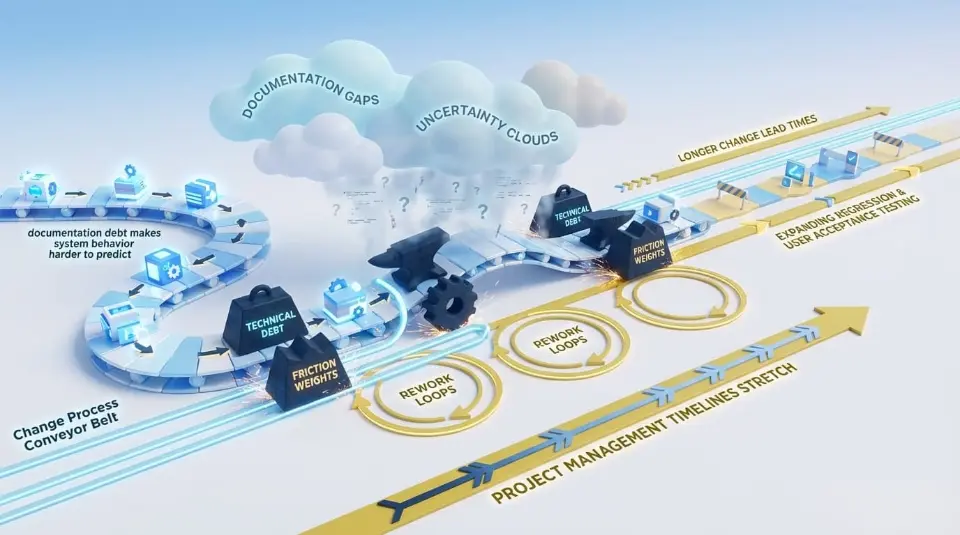
Technical debt rarely breaks an ERP overnight. Instead, it quietly slows every change your team tries to make.
In wholesale distribution, ERP platforms support tightly connected processes such as inventory management, pricing, fulfillment, and billing. When logic is scattered across custom scripts, integrations, and undocumented rules, even small updates require deep investigation before work can begin.
Teams often face:
- Longer change lead times due to unclear dependencies
- Expanding regression and user acceptance testing requirements
- Rework loops when fixes trigger unexpected issues
Over time, documentation debt makes system behavior harder to predict. Developers rely on tribal knowledge rather than reliable records, increasing the risk of outages and rollbacks. As a result, project management timelines stretch, and confidence in the ERP declines.
Modernization initiatives suffer most. Enhancements tied to automation, analytics, or cloud ERP adoption are delayed because the environment feels fragile. Technical debt begins to behave like financial debt. Each update carries interest in the form of added time, risk, and future costs.
Eventually, the ERP still runs day-to-day operations but loses its ability to support future growth.
How Wholesale Distributors Reduce Technical Debt
Reducing technical debt does not require replacing your ERP immediately. Most organizations see better results through focused modernization rather than full reimplementation.
Common reduction paths include:
- Clean core alignment to limit in-system customization
- Selective cloud ERP adoption to reduce infrastructure burden
- Integration modernization using APIs instead of rigid point connections
Cloud migration alone does not remove debt. If existing systems, workflows, and integrations are moved unchanged, the same complexity follows. True improvement comes from simplifying processes, retiring unused customizations, and consolidating data flows.
Another critical step is addressing documentation debt. Clear ownership, updated diagrams, and defined governance prevent debt from rebuilding after cleanup efforts.
When executed correctly, debt reduction lowers the total cost of ownership, stabilizes system maintenance, and restores flexibility across critical systems. More importantly, it allows the ERP investment to support growth rather than slow it down.
A Practical ERP Technical Debt Reduction Framework
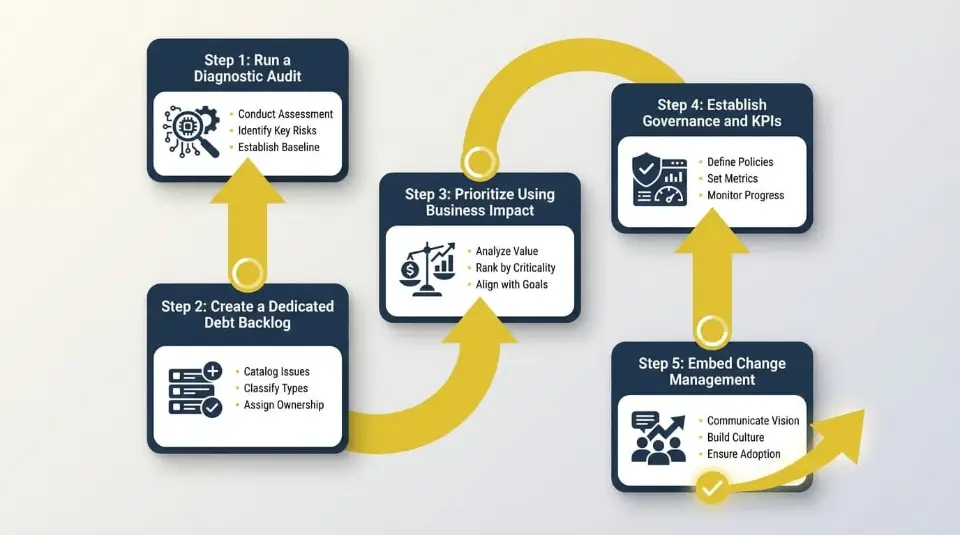
Reducing ERP technical debt requires structure, ownership, and consistency. This is not a one-time cleanup exercise. It is an ongoing discipline that protects your ERP investment, controls total cost, and supports long-term scalability.
Step 1: Run a Diagnostic Audit
Start by identifying where debt exists across core operations. Review custom business rules, integrations, reports, and workflows that depend on manual data entry or undocumented logic. Pay close attention to complex integrations, recurring errors, and processes that feel unusually time-consuming to change.
Include data migration gaps, fragile automations, and issues that repeatedly surface during upgrades or testing cycles.
Step 2: Create a Dedicated Debt Backlog
Document all findings in a centralized backlog separate from feature requests. Each item should include business impact, estimated effort, and ownership.
This makes it easier to understand how much of the total cost is consumed by maintenance versus progress toward new features such as automation, analytics, or mobile apps.
Step 3: Prioritize Using Business Impact
Not all debt carries equal risk. Focus first on items that:
- Disrupt daily workflows
- Create repeated data entry
- Increase integration challenges
- Require frequent ongoing support
This prevents teams from diverting resources toward low-impact cleanup while high-risk areas remain unresolved.
Step 4: Establish Governance and KPIs
Effective debt reduction needs governance. Define approval rules for new customizations and require documentation for every change.
Track KPIs tied to reduced rework, faster delivery, lower opportunity costs, and improved system stability across each IT project.
Step 5: Embed Change Management
Sustainable improvement depends on adoption. Provide initial training, regularly update documentation, and align teams on the reasons for changes.
When managed consistently, debt reduction strengthens system reliability, reduces exposure to security breaches, and ensures your ERP supports growth rather than limiting it.
Final Words
Technical debt does not appear overnight, but its impact grows quietly year after year. What starts as small workarounds and quick fixes can slowly erode system performance, increase costs, and limit your ability to scale. For wholesale distributors, this often means higher maintenance spend, slower innovation, and growing risk across critical systems.
The solution is not to chase perfection or replace everything at once. It is building visibility, prioritizing what truly matters, and reducing debt through disciplined governance and smart modernization. When managed correctly, ERP technical debt becomes controllable rather than disruptive.
If your ERP feels harder to change, more expensive to maintain, or increasingly fragile, it may be time for a reset. Cudio helps wholesale distributors assess ERP risk, uncover hidden inefficiencies, and build clear modernization roadmaps that restore control, performance, and long-term value.
FAQs
Still have questions? Here are quick, straight answers to help you decide your next move.
How do I know if my wholesale ERP has a serious technical-debt problem?
You likely have technical debt if teams rely on manual data entry, spreadsheets, or workarounds. Repeatedly delayed upgrades are another sign. If only a few people understand the system, the risk is already high.
Is it cheaper to replace our ERP entirely instead of paying down technical debt?
Replacing an ERP is usually more expensive upfront and carries a higher risk. Paying down technical debt often delivers faster ROI. Many issues resurface after replacement if processes are not cleaned first.
How long does it typically take for a distributor to see returns from ERP tech-debt reduction?
Most distributors see early improvements within 3–6 months. Larger gains appear over 12–24 months. Project costs and delays begin to decrease almost immediately.
Does moving to cloud ERP automatically eliminate technical debt?
Cloud ERP does not remove technical debt on its own. Poor customizations and bad integrations move with the system. Clean-core design and governance are still required.
How should we talk about technical debt with non-technical executives and the board?
Explain technical debt in financial terms, not IT language. Show how it increases costs, delays projects, and limits growth. Focus on risk, opportunity cost, and long-term value.