Odoo vs Salesforce is not just a features battle. It is a question of who controls the system your whole business runs on. Odoo ERP services give you choices. You can use their hosted cloud, a managed server, or run it yourself. Salesforce gives you one option: their cloud hosting, their rules, their pricing.
Both are strong CRM software platforms. Both can help your sales teams manage customer relationships and automate tasks. But how you host them changes what you pay, what you control, and how well your CRM integrates with the rest of your business.
At Cudio, we have helped 60+ businesses choose between these two platforms and get them up and running. This guide explains the key differences in plain language so you can make a smart call for your business.
Here is what this guide covers:
- All four ways to host Odoo vs the one way to host Salesforce
- Real pricing for each option, including hidden costs
- When Salesforce cloud hosting makes sense and when it does not
- A simple decision table to match your business to the right option
- Answers to the most common questions about Odoo and Salesforce hosting
Help Me Choose Between Odoo and Salesforce
Key Takeaways
- How to host Odoo vs Salesforce comes down to one thing: control. Odoo gives you four hosting paths. Salesforce gives you one. That difference drives everything else, including your total cost, your data rights, and how much you depend on the vendor.
- Odoo is much more affordable for most businesses. Odoo Enterprise starts at about $24.90 per user per month. That includes CRM software, inventory management, accounting, and human resources, all in one. Salesforce starts at $25 per user per month for basic CRM, but real mid-market stacks often hit $100-$300+ per user once you add what you actually need.
- Salesforce has the largest market share in the CRM market. According to IDC, Salesforce holds about 20.7% of the global CRM market. That is more than Microsoft, Oracle, SAP, and Adobe combined. But market share does not mean right fit for your business.
- Odoo is a full enterprise resource planning platform, not just a CRM. Odoo CRM is one module within a larger system that includes sales cloud-style pipelines, inventory, accounting, manufacturing, and more. Salesforce CRM is purpose-built for customer relationship management but relies on third-party apps for everything else.
- Self-hosted Odoo on your own servers gives you the most control but also the most responsibility. You manage the updates, security, and backups. For medium-sized businesses without a strong IT team, Odoo Online orOdoo.sh is a better starting point.
The Hosting Decision Most Odoo vs Salesforce Comparisons Miss
Most odoo vs salesforce comparisons stop at features. They list what each CRM software can do and move on. But for a wholesale distributor, a multi-location retailer, or a manufacturer, where your software lives is just as important as what it does.
Here is a simple way to think about it. Your CRM holds your customer data, sales pipeline, customer interactions, and order history. That is the core of your business. When you compare Odoo and Salesforce, you are also deciding whether that data lives on a vendor's server or on one you control.
Comparing Odoo to Salesforce on hosting also significantly changes your total cost. Backlinko's Salesforce statistics for 2025 show Salesforce generated $37.9 billion in revenue in fiscal 2025. That revenue comes from customers paying premium prices for managed cloud hosting that they cannot opt out of.
At Cudio, we have moved clients from Salesforce to Odoo hosting and from spreadsheets to both. The most common reason businesses switch away from Salesforce is not the CRM capabilities. It is the total cost and lack of control over their own customer data.
Help Me Choose Between Odoo and Salesforce
Understanding the Core Hosting Models: Odoo vs Salesforce
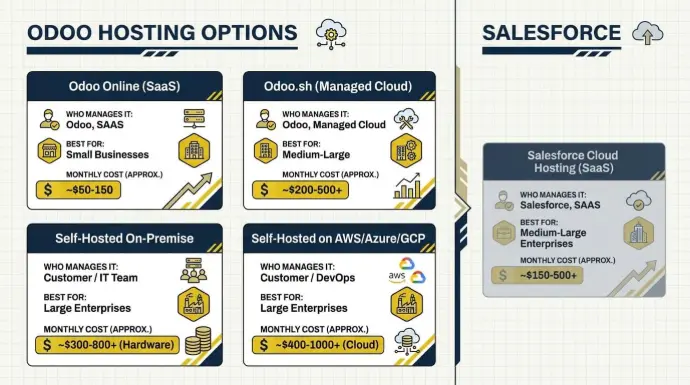
When you ask how to host Odoo, there are four real answers. The same Odoo CRM, inventory, and enterprise resource planning features run across all four. The difference is in cost, control, and who does the technical work.
Here is a summary before we go deeper:
Hosting Option | Who Manages It | Best For | Monthly Cost (approx.) |
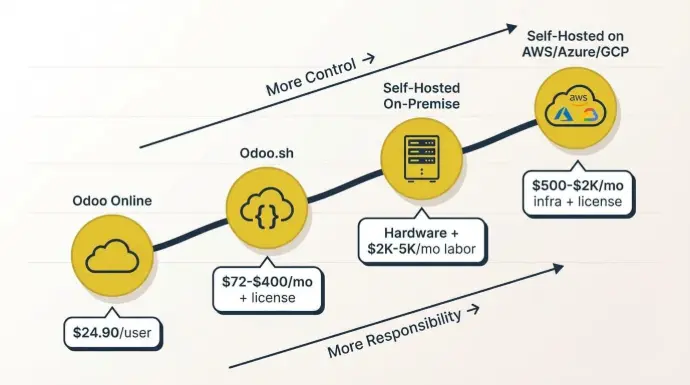
Odoo Online (SaaS) | Odoo handles everything | Small businesses, 10-50 users, fast setup | $24.90/user (license only) |
Odoo.sh (Managed Cloud) | Odoo manages servers; you manage code | Mid-size businesses needing custom modules | $72-$400/mo + license |
Self-Hosted On-Premise | Your IT team handles everything | Large enterprises need full control | Hardware + $2K-5K/mo labor |
Self-Hosted on AWS/Azure/GCP | You manage the cloud, Odoo manages the app | Tech-savvy businesses needing flexibility | $500-$2K/mo infra + license |
Salesforce Cloud Hosting (SaaS) | Salesforce handles everything | CRM-focused teams with high budgets | $25-$500/user/mo |
Option 1: Odoo Online (The Easiest Way to Host Odoo)
Odoo Online is pure cloud hosting run by Odoo. You log in through a browser. Odoo handles the servers, backups, and updates. You just use the software. This is the fastest way to host Odoo for small and medium-sized businesses that want to move fast.
What you get:
- All Odoo apps included: CRM, Sales, Inventory, Accounting, and more
- Automatic updates and security patches from Odoo
- Daily backups stored on two continents
- No IT team needed to keep it running
What you give up is the ability to install custom Python code or access the underlying database. If you need deep customizations, Odoo Online is not the right Odoo host option. Odoo's official pricing page shows the Standard plan starts at $24.90 per user per month in the US.
Option 2:Odoo.sh (The Middle Ground for How to Host Odoo)
Odoo.sh is Odoo's managed cloud platform. Think of it as a developer-friendly version of Odoo Online. Odoo still runs the servers and handles security. But you can write and deploy custom code, connect to your own tools, and use multiple staging environments to test changes safely.
This is the most popular option for medium-sized businesses that need custom workflows. It handles things like:
- Custom CRM features and sales pipelines built to your exact process
- EDI integrations and 3PL connections for supply chain management
- Multi-company setups with a centralized database
- GitHub integration for developer teams to test every code change
Odoo.sh starts at about $72 per month for basic hosting. A 50-user business typically falls in the $150- $400 per month range. Add that to your Odoo Enterprise license fees, and you still come out well below comparable salesforce CRM pricing.
Option 3: Self-Hosted Odoo On-Premise (Maximum Control)
Self-hosted Odoo means running the software on your own physical servers. You own the hardware, the database, and every piece of the stack. This is for large enterprises and businesses with strict data rules, like GDPR or HIPAA compliance, where customer data cannot leave a specific country.
What you need to run it properly in 2025:
- At least 4 CPU cores and 16 GB RAM for a production environment
- A Linux administrator who can manage PostgreSQL, Nginx, and SSL certificates
- A backup and disaster recovery plan you own and test regularly
- Budget for major upgrades every 2-3 years, which can cost $8,000-$15,000+ per cycle
This option is powerful, but it demands real technical expertise. One unpatched server left exposed is a real risk. We have seen it cost businesses far more than the savings on licensing.
Option 4: Self-Hosted Odoo on AWS, Azure, or GCP (Cloud You Control)
This option gives you the flexibility of public cloud with full control over your Odoo setup. You deploy Odoo on AWS, Microsoft Azure, or Google Cloud. You manage the virtual machines, the database, and the network. But you benefit from cloud tools like auto-scaling, managed backups, and global regions.
A typical setup uses a t3.large or t4g.xlarge instance on AWS for a 50-user business. Infrastructure costs range from $500 to $2,000 per month, plus your Odoo Enterprise license. This approach needs people who understand both Odoo internals and cloud platforms. Many businesses pair a small internal IT team with an Odoo implementation partner like Cudio to cover both sides.
Talk to Cudio About the Right Way to Host Odoo for My Business
How Salesforce Hosting Works: One Option, Full Vendor Control
Salesforce hosting is simpler to explain because there is only one option. All Salesforce products, including Sales Cloud, Service Cloud, and Marketing Cloud, run on Salesforce's servers. You do not choose your cloud provider or server size. You choose your edition and add-ons.
This has real advantages. You never have to worry about server maintenance, database tuning, or security patching. Salesforce handles all of it. Your IT team focuses on configuring the CRM software, not running it.
But it also has real limits. According to IDC data reported by CX Today, Salesforce serves over 150,000 customers through this model. The infrastructure is consistent and battle-tested. But when you need something non-standard, like a direct database query, a custom machine learning model, or a specific data residency rule, Salesforce hosting becomes a constraint.
Salesforce Cloud Hosting Tiers: What They Actually Cost
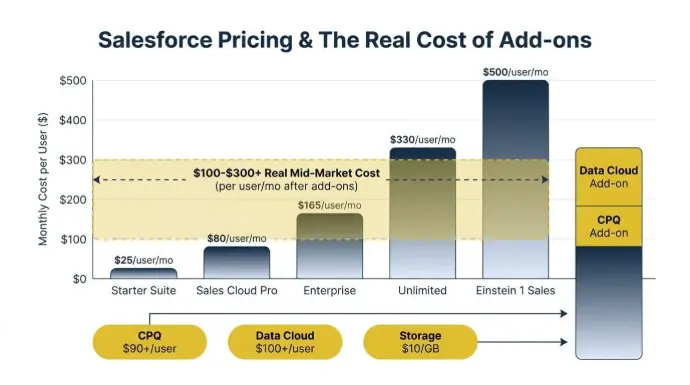
Salesforce CRM pricing has several tiers. The numbers look reasonable at first glance, but grow fast when you add what most businesses actually need. Salesforce's official pricing is documented on their news pages, but here is a plain breakdown:
- Starter Suite: $25 per user per month. Basic CRM features for very small teams.
- Sales Cloud Professional: $80 per user per month. Most sales teams need this tier.
- Enterprise version: $165 per user per month. Adds api access, advanced automation, and custom objects.
- Unlimited: $330 per user per month. Full CRM capabilities with unlimited support.
- Einstein 1 Sales (con l'intelligenza artificiale): $500 per utente al mese.
Add-ons raise the real cost significantly. CPQ (for quoting) costs $90+ per user. Data Cloud costs $100+ per user. Storage overages run $10 per GB. Many mid-market businesses end up at $100-$300+ per user per month after add-ons.
Salesforce Hyperforce: Same Hosting Model, More Regions
Salesforce Hyperforce is Salesforce's newer infrastructure that runs on top of AWS, Azure, and GCP. It does not change who controls the servers. Salesforce still manages everything. What it adds is more regional options for data residency, which helps businesses that need their customer data to stay in specific countries for compliance reasons.
Hyperforce is especially useful for large enterprises operating across multiple countries. Salesforce claims 40% infrastructure cost savings through Hyperforce, but those savings go to Salesforce, not to you. Your per-user Salesforce hosting price does not change based on which infrastructure Salesforce runs internally.
Odoo vs Salesforce: Cost Comparison Over 3 Years
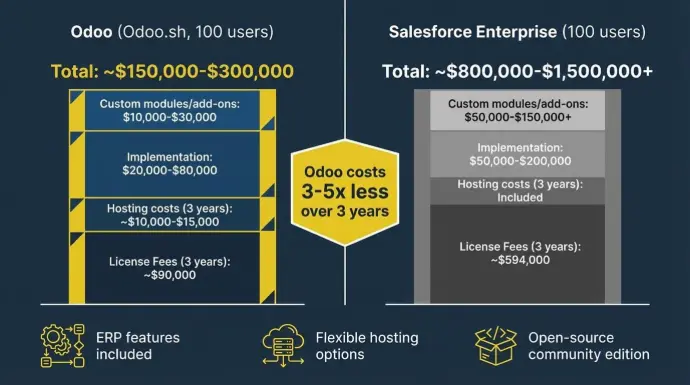
Pricing for CRM software is one of the biggest differences between Odoo and Salesforce. License fees are just the starting point. The real total cost includes hosting, implementation, and ongoing support.
Here is a cost comparison for a 100-user mid-market business:
Cost Item | Odoo (Odoo.sh, 100 users) | Salesforce Enterprise (100 users) |
License fees (3 years) | ~$90,000 | ~$594,000 |
Hosting costs (3 years) | ~$10,000-$15,000 | Included in license |
Implementation | $20,000-$80,000 | $50,000-$200,000 |
Custom modules/add-ons | $10,000-$30,000 | $50,000-$150,000+ |
Total cost (3 years) | ~$150,000-$300,000 | ~$800,000-$1,500,000+ |
The gap is large. A 100-user business comparing Odoo and Salesforce typically finds Odoo costs 3-5x less over 3 years. Third-party analysis from Cirrus Insight shows Salesforce's 3-year total cost for 100-500 user deployments in the $2.97 million to $4.5 million range.
Odoo's cost advantage comes from three things.
- First, Odoo includes enterprise resource planning (ERP) features such as inventory management, accounting, and human resources under a single user license. Salesforce charges extra for every add-on.
- Second, Odoo hosting options are genuinely flexible. You only pay for what you need.
- Third, Odoo's open-source community edition has no license fee, though it still requires technical expertise to run safely.
At Cudio, we have run this cost comparison for dozens of clients. The number that surprises people most is not the license cost. It is the add-on creep on Salesforce. What looks like a $25/user platform becomes $150+ within 12 months as the sales team asks for features that require paid upgrades.
Get My Free Odoo vs Salesforce Cost Comparison
Security, Data Control, and Compliance: The Real Differences
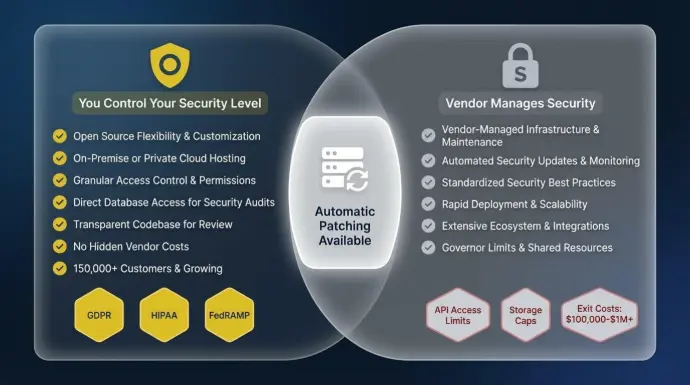
Security and compliance are not the same thing as having a lock icon on a website. They are about who controls your customer data, where it lives, and what happens when something goes wrong.
Odoo: You Control Your Security Level
With Odoo hosting, your security depends on which model you choose. Odoo Online andOdoo.sh use Odoo to manage security patches. For self-hosted Odoo, your team is fully responsible. Odoo's security documentation states that its Enterprise cloud customers receive automatic patching and advanced notice before any public security disclosures.
The compliance benefit of self-hosted Odoo is real. If your business handles customer data that must stay in a specific country or data center (think GDPR in Europe, HIPAA in healthcare, or FedRAMP for government work), self-hosted Odoo lets you pick exactly where your centralized database lives. Salesforce cloud hosting cannot always guarantee that.
Salesforce: Vendor Manages Security, You Accept the Trade-Off
Salesforce cloud hosting handles OS patches, database updates, failover, and scaling automatically. According to Salesforce's own market leadership data, they serve 150,000+ customers with consistent security across every org. That is a genuine advantage if your team does not want to manage infrastructure.
The trade-off is vendor lock-in. Your customer data sits in Salesforce's data model. Moving it out is expensive and complex.
Exit costs from Salesforce are estimated at $100,000 to $1 million or more for serious migrations. Salesforce also imposes api access limits, storage caps, and governor limits on what your developers can do within the platform.
Which Hosting Option Is Right for Your Business?
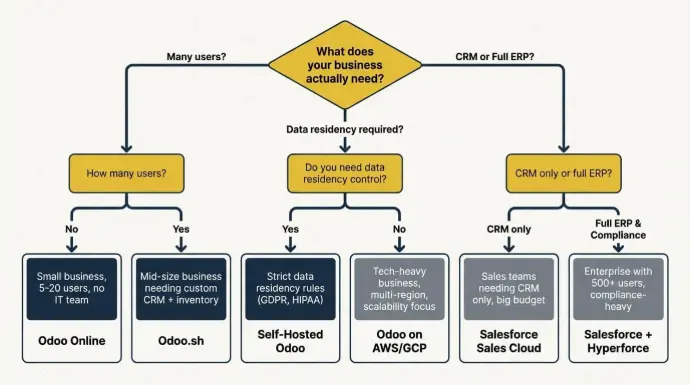
This is an executive decision, not just a technical one. The right answer depends on your user count, your budget, your technical expertise, and how tightly your CRM needs to connect to your inventory, finance, and operations systems.
Ask yourself these questions:
- Do you need customer data to stay in a specific country for legal reasons?
- Do you want your CRM software to share a centralized database with your inventory and accounting systems?
- How many users will you have in 3 years? User count drives Salesforce comparison pricing fast.
- Does your team have technical expertise to manage servers, or do you need managed cloud hosting?
- Does your business need only CRM capabilities, or full enterprise resource planning?
Here is a simple decision table based on the most common business situations:
Your Situation | Best Choice | Why |
Small business, 5-20 users, no IT team | Odoo Online | Fast setup, low cost, CRM features included |
Mid-size business needing custom CRM + inventory | Custom Odoo apps, managed cloud, lower cost vs Salesforce | |
Strict data residency rules (GDPR, HIPAA) | Self-Hosted Odoo | Full control of where customer data lives |
Sales teams needing CRM only, big budget | Salesforce Sales Cloud | Best-in-class CRM capabilities, advanced automation |
Tech-heavy business, multi-region, scalability focus | Odoo on AWS/GCP | Cloud-native flexibility, full api access |
Enterprise with 500+ users, compliance-heavy | Salesforce + Hyperforce | Enterprise version, proven CRM systems at scale |
Cudio has a 100% client retention rate and has completed 62+ successful Odoo projects. When we sit down with a business for the first time, we always start with this exact question: what does your business actually need, not what the marketing materials say you should want. Seven of our team members ran Odoo in their own businesses before becoming consultants. That means we give you honest answers, not just the ones that close a deal.
Help Me Pick the Right Hosting Option for My Business
Odoo CRM vs Salesforce CRM: What Each One Actually Does
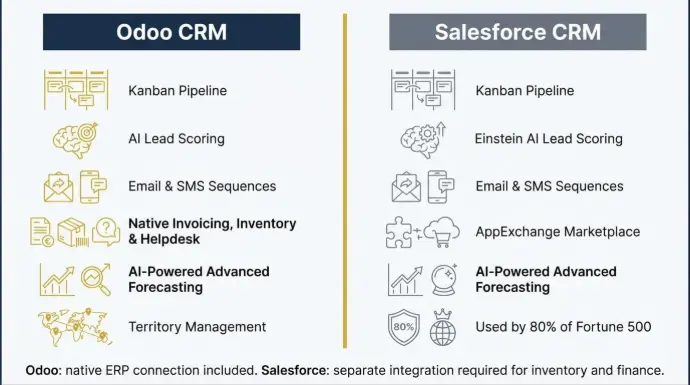
The CRM capabilities comparison between Odoo and Salesforce is often misunderstood. Many people assume salesforce CRM is always more powerful. The truth is more nuanced.
Odoo CRM Features
Odoo CRM covers the full sales pipeline: leads, opportunities, activities, emails, calls, and quotations. It connects directly to inventory management, accounting, and customer service in the same system. Your sales teams can see stock levels, create quotes, and track customer interactions all without switching apps.
Odoo CRM key features include:
- Kanban pipeline with drag-and-drop stages for sales teams
- Lead scoring using a machine learning model trained on your own customer data
- Email and SMS sequences for customer relationship management automation
- Task automation for follow-up reminders and activity scheduling
- Native integration with Odoo apps for invoicing, inventory, and helpdesk
- API access for connecting to third-party apps and external CRM systems
For small and medium businesses, Odoo's CRM module covers most CRM capabilities at no extra cost. It is included in the base Enterprise license that also covers your inventory and accounting.
Salesforce CRM Features
Salesforce Sales Cloud is the gold standard for pure CRM software. It has deeper CRM features out of the box than Odoo CRM, especially for large sales teams with complex pipelines. According to Notta's Salesforce statistics, 80% of Fortune 500 companies use Salesforce. That tells you something about its depth for enterprise sales teams.
Salesforce Sales Cloud key features include:
- Advanced forecasting with artificial intelligence-powered predictions
- Territory management for large sales teams across multiple regions
- Einstein AI for lead scoring, opportunity insights, and customer satisfaction analysis
- A huge AppExchange marketplace with thousands of third-party apps
- Deep api access for custom integrations with CRM systems
- Sales productivity analytics across the full customer journey
The catch is that most of these advanced CRM capabilities are available only in higher tiers. The Salesforce comparison between basic and enterprise version pricing is significant. And none of it connects to your inventory or finance data without a separate, costly integration.
Moving from Salesforce to Odoo: What to Expect
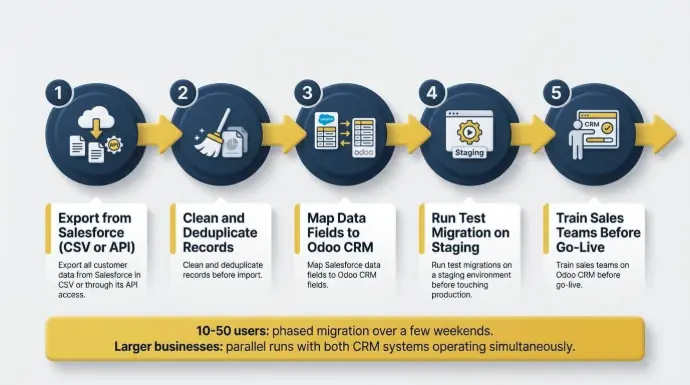
If you are comparing Odoo Salesforce options and leaning toward switching, the migration question is real. Moving from Salesforce to Odoo hosting involves exporting your customer data (contacts, accounts, opportunities, activities) and remapping it to Odoo's data model.
For 10-50 users, a phased migration over a few weekends is common. Larger businesses may need parallel runs, with both CRM systems operating simultaneously during the cutover. The key steps are:
- Export all customer data from Salesforce in CSV or through its api access
- Clean and deduplicate records before import (this step is often underestimated)
- Map Salesforce data fields to Odoo CRM fields
- Run test migrations on a staging environment before touching production
- Train sales teams on odoo CRM before go-live
Cudio has completed 32+ migrations from other CRM systems to Odoo, including Salesforce. Our team has the technical expertise to handle both the data migration and the Odoo hosting setup, so your business performance does not dip during the switch.
Get a Free Salesforce to Odoo Migration Assessment
Final Words
When comparing Odoo vs Salesforce on hosting, the answer for most mid-market businesses is clear.
Salesforce cloud hosting offers simplicity and world-class CRM capabilities at a premium price, with limited control.
Odoo offers flexible hosting, a full enterprise resource planning platform including CRM software, and a much lower total cost, but it requires more decisions upfront.
At Cudio, we are a certified Odoo partner with 30+ years of operational experience and a 100% client retention rate. We help businesses make this exact decision, set up the right hosting model, and get up and running without surprises.
Whether you are starting fresh, switching from Salesforce, or just trying to understand the differences between Odoo and Salesforce, we are the team to talk to.
Book My Free Odoo vs Salesforce Consultation with Cudio
FAQ
Here are the questions we hear most often when businesses compare Odoo and Salesforce hosting options.
Can I move from Salesforce cloud hosting to self-hosted Odoo without major disruption?
Yes, but it takes planning. You export your customer data from Salesforce, clean it, and import it into Odoo. For 10-50 users, most migrations take a few weekends with a phased approach. Larger businesses need parallel runs and custom ETL tools. The key is working with a partner who knows both platforms and can rehearse the migration at least once before the real cutover.
Can I use Odoo for enterprise resource planning and keep Salesforce as my CRM at the same time?
Technically, yes, through api access and REST integrations. But it adds cost and complexity on both sides. You end up duplicating customer data across two CRM systems, which causes data accuracy issues. This hybrid approach only makes sense if you are heavily invested in Salesforce CRM but need Odoo's inventory management, manufacturing, or advanced automation that Salesforce cannot provide natively.
How often does a self-hosted Odoo instance need upgrading?
Odoo releases one major version per year. Most businesses plan upgrades every 2-3 years to stay in the supported range. Delaying too long turns a planned upgrade into a complex rescue project. Custom modules need testing and potential rewrites with each major version. Budget both time and money for this as part of your hosting plan.
Can I keep my customer data in a specific country with both Odoo and Salesforce?
With self-hosted Odoo andOdoo.sh, yes. You choose your data center country. Odoo Online offers regional options with less granularity. Salesforce Hyperforce supports regional hosting in select areas, but exact guarantees depend on your contract and product tier. If data residency is critical for your business, self-hosted Odoo gives you the most control.
What skills does my team need to host Odoo on AWS instead of using Salesforce?
You need Linux administration, PostgreSQL management, cloud networking on AWS or Azure, and Odoo configuration experience. Most businesses combine a small internal IT team with an external Odoo partner to cover both internal and external layers. Cudio's Odoo implementation service covers both technical hosting setup and application configuration, so your team doesn't have to start from scratch.