
When comparing IFS vs Odoo ERP, IFS Cloud is the superior choice for large asset-heavy enterprises requiring complex asset management, while Odoo is the optimal flexible, modular ERP for mid-market companies seeking to unify operations without enterprise-scale overhead.
IFS Cloud excels in large, asset-heavy environments where advanced asset management and structured performance management are critical. Odoo, meanwhile, delivers a flexible enterprise resource planning platform that helps mid-market teams unify operations and generate actionable insights without enterprise-scale overhead.
The real question isn’t which ERP is bigger. It’s which platform gives your team the clarity, data, and informed decisions needed to scale without unnecessary implementation risk?
Unlike IFS, which is narrowly focused, Odoo scales across sectors — see how Cudio delivers Odoo implementation services across multiple industries from manufacturing to logistics and retail.
This guide explores the critical factors in choosing between IFS and Odoo:
- What are the key differences between IFS and Odoo ERP?
- How do IFS and Odoo compare at a glance?
- Which types of organizations should choose IFS ERP?
- How do deployment complexities and implementation risks compare?
Key Takeaways: IFS vs Odoo ERP Comparison
- Both platforms are powerful enterprise resource planning (ERP) software solutions, but IFS is typically designed for large organizations with complex asset management, global operations, and structured management processes, while Odoo is better suited for mid-market companies seeking flexible ERP tools to run their business without enterprise-level overhead.
- Deploying IFS ERP usually requires extensive project management, specialized support, and complex integration of operational data and processes. Odoo reduces implementation risk by allowing companies to manage the Odoo migration and rollout process gradually while maintaining control over customization, workflows, and operational tools.
- By connecting finance, CRM, inventory, production, and customer management, both systems help organizations generate reliable reporting, stronger analytics, and the actionable insights needed for faster and more informed decisions.
- Many large companies in manufacturing, infrastructure, and other asset-intensive industry sectors rely on IFS software for advanced asset management, operational integration, and performance-driven management tools designed for large-scale production environments.
What Are the Key Differences Between IFS and Odoo ERP for Mid-Market Companies?
The primary difference between IFS and Odoo ERP lies in operational alignment and company maturity rather than just feature sets.
While IFS offers deep enterprise-grade capabilities for complex asset management, Odoo provides a modular approach that aligns better with mid-market operational data and internal team constraints.
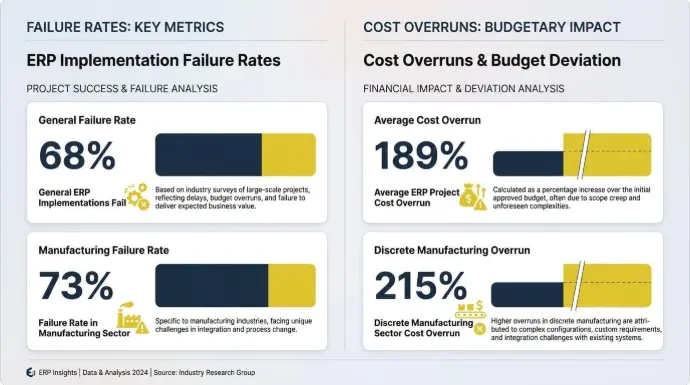
Choosing based on organizational maturity prevents the 189% average cost overrun typically associated with mismatched ERP implementations.
Implementation Risk and Budget Overruns in ERP Deployments
To begin with, it helps to understand how ERP projects perform in the real world. ccording to the Panorama Consulting Group 2025 ERP Report and Gartner ERP Research, exactly 68% of ERP implementations fail to meet initial operational objectives. In manufacturing environments, that number rises to 73%.
On top of that, many ERP projects exceed their planned budgets. Across industries, the average cost overrun is 189%, while in discrete manufacturing it reaches 215%.
In other words, ERP challenges rarely come from weak software functionality. More often, problems arise when the system does not align with the company’s processes, operational data, and internal teams.
Company Maturity Plays a Big Role
Next, it is important to consider the organization's maturity in adopting the system.
IFS Cloud sits in the enterprise ERP category and is commonly used by larger companies operating across multiple countries, plants, or operational divisions. These organizations often rely on strong asset management, advanced financial management, and complex supply chain coordination. In these environments, IFS software helps manage large volumes of operational data, maintain strong security, and support complex production operations.
However, this level of depth also requires experienced teams, structured internal processes, and ongoing support.
Many mid-market companies face a different situation. Instead of managing large industrial operations, they often work with several disconnected tools such as spreadsheets, accounting systems, inventory platforms, and standalone CRM software. Data lives in different systems, making it difficult to understand customers, operations, and the supply chain clearly.
How Do IFS and Odoo ERP Compare at a Glance?
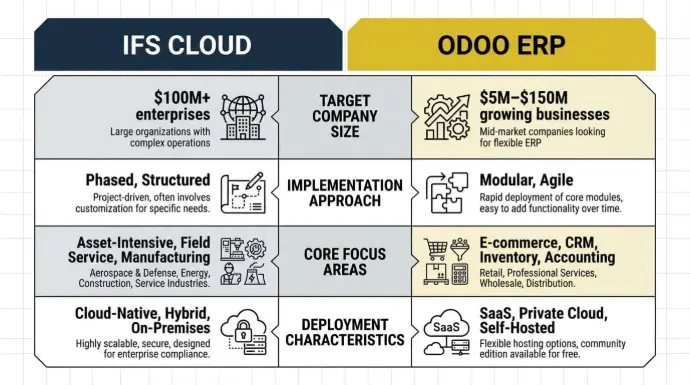
If you want a quick overview before diving deeper, this IFS vs Odoo ERP comparison highlights the main differences in functionality, implementation approach, and typical business use cases.
Feature | IFS Cloud | Odoo ERP |
Best for | Large organizations with complex operations and strong asset management needs | Mid-market companies looking for flexible ERP solutions |
Typical company size | $100M+ enterprises operating across multiple countries | $5M–$150M growing businesses |
Implementation cost | High investment in large ERP projects | Lower cost, scalable implementation |
Deployment speed | Slower due to complexity and governance | Faster due to modular applications |
Core focus | Industrial operations, asset management, and large-scale production | Unified business tools including CRM, inventory, and finance |
Flexibility | Structured enterprise architecture | High customization and modular apps |
Integration | Enterprise-grade integration across operational systems | Flexible integration with modern tools and applications |
Reporting & analytics | Advanced enterprise reporting and operational analytics | Built-in dashboards and flexible analytics for teams |
User adoption | Requires structured training and enterprise support | Easier for everyday users to adopt |
Deployment model | Primarily, cloud enterprise environments | Cloud, on-premise, or hybrid options |
Which Types of Organizations Should Choose IFS Cloud ERP?
When companies evaluate IFS ERP, the key question is not whether the platform is powerful. It is. The real question is whether your organization actually needs that level of capability.
However, not every company operates at that scale. Understanding where IFS fits best helps clarify whether it is the right ERP path.
Ideal Company Size for IFS ERP
Most organizations adopting IFS Cloud operate at the enterprise scale. These $100M+ global enterprises typically manage multiple manufacturing facilities, large operational teams, and complex supply chain environments that require deep asset integration.
In many cases, these companies have:
- Revenue typically above $100M
- Operations across multiple countries
- Dedicated internal IT and ERP teams
- Large operational environments with infrastructure, equipment, or global logistics
At this level, leaders need better visibility into operations, financial performance, and operational data across the organization. Enterprise systems like IFS software help centralize that information and support complex ERP projects.
Organizations in this category also tend to have the internal resources required to maintain enterprise systems, including specialists responsible for integrations, upgrades, and ongoing ERP support.
Industries Where IFS Cloud Works Best
IFS has become especially popular in industries where infrastructure and asset management play a major role.
For example, many organizations using IFS Cloud operate in sectors such as:
- Aerospace and defense
- Telecommunications
- Utilities and energy
- Industrial manufacturing
- Field service operations
These businesses often manage equipment fleets, service networks, and maintenance operations across large geographic areas. IFS Cloud helps bring operational data, maintenance planning, and financial reporting together in one system.
For companies operating in these environments, the platform’s enterprise capabilities can make a meaningful difference.
When IFS ERP Is Worth the Investment
IFS usually makes the most sense when operational complexity is high.
This often includes situations where companies need to manage:
- Large infrastructure or equipment networks
- Complex field service operations
- Multi-country financial and regulatory requirements
- Advanced supply chain coordination
In these environments, organizations benefit from the structured enterprise resource planning capabilities provided by IFS Cloud.
At the same time, enterprise ERP systems require planning, investment, and experienced teams to implement successfully.
From what we see at Cudio, companies with large infrastructure operations or complex global processes often benefit the most from enterprise platforms like IFS.
See How Cudio Helps ERP Projects Succeed
Which Types of Mid-Market Organizations Should Choose Odoo ERP?
While some companies need large enterprise systems, many growing businesses are looking for something more flexible. This is where Odoo ERP often stands out.
Odoo is designed for companies that want to bring finance, operations, CRM, inventory, and other business tools onto a single platform without launching a massive enterprise IT project. For many organizations, it offers a practical way to modernize operations while keeping implementation manageable.
Ideal Company Size for Odoo ERP
Odoo typically works best for mid-market and growing businesses, especially those moving beyond basic accounting software or disconnected operational tools.
Many companies adopting Odoo fall within:
- $5M–$150M in revenue
- Rapidly scaling businesses
- Organizations with small or lean ERP teams
- Companies replacing spreadsheets or legacy systems
Instead of running large enterprise implementations, these organizations often want a platform they can roll out gradually as operations grow.
Odoo’s adoption reflects this approach. As of 2025, the platform supports more than 13 million users globally according to Odoo's official user metrics, establishing it as the highest-adopted ERP system for mid-market scaling.
At Cudio, we often see mid-market businesses adopt Odoo after outgrowing tools like QuickBooks, spreadsheets, or disconnected inventory systems. Moving to a unified ERP helps them centralize operational data and gain better visibility across departments.
Show Me What’s Holding Me Back - Book ERP Assessment
Industries Where Odoo ERP Performs Best
Odoo performs particularly well in industries where businesses need flexibility and integration across multiple operational systems.
Common industries include:
- Manufacturing
- Ecommerce
- Retail
- Distribution
- Professional services
In many of these environments, companies operate with several separate tools for accounting, CRM, inventory, ecommerce, and order management. Before implementing ERP, it is common for organizations to run five to ten different systems across their operations.
Odoo helps replace those disconnected tools with a unified platform that connects sales, operations, finance, and customer management.
When Odoo Is a Better Alternative to Enterprise ERPs
For many companies, the biggest advantage of Odoo is flexibility.
Instead of deploying everything at once, organizations can start with a few core modules such as accounting, CRM, or inventory, then expand as their operations evolve. This modular rollout makes it easier to adapt the system to real business needs.
Odoo also tends to enable faster deployments, helping companies reduce the implementation timelines often associated with large enterprise ERP projects. For organizations seeking to modernize operations without committing to massive IT initiatives, this approach significantly reduces ERP implementation risk.
Many organizations we work with at Cudio choose Odoo because it allows them to modernize operations without the risk and complexity of large enterprise ERP projects.
What is the Global Market Share and Adoption Rate of IFS vs Odoo ERP in 2026?
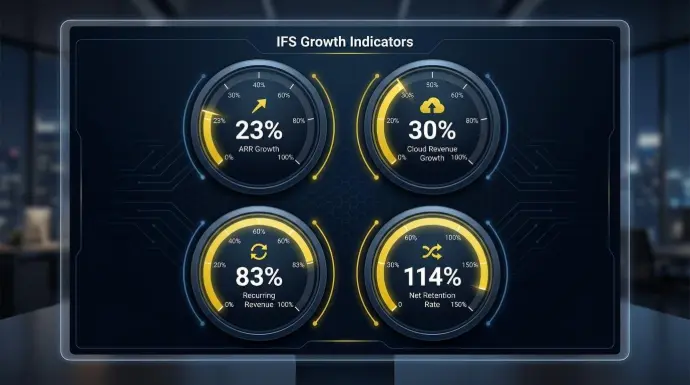
The numbers make one thing clear. IFS and Odoo are not competing in the same weight class, even though they both sit inside the ERP market.
IFS is growing as a specialized enterprise vendor. Odoo is expanding as a high-growth mid-market ERP platform. When you compare the data, the contrast becomes obvious.
Metric | IFS | Odoo |
Market positioning | Enterprise and asset-heavy ERP | Mid-market and SME ERP platform |
Growth indicators | 23% ARR growth in FY2025 | 16M+ users globally |
Cloud momentum | 30% cloud revenue growth | Strong SaaS adoption trend |
Revenue model | 83% recurring revenue | €650M revenue in 2025, projected €800M+ in 2026 |
Customer scale | Large complex organizations | 170,000+ enterprise customers |
Sources: IFS FY2025 Financial Highlights and AppVerticals Odoo ERP Market & Adoption Statistics 2026
IFS ERP Market Position and Revenue Growth
IFS is a strong vendor, but its growth tells a very specific story.
According to IFS’s FY2025 financial results, the company reported:
- 23% year-over-year growth in Annual Recurring Revenue
- 30% growth in cloud revenue
- 83% of total revenue is now recurring
- 114% net retention rate
Those are solid enterprise metrics. They show that existing customers are staying and expanding.
However, they also reveal something important. IFS is not growing through massive user adoption. It is growing through larger enterprise contracts and deeper relationships with fewer customers.
In simple terms, IFS is winning by selling large ERP projects to complex organizations, especially in industries such as infrastructure, aerospace, and utilities, where asset management and field service operations are critical.
That is a very different growth pattern from Odoo.
Odoo ERP Market Share and Global Adoption
Odoo’s numbers tell the opposite story. Instead of enterprise concentration, it is expanding through global adoption and mid-market growth.
According to the AppVerticals 2026 Odoo ERP Market & Adoption Statistics report, Odoo now has:
- 16+ million users worldwide
- 170,000+ enterprise customers
- 120,000 new customers added annually
- 5.77% global ERP market share
- 20–25% compound annual growth rate
Revenue growth reinforces the same trend:
- €650M revenue in 2025
- Projected €800M+ in 2026
- Target of €1B by 2027
Those numbers are not typical for traditional ERP vendors. They look more like a SaaS growth curve than a legacy enterprise platform.
Odoo’s growth is also fueled by faster implementation. The same report estimates 2–4 months of deployment for smaller teams and 6–12 months for larger implementations, which is significantly faster than traditional enterprise ERP timelines.
The Real Verdict From the Data
When you strip away marketing language and just look at the numbers, the conclusion becomes pretty straightforward.
IFS is succeeding as a high-value enterprise ERP vendor. Its growth comes from large, complex organizations that commit to deep ERP deployments and long-term contracts.
Odoo is succeeding through scale and accessibility. Its adoption numbers, user growth, and revenue trajectory show a platform that is expanding quickly among manufacturers, distributors, retailers, and service businesses seeking ERP without the complexity of legacy systems.
So the real takeaway from the IFS vs Odoo ERP market data is this:
- IFS dominates in complex, asset-heavy enterprise environments.
- Odoo dominates in the mid-market where flexibility, speed, and cost matter.
Both platforms are growing. They are simply growing in different parts of the ERP market.
Explore Cudio Odoo Case Studies
What IFS Cloud ERP Is Designed For
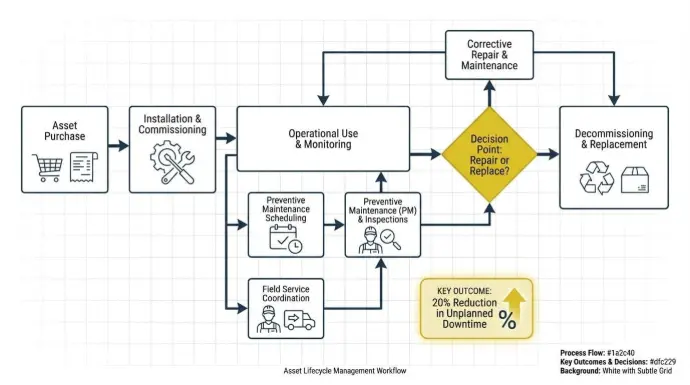
IFS Cloud is built for organizations running complex operations where equipment, infrastructure, and service networks are core to the business. In these environments, ERP is not just about finance or inventory. It is about managing assets, maintenance operations, and field service teams across large organizations.
Enterprise Asset Management and Field Service
The primary capability of IFS Enterprise Asset Management (EAM) is its ability to track the complete financial and operational lifecycle of high-value industrial equipment, reducing unplanned downtime by up to 20%.
Companies using IFS often need to manage thousands of assets across facilities and field locations. The system helps organizations track equipment performance, schedule maintenance, and coordinate service teams.
Common use cases include:
- Tracking assets from purchase to replacement
- Managing preventive maintenance schedules
- Coordinating field service technicians and repair operations
For industries where equipment downtime is expensive, these capabilities are essential.
Industrial AI and Predictive Maintenance
Another key part of the IFS Cloud ERP features is Industrial AI.
IFS analyzes operational data to detect equipment issues early. Instead of reacting to failures, companies can anticipate them.
This includes:
- Anomaly detection that flags unusual asset behavior
- Predictive maintenance that schedules repairs before breakdowns
- Operational analytics to improve asset performance
For asset-heavy businesses, this helps reduce downtime and improve reliability.
Global Enterprise Capabilities
IFS is also designed for companies operating internationally.
The platform supports:
- Multi-currency financial management
- Multi-GAAP accounting
- Global regulatory compliance across multiple countries
These capabilities make IFS suitable for organizations managing complex global operations.
What Are the Core Capabilities and Primary Use Cases of Odoo ERP?

While IFS targets large enterprises, Odoo ERP focuses on flexibility and scalability for growing companies.
Instead of one large system, Odoo provides a collection of connected business applications that companies can adopt gradually.
Odoo’s Modular ERP Architecture
Odoo follows a modular ERP model. Businesses start with the apps they need and expand later.
For example, a company might begin with accounting and CRM, then add inventory, manufacturing, or ecommerce as operations grow.
As of 2026, the Odoo ecosystem features 40 native core business applications and over 12,000 community-developed modules available via the Odoo Apps Store.
This modular structure makes Odoo highly adaptable for different industries and operational setups.
Replacing Multiple Business Systems with One Platform
Many companies adopt ERP because their operations are spread across too many tools.
It is common to see businesses using separate systems for:
- CRM and customer management
- Accounting and finance
- Inventory and procurement
- Ecommerce operations
Odoo brings these tools together in one platform.
At Cudio, we often see companies replace 6–12 disconnected tools when implementing Odoo. Consolidating these systems simplifies operations and improves visibility across the business.
Show Me What’s Holding Me Back - Book ERP Assessment
Odoo is also widely used by growing manufacturers and distributors.
The platform includes Odoo business applications that support:
- Bill of Materials (BOM) management
- Warehouse and inventory tracking
- Procurement and purchasing
- Production planning and supply chain coordination
For many mid-market manufacturers, this provides the functionality needed to run operations without the complexity of large enterprise ERP platforms.
How Do Implementation Costs and Total Cost of Ownership Compare Between IFS and Odoo?
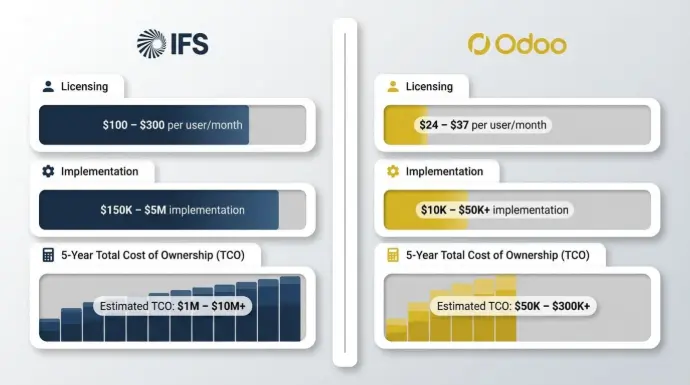
ERP pricing is rarely just about the software license. The real ERP implementation cost usually comes from consulting, configuration, integrations, training, and long-term support.
According to a 2026 Total Cost of Ownership analysis by ERP Research, software licensing represents only 20–30% of the total ERP investment, with implementation and operational maintenance accounting for the remaining 70–80%.
That is why comparing ERP systems based only on monthly pricing can be misleading.
IFS ERP Pricing and Implementation Costs
IFS Cloud is priced like most enterprise ERP platforms. The system uses per-user subscription licensing, combined with large implementation projects handled by specialized partners.
Typical pricing benchmarks include:
- $100–$300 per user per month
- Around $110/user/month starting price
- Implementation projects ranging from $150,000 to $5,000,000
- Typical total ERP project cost between $200K and $1M+
Most IFS deployments also take 6–14 months, depending on complexity.
These higher costs usually come from several factors:
- Complex configuration for asset management and field service
- Industry-specific modules
- Multi-country financial configuration
- Extensive integrations with other enterprise systems
IFS projects are therefore usually justified when companies truly need enterprise-scale capabilities.
Odoo ERP Pricing and Deployment Costs
Odoo follows a very different pricing model.
The platform offers two main versions:
- Odoo Community Edition — open-source and free to use
- Odoo Enterprise Edition — subscription-based licensing
Typical Odoo Enterprise pricing starts around:
- $24–$37 per user per month, depending on hosting and features
Implementation costs vary depending on the level of customization and the number of integrations. Typical ranges include:
- $10,000–$30,000+ for small deployments
- $50,000+ for mid-market implementations with more customization
Many Odoo deployments also launch faster, often in 1–3 months for smaller projects.
At Cudio, many Odoo development services projects start with modular deployments. Instead of implementing everything at once, businesses often begin with accounting, inventory, or CRM, then expand over time. This reduces upfront risk and allows the ERP system to scale with the company.
Show Me What’s Holding Me Back - Book ERP Assessment
5-Year ERP Total Cost Comparison
When companies compare ERP platforms, they should evaluate the five-year total cost of ownership, not just licensing.
A typical ERP TCO model includes:
- Software licensing
- Implementation and consulting
- Data migration
- Training
- Support and maintenance
- Future upgrades
Cost Category | IFS Cloud ERP | Odoo ERP |
Licensing | $100–$300 per user/month | $24–$37 per user/month |
Implementation | $150K – $5M depending on complexity | $10K – $50K+ typical |
Deployment timeline | 6–14 months | 1–6 months |
Annual support | ~20% of license cost | Partner support varies |
5-year TCO range | $200K – $1M+ for mid deployments | ~$150K – $500K typical |
Sources: ERPResearch ERP Pricing Guide (2026), Itransition Odoo Cost Guide (2025).
The takeaway is simple.
IFS can be the right investment for large asset-heavy enterprises running complex global operations.
Odoo, on the other hand, often delivers a significantly lower total cost of ownership for mid-market companies that want to modernize operations without committing to a multi-year enterprise ERP project.
How Does IFS's Unified Architecture Compare to Odoo's Modular Design?
Beyond pricing and industry fit, another important difference in the IFS vs Odoo ERP comparison is how each platform is built. The underlying architecture shapes how easily companies can adapt the system, expand its functionality, and integrate with other tools.
IFS Unified Data Model and Enterprise Architecture
IFS Cloud uses a tightly unified architecture. Most core capabilities are built into the platform and share a structured data model across departments.
This design works well for organizations that require strict governance and consistent processes across large operations.
Typical characteristics include:
- Centralized data structures across finance, operations, and service
- Strong process standardization across departments
- Built-in modules designed for complex operational environments
Because everything is deeply integrated, changes usually require careful configuration and testing. Large organizations often dedicate internal ERP specialists and partner consultants to manage these environments.
Odoo Modular ERP Architecture and API Ecosystem
Odoo takes a different approach. The platform follows a modular ERP architecture, in which each business capability is delivered through applications that share a common database.
Companies can activate new functionality without redesigning the entire system.
This modular architecture delivers three primary technical advantages:
- Progressive Activation: Independent applications (like CRM or Inventory) can be activated without requiring a full-system redeployment.
- API Flexibility: Open-source APIs allow for rapid integration with legacy external software.
- Community Scalability: Access to a verified ecosystem of third-party modules prevents expensive custom code development.
This architecture allows organizations to expand gradually. Instead of implementing everything at once, teams can add new capabilities as the business grows.
For companies that want flexibility while modernizing operations, this approach often makes ERP adoption easier.
Which ERP Offers Better Financial Management and Accounting Capabilities?
Financial systems are often the foundation of an ERP implementation. Both platforms provide strong accounting capabilities, but they serve different operational needs
Financial Reporting and Multi-Entity Consolidation
IFS Cloud is designed for organizations managing multiple legal entities across regions. The platform supports complex financial structures and enterprise-level reporting requirements.
Common capabilities include:
- Consolidation across subsidiaries
- Multi-currency financial reporting
- Compliance with different accounting standards
These features help large organizations maintain consistent reporting across global operations.
Odoo also provides solid financial functionality, particularly for mid-market companies that need clear operational visibility without heavy financial infrastructure.
Typical capabilities include:
- General ledger and automated accounting entries
- Multi-company accounting within one environment
- Integrated financial dashboards for operational reporting
For many mid-market organizations, these capabilities cover the majority of financial management needs.
Accounting Automation and Compliance
Automation is another area where both systems deliver value.
IFS often focuses on structured financial governance and large-scale operational accounting. Organizations can configure workflows for approvals, financial controls, and internal audit requirements.
Odoo focuses more on usability and operational efficiency. Finance teams can automate routine tasks such as invoicing, reconciliation, and reporting directly within the platform.
This allows finance teams to spend less time on manual processing and more time analyzing operational performance.
How Do IFS and Odoo Compare for Supply Chain and Manufacturing Operations?
Manufacturing and supply chain operations are often the reason companies move to ERP in the first place. Both systems support these functions, but they address different levels of operational complexity.
Manufacturing Capabilities in IFS Cloud
IFS Cloud is built for environments where production operations are deeply connected with maintenance, service networks, and complex asset management.
Organizations using IFS often operate large production facilities or project-based manufacturing environments.
Typical capabilities include:
- Advanced production planning
- Complex project-driven manufacturing models
- Integrated maintenance and operational management
These capabilities allow companies to coordinate manufacturing operations alongside service and infrastructure management.
Manufacturing Workflows in Odoo ERP
Odoo focuses on providing flexible tools that help manufacturers manage day-to-day production workflows.
Common capabilities include:
- Bill of Materials management
- Work order planning and production tracking
- Inventory visibility across warehouses
Because these features integrate directly with purchasing, sales, and accounting, companies can manage operations from a single system.
Which ERP Works Best for Mid-Market Manufacturers
For most mid-market manufacturers, the decision usually comes down to operational scale.
IFS Cloud tends to fit organizations running complex production environments tied to large infrastructure operations.
Odoo, on the other hand, often suits manufacturers seeking a unified system that connects inventory, production, purchasing, and sales without deploying a large enterprise platform.
In these environments, the goal is not maximum complexity. It is operational visibility and control.
What Are the Implementation Risks and Deployment Complexities of IFS vs Odoo?
ERP projects rarely fail because of missing features. Most problems appear during implementation.
The complexity of the deployment process can significantly affect cost, timelines, and user adoption.
IFS ERP Implementation Timeline and Risks
IFS projects typically involve structured enterprise deployments. These implementations often include extensive process mapping, data migration, and system configuration.
Typical characteristics include:
- Large cross-department implementation projects
- Heavy reliance on specialized consultants
- Longer testing and validation phases
Due to this architectural complexity, standard IFS enterprise deployments typically require 9 to 18 months from project kickoff to final go-live, depending on customization scope.
Organizations usually need experienced internal teams to guide the project and maintain the system after launch.
Odoo ERP Implementation Speed and Flexibility
Odoo implementations tend to be more flexible. Many companies start with a smaller system and expand over time.
This phased approach can include:
- Deploying core modules first
- Activating additional applications later
- Adjusting workflows gradually after go-live
By rolling out the platform step by step, companies often reduce implementation pressure and allow teams to adapt more easily.
Why Implementation Strategy Matters More Than Features
At the end of the day, the success of an ERP project rarely depends on the number of features available. It depends on how well the system aligns with the organization’s processes and internal capabilities.
Companies that plan carefully, involve operational teams early, and work with experienced implementation partners are far more likely to achieve successful ERP outcomes.
What is the Best Decision Framework for Choosing Between IFS and Odoo?
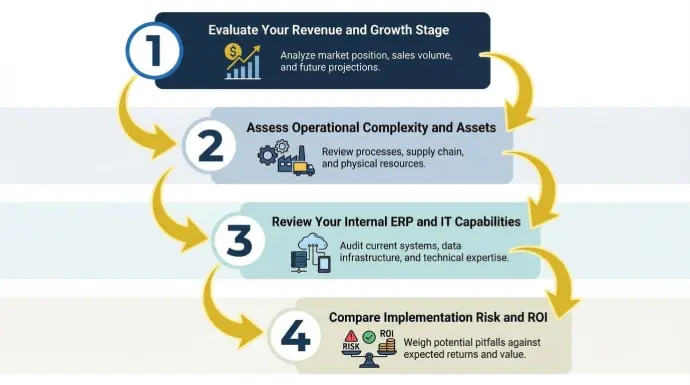
Selecting an ERP system should never rely solely on brand reputation or feature lists. A structured decision process helps organizations align technology choices with real operational needs.
Evaluate Your Revenue and Growth Stage
Start by looking at the company scale and growth trajectory.
Organizations with large global operations may require enterprise-level infrastructure. Smaller or mid-market companies often benefit from more flexible systems.
Assess Operational Complexity and Assets
Next, evaluate operational complexity.
Businesses managing large equipment networks or infrastructure may require systems designed for those environments. Others simply need better coordination across finance, operations, and customer processes.
Review Your Internal ERP and IT Capabilities
ERP systems also require internal expertise.
Companies with dedicated IT teams and ERP specialists may be comfortable managing complex platforms. Organizations with lean teams often prefer systems that are easier to configure and maintain.
Compare Implementation Risk and ROI
Finally, consider the balance between risk and return.
ERP projects represent major operational investments. The most successful implementations typically come from systems that match the company’s scale, processes, and internal capabilities.
Choosing the right ERP is not about selecting the largest platform. It is about selecting the system your organization can implement successfully and use effectively over time.
Show Me What’s Holding Me Back - Book ERP Assessment
Final Thoughts
IFS and Odoo solve very different ERP problems. IFS Cloud is powerful but heavy, built for asset-intensive enterprises with the budget, teams, and time to run large ERP programs. Odoo, on the other hand, gives growing companies a faster path to unify operations, data, and workflows without enterprise-level complexity.
The real advantage comes from implementation. At Cudio, we help companies choose the right platform, avoid costly ERP mistakes, and launch systems that actually work in the real world.
Ready to modernize your ERP? Talk to a Cudio expert and see how we help businesses implement Odoo successfully.
Show Me What’s Holding Me Back - Book ERP Assessment
FAQs
Here are the most common questions decision-makers ask when evaluating IFS vs Odoo ERP.
Can we start on Odoo and later move to IFS if we outgrow it?
Yes. Many companies start on Odoo and later move to IFS when they reach enterprise scale, typically after major growth or global expansion. For most $20M–$150M businesses, Odoo provides more than enough capability for years before an enterprise platform becomes necessary.
Is Odoo secure enough compared to IFS Cloud?
Yes, Odoo is secure enough for most businesses when deployed correctly. Both Odoo and IFS Cloud support enterprise-grade security features like role-based access, encryption, and audit logs. In practice, security depends more on how the system is hosted and managed than on the ERP itself.
How do integration options differ between IFS and Odoo?
IFS integrations are usually handled through specialized partners within structured enterprise architectures. Odoo integrations are typically faster and easier because the platform is API-friendly and highly customizable. This makes Odoo more flexible for companies connecting modern SaaS tools, ecommerce systems, or manufacturing equipment.
What internal team do we need for a successful IFS vs Odoo project?
IFS projects usually require a larger internal team, including a project manager, functional owners, and experienced IT specialists. Odoo projects can often succeed with a smaller team supported by an experienced implementation partner. The simpler deployment model makes Odoo easier for organizations with lean internal resources.
How do upgrades and long-term maintenance compare between IFS and Odoo?
IFS upgrades are typically larger projects that require planning and partner involvement. Odoo releases updates more frequently, but upgrades are usually smoother when companies stay close to standard modules. In both systems, long-term maintenance depends heavily on the level of customization introduced during implementation.