


Most businesses begin scoping an Odoo project by looking at the license price. That number is visible and easy to compare, but it's only one part of the total Odoo implementation cost, often not the largest part.
The real cost depends on your user count, apps and modules, hosting setup, data migration complexity, integrations, customization needs, and how well your team is trained before go-live. Underestimating any one is where budget overruns begin.
For US and Canadian businesses, 2026 adds an extra layer of pressure: Odoo's Enterprise terms allow renewal increases of up to 7% a year, and older databases may carry a 25% surcharge. This guide covers every major cost driver, the hidden costs teams miss, and how to build a realistic budget.
Key Takeaways
License cost is rarely the largest line item in an Odoo implementation; customization, data migration, integrations, testing, and training usually add up to more.
Two 2026-specific pricing factors matter for US and Canadian businesses: up to 7% annual renewal indexation, and a 25% surcharge on databases running versions older than Odoo's covered range.
Over-customization is one of the most common sources of avoidable cost, since every custom module needs maintenance, testing, and updating with each new Odoo release.
A low upfront quote is often a warning sign, not a good deal. It usually means the scope wasn't fully defined and the real cost will surface mid-project or after go-live.
The single biggest lever for controlling cost is a thorough discovery and scoping process before the project starts, not cost-cutting once it's underway.
What Affects Odoo Implementation Cost in 2026?
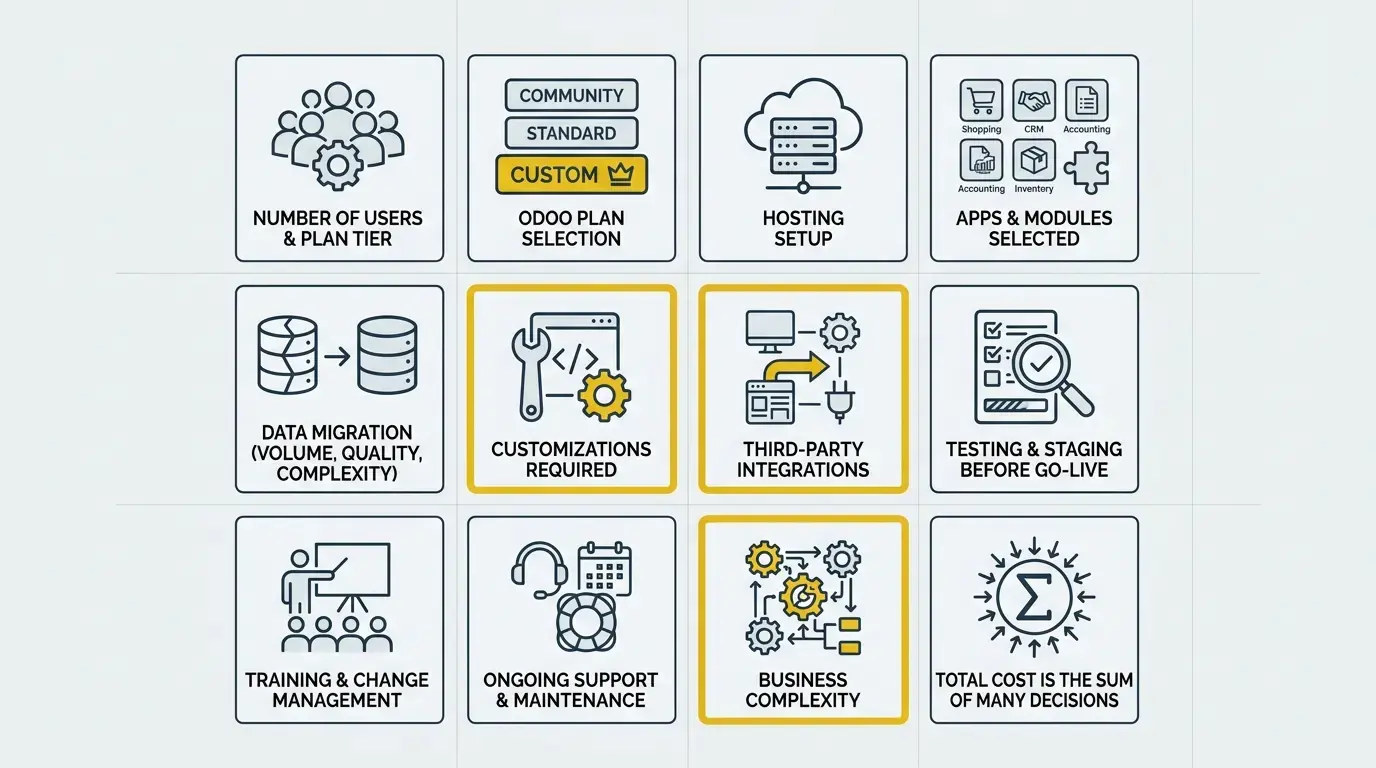
Before diving into individual cost categories, it helps to see the full picture. Odoo implementation cost isn't a single line item. It's the sum of several interconnected decisions, and each one has a price attached to it.
The main cost drivers include:
Number of users and which plan tier they require
Odoo plan selection (Community, Standard, or Custom)
Hosting setup (Odoo Online, Odoo.sh, on-premise, or third-party cloud)
Apps and modules selected for your business processes
Data migration volume, quality, and complexity
Customizations required to fit your specific workflows
Third-party integrations with eCommerce platforms, accounting tools, shipping systems, and marketplaces
Testing and staging before go-live
Training and change management for your team
Ongoing support and maintenance after launch
Business complexity, including multi-company, multi-warehouse, or multi-currency setups
None of these factors exist in isolation. A business with clean data, standard workflows, and a small user base will have a very different cost profile than a mid-market company running multiple warehouses, marketplace integrations, and custom reporting. The sections that follow break each of these down in practical terms.
Odoo Pricing in 2026: What Budget Owners Should Know
The price for an Odoo implementation isn't a fixed number you can look up once and rely on indefinitely.
It varies by region, plan, billing term, user count, hosting setup, and contract terms. Odoo's own pricing page lists current tiers by region, but for businesses in the US and Canada specifically, pricing should be verified directly with Odoo or a certified Odoo partner before building a budget, because figures that appear in older articles or comparison sites may no longer reflect current rates.
What budget owners should understand going into 2026 is that the licensing cost itself is only the starting point.
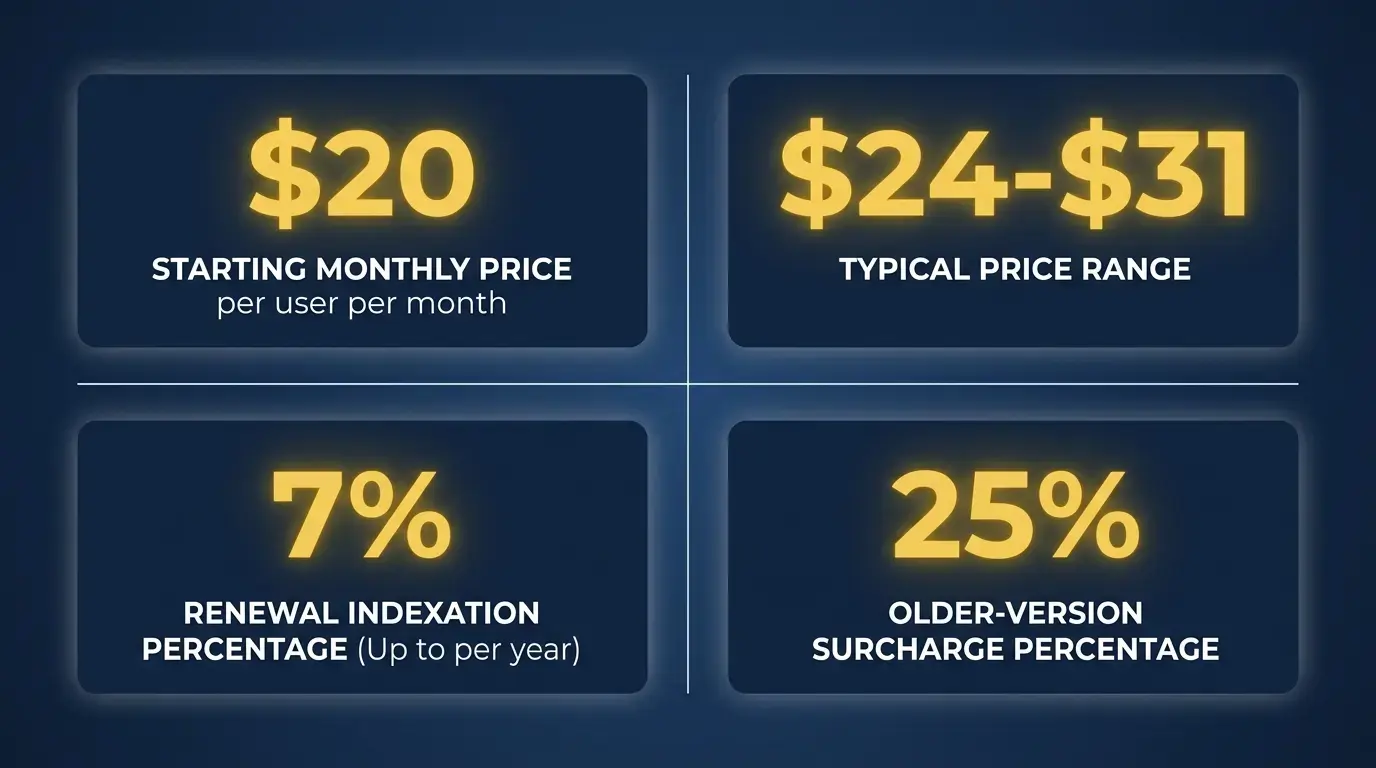
Odoo Enterprise starts at about $20 per user per month. In practice, odoo enterprise pricing in 2026 is often cited in the roughly $24 to $31 range as a monthly cost by region and term. Two additional factors deserve attention during contract and renewal planning.
First, Odoo's Enterprise terms include renewal indexation of up to 7% per year of the previous term when prior charges are lower than the current applicable list price. Over a multi-year contract, that compounds. A business that locks in a rate today should model what renewal looks like in year two and year three, not just year one.
Second, databases running on Odoo versions older than the covered versions may carry a 25% surcharge. For businesses that have delayed upgrades, this creates real cost pressure at renewal time. Planning an upgrade before that window closes is often more cost-effective than absorbing the surcharge.
"ERP transformations are difficult. We move entire operating systems into a single source of truth. There will be surprises, but those surprises shouldn't be your financial burden." — Gordon Cummins, CEO of Cudio
For the most accurate current pricing, consult Odoo directly or work with a certified partner who can provide a region-specific quote based on your actual user count, plan, and hosting setup; Odoo Enterprise generally includes all apps under a per-user subscription, so budgeting should center on user count, subscription cost, and implementation work rather than separate licensing costs per module.
Odoo License Costs: Standard vs. Custom vs. Community
Odoo offers three main licensing paths, and the right choice depends on your technical resources, customization needs, and hosting preferences.
Plan | Hosting | Customization | Best For |
Community | On-premise or self-hosted | Open-source, fully customizable | Technical teams comfortable managing their own infrastructure |
Standard | Odoo Online only | Limited to standard apps | Businesses wanting a managed cloud setup with less complexity |
Custom | Odoo Online, Odoo.sh, or on-premise | Full access including Odoo Studio and custom modules | Companies needing advanced flexibility, custom workflows, or multi-company setups |
Community
Odoo Community is the free, open-source version of the odoo system, but “free” refers to the license only. Hosting, implementation, customization, and support all carry costs.
The odoo community edition is self-hosted, includes no official support, and is usually a better fit for a small business with technical resources than for teams that want a managed deployment.
Teams comparing paid options with odoo community should still account for implementation and ongoing support even when license fees are zero.
Standard
Standard is designed for businesses that want a straightforward Odoo Online setup with access to standard apps. It's a managed environment, which reduces infrastructure overhead, but it limits what you can customize.
Custom
Odoo Enterprise is the paid option most businesses use when they need Custom-plan flexibility, including Odoo Studio, custom-built modules, Odoo.sh hosting, on-premise deployment, or more advanced configuration.
It is usually the better fit for larger teams whose business needs call for advanced configuration, custom workflows, or multi-company support.
It offers the most flexibility but also carries the highest licensing cost and the most implementation complexity, since Custom also enables external API access for advanced integrations and development work in the odoo backend.
Choosing the wrong plan early is a common source of rework. A business that starts on Standard and later discovers it needs Custom-level features will face a plan upgrade and potentially a re-scoping of the implementation.
Hosting Costs: Odoo Online, Odoo.sh, On-Premise, or Cloud
Hosting is a cost category that many businesses underestimate during initial budgeting. The choice of hosting environment affects not just the monthly or annual fee, but also the level of technical management required, the flexibility available for customization, and the long-term cost of upgrades and maintenance.
Odoo Online
Odoo Online is Odoo's fully managed cloud environment. It reduces infrastructure management overhead and is included with Standard and Custom plans. The tradeoff is that customization is more limited compared to other hosting options. For businesses with straightforward workflows and no need for custom modules, it's a practical choice.
Odoo.sh
Odoo.sh is Odoo's developer-friendly cloud platform. It supports custom modules, staging environments, and version control, making it well-suited for businesses that need more flexibility than Odoo Online allows. It adds hosting costs beyond the base license and requires more technical involvement to manage effectively.
On-Premise
On-premise deployment lets your team host Odoo with full control over the infrastructure, data, and environment. It's the most flexible option but also the most resource-intensive.
Your team is responsible for server management, security, backups, updates, and uptime, so it only makes sense if you can absorb the ongoing costs internally.
For businesses with strong internal IT capabilities or strict data residency requirements, it can make sense. For everyone else, the hidden operational costs often outweigh the perceived savings.
Third-Party Cloud
Third-party cloud hosting, such as AWS, Azure, or Google Cloud, sits between on-premise and Odoo.sh in terms of flexibility and management burden. It can be a good fit for businesses that want cloud infrastructure without being locked into Odoo's own hosting environment, but it requires technical expertise to configure and maintain correctly.
Implementation Approach: Self-Service, Odoo Support, or Odoo Partner
How you implement Odoo is as important as what you implement. The approach you choose affects cost, timeline, risk, and the quality of the final system.
Self-Service Implementation
Self-service implementation can appear to be the lowest-cost option because it relies on internal resources rather than external fees. In practice, it works well only when your team has direct Odoo experience, your workflows are straightforward, your data is clean, and your integration needs are minimal. When those conditions aren't met, self-service implementations tend to take longer, produce more rework, and ultimately cost more than a properly scoped partner engagement.
Odoo's Direct Implementation Support
Odoo's direct implementation services may be appropriate for simpler projects where the scope is limited and the business processes align closely with Odoo's standard functionality.
It's worth evaluating for smaller teams or businesses with a single primary use case, especially when the implementation process is narrow and the company is adopting mostly standard functionality.
A Certified Odoo Partner
Working with the right Odoo partner, one verifiable through Odoo's own partner directory, is generally the better choice for businesses with complex workflows, multiple departments, data migration requirements, third-party integrations, or customization needs.
A partner brings implementation experience, scoping discipline, stronger project management for ERP projects, and the ability to anticipate problems before they become expensive for a successful implementation.
The upfront cost is higher, but the total project cost is often lower because scope is managed more carefully from the start.
The right approach depends on your internal capabilities, your project complexity, and how much risk you're willing to carry. For most mid-market businesses, a partner engagement is the most reliable path to a stable, well-configured system.
The Real Cost of Odoo Implementation Beyond Licensing
License cost is the number most people focus on when evaluating Odoo, and it's also the number that least often causes budget overruns. The real cost of an Odoo implementation lives in the work required to make the system fit your business, and that work is where most projects go over budget.
Customization and Module Selection
Odoo covers a wide range of business functions through its standard app library. For many workflows, the standard functionality in its Odoo modules is sufficient, and using it as-is is both faster and cheaper than building something custom.
That kind of customization can add roughly $2,000 to $15,000+ to implementation costs, depending on complexity.
The problem arises when teams assume that every gap between their current process and Odoo's default behavior requires a custom solution.
Over-customization increases implementation cost, slows down future upgrades, and creates long-term maintenance obligations; every custom module is code that needs to be maintained, tested, and updated when Odoo releases a new version.
In practice, custom module development often falls in the same $2,000 to $15,000+ range per project, with experienced Odoo developers commonly billing $60 to $150 per hour.
A more strategic approach is to evaluate whether a workflow gap is worth customizing or whether the business process itself can be adapted to fit Odoo's standard design. In many cases, the standard approach is more efficient than the legacy process it's replacing. For situations where customization is genuinely necessary, scoping the work tightly and building it with upgrade compatibility in mind is exactly what a properly run Odoo customization engagement protects against, because when companies customize Odoo, the main cost drivers are custom development scope, building custom modules, and long-term maintenance of those changes.
Data Migration and Cleanup
Data migration is consistently one of the most underestimated cost categories in ERP implementations. Data migration costs often range from about $2,000 to $20,000, but can run from $1,500 to $40,000 depending on source systems and cleanup needs.
The assumption is that moving data from one system to another is a technical task with a predictable timeline. In practice, data quality is the variable that determines how long migration actually takes.
Before data can be migrated, it needs to be audited, cleaned, deduplicated, mapped to Odoo's data structure, and validated.
Customer records with inconsistent formatting, product catalogs with missing fields, historical transactions with incomplete references, and supplier data that has never been standardized all require manual work before they can be imported reliably.
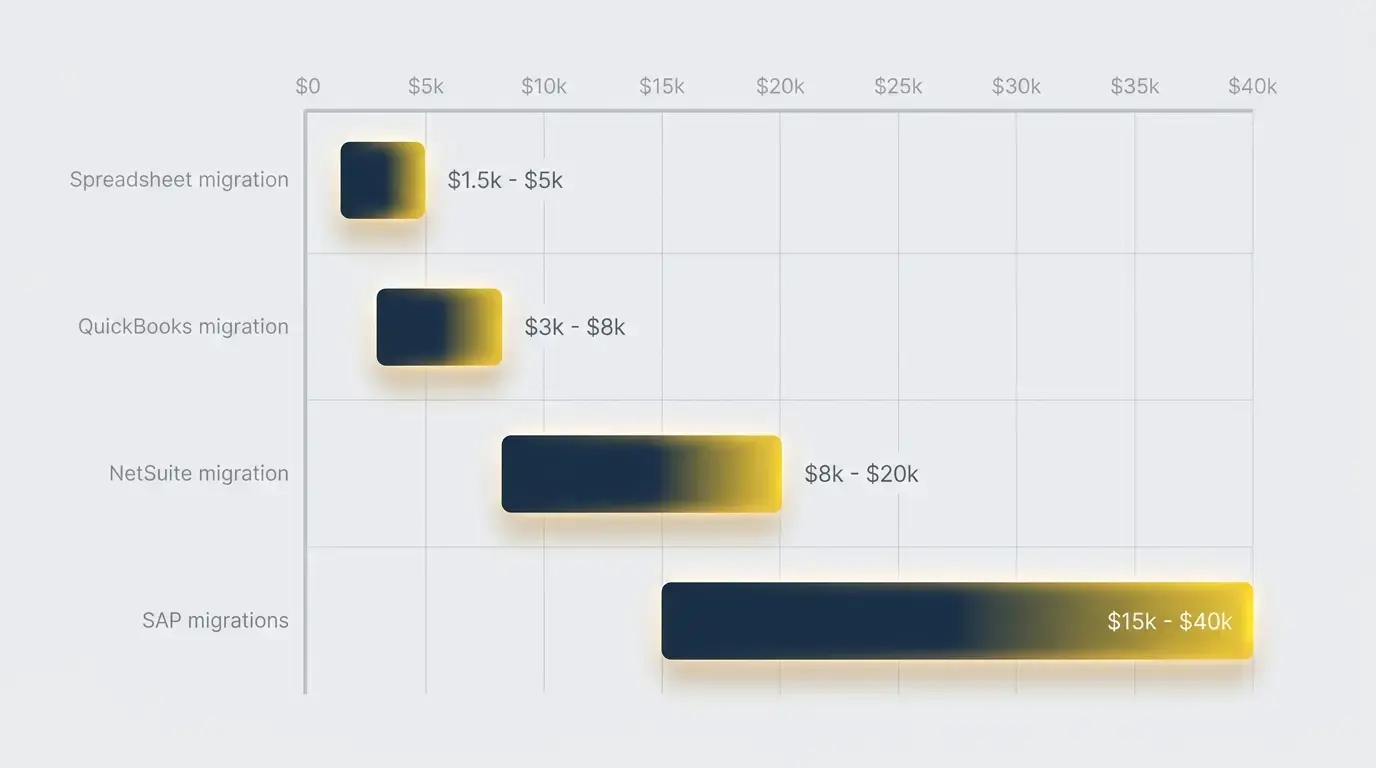
For example, spreadsheet migration is often $1,500 to $5,000, QuickBooks migration commonly runs $3,000 to $8,000, NetSuite migration may reach $8,000 to $20,000, and SAP migrations can exceed $15,000 to $40,000.
The cost of data migration scales with the volume of records, the number of source systems, the quality of the existing data, and the complexity of the mapping and validation required in the Odoo environment. Businesses that invest in data cleanup before the migration phase typically move faster and encounter fewer post-launch issues than those that try to clean data during the migration itself — a reality that professional Odoo migration services are specifically structured to address.
API, EDI, and Third-Party Integrations
Most businesses don’t run Odoo in isolation, and they often need integrating Odoo with accounting tools, marketplaces, and e commerce platforms rather than relying on it alone. Each of those connections carries a cost.
Third-party integrations typically cost between $2,000 and $10,000 each, depending on connector availability and workflow complexity.
Integration cost depends on whether a pre-built connector exists, how well-documented the external system’s API is, how much data needs to flow between systems, and how frequently that data needs to sync. A simple one-way product feed is very different from a bidirectional order management integration with real-time inventory updates.
EDI integrations with suppliers or retail partners add another layer of complexity, since EDI standards vary by trading partner and maintaining those connections over time requires ongoing attention as partner requirements change.
For businesses selling through major marketplaces, that’s exactly the kind of connection covered under Odoo integration and Rithum connector work, where 420-plus marketplaces get handled through a single connector rather than a separate build for each channel.
Testing and Staging
Testing isn't optional for a serious Odoo implementation, but it's frequently underbudgeted. Before go-live, workflows need to be validated end-to-end, reports need to produce accurate outputs, user permissions need to be verified, integrations need to be tested under realistic conditions, and data needs to be confirmed as complete and correctly mapped.
Skipping or compressing the testing phase is one of the most reliable ways to create expensive post-launch problems; issues that take an hour to fix in a staging environment can take days to resolve in a live system where real transactions are running.
A proper testing phase includes unit testing of individual configurations, integration testing across connected systems, user acceptance testing with actual end users, and a go-live readiness review. Each of these takes time, and that time has a cost.
Training and Change Management
Training and change management are essential to employee training and long-term adoption, not just technical completion.
Training costs depend on the number of users, the complexity of the workflows they need to learn, and the format of the training itself; live sessions, recorded walkthroughs, written documentation, and super-user programs all serve different purposes and carry different costs.
For larger teams or businesses with high staff turnover, building reusable training materials is a worthwhile investment. Training costs for an Odoo implementation can reach $5,000 to $10,000 depending on team size and delivery format.
Change management goes beyond training, and ongoing training after go-live helps users keep up with updates and reduce future support needs.
It includes communicating the reasons for the change, managing resistance, identifying internal champions who can support their colleagues, and providing structured support during the transition period. Implementations that skip this work tend to see lower adoption rates, more support requests, and slower time-to-value.
Support and Maintenance
The work doesn't end at go-live. Post-launch support covers bug fixes, workflow optimizations, small configuration changes, user questions, and system stability monitoring.
For most businesses, some level of ongoing support is necessary to keep the system running well and to handle the inevitable adjustments that come after real-world use begins. Support costs vary depending on whether you manage it internally, rely on Odoo's support channels, or retain a partner for ongoing assistance. Businesses that build post-launch support into their budget from the start are better positioned to address issues quickly and avoid the compounding cost of deferred fixes.
Hidden Odoo Implementation Costs to Watch For
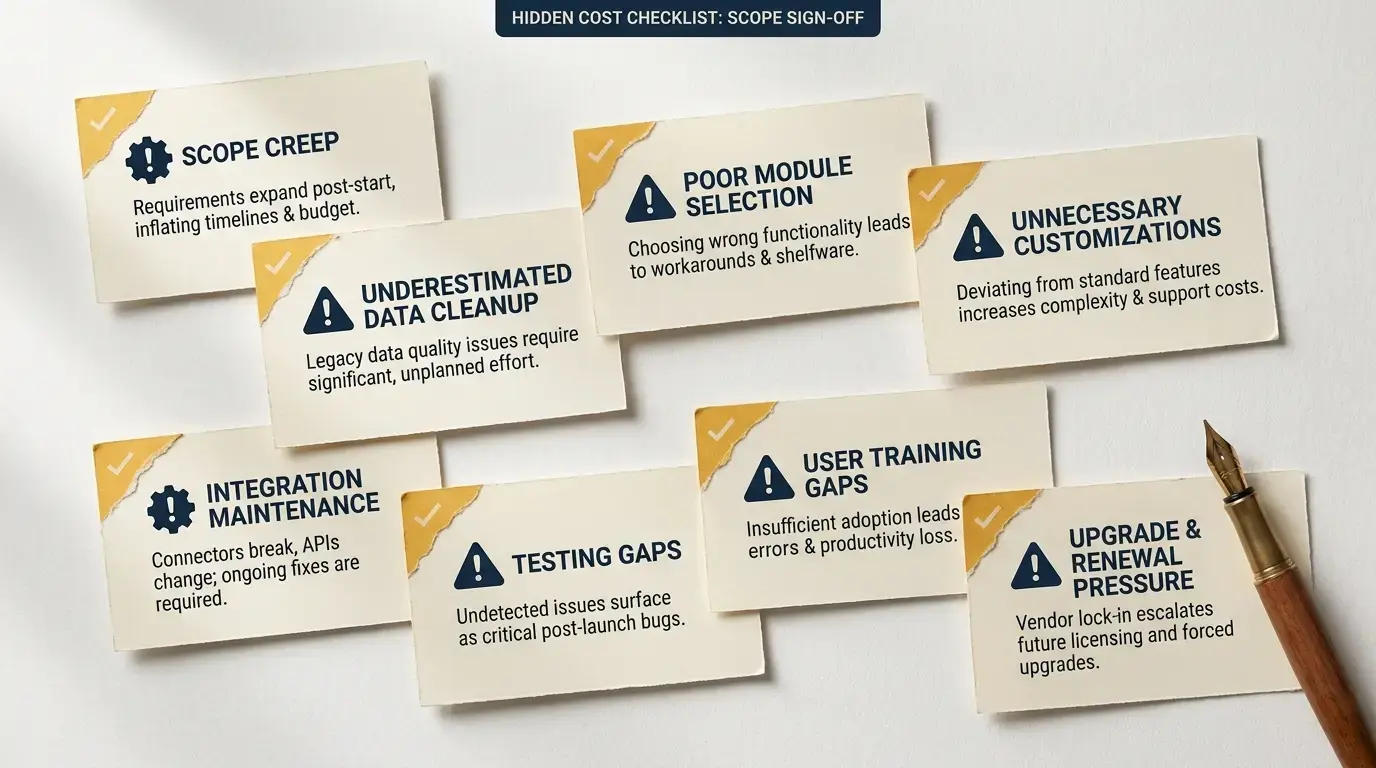
Even well-planned implementations encounter costs that weren't fully anticipated at the start. Some of these are predictable with the right scoping process. Others emerge from decisions made early in the project that have downstream consequences.
The most common hidden cost categories include:
Scope creep from requirements that expand after the project starts
Underestimated data cleanup when source data quality is worse than expected
Poor module selection that requires reconfiguration or replacement mid-project
Unnecessary customizations that add cost without adding proportional value
Third-party app configuration that takes longer than anticipated
Integration maintenance as external systems update their APIs or change their data formats
Testing gaps that surface as post-launch bugs requiring emergency fixes
User training gaps that result in incorrect usage and data quality problems
Reporting rebuilds when standard Odoo reports don't match business requirements
Upgrade and renewal cost pressure from older-version surcharges or renewal indexation
Post-launch support needs that weren't budgeted because the project was assumed to be complete at go-live
The cause behind most of these is the same: A cost that was either not identified during scoping or was identified but not allocated a realistic budget.
The solution is a thorough discovery process before the project starts, not after problems appear.
A structured, budget-focused implementation engagement is where that discovery work happens before any number gets committed to.
How 2026 Price Changes Affect Odoo Budgets in the US and Canada
For businesses in the US and Canada reviewing their Odoo budgets in 2026, two specific factors deserve attention beyond the base license price.
Renewal Indexation
Odoo's Enterprise terms allow for renewal price increases of up to 7% per year of the previous term when prior charges are lower than the current applicable list price.
For a business on a multi-year contract, this means the cost in year two or year three may be higher than the rate locked in at signing. Modeling renewal cost over the full contract term, rather than just the first year, gives a more accurate picture of total licensing spend.
The Older-Version Surcharge
Databases running on Odoo versions older than the covered versions may carry a 25% additional fee. For businesses that have been deferring upgrades, this creates a meaningful cost event at renewal.
"Your ERP 'failure' is actually a slow-motion car crash that started months ago. Code only fails because of a compounding series of poor decisions, weak governance, and 'quick fixes' that have finally reached their breaking point." — Gordon Cummins, CEO of Cudio
These factors don't change the fundamental value proposition of Odoo as a platform. They do, however, make accurate budgeting more important than it was in previous years. Businesses that plan for these variables in advance are in a much stronger position than those that encounter them as surprises at renewal time.
Odoo Implementation Cost by Business Complexity
Because Odoo implementation cost depends on so many variables, the actual cost depends not only on technical complexity but also on business size and operational scope. A more useful framework is to think about cost in terms of project complexity.
Complexity Level | Typical Characteristics |
|---|---|
Simple | Small user count, standard apps, limited customization, minimal data migration, few or no integrations; often starts with core modules |
Moderate | Multiple departments, some custom workflows, one or two integrations, reporting needs, moderate data migration |
Complex | Multi-company or multi-warehouse, eCommerce and marketplace integrations, EDI, custom modules, heavy data migration, advanced reporting |
A simple setup involves fewer moving parts, a shorter implementation timeline, and lower total cost. Simple implementations are often tied to small business teams, while larger organizations usually move into moderate or complex ranges because of broader existing business processes.
A complex setup requires more discovery, more configuration, more testing, and more training, all of which add to the budget.
Most mid-market businesses fall somewhere in the moderate-to-complex range, particularly when they're replacing a legacy system, managing multiple sales channels, or operating across more than one location.
Odoo's own project cost estimator can give a rough starting figure based on company size, but it doesn't account for data quality, existing customizations, or integration complexity, which is exactly where the estimate and the real number tend to diverge.
Understanding where your project sits on this spectrum is the first step toward building a realistic budget.
How Cudio Estimates Your Odoo Implementation Cost
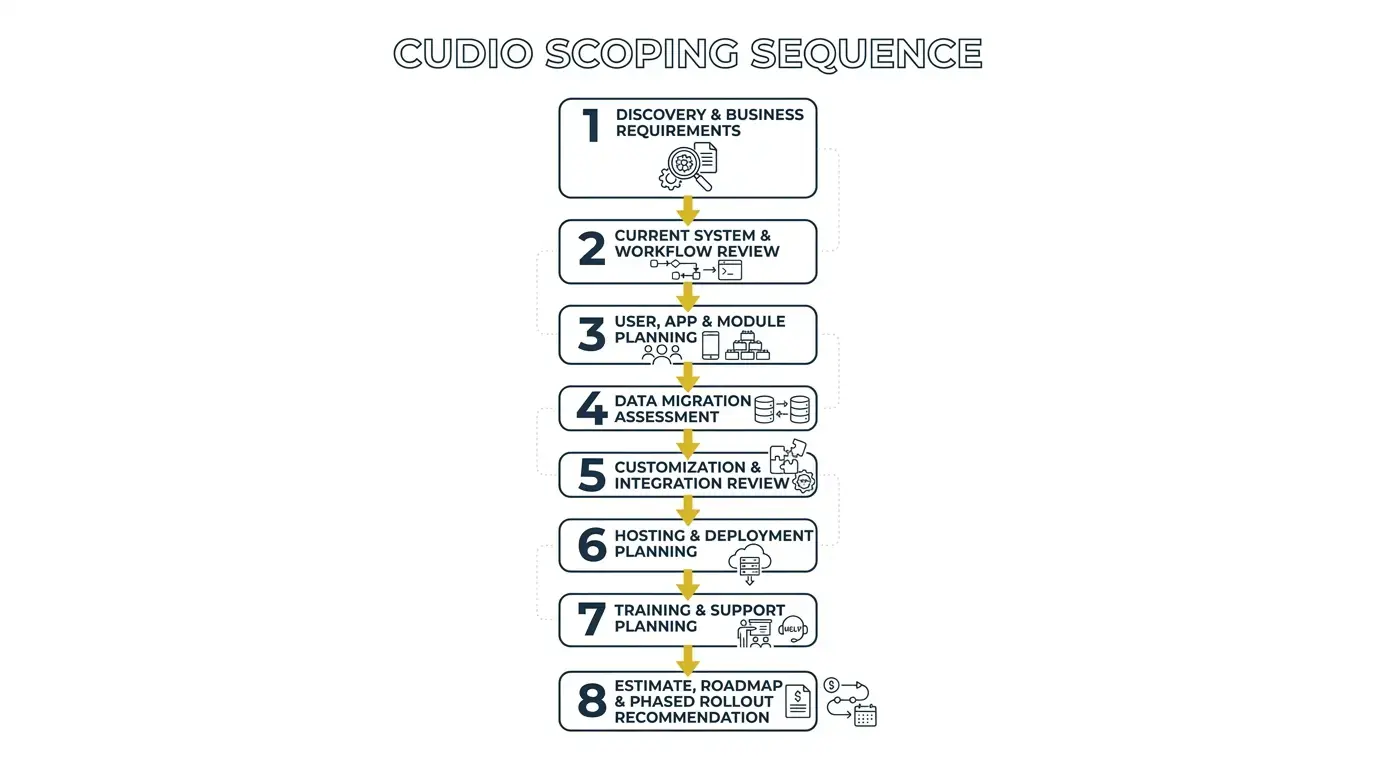
At Cudio, we don't provide implementation estimates based on a standard rate card. Every project is scoped based on the specific requirements of the business, because two companies with the same user count can have very different implementation needs depending on their workflows, data, and integrations.
Our scoping process follows a structured sequence:
Discovery and business requirements to understand your current processes, pain points, goals, and core business needs
Current system and workflow review to identify how existing business processes should be replicated, improved, or replaced in Odoo
User, app, and module planning to determine which Odoo apps are needed and how system configuration will set up modules, workflows, and roles
Data migration assessment to evaluate the volume, quality, and complexity of the data that needs to move
Customization and integration review to identify where standard Odoo functionality is sufficient and where custom work is genuinely necessary, reducing rework later
Hosting and deployment planning to select the right environment for your technical requirements and budget
Training and support planning to ensure your team is prepared for go-live and supported afterward
Estimate, roadmap, and phased rollout recommendation so you have a clear picture of cost, timeline, and sequencing before the project starts, improving cost savings by preventing avoidable scope changes
This process exists because underscoped projects are the primary cause of budget overruns. A thorough discovery phase takes time upfront, but it produces an estimate that reflects the actual work required rather than an optimistic number designed to win the engagement, which is exactly the philosophy Cudio's implementation scoping is built around for businesses at different stages of complexity.
How to Reduce Odoo Implementation Costs Without Cutting Corners
Reducing implementation cost doesn't mean doing less. It means making smarter decisions about where to invest and where to rely on Odoo's standard functionality.
The most effective cost-reduction strategies include:
Start with must-have workflows: Implement the processes that are critical to operations first, and defer nice-to-have features to a later phase.
Use standard Odoo features where possible: Every customization adds cost and maintenance obligation. If a standard feature covers 80% of the need, it's worth evaluating whether the remaining 20% justifies the investment.
Avoid unnecessary customization: Custom modules should solve genuine business problems that can't be addressed through configuration. Building custom solutions for edge cases or personal preferences is a common source of avoidable cost.
Clean data before migration: Data cleanup done before the migration phase is faster and cheaper than cleanup done during or after it.
Phase the rollout: Implementing Odoo in stages reduces the complexity of each phase, makes testing more manageable, and allows the team to build confidence before tackling more advanced functionality.
Test before go-live: A thorough testing phase prevents the expensive post-launch fixes that come from skipping validation.
Train internal champions: Identifying and training a small group of internal super-users reduces the ongoing support burden and accelerates adoption across the broader team.
Document workflows: Clear process documentation reduces training time, supports onboarding, and makes future upgrades easier to manage.
Choose the right hosting setup: Paying for hosting capabilities you don't need adds cost without adding value. Match the hosting environment to your actual technical requirements.
Build support into the budget: Post-launch support isn't optional. Budgeting for it from the start is more cost-effective than scrambling to find resources after go-live issues appear.
When a Cheap Odoo Implementation Becomes Expensive
A low upfront implementation quote isn't always a good deal. In many cases, the low number is a sign that the scope hasn't been fully defined, and the real cost will surface later in the project or after go-live.
The pattern is consistent: A business receives a low quote, the project starts, and then requirements expand as the team realizes what wasn't included. Data cleanup takes longer than expected. Integrations are more complex than the initial estimate assumed. Users aren't adequately trained, and adoption is slow. Custom workflows were built without upgrade planning, and the next version of Odoo requires expensive rework to maintain them.
Each of these scenarios adds costs that weren't in the original budget. By the time the project is complete, the total spend often exceeds what a properly scoped engagement would have cost from the start, and the business has also absorbed the cost of delays, rework, and post-launch instability.
The warning signs of an underscoped quote include:
A very short discovery phase
Vague scope documentation
No explicit line items for testing or training
An implementation timeline that seems optimistic given the complexity of the project.
If a quote doesn't account for data migration, integration work, and post-launch support, those costs haven't disappeared; they've simply been deferred to a point where they're harder to manage.
If your Odoo project has already run into these problems, that's a different starting point than a new implementation, and stabilizing an environment before layering anything else on top is exactly what an Odoo rescue engagement is designed to do.
Why Work With Cudio on Odoo Implementation Budgeting?
Cudio is a certified Odoo partner focused on helping businesses scope, implement, and manage Odoo projects accurately. Our approach is built around transparency at the budgeting stage, because the most expensive problems in ERP implementations are the ones that weren't anticipated before the project started.
We work with budget owners, CFOs, founders, and operations leaders who need a realistic picture of what their Odoo implementation will actually cost, not a number designed to get the project started. That means a thorough discovery process, honest scope documentation, and a phased roadmap that reflects your business complexity rather than an optimistic template.
Our team has experience across the full range of implementation scenarios, from straightforward single-department setups to complex multi-company, multi-warehouse environments with marketplace integrations and custom workflows. Our Odoo development services also support businesses that are upgrading from older Odoo versions, migrating from other ERP systems, or recovering from implementations that didn't go as planned.
Get a Realistic Odoo Implementation Estimate from Cudio
Final Words
The cost of an Odoo implementation in 2026 comes down to more than one number. Licensing, hosting, customization, data migration, integrations, testing, training, support, and the ongoing cost of keeping the system current through upgrades and renewals all factor in.
For businesses in the US and Canada, 2026 adds specific planning considerations around renewal indexation and older-version surcharges that make accurate budgeting more important than in previous years. The businesses that manage these costs well are the ones that plan for the full picture before the project starts, not after the first invoice arrives.
At Cudio, we help budget owners build realistic Odoo implementation budgets, scope projects accurately, and avoid the underestimation that turns a promising ERP project into an expensive recovery effort. If you're planning an Odoo implementation or reviewing your current Odoo costs, we're ready to help you get the numbers right from the start.
Talk to Cudio Before You Budget
FAQs About Odoo Implementation Cost
Wondering how much an Odoo implementation really costs? Here are quick answers to the most common questions about pricing, budgeting, and the factors that influence your total investment.
How much does an Odoo implementation cost?
Odoo implementation costs vary depending on your business requirements. Factors such as project scope, number of users, customizations, integrations, and data migration all affect the final price. A simple implementation costs much less than a complex, multi-company deployment. The best way to estimate your cost is through a detailed project assessment.
What affects Odoo implementation cost?
Several factors influence implementation cost, including the number of users, required modules, hosting option, data migration, customizations, integrations, training, and post-launch support. Business complexity also plays a major role. Projects involving multiple companies, warehouses, or advanced workflows generally require a larger investment. Proper scoping helps prevent unexpected costs later.
Is Odoo implementation more expensive in 2026?
Not necessarily. While Odoo's pricing and renewal terms have changed, implementation costs still depend primarily on your project requirements. However, businesses should budget carefully for long-term licensing, upgrades, and potential renewal increases. Planning early can help control overall costs.
What are the hidden costs of Odoo implementation?
Common hidden costs include scope changes, data cleanup, additional customizations, integration maintenance, user training, testing, and post-launch support. These expenses often arise when projects are not fully scoped before implementation begins. A thorough discovery phase helps identify and budget for these items upfront.
Is Odoo Online cheaper than Odoo.sh?
It depends. Odoo Online generally has lower infrastructure management costs because it is fully managed by Odoo. Odoo.sh provides greater flexibility for customization and development but requires additional technical management and hosting costs. The right option depends on your business requirements rather than price alone.
How much does Odoo customization cost?
Customization costs depend on the complexity of the requested changes. Simple configuration adjustments are relatively inexpensive, while custom modules and advanced business logic require significantly more development time. The more custom code a system contains, the higher the long-term maintenance costs may become. Avoiding unnecessary customization can help reduce your overall budget.
How much does Odoo data migration cost?
Data migration costs vary based on the amount, quality, and complexity of your existing data. Businesses with clean, organized data typically spend less on migration than those with multiple legacy systems or inconsistent records. Preparing your data before migration often reduces both cost and implementation time.
Do integrations increase Odoo implementation cost?
Yes. Each integration adds development, testing, and maintenance work to the project. Costs depend on the number of systems involved, whether pre-built connectors exist, and the complexity of the data being exchanged. More integrations generally mean higher implementation costs.
How can I reduce Odoo implementation costs?
You can reduce implementation costs by prioritizing essential features, minimizing customizations, cleaning your data before migration, and implementing Odoo in phases. Investing in user training and thorough testing also helps prevent costly issues after go-live. Careful planning usually saves more money than cutting corners.
Why work with an Odoo implementation partner?
An experienced Odoo implementation partner helps define project scope, manage risks, and avoid costly mistakes throughout the implementation. They can recommend best practices, reduce unnecessary customization, and guide your team through deployment and training. For complex projects, working with a partner often results in a smoother implementation and a lower total cost over time.