


ESG reporting used to be a large-enterprise problem, but that's no longer the case. Regulatory pressure, investor expectations, and supply chain requirements are pulling mid-market businesses into disclosure obligations they were never built to handle.
The data most businesses need already exists. It lives in HR, fleet management, purchasing, and accounting. The problem is that it's scattered across spreadsheets and disconnected systems with no clear path to a structured report.
Odoo 19 ships with a native ESG app designed to change that. This article covers what it actually does, what you need to prepare, and where the real implementation work sits.
What You Need to Know at a Glance
Odoo 19 includes a native ESG app that pulls data directly from Accounting, Fleet, Payroll, and Employees, with Scope 3 activity like purchased goods captured through tagged Accounting entries
The ESG app is an Enterprise-only feature; it isn't included in Odoo's free Community edition
Mid-market businesses in manufacturing, healthcare, and logistics face growing pressure to report ESG data, driven largely by CSRD supply chain cascades pushing obligations downstream
The app supports Scope 1, Scope 2, and Scope 3 emissions, alongside gender parity, pay gap, and governance metrics natively
ESG reporting is only as accurate as the data feeding it; data hygiene and source mapping need addressing before any report runs
We help businesses configure, clean, and validate ESG data pipelines so the numbers that go into reports are defensible
Odoo ESG reporting is a compliance support tool, not a legal compliance guarantee; confirm your specific obligations with qualified advisors
What Odoo ESG Reporting Actually Does
Before Odoo 19, businesses running Odoo had no native path to structured ESG reporting. The workaround was a patchwork of custom modules, manual exports, and spreadsheet consolidation that produced outputs nobody could confidently put in front of an auditor.
A Native App, Not an Add-On
The Odoo ESG app changes that. It's a native application built directly into Odoo 19, not a third-party add-on bolted onto the side. As an ESG module, it stays tightly connected to the rest of the system.
According to Odoo's own ESG documentation, it integrates directly with Accounting, Fleet, Payroll, and Employees, pulling environmental, social, and governance data from your existing operations and structuring it in one place. This creates a central dashboard with real-time visibility into ESG metrics and reporting performance.
Built Around Recognized Frameworks
What makes this meaningful for mid-market operators is the framework alignment.
The app organizes emission factors against the GHG Protocol, or Greenhouse Gas Protocol, the most widely used international standard for carbon accounting, and supports importing certified emission factor data from sources like the ADEME database; under that framework, direct emissions are separated from purchased energy and other indirect emissions.
That's not cosmetic; it means the data structure maps to what regulators and auditors actually expect to see.
Designed for External, Auditable Output
The output is also designed with external use in mind. Odoo's own documentation confirms the app is built to produce structured, exportable reports rather than internal summaries that stop at the operations team. That makes it much more than merely a management system.
A Meaningful Shift, With a Licensing Decision Attached
It's worth framing this clearly: Odoo ESG is a relatively new native offering, and it requires an Enterprise license.
It’s especially relevant for growing businesses that want to keep compliance and sustainability reporting inside one system.
Businesses running Community edition or earlier Odoo versions will find this is a major shift from what was previously available, not an incremental update, and it comes with a real licensing decision attached.
If you’re weighing that tradeoff, consider whether native ESG reporting and tighter integration justify the cost of moving to an Enterprise license.
What Changed Between Odoo 18 and Odoo 19 for ESG
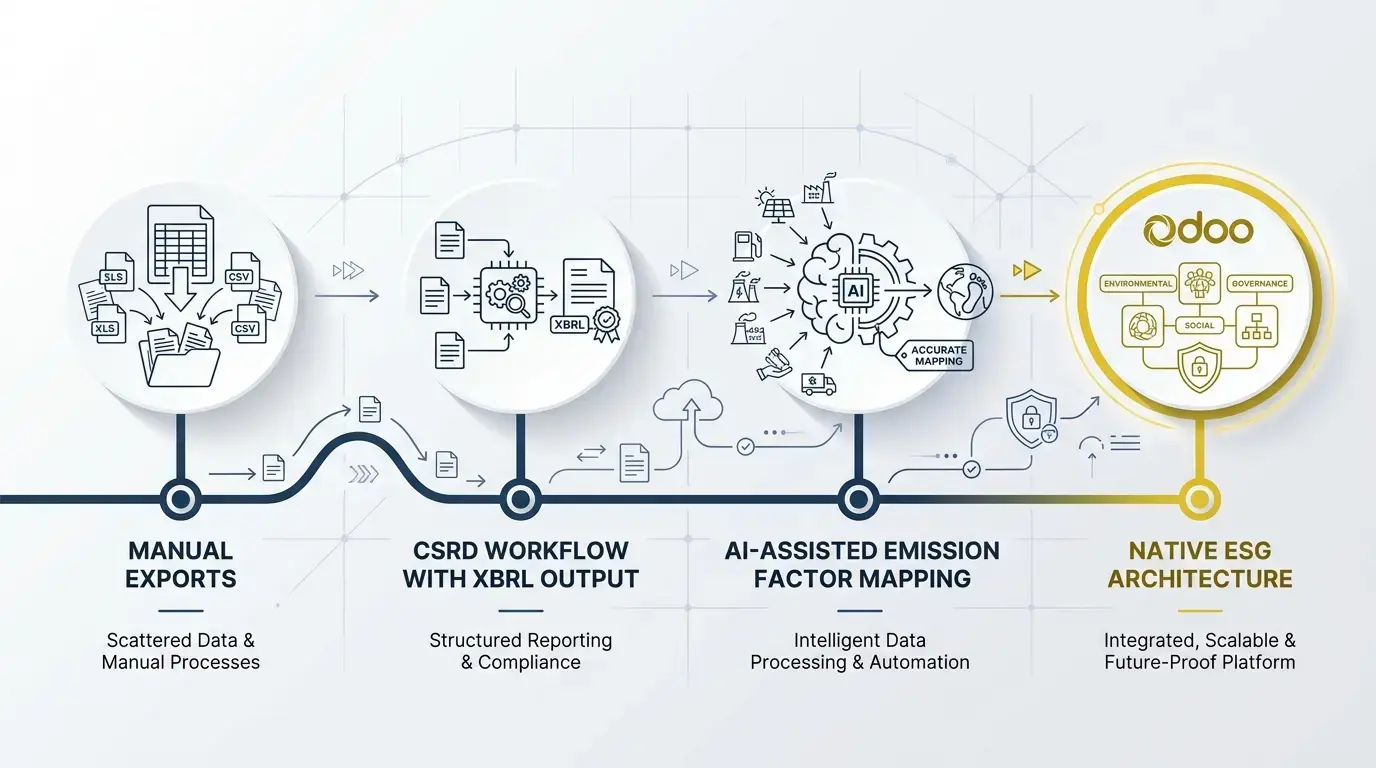
Before Odoo 19, getting ESG data out of Odoo meant building around the platform rather than with it.
Custom modules, manual CSV exports, and fragmented dashboards were the standard workaround.
The outputs were difficult to defend and harder to audit. Odoo 19 changed the architecture, not just the feature list.
From Manual Exports to Native Architecture
The Odoo ESG app shipped as a core module, meaning it integrates at the data model level rather than sitting on top of existing structures as an add-on. Activity data is captured directly from journal entries posted to expense and asset accounts, so the native architecture works as a carbon footprint tool built for emissions tracking rather than just a reporting layer. Once recorded, an entry appears under ESG > Collect > Emitted Emissions and feeds straight into the carbon footprint report, without intermediate exports or reconciliation steps. Odoo can automate ESG data collection from daily operations by using accounting records to support carbon footprint calculations and automate carbon emissions reporting.
The Odoo 19.1 CSRD Workflow
Odoo 19.1 extended this further by introducing a CSRD workflow that includes double materiality assessment, which evaluates both the business impact of sustainability issues and the company's impact on the outside world, and XBRL-formatted output, the structured data format European regulators require for machine-readable submissions. CSRD requires this double materiality assessment by 2025.
AI-Assisted Emission Factor Mapping
One additional capability arrived alongside this: AI-assisted emission factor mapping, which suggests emission factor assignments for activity data and can use assignation rules to link factors by criteria such as product, partner, or account, reducing manual classification work in carbon analytics. These rules help maintain accurate data, support retroactive application to older activity data, and strengthen auditability of emissions data. It's a suggestion engine, not an autopilot; suggested mappings still need human review before they go into a final report.
The Upgrade Doesn't Do the Work for You
Existing Odoo users who upgrade gain native access to all of this. However, the upgrade doesn't automatically produce clean reports.
Historical data still needs to be mapped, and emission sources need to be configured correctly before outputs are defensible. That configuration step is where most of the real implementation work sits.
Odoo's own perspective on where this is headed confirms this direction has been deliberate and ongoing, with more coverage planned across additional apps.
Why Mid-Market Businesses Are Now on the Compliance Radar
ESG reporting obligations didn't start with mid-market businesses. They started with large enterprises. But that's exactly how the pressure reaches smaller operators.
The CSRD Cascade Effect
The CSRD, or Corporate Sustainability Reporting Directive, applies directly to large EU-based companies, requiring them to disclose structured sustainability data under the European Sustainability Reporting Standards. To produce that data, those enterprises need verified inputs from their supply chains, and that pressure is now reaching smaller businesses even when they are not yet legally required to file full ESG reports.
That means their suppliers, including mid-market manufacturers, logistics providers, and healthcare distributors, are now receiving ESG reporting questionnaires as a condition of doing business.
This is the cascade effect: The regulatory obligation sits with the large enterprise, but the data collection pressure lands on you, and the voluntary sustainability reporting standard is becoming more relevant as larger buyers ask suppliers for more standardized sustainability data.
It's Not Just Europe
Equivalent frameworks are emerging across other jurisdictions, meaning mid-market businesses with global customers face multi-directional pressure simultaneously. A session recap from Odoo Experience 2025 covers how Odoo is positioning its native tooling against exactly this pressure, including where the app's compliance coverage currently ends.
The Commercial Stakes
Companies that can't produce structured ESG data risk losing enterprise contracts to suppliers who can. What was once a voluntary exercise is becoming a procurement prerequisite in several industries.
One important note: The specifics of your reporting obligations depend on your jurisdiction, customer contracts, and industry. Always confirm your legal requirements with qualified legal, accounting, or compliance advisors.
Why Spreadsheets Break Down at ESG Scale
Spreadsheets are a reasonable starting point for ESG experiments. When a business is simply tracking a handful of metrics to satisfy a one-off customer questionnaire, a shared workbook gets the job done. The problem starts when ESG reporting moves from exploratory to obligatory.
Version Control Problems Compound
At that point, the structural weaknesses become impossible to ignore. Manual data entry across fleet, HR, purchasing, and utilities creates version control problems that compound with every reporting cycle. When five people update five copies of the same file, reconciliation becomes a project in itself, and nobody can say with confidence which version is correct.
The Auditability Gap
The deeper issue is auditability. Spreadsheet-based ESG reports can't be traced back to source transactions, and disconnected files force different teams and different departments to reconcile the same ESG data manually instead of working from one audit trail. When an auditor or enterprise customer asks for evidence behind a carbon figure, a spreadsheet cell with a manually typed number provides no trail. That gap isn't a minor inconvenience. It's a credibility problem.
Invisible Data Gaps
Data gaps in spreadsheets are also invisible until they matter. Incomplete records from six months ago can't be backfilled at reporting time, and the absence of a figure is often only discovered when the report is already due.
Moving to Odoo ESG doesn't eliminate these problems. What it does is surface them earlier, when they're still fixable. Businesses that want audit-ready data out of their custom configuration need to address data hygiene before automation can help. The real risk is assuming the platform replaces that work. It doesn't.
How Odoo ESG Connects to Your Existing Operations
The Odoo ESG app doesn't generate data on its own. It reads from modules your business is already running, which means the quality of your ESG output depends directly on the quality of your operational data.
Module-to-Metric Data Flow
The table below maps each source function to the data it typically contributes and the ESG category it feeds.
Business Function | ESG Data Type | Emission or Metric Category |
|---|---|---|
Fleet | Fuel consumption, vehicle mileage | Scope 1 emissions, Scope 2 emissions |
Accounting | Energy invoices, utility spend | Scope 2 emissions |
Accounting (tagged purchases) | Supplier spend, goods origin | Scope 3 emissions |
Accounting (tagged purchases) | Packaging materials, waste-related spend | Scope 3 emissions |
Accounting (manufacturing-related spend) | Process energy, material inputs | Scope 1 emissions, Scope 3 emissions |
Payroll and Employees | Headcount, gender, pay data | Social and workforce metrics |
Accounting (travel and logistics spend) | Travel and logistics activity | Scope 3 emissions |
Where data is clean and consistently tagged at the point of entry, these flows are largely automated, supporting ESG data collection and sustainability tracking across environmental, social, and governance sources while keeping sustainability metrics current. The app also brings together esg environmental social data from different departments into a single reporting flow. Where records are incomplete or inconsistently categorized, manual mapping is required before emission factors can be applied accurately, and some values still require manual input when automation is not feasible.
That gap is common, and it's worth identifying before your first report run.
The GDPR Consideration
There's also a governance consideration that most implementation guides skip entirely.
Pulling Payroll data into ESG reports, particularly for workforce composition and gender pay metrics, involves personal data under GDPR. Data on employee commuting activity and travel used in Scope 3 emissions calculations is often included when evaluating environmental impact, and may require consent or anonymization depending on your jurisdiction.
This isn't a reason to avoid the data. It's a reason to involve your DPO or legal advisor before the pipeline goes live.
Carbon Analytics and Footprint Reporting in Odoo 19
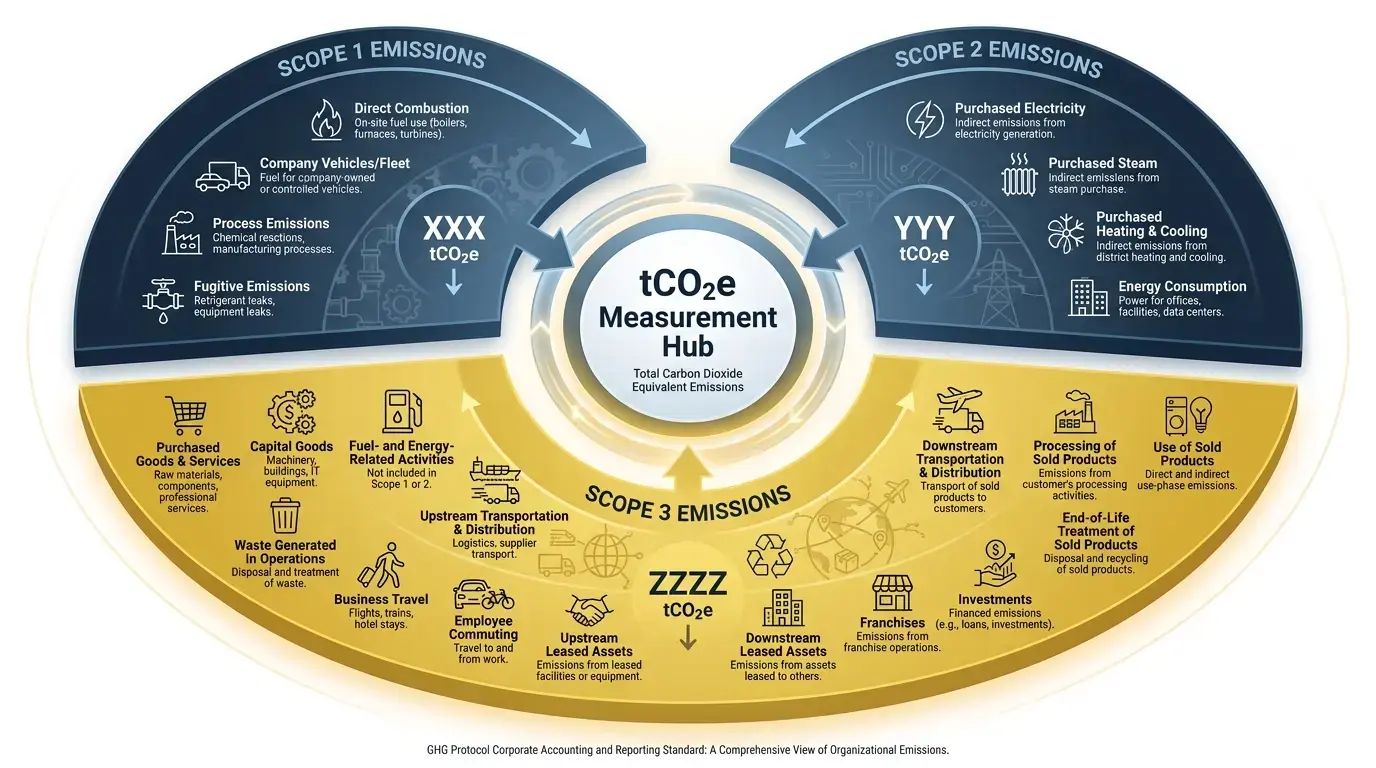
Odoo 19 brings carbon data into one reporting environment, helping businesses measure emissions, organize them by scope, and track progress over time.
The Three GHG Scopes
Odoo 19 calculates carbon footprint in tCO2e, tonnes of CO2 equivalent, across all three GHG scopes. Scope 1 emissions cover direct sources your business controls, such as company vehicles and on-site equipment. Scope 2 emissions cover purchased electricity and energy. Scope 3 emissions cover everything upstream and downstream, including supply chain activity, employee commuting, and business travel.
Framework Alignment
The framework alignment is deliberate. Odoo maps its carbon analytics against the GHG Protocol and, per Odoo's own documentation, supports importing certified emission factor sources such as the ADEME database. That means the data structure your reports produce is one auditors and enterprise customers already know how to read.
Tracking Progress Over Time
Carbon analytics dashboards allow period-over-period tracking and reporting by business unit or location, giving you a daily environmental impact view as well as longer-term trend tracking when you need to show progress rather than just a point-in-time number.
Emission Factors and How Odoo Maps Activities to Carbon Data
Accurate carbon reporting depends on connecting business activities with the correct emission factors. Odoo 19 simplifies this process by combining certified data sources with AI-assisted mapping.
Importing Certified Emission Factor Data
Odoo 19 supports importing certified emission factor data, which allows activity data pulled from Fleet, Accounting, and tagged purchases to be matched against recognized carbon conversion values.
AI-Assisted Mapping Still Needs Human Review
The AI-assisted emission factor mapping feature uses suggested tagging to match activities with the appropriate emission factors. This reduces manual classification work considerably. However, it doesn't replace human review. Suggested mappings still require validation before they feed into a final report.
That distinction matters. The automation handles the volume. The accuracy depends on a qualified person confirming the assignments are correct for your specific operations. Don't treat suggested mappings as final outputs.
Social Metrics and Workforce Reporting
The environmental pillar tends to get the most attention in ESG implementations. The social and governance sections are frequently underprepared, and for mid-market businesses, that gap creates real reporting risk.
What's Tracked Natively
The Odoo ESG app pulls workforce data directly from the Employees and Payroll modules, and these social metrics help track social impact as part of broader ESG metrics.
Metrics tracked natively include gender parity, pay gap reporting, typically calculated from average male and female salaries, headcount, staff turnover, and training hours.
These map to ESRS S1 requirements under CSRD, which covers own workforce disclosures. Board composition and committee oversight data can also be captured for governance reporting.
The GDPR Consideration for Workforce Data
The data connections are useful. However, they come with a compliance consideration that most implementation guides skip entirely.
Pulling employee-level data into ESG reporting workflows involves personal data under GDPR. Pay gap and gender parity figures must be anonymized or aggregated before they appear in any external report. HR data used for Scope 3 emissions calculations, such as employee commuting patterns or business travel, may require explicit consent depending on your jurisdiction.
This isn't a reason to avoid these metrics; it's a governance checkpoint that needs to happen before the data pipeline goes live. Involve your DPO or legal advisor early.
Conditions to Confirm Before Your First Social Report
Key workforce conditions to confirm before your first social report runs include:
Gender and pay data is aggregated, not individual-level, in external outputs
Commuting and travel data collection has appropriate consent or anonymization in place
Training hours and turnover figures are sourced consistently across payroll periods
ESG Reporting Across Manufacturing, Healthcare, and Logistics
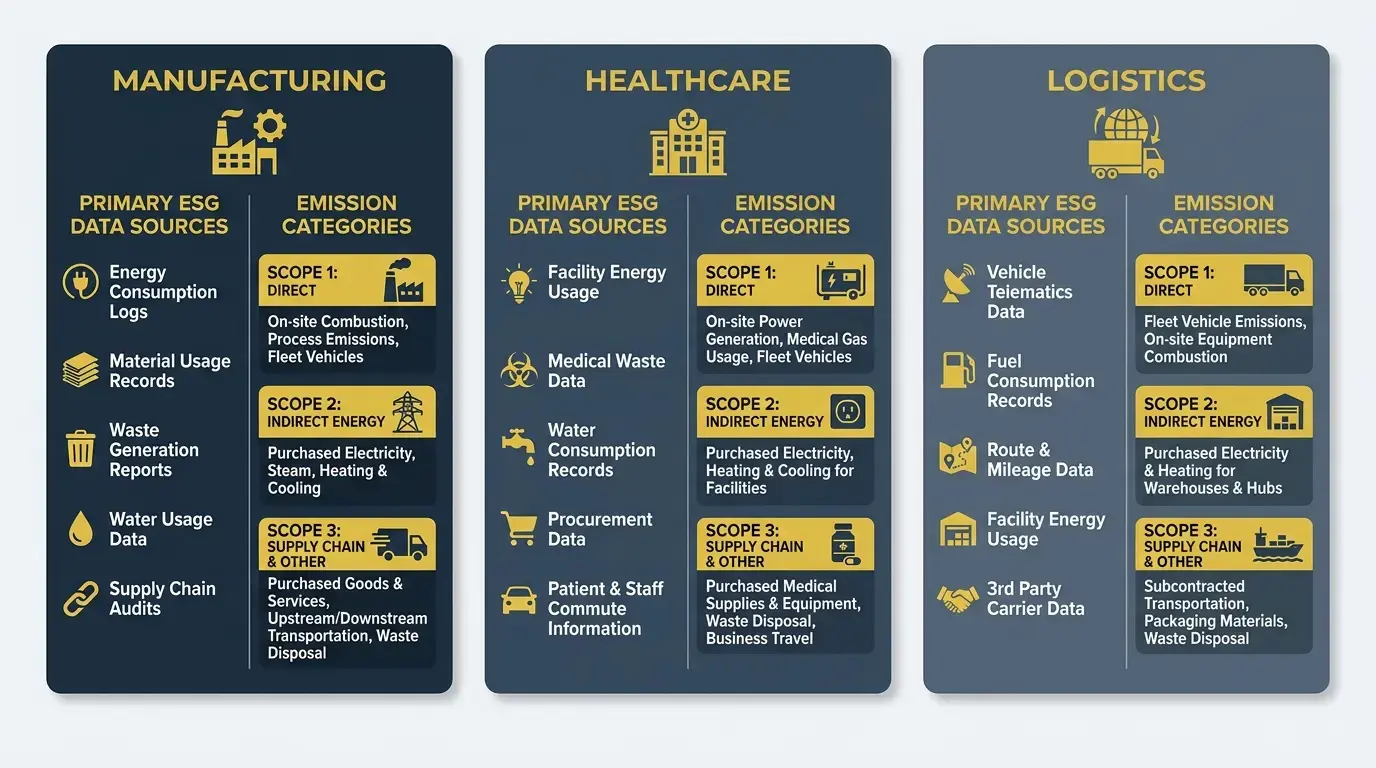
Mid-market businesses in manufacturing, healthcare, and logistics each face ESG reporting pressure, but the data sources, compliance triggers, and practical challenges look quite different across each vertical.
Knowing where your industry sits helps you prioritize which Odoo modules to configure first and where data quality problems are most likely to appear.
Manufacturing: Emissions from Production and Supply Chain
Manufacturing operators typically encounter ESG pressure earlier than other mid-market segments. Enterprise customers subject to CSRD obligations are pushing ESG questionnaires down their supply chains, and manufacturers are often the first to receive them.
Manufacturing-related process energy and material inputs feed Scope 1 emissions once tagged through Accounting, and supplier spend and goods origin, also tracked through Accounting, feed Scope 3 emissions. Applying accurate emission factors to this activity data is where most of the configuration work sits.
Healthcare: Workforce Compliance and Operational Waste
Healthcare operators carry a heavier social reporting burden than most. The Payroll, HR, and Employees modules are the core data sources for workforce diversity, pay gap, and governance metrics under ESRS S1. Clinical waste volumes and facility energy use feed the environmental side through tagged Accounting entries.
One compliance risk that often gets missed: Employee data and patient data must remain strictly separated when generating ESG outputs. Pulling workforce records into the Odoo ESG app requires GDPR review before any external report is produced. That step isn't optional.
Logistics: Fleet Emissions and Delivery Network Carbon Data
For logistics operators, Scope 1 and Scope 2 emissions calculations run primarily through the Fleet module, using vehicle fuel consumption and mileage records as the base inputs. This is typically the most mature data source in a logistics business.
Last-mile delivery and third-party carrier activity sit in Scope 3 emissions and require either supplier-reported figures or estimation via recognized emission factors. That data rarely arrives clean.
Across all three verticals, centralizing ESG data in Odoo is achievable, but the starting point depends heavily on how consistently each function has been used before reporting begins.
What Odoo ESG Reporting Can and Cannot Do
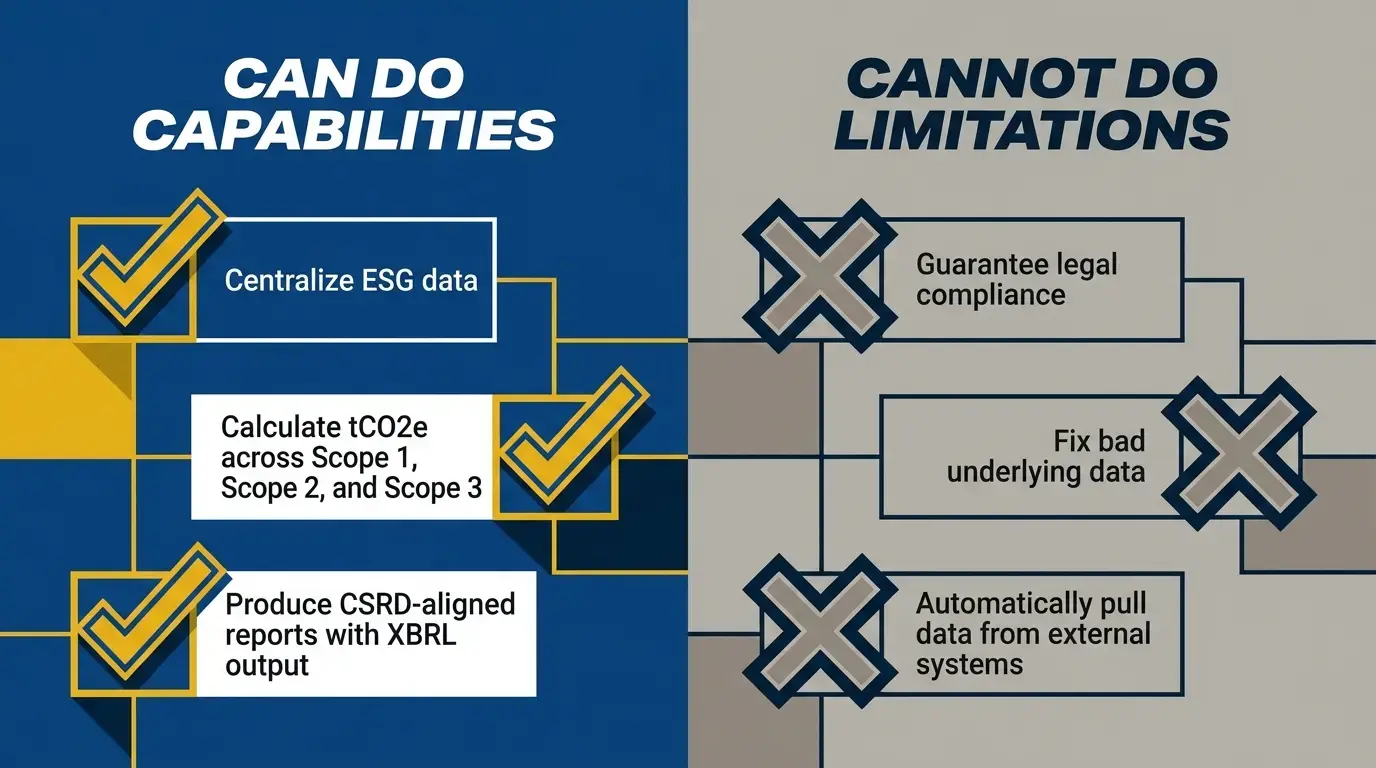
Odoo ESG is a capable reporting support tool. It's not a compliance guarantee. As the sections above make clear, the platform handles structure and aggregation well. Accuracy and compliance, however, remain a human responsibility. Knowing exactly where the boundaries sit will save you from building a reporting process on assumptions that don't hold.
What Odoo ESG Can Do
Centralize ESG data from across your operational modules into a single structured view that acts as a central dashboard for ESG metrics and sustainability metrics
Calculate tCO2e across Scope 1, Scope 2, and Scope 3 categories using recognized emission factors
Track social and governance metrics pulled directly from the HR and Payroll modules
Produce CSRD-aligned reports with XBRL output via the Odoo 19.1 CSRD workflow
Support double materiality assessment as part of CSRD compliance preparation
Tie ESG activity directly to journal entries, giving reports a genuine audit trail back to source transactions
Manage esg initiatives through project management workflows in the ERP when teams need to assign owners and track execution alongside reporting
What Odoo ESG Cannot Do
Guarantee legal compliance; that requires human review and qualified advisor sign-off
Fix bad underlying data; carbon analytics and reporting outputs aggregate what's already in the system, so poor data in means poor data out
Replace third-party assurance or external audit processes required under certain frameworks
Automatically pull data from external systems or suppliers not connected to Odoo
ESG Reporting Readiness Checklist
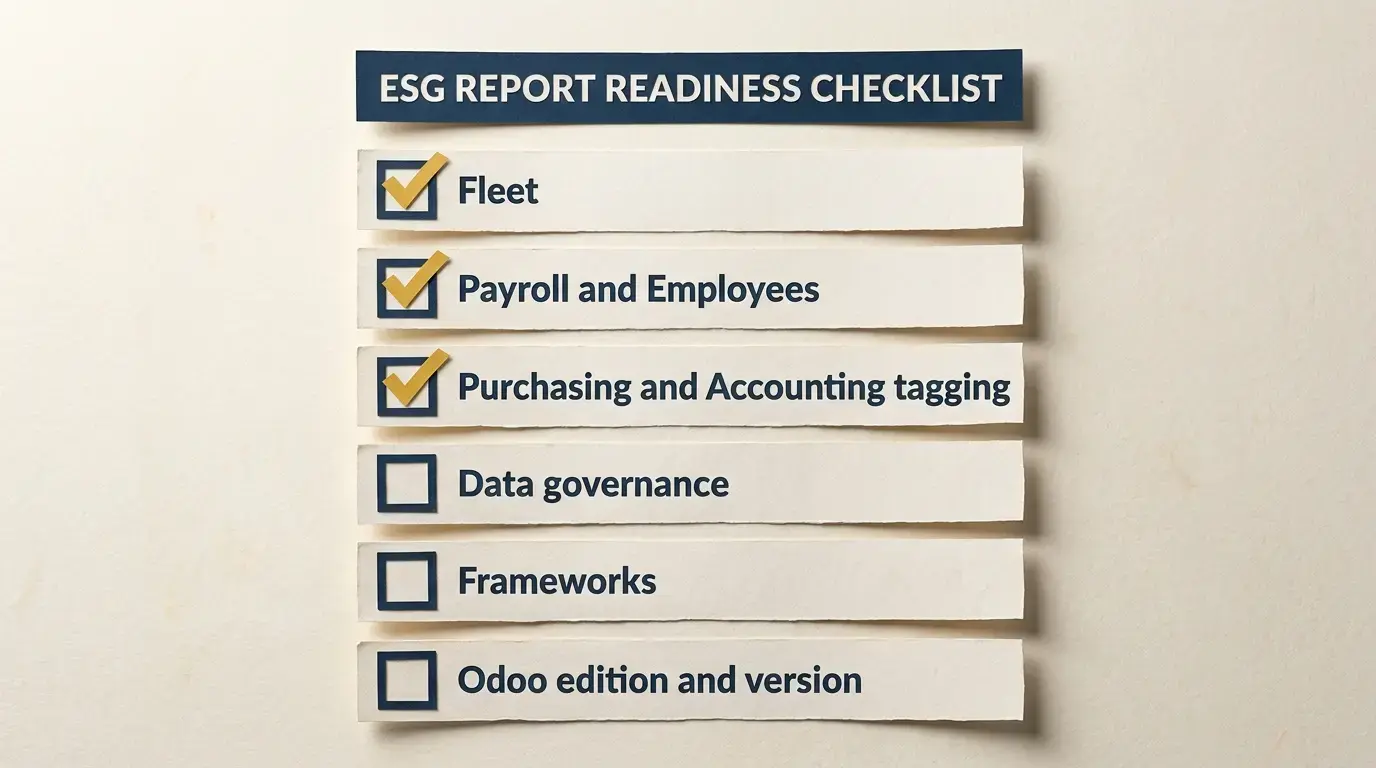
Before your first report runs, confirm each of these data conditions is in place. Gaps identified now are fixable. Gaps discovered at submission time are not.
Fleet: Are vehicle fuel consumption and mileage records complete and accurate for the full reporting period? Incomplete fleet data is one of the most common reasons Scope 1 emissions figures can't be defended.
Payroll and Employees: Is headcount, turnover, gender, and pay data structured, consistently recorded, and current? Inconsistent payroll records create gaps in ESRS S1 workforce disclosures.
Purchasing and Accounting tagging: Are supplier categories and procurement transactions tagged in a way that supports Scope 3 emissions calculation? Untagged spend can't be mapped to GHG Protocol categories.
Accounting: Are energy utility bills and cost centers mapped to the correct locations and business units? This mapping needs confirming before any emissions calculation runs.
Manufacturing: Are production activity records complete enough to support emissions calculations at the process level, once routed through Accounting?
Data governance: Has your organization reviewed which HR and operational data sources require GDPR review before inclusion in ESG reports? Auditability depends on data that was collected lawfully.
Frameworks: Have you confirmed which reporting frameworks apply to your business, including CSRD, ESRS, and the GHG Protocol, with your legal or compliance advisor?
Odoo edition and version: Are you on Odoo 19 or later, on an Enterprise license, to access the native ESG app and CSRD workflow?
Common ESG Reporting Mistakes Mid-Market Businesses Make
Even well-run businesses make predictable mistakes when they first set up ESG reporting in Odoo. These are the ones that cause the most problems in practice:
Assuming the Odoo ESG app works out of the box. It doesn't. Data source mapping and configuration are required before any meaningful output is possible.
Running reports before verifying source data. If Fleet, Payroll, or purchasing records are incomplete, the report inherits those gaps. Clean the data first.
Treating ESG as an annual exercise. ESG should be embedded in daily operations, with data quality maintained throughout the year rather than handled in a scramble at submission time.
Conflating voluntary sustainability goals with mandatory regulatory obligations. CSRD has specific legal requirements. Internal targets aren't a substitute for structured compliance.
Skipping the DPO review before pulling HR data. Employee and pay data entering ESG reporting workflows involves personal data under GDPR. That review isn't optional.
Skipping the double materiality assessment. Under CSRD timelines, this step is legally required and determines both financial relevance and external impact, which in turn decides what must actually be reported. Skipping it means you may be reporting the wrong things entirely.
Failing to document emission factor selections and data sources. When auditors or customers request evidence, undocumented methodology creates a credibility problem that's difficult to fix after the fact.
How Cudio Helps You Make Odoo ESG Reporting Usable
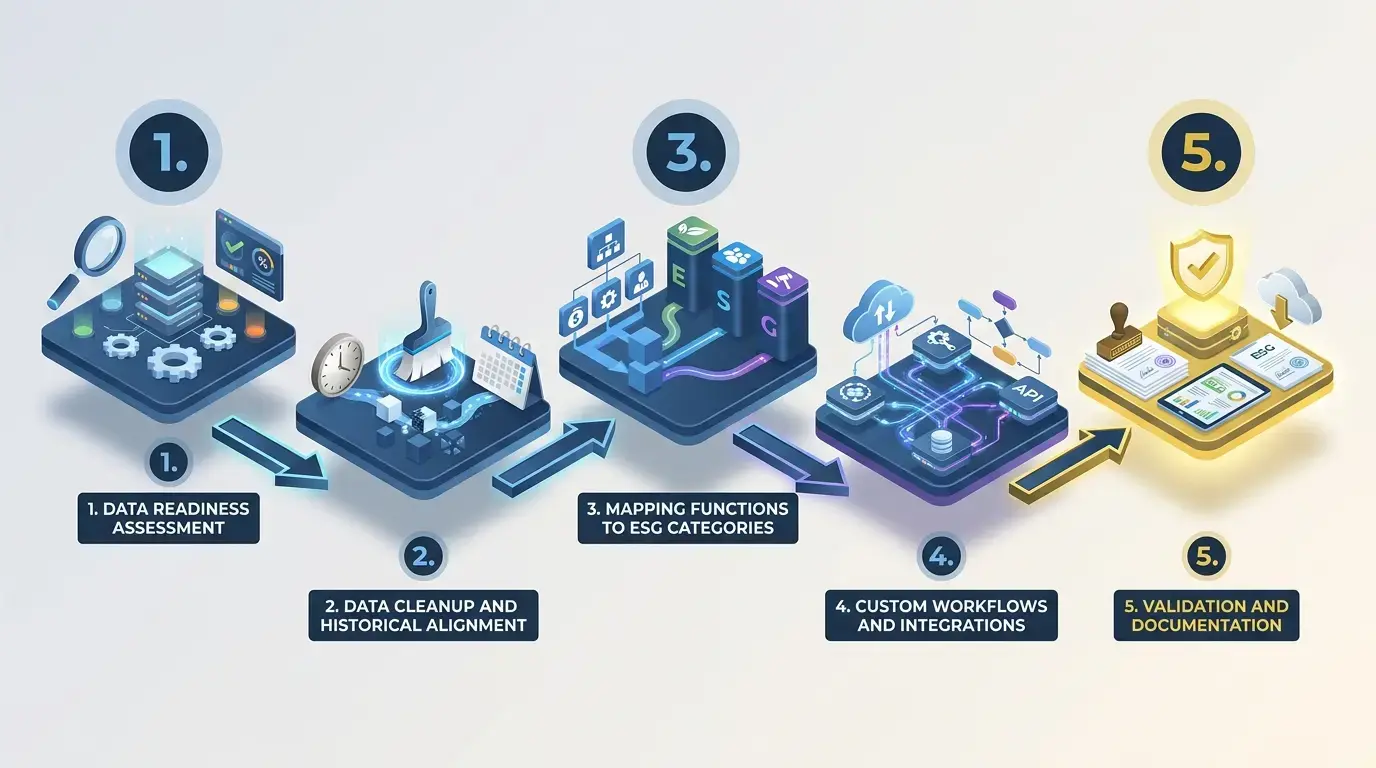
Getting the Odoo ESG app configured correctly isn't a software problem. It's a data problem.
Step 1: Data Readiness Assessment
Before any workflow is built or report is run, we assess ESG data readiness across your existing Odoo environment to understand what's clean, what's missing, and what needs to be rebuilt.
Step 2: Data Cleanup and Historical Alignment
Fleet mileage logs, payroll records, purchasing categories, and manufacturing activity data are reviewed and corrected before any emission factors are applied. Skipping this step produces reports that can't be defended.
Step 3: Mapping Functions to ESG Categories
Once source data is in order, we map each function to the correct ESG reporting metric category. That mapping determines which data feeds Scope 1, Scope 2, or Scope 3 calculations, and which records support social and governance disclosures. Getting this right at the source is what makes auditability possible downstream.
Step 4: Custom Workflows and Integrations
Where native Odoo outputs don't match a specific framework requirement or enterprise customer template, we configure custom reporting workflows to bridge that gap without compromising the underlying data structure. Integration work is handled where Odoo ESG data needs to connect to external reporting tools or customer portals.
Step 5: Validation and Documentation
After configuration, we validate report outputs against source data to confirm the numbers trace back correctly. Every engagement closes with full documentation of methodology, data sources, and configuration decisions. You own the process after handoff, not a dependency on us to run it.
Getting Your Odoo ESG Reporting Right Before It Becomes Urgent
ESG reporting obligations are reaching mid-market businesses faster than most operators expect. The CSRD cascade is already moving, and the window to prepare ahead of customer or regulatory pressure is narrowing. Odoo 19 provides a solid native platform for centralizing and structuring ESG data across the business, but the platform is only part of the answer.
The real work is in the data. Preparation, mapping, and ongoing quality discipline matter more than the tool itself. At Cudio, we've done this work across complex Odoo environments. We know where the gaps appear and how to close them before they become a reporting problem. If your ESG data isn't ready yet, now is the right time to start.
Talk to Cudio About ESG Reporting
FAQs About the Odoo ESG App
Considering Odoo ESG for sustainability reporting? Here are quick answers to the most common questions about implementation, compliance, and reporting capabilities.
Does the Odoo 19 ESG app support XBRL output for CSRD filings, and what does that process look like?
Yes. Odoo 19 supports XBRL output as part of its CSRD reporting workflow. Businesses complete a double materiality assessment, map disclosures to the appropriate ESRS requirements, and generate the XBRL file for reporting. The output should always be reviewed before submission to ensure accuracy and compliance.
How does tCO2e calculation work inside Odoo, and how does the system handle emission factor updates?
Odoo calculates tCO2e by applying emission factors to operational data collected from supported modules such as Accounting and Fleet. Emission factors can be updated when new values become available. However, historical records are not updated automatically and may need to be recalculated manually. Regular reviews help maintain consistent reporting over time.
Which Odoo modules should be active before manufacturing businesses generate ESG reports?
Accounting is the minimum requirement for meaningful ESG reporting because it provides financial and operational data. Manufacturing businesses should also use modules such as Fleet, Payroll, and Employees when those areas are included in reporting. The quality and completeness of the data are just as important as the modules themselves. Well-maintained operational records produce more reliable ESG reports.
What HR data privacy obligations apply under GDPR when using Odoo ESG?
Businesses must ensure employee information is handled in accordance with GDPR requirements. Personal data used for diversity, pay gap, or workforce reporting should be anonymized before external reporting. Organizations should also confirm they have an appropriate legal basis for processing employee data. Reviewing data privacy requirements before implementation is recommended.
Is the Odoo ESG app available in Community edition, or does it require an Enterprise license?
No. The Odoo ESG app is only available with an Odoo Enterprise license. It is not included in the Community edition. Businesses planning to use ESG reporting should include Enterprise licensing in their implementation budget.
What does a typical Cudio ESG reporting implementation cover, and how long does it take?
A typical Cudio ESG implementation includes data readiness assessment, configuration, emission factor mapping, reporting setup, and validation of ESG outputs. The overall timeline depends on the quality of your existing Odoo data and how much preparation is required. Businesses with clean, well-maintained data generally complete implementation faster than those requiring significant remediation.