
At Cudio, we’ve been involved in many Odoo implementations.
Some we built from scratch, configuring multi-company charts of accounts structures, mapping putaway rules and warehouse routes in the Inventory module, and writing Python-based data migration scripts for businesses moving off legacy ERPs with decades of dirty records.
Others we inherited mid-collapse, walking into environments running 130-plus installed apps with broken cron jobs silently failing in the background and reconciliation reports nobody had trusted in months.
What every one of those engagements confirmed is the same thing: Odoo doesn’t fail; implementations fail. Gartner's research predicts that more than 70% of ERP implementations will miss goals by 2027, and as many as 25% will fail catastrophically. ERP failure patterns are rarely random. They are usually traceable to preventable operational and implementation mistakes.
In this article, we’ll break down the most costly Odoo implementation mistakes businesses make, why they happen, and how to avoid them before they compromise timelines, reporting accuracy, operational stability, or long-term scalability.
Key Takeaways
- Gartner puts the ERP failure rate above 70%, with 25% of projects failing catastrophically, and the root cause is almost never the software
- Over-customization that bypasses Odoo's native ORM and module inheritance model is the single leading cause of the rescue cases we take on
- Data migration is the most consistently underestimated phase of any rollout and the most financially damaging when it goes wrong
- Go-live is a milestone, not a finish line; the 30 days after cutover are where most post-launch breakdowns originate
- These mistakes are predictable, which means they are entirely preventable with the right partner and the right process
The 8 Odoo Implementation Mistakes That Derail Projects
The following common mistakes show up across industries, company sizes, and project types. Each one is avoidable with the right structure and the right team.
Before we break each one down, let’s take a look at the key mistakes to avoid in an Odoo ERP implementation:
Mistake | Business Consequence |
No documented plan or strategy | Rework, scope drift, and wasted budget |
Wrong implementation partner | Misaligned configuration that does not match how the business operates |
Skipping business process mapping | Broken workflows encoded permanently into the system |
Data migration failures and dirty data | Corrupted records, broken reporting, and team distrust on day one |
Over-customization | Technical debt that makes future upgrades too expensive to justify |
Neglecting integration architecture | Brittle connections that break order flow and financial reporting |
Skipping user acceptance testing | Critical failures discovered in production instead of a staging environment |
Treating go-live as the finish line | Post-launch breakdowns, low adoption, and lost ROI |
1. Launching Without a Documented Plan
The most common setup for a failed implementation is also the most avoidable.
Teams get excited about what Odoo can do, and many companies rush ahead without a clear plan, activating modules and treating planning as a formality rather than the foundation on which the entire project depends.
Scope drifts. Stakeholders disagree on what “done” means.
The project burns budget on rework before a single workflow is live. Inadequate requirements gathering can lead to irrelevant features, higher implementation costs, and longer deployment times, which is why key stakeholders from every relevant department need to be involved early.
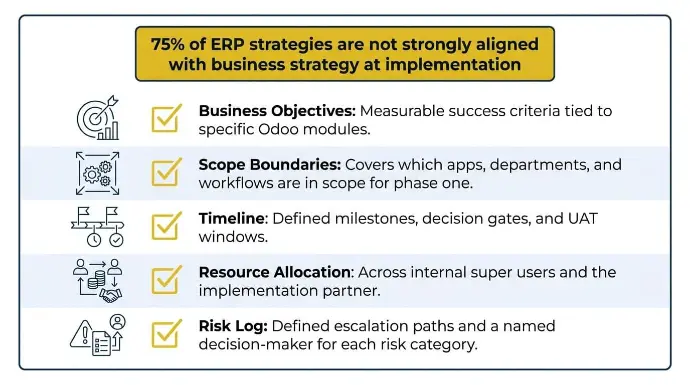
The same Gartner research cited above found that 75% of ERP strategies are not strongly aligned with business strategy at the time of implementation. Strong alignment between the ERP initiative and the organization’s overall business strategy is the single most-cited predictor of success, and it is almost impossible to establish without a documented plan in place before configuration begins.
At Cudio, we run every engagement through a structured discovery process before a single app is activated.
We map approximately 150-200 business use cases specific to that client’s operation, broken down by department and workflow, with business needs, key processes, and business processes mapped with stakeholders from each department early on, and defined acceptance criteria for each.
Super users are assigned ownership. They define, test, approve, and demonstrate competency before discussing go-live.
A planning document should cover the following before configuration begins.
- Business objectives with measurable success criteria tied to specific Odoo modules and a clear plan for the new ERP system
- Scope boundaries covering which apps, departments, and workflows are in scope for phase one
- Timeline with defined milestones, decision gates, and UAT windows
- Resource allocation across internal super users and the implementation partner
- Risk log with defined escalation paths and a named decision-maker for each risk category
“Most ERP projects don’t fail for the reasons you think. The client has quietly outsourced ownership. The best clients say: ‘This is our project. We don’t know everything. But we will own our side of the bargain.’”
Gordon Cummins, Ceo of Cudio (source)
At Cudio, we start every project with a discovery workshop, a documented use case catalog, and a fixed-price scope document. Those three artifacts, completed before any work begins, are what protect the timeline and budget from the drift that kills most projects.
Start Your Odoo Project the Right Way
2. Choosing the Wrong Implementation Partner
Not all Odoo partners are the same, and choosing a provider for odoo erp implementation services can expose a significant gap between a certified partner and one that’s truly experienced.
Odoo’s partner program provides a baseline for evaluating providers. You can browse the full list of certified Odoo partners, but certification mainly only confirms that a firm has completed Odoo’s training and sales requirements. It doesn’t necessarily mean the team has experience handling complex real-world implementations, such as multi-company intercompany transaction flows, Python migration scripts for advanced Bills of Materials, or resolving production issues like phantom journal entries caused by stock valuation layer errors.
The wrong one configures a system that technically functions, but doesn’t reflect how the business actually operates at the transaction level, creating rework, added cost, and missed opportunities.
Fixing a misaligned configuration after go-live means rebuilding workflows, re-migrating records, and retraining users who have already lost confidence in the system. Cudio has rebuilt 32 of those environments.
“Half of the customers at Cudio Inc. are rescue projects. These are organizations that originally signed with a different partner because the hourly rate was low or the sales pitch was flashy.”
Gordon Cummins, Ceo of Cudio (source)
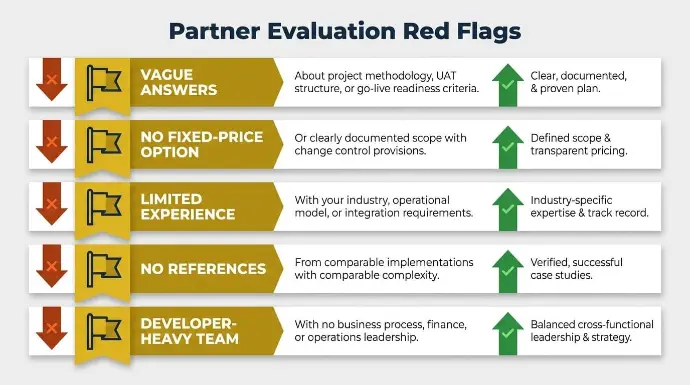
Here are some of the most common red flags to watch for during partner evaluation:
- Vague answers about project methodology, UAT structure, or go-live readiness criteria
- No fixed-price option or clearly documented scope with change control provisions
- Limited experience with your industry, operational model, or integration requirements
- No references from comparable implementations with comparable complexity
- A team that is developer-heavy with no business process, finance, or operations leadership
At Cudio, roughly three-quarters of our team are functional, finance, and project leaders. That ratio is unusual in this space, and it’s deliberate. Every implementation is driven by people who understand double-entry accounting, warehouse routing logic, and manufacturing order sequencing alongside the technical configuration that supports it, and the best teams are well equipped with functional, technical, and project leadership resources. Partner selection isn’t a procurement decision; it’s the single most consequential choice in the entire project for successful odoo erp implementation.
Choose a Partner Who Has Done This
3. Skipping Business Process Mapping Before Configuration
Business process mapping is the step most teams want to skip because it feels slow. The software is already purchased, the timeline is set, and documenting business processes before configuring the erp system can feel like a delay before the real work starts.
The Gartner research cited above also identifies misalignment between ERP configuration and actual business operations as one of the top three drivers of implementation failure.
When Odoo gets configured around undocumented or broken processes, those inefficiencies get encoded into the system at the configuration layer. Approval workflows in Odoo’s Sign module get built around existing bottlenecks.
Reordering rules in the Replenishment module get set to reflect current manual habits rather than optimized lead times. The software becomes a digital replica of the same operational problems the business was trying to solve.
We follow a process-first, software-second sequence on every engagement. Before any app is activated or any field is configured, we need a clear picture of how work actually flows today, where the friction points are, and what the desired future state looks like. Odoo is then configured to support the improved process, with standard modules evaluated first before custom development is considered, not to replicate the legacy one.
This step also surfaces disagreements between departments before they become configuration conflicts inside the system. It’s far cheaper to resolve a dispute about purchase approval thresholds in a discovery workshop by involving a project manager or designated owner early than to rebuild the approval matrix in Odoo’s workflow engine after it has been in use for three months.
Map My Processes Before We Configure Anything
4. Data Migration Failures and Dirty Data
Data migration is the most consistently underestimated phase of any Odoo rollout. Teams should treat data migration as a dedicated project, not a last-minute technical step, and that assumption is one of the most expensive mistakes in the entire implementation process.
The problem begins before migration even starts. Source data in old systems like QuickBooks, Fishbowl, or older Odoo versions is often incomplete, inconsistently formatted, or contains duplicates and orphaned records that have gone uncleaned for years, which creates serious data quality risks.
When corrupted data lands in Odoo’s PostgreSQL database, it corrupts financial reporting in the account.move table, breaks inventory valuation in stock.quant, and creates immediate credibility problems with the team that’s supposed to trust the new system. If mapping and validation are rushed, the risk of data loss rises fast.
The Register covered the Birmingham City Council Oracle ERP collapse, a project that ballooned from £19 million to £170 million, in detail, with data governance failures cited as a core contributing factor. That’s not an outlier. It’s the Gartner pattern playing out at scale.
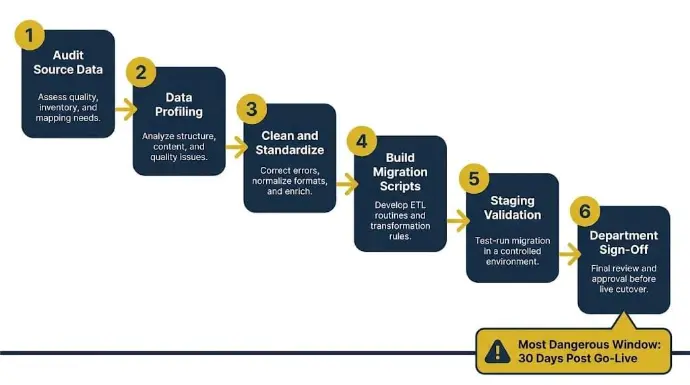
At Cudio, we audit source data before a single record moves. We run data profiling against the legacy system to identify null values, mismatched foreign keys, duplicate partner records in res.partner, and inconsistent product categorization in product.template.
We resolve those issues in the source before writing migration scripts, with data cleaned and standardized before import, including removing duplicates and verifying key fields.
We build custom Python scripts using Odoo’s ORM API for complex datasets, including multi-currency records, intercompany balances, serialized inventory with full lot traceability history, and Bills of Materials with multi-level component structures.
Every migration runs against a staging instance first. We validate critical datasets with department sign-off before any record touches production.
The most dangerous window in any migration isn’t the go-live day itself, but the 30 days that follow. That’s because this is when reconciliation discrepancies surface in Odoo’s account move lines, and nobody can explain the delta between what the old system showed and what Odoo is reporting. We plan to explicitly define the post-migration monitoring window and stay engaged through it.
Move My Data to Odoo Without Risk
5. Over-Customization and the Technical Debt It Creates
Odoo’s open-source architecture is one of its most powerful features. It’s also the most common reason we get called in to fix a system that cannot be upgraded.
The Gartner research above is explicit on this: ERP projects that are highly customized to current or near-term requirements will fail to keep pace with changing business goals after implementation and may need to be replaced entirely at significantly higher cost.
When a team encounters a workflow that does not match Odoo’s standard behavior, the instinct is to write a custom Python module instead of first adapting the process to Odoo’s standard modules and configuration options.
Do that enough times, and the implementation diverges significantly from Odoo’s core codebase in ways that are invisible until an upgrade is attempted. Each custom module that overrides a core Odoo method using Python inheritance must be tested, maintained, and rewritten with every major version release.
Custom fields added directly to core tables rather than through proper model inheritance break during database schema migrations.
Overridden compute methods in account.move or stock.quant create silent calculation errors that surface months after go-live. What started as a shortcut becomes a structural liability.
“Custom code is future pain. If a partner reaches for code before exhausting every configuration option, they’re building an upgrade nightmare.”
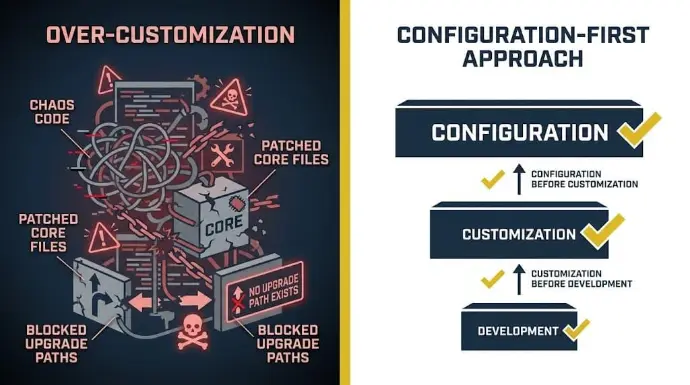
Our philosophy is configuration before customization, and customization before development, which helps keep the system scalable as the business grows. Odoo’s native automation and workflow tools (including automated actions, server actions, scheduled actions, and custom QWeb report templates) cover a wide range of scenarios that many partners reach for custom code to solve.
When development is genuinely necessary, we build using Odoo’s official module inheritance model rather than patching core files, document every override, and treat it as a deliberate trade-off with a known maintenance cost.
The biggest technical problem we encounter in rescue projects is what we call chaos code: Odoo environments built with so many overriding Python classes, patched core files, and undocumented custom models that no upgrade path exists. We have rescued 32 of those environments.
In every case, the previous partner reached for code as a first response rather than a last resort.
Fix My Over-Customized Odoo System
6. Neglecting Integration Architecture and Failure Handling
Integrations are where many implementations quietly break down while costs pile up.
Project planning tends to focus on Odoo's internal module configuration, and connections to external systems get scoped as an afterthought in the final project phase. That approach produces brittle architecture that behaves well in testing and fails under production load.
A broken integration doesn’t just affect one system.
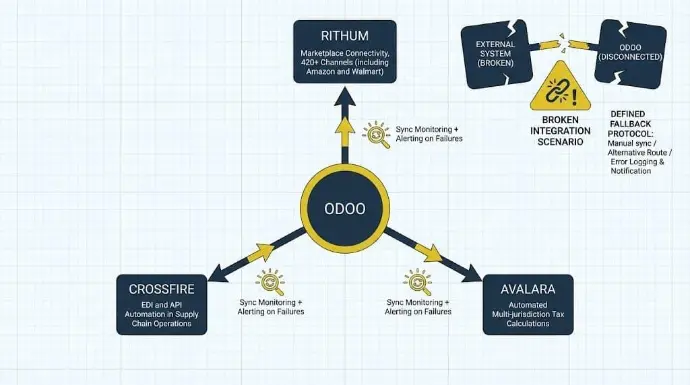
A failed sync can leave Odoo's Inventory module stock.quant table out of sync with a third-party warehouse management system, generate duplicate account.move entries from a double-posted payment gateway transaction, or leave Odoo's tax line items empty because the Avalara AvaTax connector failed silently during invoice confirmation in Odoo's Accounting module. The business impact is immediate. The root cause is almost always architectural: The integration was designed to work, not designed to fail gracefully.
Integration architecture needs to be designed before configuration begins. The design must document what data objects move between systems, the direction and frequency of each sync, the field-level mapping between external schemas and Odoo's data model, and the failure-handling logic for every integration point.
Every connector needs a defined fallback protocol so that a disruption in one system does not cascade into data corruption across the operation.
At Cudio, we design and implement integrations with Rithum for marketplace connectivity across 420+ channels, including Amazon and Walmart, Avalara for automated multi-jurisdiction tax calculations within Odoo's account.tax framework, and Crossfire for EDI and API automation in supply chain operations. In every case, we build sync monitoring with alerting on failures, document the complete field mapping, and test under realistic transaction volumes before go-live.
Connect Odoo to My Entire Tech Stack
7. Skipping User Acceptance Testing Before Go-Live
User acceptance testing is the last structured checkpoint before a broken workflow becomes a live incident, and it is also the step most frequently compressed or cut when timelines slip, reducing thorough testing.
Implementation testing validates that modules are configured correctly in isolation.
UAT validates that the system works for the people who will actually use it, across the end-to-end workflows they will actually run, with the real data volumes and exception scenarios they will actually encounter. These are entirely different tests with different failure modes.
It is crucial to test every part of the working system carefully before go-live so it supports the business effectively from day one. Skipping UAT means the first real test of the system happens in production, with live customer orders, financial records, and inventory movements on the line. UAT also lets end users confirm the system meets their needs and is easy to use before launch.
Issues that would have taken an hour to fix in a staging environment can take days or weeks to untangle in a live PostgreSQL database.
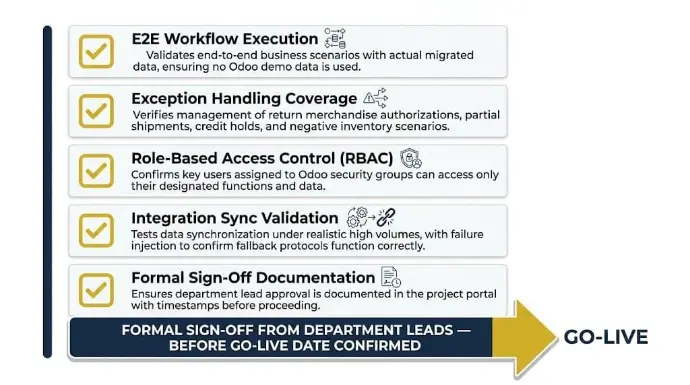
UAT at Cudio is structured around the following requirements.
- End-to-end workflow execution using the client’s actual business scenarios and real migrated data, not Odoo demo data
- Exception handling coverage, including return merchandise authorizations, partial shipments, credit holds, and negative inventory scenarios
- Role-based access control verification by key users assigned to each security group in Odoo’s access rights model, with early feedback that reduces resistance and builds ownership
- Integration sync validation under realistic order volumes, with failure injection to confirm fallback protocols work
- Formal sign-off from department leads, documented in our project portal with timestamps, before any go-live date is confirmed
We maintain a catalog of over 1,600 business use cases. For each client, we identify the 150-200 that apply to their operation and require demonstrated competency from their super users before the go-live decision is made.
Run Proper UAT Before Going Live
8. Treating Go-Live as the Finish Line
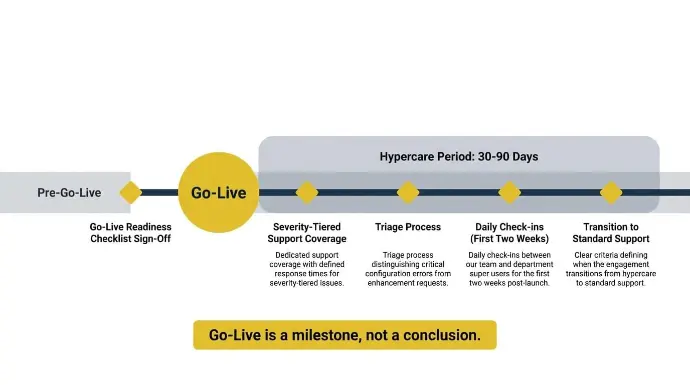
Go-live is a milestone, not a conclusion. Many businesses treat it like the finish line, even though a successful implementation of Odoo ERP depends on support after launch as much as the build itself.
As Gartner’s research above makes clear, 70% of ERP initiatives fail to meet their original goals and the most damaging breakdowns typically surface in the weeks immediately following launch rather than during the implementation itself.
Users encounter transaction scenarios not covered in training. Processes that executed cleanly against 500 test records behave differently under 5,000 live transactions.
Small gaps in Odoo’s reordering rules, automated email templates in the mail.template model, or tax fiscal position configuration surface, quickly once real volume runs through the system.
“Some of the ‘worst’ ERP failures I see are the ones everyone thinks succeeded. The project ‘ends,’ go-live is celebrated, invoices are paid… and almost nothing is done to document or train properly.”
A defined hypercare period is the structural answer to post-go-live instability. This is a dedicated support window, typically 30 to 90 days after the production cutover, during which our team remains closely engaged to resolve issues in real time.
Many companies overlook post implementation support and ongoing support after launch, which can disrupt business processes and reduce system effectiveness.
We monitor error logs and review the chatter on critical records in Odoo’s mail.thread model, check cron job execution in the Odoo technical scheduler, and remain reachable around the clock during the first critical weeks. We do not hand over documentation and disengage.
A hypercare plan should include the following.
- Dedicated support coverage with defined response times for severity-tiered issues
- A triage process distinguishing critical configuration errors from enhancement requests
- Daily check-ins between our team and department super users for the first two weeks post-launch, with proper training as users adapt to live workflows
- A documented go-live readiness checklist signed off before the production cutover date
- Clear criteria defining when the engagement transitions from hypercare to standard support
Keep My Team Supported After Go-Live
What a Successful Odoo Implementation Looks Like
We have completed over 62 successful Odoo implementations.
The ones that deliver consistently share the same characteristics: a documented scope from day one, validated data before migration begins, configuration using Odoo's native capabilities before any custom Python is written, real UAT before the cutover date, and a structured hypercare window after launch.
Lexington Medical operates across 30 countries. After implementing Odoo with our team, they reduced their financial close time by 50% and significantly cut their error rate across intercompany transactions and multi-currency reconciliation, without adding a single additional piece of software.
R&W Rope replaced QuickBooks, Fishbowl, and Shopify with a single, unified Odoo environment, saving $35,000 annually while eliminating 40-60 hours of administrative work each week. Almac Imports achieved 40% business growth and reduced inventory write-offs by 80% without increasing headcount.
Read Our Client Success Stories
These results are anything but accidental. They’re the direct output of a process that treats implementation as a business transformation rather than a software installation.
See How We Implement Odoo Differently
Frequently Asked Questions
Here are the questions we hear most often from businesses at this stage of the process.
What percentage of ERP implementations fail?
ERP implementation failure rates are higher than most businesses expect. Research from Gartner estimates that over 70% of ERP projects fail to meet their original goals, with many experiencing major operational issues. In most cases, the problem comes from poor planning, unclear processes, or a weak implementation strategy rather than the software itself. A structured implementation approach significantly lowers that risk.
How long does an Odoo implementation take?
An Odoo implementation can take anywhere from three months to over a year, depending on project complexity. Smaller businesses with limited modules and straightforward workflows often complete implementation faster. Larger deployments involving custom integrations, multi-company structures, and phased rollouts naturally take longer. Rushing timelines without adjusting the scope is one of the biggest causes of failed go-lives.
What is the biggest technical risk in an Odoo implementation?
The biggest technical risk in an Odoo implementation is usually over-customization combined with poor data migration practices. Excessive custom code can lead to upgrade problems and unstable environments later. Bad data migration can introduce hidden calculation and reporting issues that only appear after go-live. Clean architecture and proper migration validation are critical for long-term system stability.
How do we know if our Odoo project is already at risk?
An Odoo project is usually at risk when the scope keeps expanding without timeline or budget adjustments. Other warning signs include unclear go-live criteria, weak communication between technical teams and operations, and rushed data migration planning. If leadership cannot clearly explain project readiness, that’s often a major concern. Independent assessments can help identify issues before they become expensive recovery cases.
Do large enterprises use Odoo?
Yes, many large enterprises use Odoo across complex operational environments. The platform supports multi-company structures, multi-currency accounting, international operations, and large transaction volumes. Businesses use it for manufacturing, retail, logistics, finance, and global supply chain management. Odoo’s modular system allows companies to scale functionality as operations grow.
What should we ask an Odoo partner before hiring them?
Before hiring an Odoo partner for Odoo ERP implementation, ask about their implementation process, rescue experience, data migration strategy, and post-launch support structure. Strong partners should also be well equipped to provide post implementation support and ongoing support after go-live, and they should clearly explain how they validate data, manage scope, and handle upgrades. Ask for examples of complex projects they have handled, especially rescue cases. If the answers stay vague or overly sales-focused, that’s usually a red flag. Some providers offer a free consultation, but you should still evaluate their methodology, project manager involvement, and delivery depth.
Final Words
Every mistake in this article is a process failure, not a software failure. Odoo delivers when the implementation is structured correctly, the data is clean before migration begins, configuration stays within standard module capabilities wherever possible, and the right partner is involved from the first conversation.
At Cudio, we scaled our own omnichannel business on Odoo before we ever guided another company through it. That operator experience shapes how we approach every engagement, from the first discovery workshop through the final hypercare sign-off. We maintain a 100% client retention rate because we understand that the stakes are too high for anything less than a fully transparent, fully accountable process.
If you’re ready to implement Odoo correctly, or if you’re dealing with an implementation that’s already in trouble, we’re the team to trust to handle both.
Book a Free Odoo Assessment With Cudio