


If your Odoo renewal is coming up, now is the time to review your costs, not after the invoice arrives.
At Cudio, we've spent 30+ years running and fixing ERP systems; 2026 is one of the more consequential years we've seen for Odoo pricing. In the US and Canada, Odoo's 2026 changes mean subscription prices rose by as much as 30%, renewals now carry a 7% annual indexation clause, and customers on versions older than Odoo 17 may also face a 25% legacy-version surcharge.
For businesses across the United States and Canada using Odoo ERP, that can mean renewing into higher list prices, a faster-moving indexation clause, and a new legacy-version surcharge, sometimes all three at once. Before your next term locks in, the practical questions are whether to renew as-is, upgrade, or fix the setup first.
None of this is a reason to panic. It is, however, a reason to act before your renewal locks in another term. Waiting until the invoice lands leaves no room to audit users, clean up unused apps, assess customizations and integrations, or decide whether upgrading actually saves you money. This guide breaks down the 2026 Odoo price increase, what is driving your renewal cost, and where Cudio can help reduce waste and improve system performance before you commit.
Key Takeaways
Odoo raised U.S. and Canada subscription prices by up to 30% in early 2026, and every new or renewed contract now carries a 7% annual indexation clause.
A 25% legacy-version surcharge started hitting invoices in April 2026 for anyone on a non-covered version (currently anything older than Odoo 17) whose contract renewed after July 4, 2025.
The businesses hit hardest are large user counts, older versions, heavy customization, and unreviewed contracts. If more than one applies to you, a pre-renewal audit pays for itself.
Starting your review 60 to 90 days before renewal is what actually gives you negotiating room.
What Changed With Odoo Pricing in 2026?
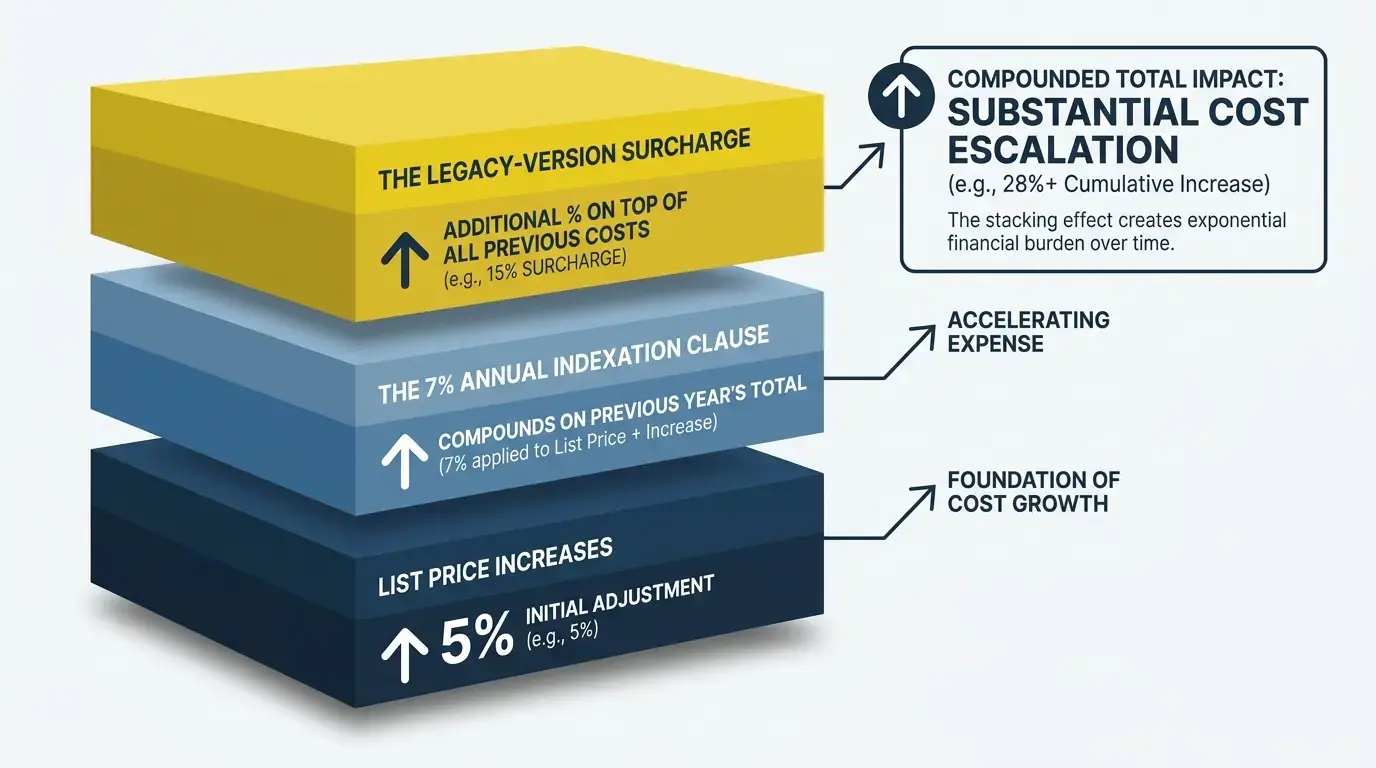
We tell every client the same thing: Don't judge your renewal by a single headline number.
There are three separate mechanisms stacking on top of each other this year, and each one matters differently depending on your setup.
List Price Increases
Odoo raised its published subscription pricing in the US and Canada by up to 30% in early 2026.
That increase touches both tiers: the standard plan is about $24.90 per user month on monthly billing, while Custom is about $37.40 per user month, and Enterprise generally lands around $25-$37 per user per month; Standard includes Odoo Online hosting with no Odoo Studio or external API access, while Custom adds Odoo Studio, multi-company support, external API access, and a choice of Odoo Online, Odoo.sh, or on-premise hosting).
The one app free plan is the free plan, also called the app free plan, and it supports unlimited users for one application group, but adding more apps requires an upgrade.
If your contract is renewing this year, the list price you're measured against is higher than the one you originally signed at.
The 7% Annual Indexation Clause
Odoo's Enterprise Subscription Agreement states that upon renewal, if the charges from your previous term sit below the current list price, those charges increase by up to 7% per year of the previous term.
Odoo tightened enforcement of this clause in 2026 so it applies at every renewal instead of only occasionally, which means it compounds year over year instead of resetting.
The Legacy-Version Surcharge
This is the newest and most concrete change. Odoo began invoicing an additional 25% surcharge in April 2026 on any database running a version outside its officially defined "Covered Versions", which are the three most recently released major versions, currently Odoo 17, 18, and 19.
Standard support for each version runs three years from its release date; once that window closes, staying on the version means the surcharge lands on top of standard indexation.
If you're on Odoo 16 or earlier and your contract renewed after July 4, 2025, that 25% is now showing up on your invoice for as long as you stay unupgraded. Contracts renewed before July 4, 2025 are grandfathered, but only until their next renewal.
Because all three of these interact differently depending on your plan, user count, hosting environment, and contract terms, verify your exact renewal quote with us or with Odoo directly rather than drawing conclusions from a general article. What matters is understanding your own exposure before your renewal date arrives.
Why This Matters Before You Renew
This isn't just a pricing story. It's a planning story, and here's why we push every client to treat it as a trigger to review their whole Odoo setup, not just the subscription line.
Renewal timing affects your budget. A mid-year renewal with a surprise increase can blow through an already-approved budget. Reviewing early gives your finance team room to adjust before the invoice, not after it.
Upgrade timing has become a financial decision, not just a technical one. Between the 7% indexation clause and the legacy-version surcharge, the cost of standing still now compounds every year you delay. Which factors hit you hardest depends on your specific setup, covered next.
Waiting shrinks your options. Auditing users, cleaning up apps, and evaluating an upgrade all take time. Starting 60 to 90 days out gives you real choices. Starting after the invoice arrives does not.
List Price vs. Renewal Indexation vs. Total Cost and Hidden Costs
One of the most common points of confusion we see is the difference between what Odoo publishes, what your contract allows, and what you actually end up paying.
These are three different numbers.
Cost Component | What It Means | Why It Matters |
|---|---|---|
List Price | The current published subscription price for your plan and user count | Sets the ceiling that renewal indexation is measured against |
Renewal Indexation | Contractual increase of up to 7% per year of the previous term, when prior charges are below current list price | Now compounds annually, not just occasionally at renewal |
Legacy Version Surcharge | An additional 25% on non-covered versions, effective April 2026 | Applies on top of indexation for anyone on Odoo 16 or older |
Total Cost | Subscription + implementation + hosting + support + integrations + custom development | The number that actually hits your ERP budget, and the license often represents only about 20% of that total for odoo erp |
Businesses tend to focus on the subscription line and overlook the rest. For most businesses, that gap is where the hidden costs show up, so any odoo pricing compare should contrast published pricing with actual spend. A renewal that looks manageable on paper can get expensive fast once support contracts, hosting, and custom module maintenance are added in, and third-party modules from the odoo app store can add roughly $1,000 to $22,500 annually.
Who Is Most Affected?
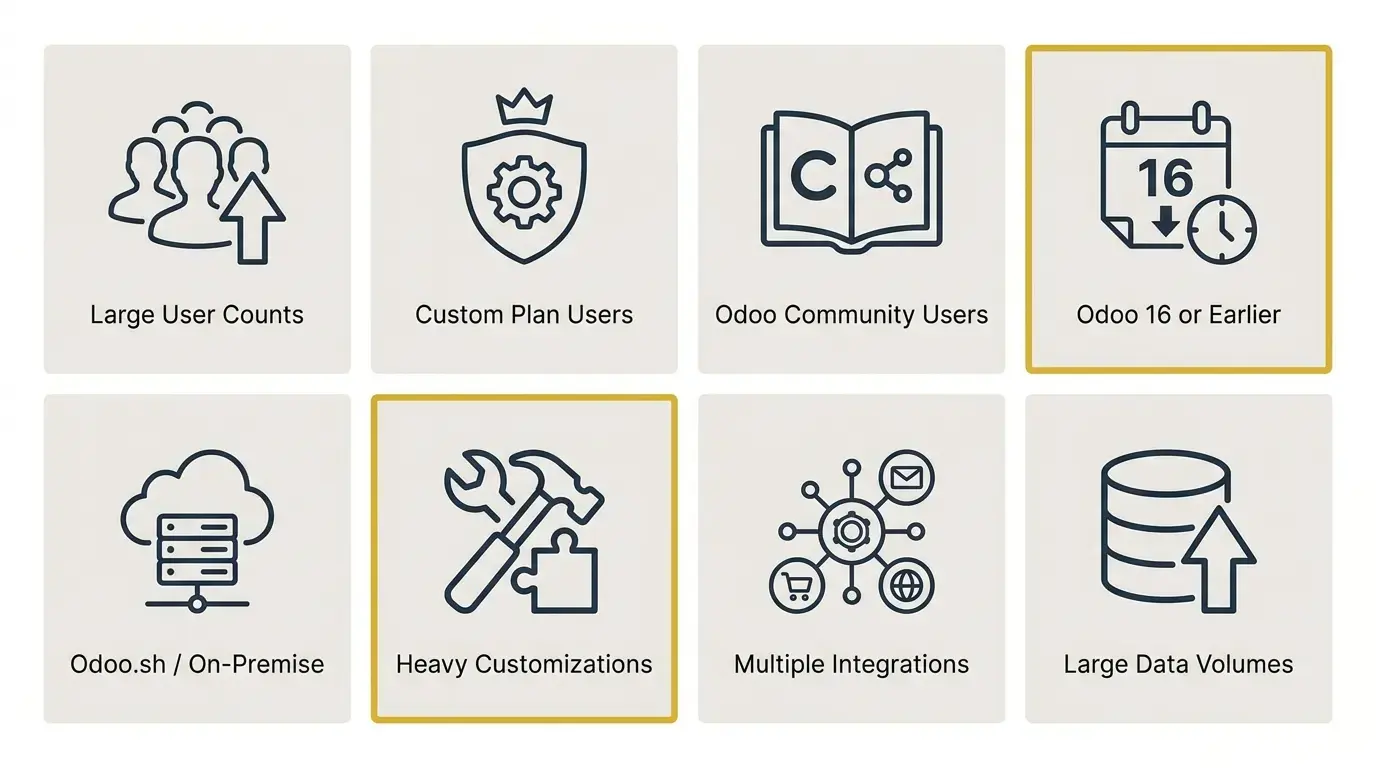
Not every Odoo customer feels this the same way. The following profiles carry the highest renewal risk heading into their next term:
US and Canada businesses whose contracts haven't been reviewed since the original implementation
Companies with large user counts, where per-seat increases multiply fast
Businesses on the Custom plan, which carries higher base pricing and more complex renewal terms
Businesses on Odoo Community or the community edition: while Odoo Community Edition is free and open source, it is usually self hosted on own servers, lacks official Odoo support and official support, does not include the Odoo mobile app, and can still face renewal-like cost pressure through hosting, maintenance, and third-party help
Anyone still running Odoo 16 or earlier, now subject to the 25% legacy surcharge on top of indexation
Businesses on Odoo.sh or on-premise, where hosting and infrastructure add a separate layer of exposure
Companies with heavy customizations, where maintenance and upgrade costs increase every cycle
Businesses with multiple third-party integrations, where compatibility work creates ongoing support costs
If more than one of these applies to you, the case for a pre-renewal audit gets stronger fast.
What to Review Before Your Odoo Renewal
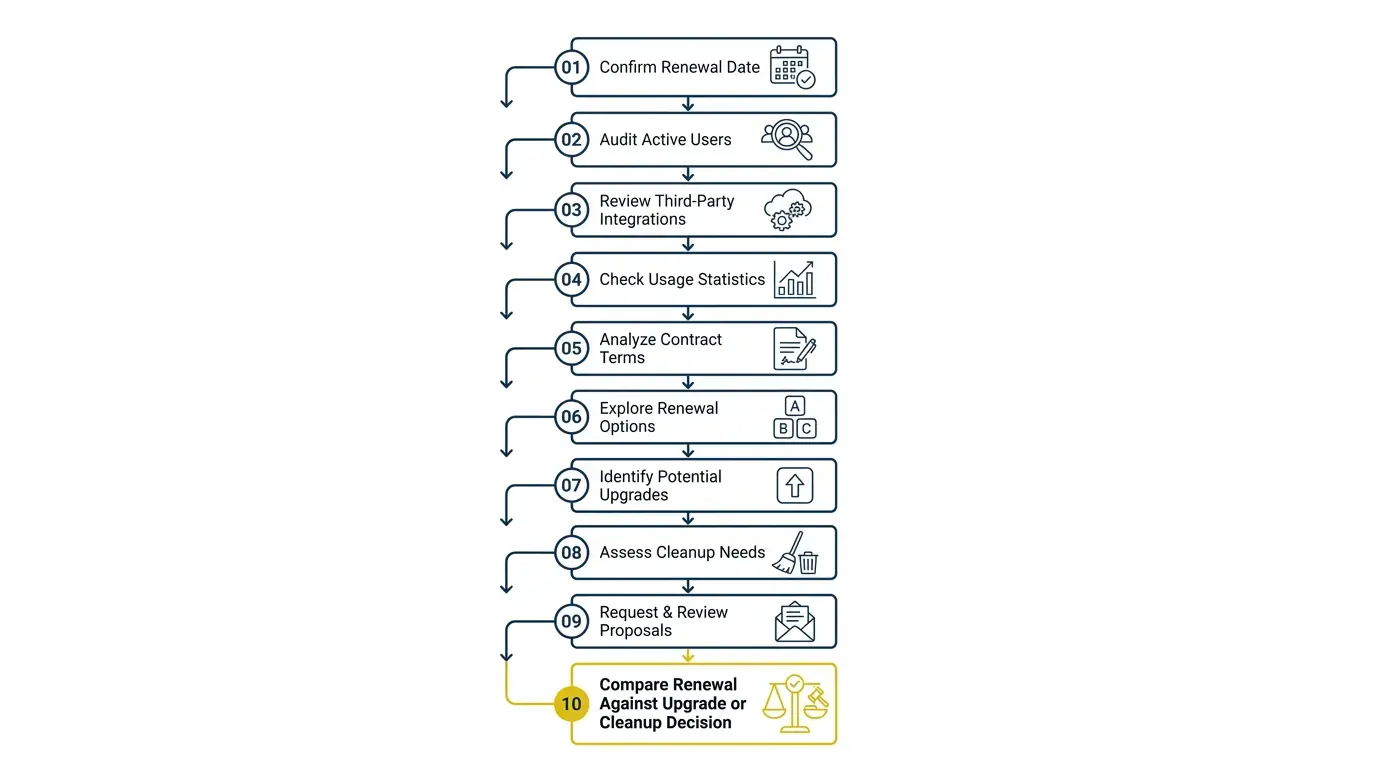
We walk every client through the same structured review before signing anything:
Confirm your renewal date: Know exactly when your current term ends so you have real lead time.
Review your contract terms: Understand what indexation clause applies and what your current pricing is measured against.
Check plan and billing frequency: Annual billing typically costs less than monthly. Confirm you're on the right tier for actual usage.
Audit active users: Identify who is actually using Odoo and who isn't.
Remove inactive or unnecessary users: Former employees, seasonal accounts, and duplicates all add to your per-user cost.
Review apps and modules: Confirm what's actively used versus installed and forgotten.
Check customizations and Studio changes: Ask whether custom workflows are still needed or can be replaced by standard features.
Review third-party integrations: Confirm which connections are still in use and whether their maintenance is justified.
Confirm hosting and support costs: Review Odoo.sh fees, on-premise infrastructure, and partner agreements.
Compare renewal against upgrade or cleanup: In some cases, upgrading or cleaning up before renewal reduces long-term cost more than renewing as-is.
User Audit: Are You Paying for Seats You No Longer Need?
User count is one of the fastest ways ERP costs grow unnoticed. Because Odoo bills per user, every unnecessary seat adds directly to your renewal total, and paying users are internal backend users who create, view, or edit records. Portal users do not count toward that total, which is especially important for businesses with lots of customer or supplier access. Promotional pricing may also apply only to the initial users, so your current user mix matters at renewal. Worth checking:
Former employees whose accounts were never deactivated
Seasonal or temporary users added for a project and never removed
Duplicate accounts created during implementation or migration
Shared accounts, which can violate licensing terms and create compliance risk
Users with elevated permissions they no longer need
Departments with low adoption, where licenses were bought but the rollout never stuck
A user audit doesn't need a full system review. Pulling an active-user report and cross-referencing it against HR records usually surfaces quick wins within a few hours.
Version Audit: Is an Older Version Costing You More?
Running an outdated version now carries a direct financial cost, not just a technical risk. If you're on Odoo 16 or earlier, ask:
Is my version still covered? Covered means Odoo 17, 18, or 19. Anything older is subject to the 25% surcharge as of April 2026.
What would upgrading cost, versus staying and paying the surcharge? Run the break-even math: the surcharge amount divided into the upgrade cost tells you how many years it takes to recoup the investment. For simpler projects, implementation costs can range from $5,000 to $40,000, while larger rollouts often fall between $15,000 and $350,000, including for 100+ users.
55-75% of ERP projects exceed their original budget, so estimates should account for training and data migration; training costs typically range from $2,000 to $8,000, and migration is a significant part of the overall project cost.
Is my current version creating operational friction? Check the release notes for each version you'd be skipping. Features like native ESG reporting, expanded Peppol e-invoicing, and improved API rate limits often replace what used to require custom Python modules or third-party connectors.
What's the realistic upgrade timeline? Upgrading before renewal, rather than after, avoids the surcharge entirely for that billing cycle.
At Cudio, we've upgraded clients from as far back as version 8 with zero data loss and minimal downtime; most of the heavy lifting happens in staging environments, with cutover to production often completed in hours over a weekend, though total cost still varies with custom code, integrations, and project complexity.
If you're weighing whether now is the moment, our Odoo upgrade services walk through exactly what that looks like for your setup, including how we handle custom code, ORM-level module compatibility, and third-party integrations during the version jump.
Customization Audit: Are You Paying to Maintain Complexity?
Custom development is often necessary at implementation. Customization commonly adds about $1,500 to $10,000 per module, depending on scope. Years later, it's frequently the most expensive thing to maintain. Before renewing, ask:
Are these workflows still in use, or built for a process that no longer exists?
Can standard Odoo now replace what used to require custom code? Native functionality has expanded a lot since Odoo 14 or 15, and the lower-cost baseline is usually minimal customization.
What does it cost to test and maintain custom Python modules and ORM-level changes at every upgrade? Post-go-live costs often continue through incremental customization and annual support, with ongoing costs after Year 1 often around 8-15% of Year 1 total and ongoing developer support often running $5,000 to $20,000 per year.
Are Odoo Studio changes creating upgrade friction because they were never documented, even when they began as low code customization?
Integration Audit: Are Your Connected Systems Still Worth the Cost?
Every connected system—whether it is payment providers, shipping carriers, or other external software tied into Odoo—adds ongoing maintenance overhead as Odoo versions and APIs evolve.
It’s worth asking:
Is this integration still actively used?
Is it generating disproportionate support tickets relative to its value?
Will it survive the version you're moving to?
Has a native Odoo feature, including options in the broader Odoo apps ecosystem, made it redundant and reduced custom work while still adding dependencies and maintenance cost?
If relevant to the connection, are functions like subscription billing or marketing automation part of what you still need to support?
Our Odoo integration services can tell you which connections are worth keeping and which are quietly adding cost.
Should You Renew, Upgrade, or Fix Your Setup First?
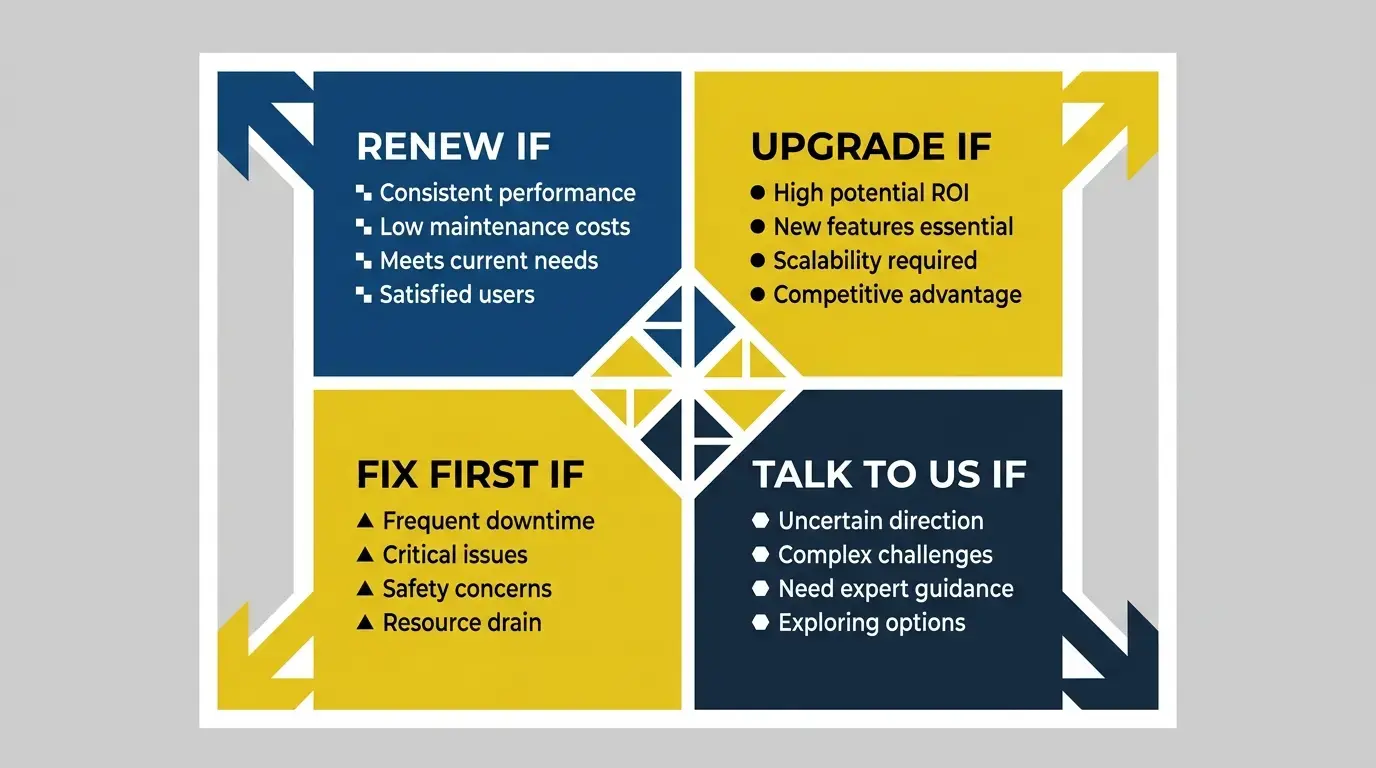
We don't believe every business should approach renewal the same way, especially for growing businesses where scale and complexity change the decision. Here's the framework we actually use with clients:
Renew if:
The system is stable and actively used across the business
Costs are well understood and within budget
No significant version, customization, or integration issues exist
Upgrade if:
The current version is creating support, compatibility, or efficiency problems
The legacy surcharge is now adding cost pressure at renewal
Upgrade investment is lower than the cost of staying put through another cycle
You need advanced features that are not practical to support in the current setup
Fix first if:
The system is over-customized, underused, or unreliable
Users are working around Odoo instead of in it
The setup no longer reflects how the business actually operates
Costs and delays keep increasing because of how much customization the setup now requires
Talk to us if:
The renewal decision touches multiple departments or budget owners
You're not sure whether to renew, upgrade, or restructure
You want an independent read on your setup before committing to another term
Does the Price Increase Change the Odoo vs. Alternatives Question?
A pricing jump naturally makes some businesses ask whether Odoo is still the right platform. That's a fair question, and it deserves a straight answer.
Switching ERP systems is rarely a simple cost decision, and Odoo is first an erp system, which changes how it should be compared with alternatives.
A full migration means retraining, process redesign, data cutover, and re-implementation - costs that can easily exceed several years of Odoo renewal increases, especially when moving from higher-cost platforms such as SAP Business.
The real comparison isn't Odoo's renewal price against a competitor's list price. It's Odoo's total cost of ownership, optimized, against a competitor's total cost of ownership, including everything it takes to get there, particularly for businesses managing multiple companies or dealing with more complex multi company setups.
In most cases we see, renewal optimization, upgrade planning, and targeted cleanup deliver better value than a full platform swap. But if your current setup is fundamentally misaligned with how the business actually runs, a broader evaluation can be the right call.
As Gordon Cummins, our CEO, puts it:
"We see migration as a strategic investment, not just a technical project." — Gordon Cummins, CEO of Cudio
The key is making that decision from a clear-eyed look at total cost, not a reaction to one invoice.
How to Reduce Odoo Cost Before Renewal
A focused set of actions in the weeks before renewal can meaningfully change what you pay next term:
Remove inactive users before the renewal count locks in
Confirm you're on the right plan tier for actual usage
Confirm current pricing directly with Odoo before renewal, since rates and plan packaging can change
Clean up unused apps and modules
Simplify custom workflows that standard Odoo can now handle
Consolidate or retire integrations no longer in active use
Fix reporting issues pushing teams to work outside Odoo
Upgrade before the legacy surcharge becomes a recurring cost
Confirm your ongoing support arrangement still matches what you actually use, not what you signed up for at implementation, and scope any cleanup or remediation work as a fixed fee when appropriate
Plan ahead instead of renewing under time pressure
Each of these is more effective the earlier you start; 60 to 90 days out gives you real leverage. The closer you get to your renewal date, the fewer options remain.
Real Results From Businesses That Got Ahead of Their Odoo Costs
We've done this work with businesses in this exact position:
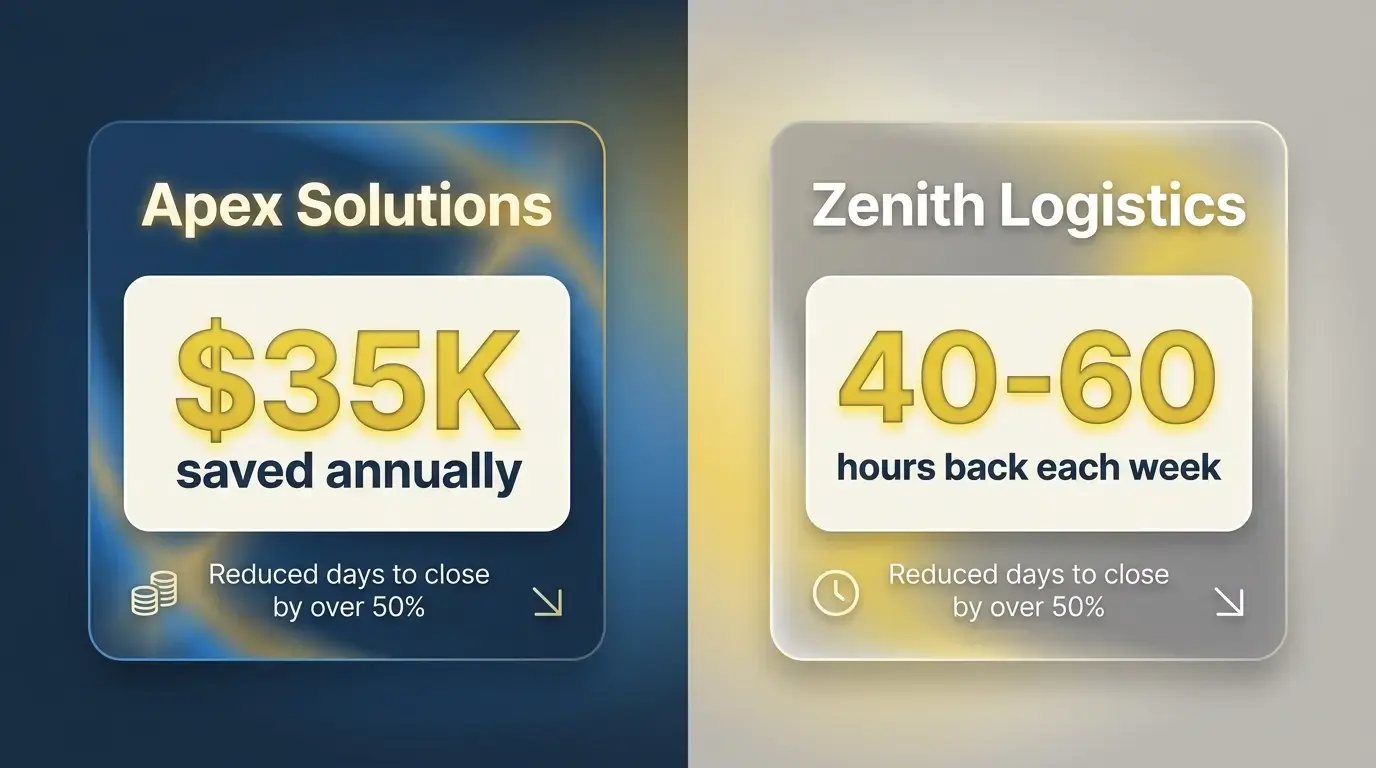
R&W Rope was running QuickBooks, Fishbowl, and Shopify as three disconnected systems before we unified everything - ERP, e-commerce, and inventory - into one Odoo platform.
"$35K saved annually. 40-60 hours back each week. Full visibility achieved."
Lexington Medical operates across 30 countries and 5 subsidiaries, with multilevel bills of materials, lot tracking, expiration dates, and intercompany transactions to reconcile. After we migrated them to Odoo with custom modules built for global manufacturing scale:
"Reduced days to close by over 50% while reducing error rate. Odoo now handles global complexity that our legacy system couldn't."
See How Cudio Helped Lexington Medical
Where Cudio Can Help Before You Renew
We work with Odoo customers across the U.S. and Canada who want to make a smarter decision before their next term locks in. Our team can help you:
Review your renewal exposure across contract terms, user count, and plan configuration, including support planning for Odoo Enterprise versus Community-style deployments where costs often shift into developer retainers
Audit users, apps, customizations, and integrations to find where costs can be reduced, and review whether any offer of unlimited support actually matches your support needs
Assess whether to renew, upgrade, or fix first, based on the real state of your system
Build a cost optimization plan that addresses both this renewal and total cost of ownership going forward
Plan an upgrade if legacy fees are adding pressure, through our Odoo upgrade services
Rescue an over-customized or drifted setup; we've recovered 32+ failed or stalled projects through our Odoo Rescue services
Handle a full platform move through our Odoo migration services, if a broader evaluation points that way
We've rescued 32+ failed or stalled Odoo projects and completed 62+ successful implementations, with a 95%+ client retention rate. Community environments may require $500 to $3,000 monthly in developer support, while broader ongoing developer support can cost $5,000 to $20,000 per year. We don't push unnecessary upgrades or replacements. We help you understand what you have, what it costs, and what the smartest next step actually looks like.
Review Your Odoo Renewal Costs
Odoo Renewal Checklist for US and Canada Businesses
Use this before signing your next renewal:
Checklist Item | Status |
|---|---|
Renewal date confirmed | |
Current pricing reviewed | |
Contract terms checked | |
Active users audited | |
Unused users removed | |
Apps and modules reviewed | |
Customizations assessed | |
Integrations reviewed | |
Legacy-version surcharge risk checked | |
Upgrade timing evaluated | |
Support needs confirmed | |
Budget owner aligned |
Final Words
The 2026 Odoo price increase gives US and Canada businesses a clear reason to review renewal costs before signing. But the bigger opportunity isn't just reacting to higher pricing, it's making sure you're not renewing a bloated, outdated, or over-customized setup that costs more every year that passes.
Businesses that review users, apps, customizations, integrations, and version status before renewal end up in a far stronger position than those who sign first and audit later. That difference isn't just financial. It's operational. A cleaner, better-optimized Odoo setup performs better, costs less to support, and upgrades more smoothly when the time comes.
We help US and Canadian businesses review their Odoo costs, reduce waste, and plan the right next step before renewal locks in another term. Whether you need a user audit, an upgrade assessment, or a full pre-renewal consultation, we're here to help you make a decision you're confident in.
Talk to Cudio Before You Renew
FAQs About the 2026 Odoo Price Increase
Concerned about Odoo's 2026 pricing changes? Here are quick answers to the most common questions about subscription costs, renewals, and upgrade planning.
What changed with Odoo pricing in 2026?
Odoo increased subscription list prices for customers in the US and Canada in 2026, including standard and custom plans. The updated Enterprise Agreement also allows renewal prices to increase under certain conditions and introduces a surcharge for businesses running unsupported legacy versions, while current Enterprise pricing is roughly $25-$37 per user per month. These changes may affect both new and existing customers depending on their contract terms, even though deployment options use the same software.
Does the price increase affect Canadian businesses too?
Yes. Canadian customers are subject to the same pricing changes as US customers. This includes subscription price increases, renewal terms, and legacy version surcharges where applicable. Your renewal costs will depend on your current contract and Odoo version.
How much can Odoo renewal pricing increase?
Odoo renewal pricing can increase by up to 7% per year under the terms of the Enterprise Subscription Agreement. The exact increase depends on your existing subscription price and the current list price at renewal. Reviewing your contract before renewal can help you understand your expected costs.
What is the 25% legacy version surcharge, and who does it apply to?
The 25% legacy surcharge applies to businesses running Odoo versions that fall outside Odoo's supported release window. It primarily affects organizations that continue using older versions instead of upgrading. Whether the surcharge applies depends on your Odoo version and contract renewal date. Reviewing your renewal timeline early can help avoid unexpected costs.
Should I upgrade Odoo before renewing?
It depends. If you're running an older Odoo version, upgrading before your renewal may help avoid additional legacy version charges. However, the best timing depends on your customizations, integrations, and overall upgrade readiness. A technical assessment can help determine the most cost-effective approach.
How can I reduce my Odoo costs before renewal?
You can often reduce Odoo costs by removing inactive users, eliminating unused apps, simplifying unnecessary customizations, and reviewing third-party integrations. Starting this process well before your renewal date gives you more flexibility to optimize licensing and system costs. An audit can also identify opportunities to lower ongoing expenses.
How can Cudio help with Odoo renewal planning?
Cudio helps businesses evaluate their renewal options before signing a new subscription. We review your current Odoo environment, assess upgrade readiness, identify unnecessary costs, and recommend the most practical path forward. Whether you need to renew, upgrade, or stabilize your system first, we can help you make a more informed decision.