



When it comes to Odoo pricing in 2026, here’s the first thing you should know: the license is only the initial part of the equation. Odoo offers a $0 One App Free option for unlimited users on one app, while paid plans start at about $31.10 per internal user per month on Standard and around $46.80 per user on Custom when billed annually, but your real budget must also cover implementation, data migration, hosting, integrations, training, development, and support.
At Cudio, we see this confusion often. A business compares subscription prices, chooses a plan, and only later discovers the decisions that move the total.
This pricing hub is for businesses and teams evaluating Odoo ERP in 2026, especially decision-makers who need to understand the full cost before they commit.
We’ll work through the pricing plans, user licensing, implementation, hosting, renewal pricing, hidden costs like custom code maintenance and third-party apps, and the total cost of ownership in the order these decisions usually arise, from choosing a plan to estimating the first year of operation.
Key Takeaways
Odoo offers One App Free, Standard, and Custom. One App Free is genuinely free and supports unlimited users for one app.
Paid Odoo Enterprise pricing scales per internal user. Portal users generally aren’t billable.
Standard includes all apps and Odoo Online but no custom code. Custom adds Studio, API access, multi-company tools, and more hosting choices.
Implementation often costs more than the license. Many small and mid-market projects fall between $5,000 and $45,000, although complex programs can exceed it.
Before renewing in 2026, check list prices, indexation, legacy-version charges, and regional terms.
Odoo Pricing Breakdown for 2026
Let’s start where your quote starts: the subscription.
The table below provides a practical comparison of all three plans, but the figures are planning estimates rather than guaranteed invoice amounts. Your country, billing term, promotion, and contract date can change the rate.
Confirm live pricing on the official Odoo pricing page or directly with Odoo before approval.
Plan | Planning price | Users | Best fit |
One App Free | $0 | Unlimited | One app and its required dependent apps |
Standard | About $31.10/user/month annually | Internal users billed | All apps on Odoo Online without custom code |
Custom | From about $46.80/user/month in Tier-1 markets | Internal users billed | Studio, API, multi-company, Odoo.sh, or on-premise |
One App Free Plan
If your team only needs one focused function, One App Free may be all you need. It costs $0, supports unlimited users in a single Odoo app, and doesn’t expire like a trial. Hosting, maintenance, and standard platform support are included.
Required dependent apps are included at no extra fee. Installing a second independent app moves the database to a paid plan, so One App Free suits a focused need, such as CRM or lead generation, rather than a multi-app rollout.
Standard Plan
Need a second independent app? That’s the point where Odoo moves you to a paid plan. Standard includes all Odoo apps in a single subscription and runs on Odoo Online.
Use about $31.10 per user per month annually for planning, then verify the rate for your region; official entry-level Odoo Enterprise pricing starts at approximately USD 9 per user per month, and in 2026 some markets or promos list USD 9 per user/month, while actual Standard rates vary by region and plan context. Annual billing is generally cheaper than monthly billing for Odoo subscriptions.
Standard is the lower-cost paid version when built-in workflows are enough. It doesn’t permit custom modules or custom code, and installing Odoo Studio or enabling multi-company features can trigger an upsell to Custom.
Custom Plan
Standard stops being the right fit when the system has to adapt beyond Odoo’s built-in workflows. Custom starts at around $46.80 per paying user per month in Tier-1 countries, though official custom plan pricing may start in the USD 19 to USD 24 per user/month range in some markets, and includes Odoo Studio, external API access, and multi-company management.
Custom also supports Odoo Online,Odoo.sh, or on-premise hosting. It is also the plan used for multi-company setups and deeper technical tailoring. Choose it when you need third-party applications, custom development, more advanced features, or a multi-company setup.Odoo.sh infrastructure and certain external services may still incur an additional fee.
At Cudio, we don’t recommend Custom simply because it offers more features. We first map each required workflow, integration, entity, and reporting need. If Standard can support the operation, we’ll say so. If Custom is necessary, we show which requirements justify the higher rate.
Odoo Enterprise vs Odoo Community Edition
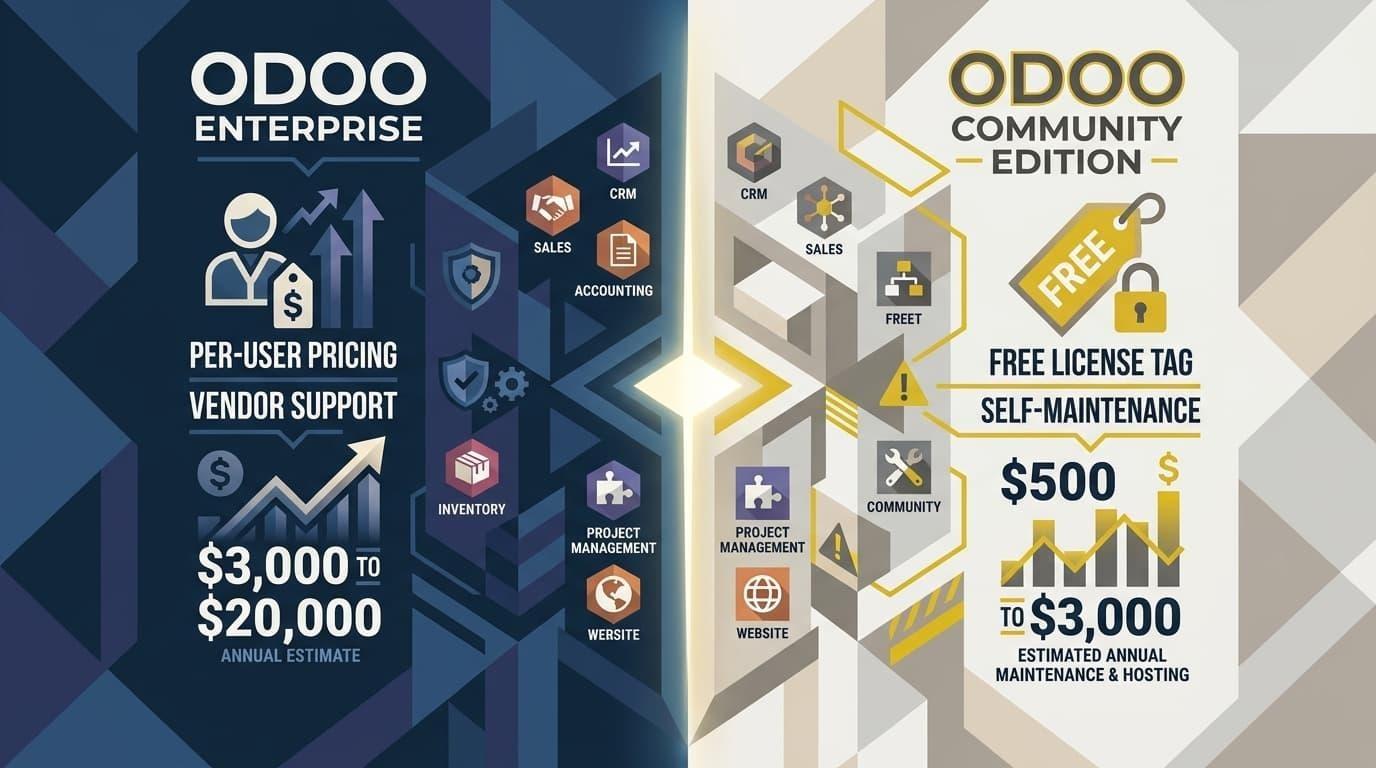
At this point, you may be wondering where Odoo Community fits. One App Free, Standard, and Custom sit within Odoo Enterprise. Enterprise follows the per-user model above and includes proprietary features, upgrades, and official support. Odoo Community Edition is free and open source and has no license fee.
Odoo Community still requires servers or a cloud platform, security, backups, upgrades, support, and possibly third-party apps. Odoo Community often carries ongoing maintenance costs in the $500 to $3,000 monthly range.
Annual upgrades can also cost roughly $3,000 to $20,000 depending on scope. It suits a technical team, while Enterprise Edition is easier to budget for when you want vendor-backed Odoo software and advanced features.
How Odoo Counts Users
Once the plan is clear, count the people who will actually work inside Odoo. Named internal users with Odoo backend access are normally billable.
That includes a warehouse manager, accountant, or salesperson who creates or edits records, even if they log in infrequently.
Portal users, such as customers and suppliers with restricted access to the portal, generally aren’t considered paid internal users. Audit inactive accounts before renewal, especially if promotional terms covered only the initial users.
Odoo Price Increase 2026 and What Changed
Now you have the base calculation: plan plus paying users. The next question is what the Odoo price increase 2026 means for a new quote or renewal.
We’ve brought the relevant guidance into this hub because list price, renewal price, and total operating cost aren’t the same number. Odoo uses localized pricing and periodic indexation adjustments to counter inflation, so quotes and renewals can move differently across Odoo pricing plans.
List Prices Vary by Region
Odoo licenses use regional pricing, so another country’s figures may not match your market. Annual and monthly terms also differ. Treat published amounts as planning references, not a universal Odoo license cost.
Renewal Indexation Can Raise Existing Rates
Odoo’s contract may increase renewal charges if the prior rate is below the current list price. Read the Odoo Enterprise subscription agreement terms for the exact mechanism that applies to your term. Cudio’s 2026 review identified annual indexation of up to 7% in relevant contracts, but buyers should verify their own agreement.
Older Versions May Carry a Surcharge
The absorbed article also identified a 25% charge for non-covered legacy versions in affected renewals. Don’t apply that percentage blindly. Confirm the covered versions, effective date, and contract terms on your renewal quote, then compare the surcharge with the cost of an upgrade.
Cudio reviews the renewal date, plan, users, contract, apps, and Odoo version together. That keeps an upgrade, unused seat, or unsupported customization from being overlooked.
Odoo Hosting Costs
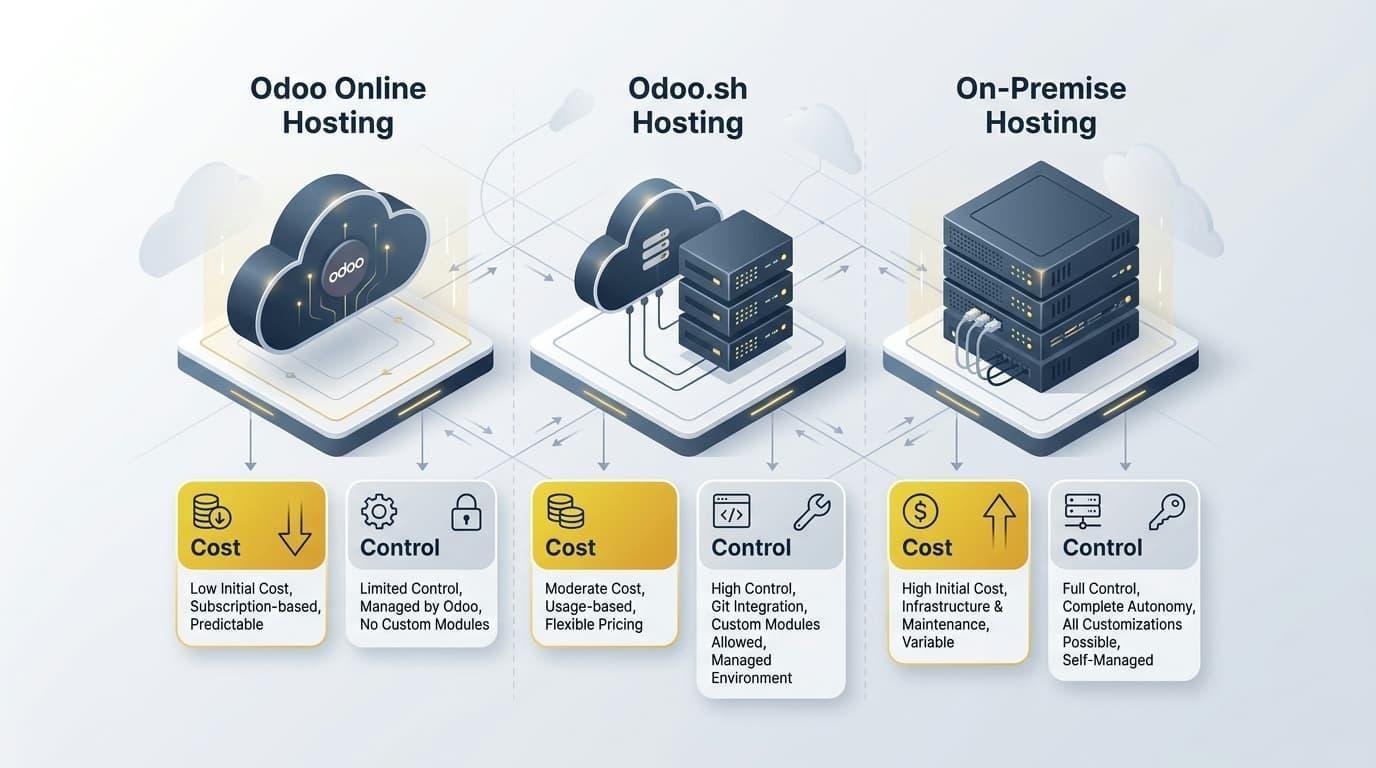
Your plan choice also determines where the system can run. That brings us to hosting. Odoo Online, Odoo.sh, and on-premise each give you a different balance of simplicity, customization, control, and cost. The official Odoo hosting options documentation explains the deployment models.
Odoo Online Hosting
Odoo Online hosting is included in Standard and Custom subscriptions. There’s no separate hosting price, and Odoo handles infrastructure, maintenance, backups, and upgrades. The trade-off is that Odoo Online doesn’t allow custom code, even on Custom.
Odoo.sh Hosting
Odoo.sh is Odoo’s cloud platform for projects that need custom development, staging environments, branches, and deployment tools. It supports custom modules, but the hosting resources are priced separately from Enterprise licenses. Workers, storage, staging, and build requirements affect the quote.
On-Premise Hosting
On-premise means running Odoo on your own servers or chosen provider. Infrastructure, monitoring, backups, security, and administration remain real costs. If managed hosting starts around $29 per month, verify what that entry price includes.
Cudio matches hosting to the system you’ll operate. We consider custom modules, integrations, volume, staging, IT capacity, recovery, and upgrade responsibility before recommending Odoo Online, Odoo.sh, or on-premise.
Odoo Implementation Costs
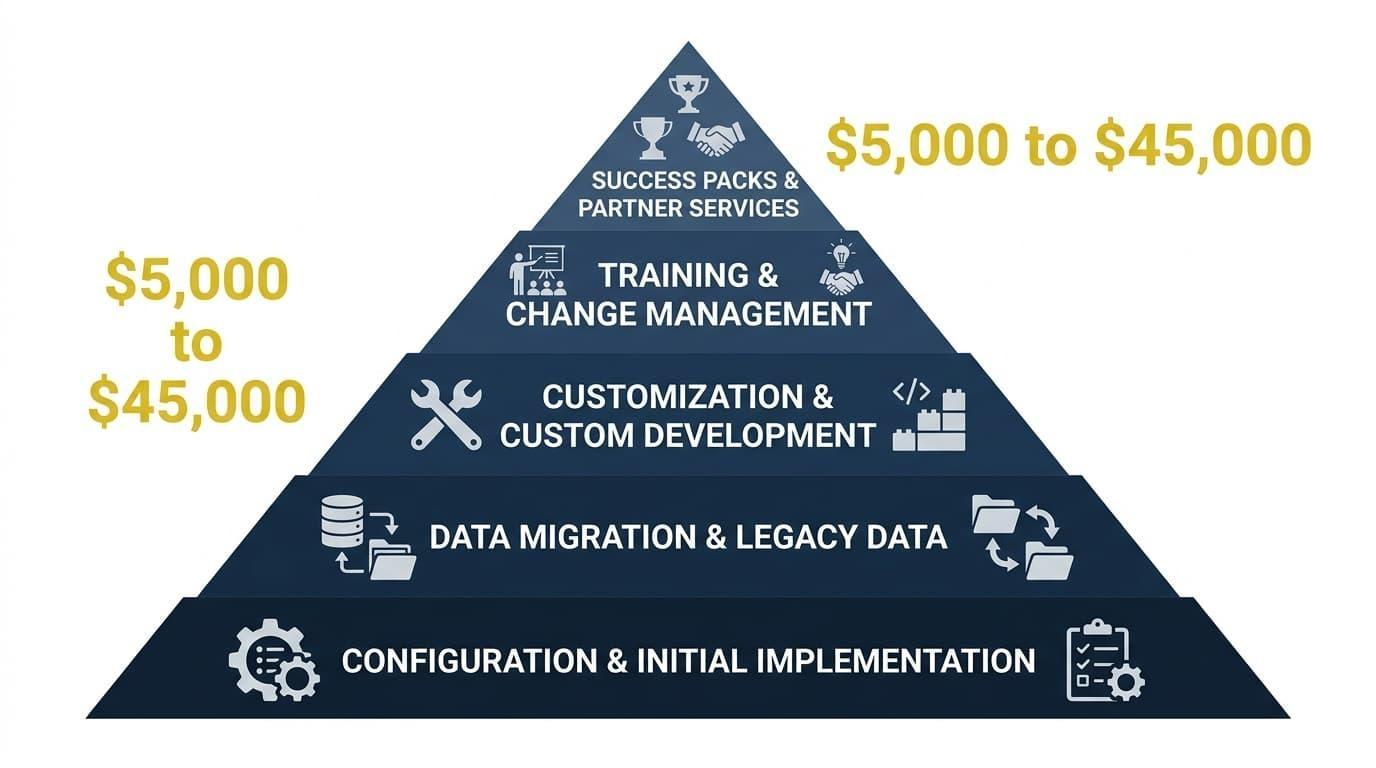
A license and a server still don’t give you a working ERP system. Implementation is the work that connects Odoo ERP to the way your business operates, including discovery, configuration, data import, customization, testing, training, change management, and go-live support.
Many small and mid-market implementations range from $5,000 to $45,000, while specialized or multi-entity programs can cost more.
For limited-scope projects, Odoo ERP pricing for small businesses typically ranges from USD 5,000 to USD 11,500. Cudio’s Odoo implementation cost breakdown explains how scope changes the number.
Configuration and Initial Implementation
Configuration helps configure Odoo apps to approvals, roles, taxes, warehouses, vendor bills, marketing automation, and reporting. A narrow implementation scope built around standard workflows is usually the lowest-cost route to success. Starting with core modules is usually the best way to control scope before expanding further.
Data Migration and Legacy Data
Data migration depends on the volume, quality, and data complexity of legacy data, not simply company size. Data migration costs vary significantly based on the source system and the complexity of the migration. Clean customer records are easier to manage than years of duplicate products, transactions, attachments, and open documents pulled from several legacy systems.
Customization and Custom Development
Odoo Studio can handle many low-code changes, but specialized workflows, custom modules, and third-party applications require design, development, testing, and ongoing maintenance.
In practice, customization costs can range from about USD 1,500 to USD 10,000 per module depending on the workflow and technical demands.
In complex deployments, customization costs can exceed $50,000. The more you customize Odoo, the more customization costs, upgrade effort, and ongoing support you should expect.
Training and Change Management
Process owners need input, users need role-based onboarding, and new hires need repeatable materials. Skipping these recurring costs raises adoption risk and makes implementation look artificially cheap.
Success Packs and Partner Services
A Success Pack or partner engagement may cover consulting hours for configuration, data import, and support. Check the deliverables closely. “Unlimited support” may describe access rather than unlimited custom work, and tasks outside the scope are often priced separately.
Cudio starts with discovery because a useful estimate needs defined outputs. Once scope, assumptions, and exclusions are clearly defined, Cudio can provide a fixed price.
We separate configuration, migration, integrations, training, testing, and post-launch support, then identify assumptions and exclusions. You see what each cost covers before work begins.
Scope Your Odoo Implementation
Hidden Odoo Costs to Add to the Budget
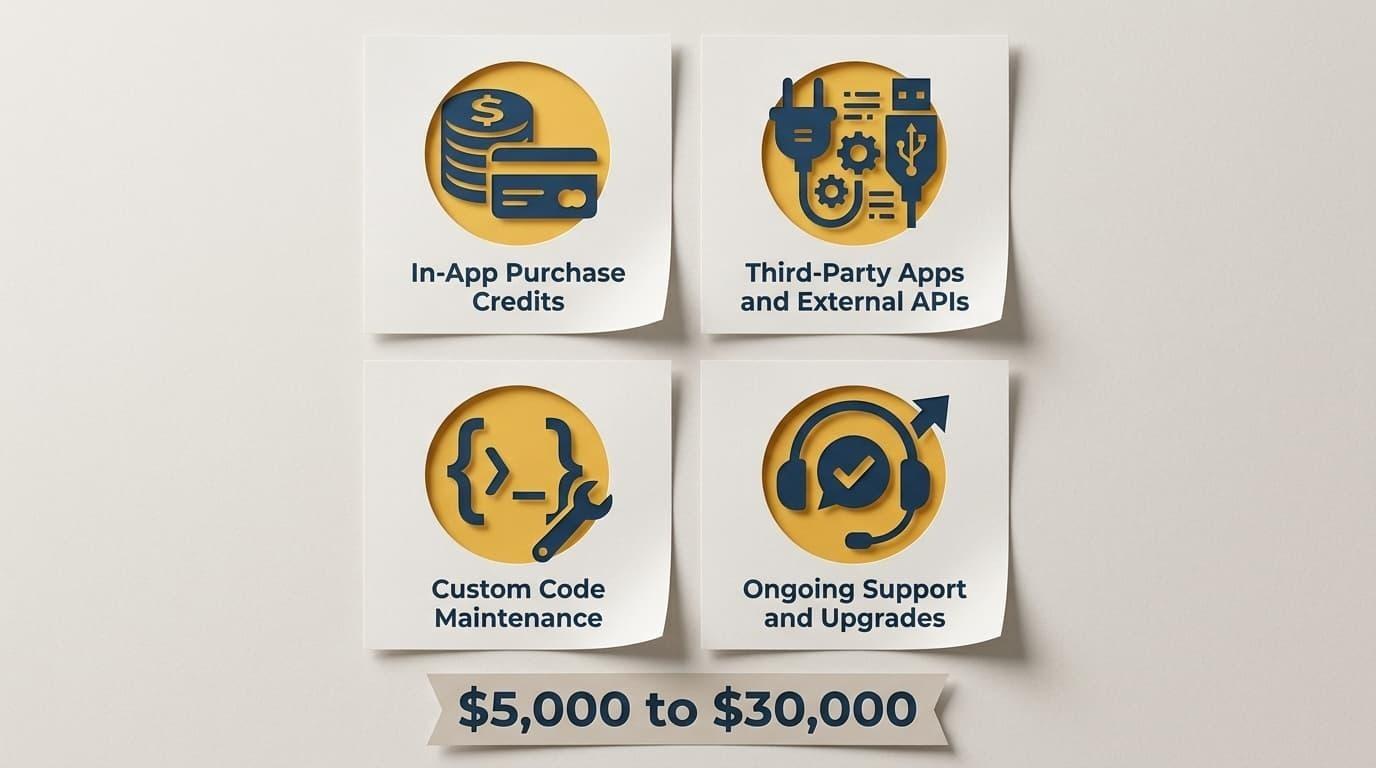
Once implementation is scoped, look beyond go-live. Several recurring items fall outside the license and become hidden costs because they weren’t included in the initial budget. These are the charges we ask clients to price early. Hidden additional costs often include integration expenses of $5,000 to $30,000, and unexpected costs can still surface later.
In-App Purchase Credits
In-app purchase credits pay for usage-based services such as SMS or document digitization. They’re separate from the subscription, so estimate transaction or message volume instead of treating them as included.
Third-Party Apps and External APIs
Third-party apps can carry purchase, renewal, and maintenance costs. An API or connector may also require Custom. Confirm access, vendor fees, upgrade compatibility, and support ownership. In practice, connecting Odoo to external tools can require significant implementation effort and incur vendor costs.
Custom Code Maintenance
Custom code creates an asset and a maintenance obligation. Budget for documentation, regression testing, security fixes, and version upgrades. A cheap module that breaks a critical workflow can cost more over time than a well-scoped build.
Ongoing Support and Upgrades
Post-launch support covers questions, fixes, monitoring, changes, and upgrade preparation. Maintenance recurs whether you work with Odoo directly or a partner. Define response times and what work is included before comparing offers.
Cudio also assesses the maintenance burden introduced by each proposed customization and connector. We use built-in Odoo functionality where it meets the business need, then reserve custom development for requirements with clear operational value. That decision reduces avoidable support and upgrade work later.
How to Calculate Odoo Total Cost of Ownership
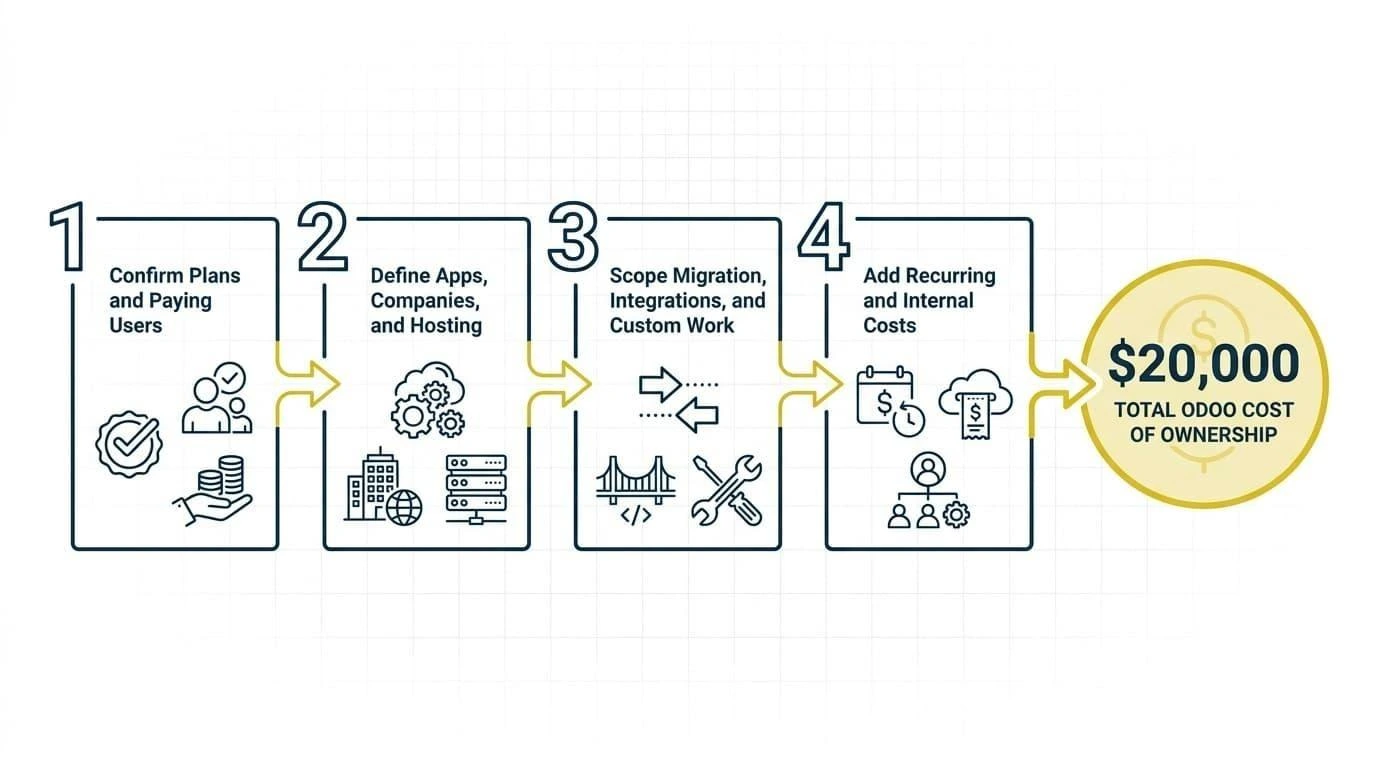
You now have every part of the calculation, so let’s put together the actual cost of first-year ownership.
We calculate first-year ownership as licenses + implementation + migration + hosting + integrations + third-party apps + credits + training + internal labor + support. Even with a modest subscription, that total can reach $20,000 for a small business.
Step 1: Confirm Plans and Paying Users
Choose between the standard or custom plan, then count backend users; keep One App Free in mind if it fits. Keep portal users separate, and model expected hires so the budget doesn’t cover only today’s headcount.
Step 2: Define Apps, Companies, and Hosting
List each Odoo app, entity, warehouse, and country. Decide whether you need multiple companies, multi-company structures, Odoo Studio, external API access,Odoo.sh, or on-premise infrastructure.
Step 3: Scope Migration, Integrations, and Custom Work
Document every source system, dataset, third-party application, report, project management process, and workflow gap. Decide what to configure, what to replace with a standard feature, or, when standard features fall short, what to build as custom modules. This is where estimates become credible.
Step 4: Add Recurring and Internal Costs
Include license renewals, hosting, in-app credits, module renewals, support, upgrade work, training, operational costs, and the time your employees spend on workshops and testing. That produces a useful total, not just a software invoice.
Cudio turns these inputs into a line-item estimate tied to the implementation scope. We allow for unresolved requirements, then narrow the range through discovery and show which decisions could still move the total.
Standard vs Custom Plans
This full-cost view makes it easier to compare Odoo pricing plans. Standard is usually enough when Odoo’s apps and Online hosting support your workflows without custom code.
Custom becomes relevant when you need Studio, multiple companies, external APIs, custom modules,Odoo.sh, or on-premise. At Cudio, we weigh that flexibility against the extra implementation and maintenance it creates.
Real Results, Real Impact
That broader view matters because value isn’t limited to the new invoice. For R&W Rope, we replaced disconnected QuickBooks, Fishbowl, and Shopify with Odoo.
The project saved $35,000 annually and recovered 40 to 60 administrative hours each week. That consolidation delivered measurable cost savings and reduced operational costs. Results vary, but the case shows what a complete cost comparison can reveal.
“$35K saved annually. 40 to 60 hours back each week. Full visibility achieved.”, R&W Rope
“Moving to Odoo consolidated our multiple systems into one, enhancing efficiency across the board.”, Ashley A. Almac, Almac Imports
“We see migration as a strategic investment, not just a technical project.”, Gordon Cummins, CEO of Cudio
How Cudio Builds an Odoo Cost Estimate
When you’re ready to move from rough numbers to a working budget, we build the estimate around your operation. We map users, apps, entities, warehouses, transaction volumes, hosting, integrations, migration, and support. Then we separate what standard Odoo already handles from custom work that earns its place in the budget.
Our high-level estimate includes a 20% to 30% planning variance for unknowns. Once discovery resolves those unknowns, we define milestones and a fixed scope to reduce hidden fees and avoid additional costs from vague requirements.
See Cudio’s transparent pricing approach or discuss the project with our Odoo implementation team. Teams can also start with a free consultation to review scope and receive a transparent estimate.
Odoo Pricing FAQs
Here are common questions teams ask when comparing plans or preparing a budget.
Is Odoo free?
Yes. One App Free costs $0 for unlimited users on one app, and Odoo Community is free and open source with no license fee. Both can still incur costs for implementation, hosting, training, and support.
How much does Odoo cost?
For planning, Standard is approximately $31.10 per internal user per month annually, while Custom starts at around $46.80 in Tier-1 countries. Odoo Enterprise cost depends on regional pricing, contract term, and promotions, so confirm the current rates before budgeting.
Does Odoo charge per app?
One App Free covers one app. Standard and Custom include all apps in the subscription, but installing more apps can expand implementation scope, training, integrations, credits, and operational complexity.
What is the highest Odoo cost?
For many businesses, implementation costs exceed the first-year subscription. Data migration, integrations, custom development, training, and support often move the budget more than the user count. In other words, Odoo pricing covers only the subscription, while implementation, migration, customization, and training are usually separate costs.
Can Odoo manage multiple companies?
Yes. Multi-company management in a single database is a Custom plan feature. Model each entity’s accounting, tax, access, consolidation, and intercompany requirements because those needs also affect implementation effort.
How do I price Odoo accurately?
Start with the current license and user count to accurately price Odoo ERP, then add hosting, implementation scope, legacy data, integrations, custom work, credits, support, upgrades, training, and internal labor. Validate the result against a scoped estimate rather than a generic calculator.