



When selecting the ideal business management platform for 2026, companies must consider scalability, functionality, and overall alignment with their business objectives. Two names often compared in this space are Odoo and GoHighLevel (GHL). While both platforms excel in different areas, the choice ultimately comes down to what your business truly needs: a comprehensive ERP and CRM platform or a marketing automation powerhouse explicitly designed for agencies.
This comprehensive guide compares Odoo vs GoHighLevel across multiple dimensions, including customer relationship management, marketing automation, project management, inventory management, client management, pricing, scalability, and more. We also provide insights into use cases, specific business needs, and real-world examples, all while integrating essential SEO keywords throughout.
Where GoHighLevel stops at marketing automation, Odoo extends into full business operations — explore Cudio's Odoo CRM and marketing automation services for growing teams to see what a unified approach looks like in practice.
Key Takeaways
- Odoo CRM is a comprehensive business management suite that encompasses ERP, CRM, HR, inventory management, marketing automation, and more. It is ideal for medium-sized businesses and enterprises with complex operations.
- GoHighLevel CRM is a specialized marketing automation powerhouse designed for marketing agencies and teams focused on customer acquisition and client management.
- If your goal is to unify systems and automate internal workflows, choose Odoo. If you're prioritizing sales funnels, automated follow-ups, and email/SMS marketing, choose GoHighLevel.
What is Odoo? The All-in-One Business Operating System
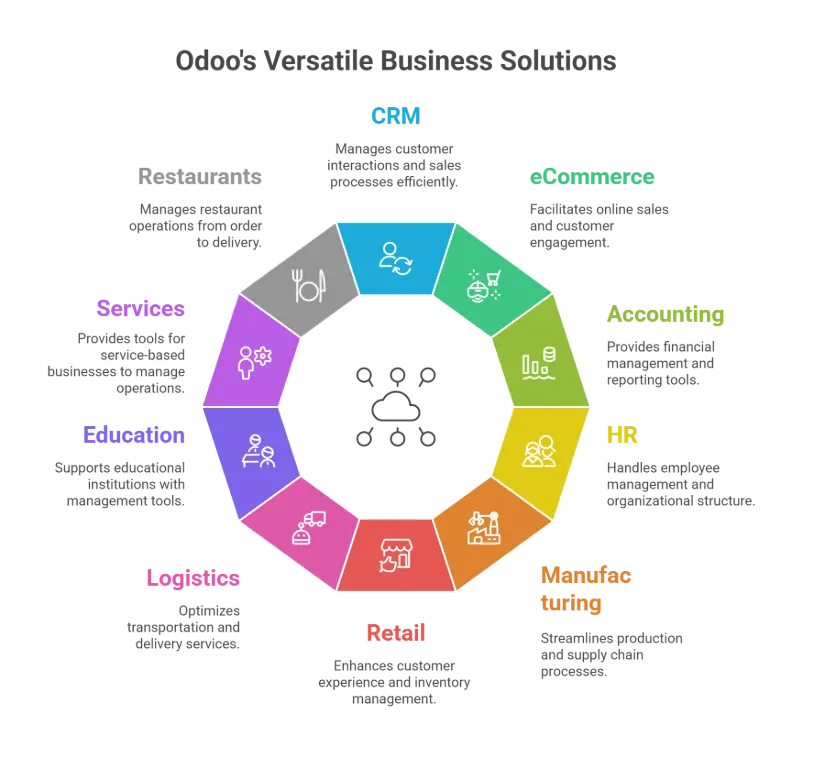
Odoo CRM is part of a broader suite of over 40 fully integrated business applications. This includes everything from accounting and inventory management to sales funnel management, project management, human resources, and e-commerce. Learn more about Odoo business software.
Its modular approach allows companies to start small and expand as their operations grow. Odoo is ideal for businesses that require seamless coordination between multiple departments, and it serves industries such as:
If you're considering running both platforms or migrating from one to the other, talk to a CRM and ERP integration expert who can design a workflow that eliminates data silos between your sales and operations teams.
With Odoo, businesses can manage their entire business on a single, scalable platform. Every application is designed to work seamlessly together, ensuring data flows smoothly between sales, inventory, HR, and finance.
What Odoo offers that GHL does not:
- Full accounting and inventory management with real-time tracking across multiple warehouses
- Integrated project management with time tracking, task assignment, and performance reporting
- Comprehensive HR and payroll tools for workforce management
- Built-in capabilities for e-commerce, point of sale, and supply chain visibility
- Cross-company management and multi-entity financial reporting
- Open-source flexibility with thousands of add-ons through the Odoo App Store
Odoo is best suited for companies that require a reliable, customizable system to run operations across multiple departments. It excels in scenarios where back-end operations, such as finance, compliance, inventory, and manufacturing, are as crucial as front-end marketing and sales.
For a deeper look at where Odoo is headed, check out this detailed article on 2026 trends in Odoo development. The piece outlines significant developments, including AI-driven automation, mobile-first app design, blockchain adoption, and microservices architecture.
What is GoHighLevel (GHL)? The Ultimate Marketing & Sales Engine
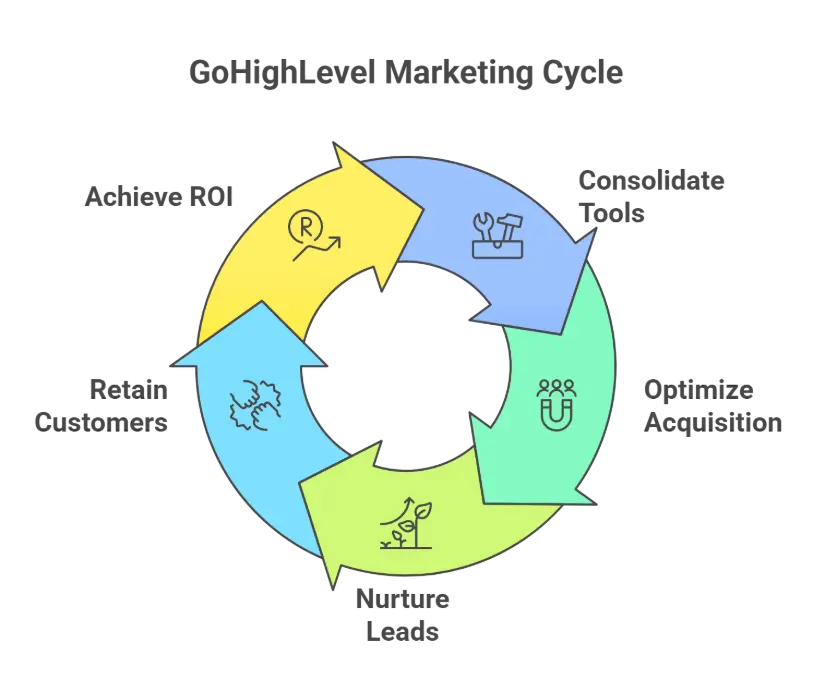
While Odoo offers a comprehensive suite of tools for managing operations, GoHighLevel (GHL) focuses solely on marketing automation, sales funnels, and client management. It is purpose-built for marketing agencies, coaches, consultants, and service-based businesses that rely on digital outreach and lead generation.
Key features of GoHighLevel include:
- Intuitive drag and drop functionality for building sales funnels
- Advanced email marketing and SMS marketing automation
- Appointment scheduling, reminders, and call tracking
- Lead scoring, client pipelines, and nurture sequences
- White-label dashboards for agencies managing multiple clients
Everything in GoHighLevel is optimized for speed, simplicity, and conversion. The platform allows non-technical users to launch sophisticated campaigns without needing to write code or manage multiple disconnected tools.
What GHL offers that Odoo does not:
- A dedicated focus on customer acquisition and marketing tools that support campaigns from start to finish
- Pre-built automated workflows for lead nurturing and follow-ups
- Tools for online reputation management and client review generation
- Built-in landing page builders, funnel cloning, and campaign templates
- Seamless communication integrations via SMS, voice calls, and email
- Reseller support with SaaS white-labeling options for agency owners
GHL is ideal for marketing-focused teams seeking a straightforward and cost-effective approach to managing their client acquisition, engagement, and retention strategies. It prioritizes speed and ease of use over operational depth.
Head-to-Head: Odoo vs GHL Feature Breakdown
To make an informed decision between Odoo and GoHighLevel (GHL), it’s essential to evaluate how each platform performs across key business functionality areas. This side-by-side analysis explores their strengths and limitations in:
- Customer Relationship Management (CRM)
- Marketing Automation
- ERP and Business Management
- Integration and Extensibility
- User Experience and Interface
By comparing these categories in detail, businesses can determine which platform aligns best with their operational needs and long-term goals.
Who Wins for CRM and Lead Nurturing?
We start where most companies begin, with Customer Relationship Management (CRM). After all, every sale, campaign, and support ticket ties back to how you manage relationships.
If you’re an agency or service-based business seeking speed and scale, GoHighLevel immediately captures attention. Its CRM is fast, intuitive, and purpose-built for conversion. With tools like automated follow-ups, multi-step email and SMS campaigns, and even sales funnel management, it takes leads from cold to closed with minimal effort. Everything is optimized for lead generation, and even non-technical users can master it quickly.
But what GHL gains in simplicity, it loses in depth.
Odoo, by contrast, offers a CRM system that isn’t just about capturing leads; it’s about connecting those leads to your entire business ecosystem. When a sales representative converts a lead in Odoo, the data can automatically be tied to inventory management, trigger a project, or be linked directly to an accounting integration. This type of integration is crucial for businesses where sales and operations are closely integrated. While it may require more setup, Odoo delivers end-to-end visibility and cross-departmental alignment.
If you want quick wins and client-centric automation, GHL is a powerful choice. However, if your CRM needs to do more than just close deals, such as integrating with supply chains, project delivery, or invoicing, Odoo is the smarter investment.
Marketing Automation
GHL wins here in terms of speed and ease. It's a marketing automation powerhouse that includes prebuilt workflows, automated triggers, and robust email marketing and SMS marketing tools. Agencies can launch lead gen campaigns without technical help and drive fast results. As shared by users on GHL's own blog, some agencies have seen over 30 percent growth in client ROI using automated workflows alone.
Odoo’s approach to automation is broader. Its marketing automation app integrates with customer journeys, product triggers, invoice reminders, and even inventory workflows. This versatility makes it a solid choice for businesses focused on both marketing and internal operations, even if it lacks GHL’s built-for-marketers flash.
For companies that want sales funnel firepower, GHL is the faster fit. But for those with complex sales cycles, product dependencies, or cross-team coordination, Odoo offers the all-purpose muscle.
Book Your Marketing Automation Demo
Customer Relationship Management (CRM)

GHL excels in CRM functionality with:
- Effective lead nurturing tools
- Multi-channel communication Its specialized sales funnel management features are particularly beneficial for marketing agencies, including:
- Landing page builders
- Automated follow-ups
Odoo, on the other hand, uses a traditional CRM approach with stages and conversion metrics. Its CRM is tightly integrated with ERP modules, allowing for cohesive management of sales and operations, which is ideal for small to medium-sized businesses.
Marketing Automation
GHL wins here in terms of speed and ease. It's a marketing automation powerhouse that includes prebuilt workflows, automated triggers, and robust email marketing and SMS marketing tools. Agencies can launch lead gen campaigns without technical help and drive fast results. As shared by users on GHL's own blog, some agencies have seen over 30 percent growth in client ROI using automated workflows alone.
Odoo’s approach to automation is broader. Its marketing automation app integrates with customer journeys, product triggers, invoice reminders, and even inventory workflows. This versatility makes it a solid choice for businesses focused on both marketing and internal operations, even if it lacks GHL’s built-for-marketers flash.
For companies that want sales funnel firepower, GHL is the faster fit. But for those with complex sales cycles, product dependencies, or cross-team coordination, Odoo offers the all-purpose muscle.
ERP and Business Management
GoHighLevel does not include ERP features. It is not built for accounting and inventory management, manufacturing, or HR. For businesses looking only for marketing tools, it works well. But if you need a system to run your entire business, it's limited.
Odoo, on the other hand, is a complete ERP and business management platform that handles accounting, project management, eCommerce, and inventory in one modular environment. It's tailored for service based business models, manufacturers, retailers, and even logistics companies. With over 40 apps and growing, it supports different business types at every stage.
If you’re looking to replace disconnected systems with one app that actually talks to itself, Cudio makes the transition simple with guided migration and validation.
Integration and Extensibility
GHL integrates well with marketing-related apps. Tools like Stripe, Twilio, Google Calendar, and Zapier allow quick connections for payment processing, messaging, and automation.
Odoo offers much deeper extensibility. Through the Odoo App Store, it connects with tools like Avalara for tax compliance, Crossfire for supply chain automation, and Rithum for eCommerce syndication. This level of integration makes it easier to streamline operations across departments, not just within marketing.
If you want rapid plug-ins for marketing, GHL gets the job done. But if your company juggles multiple tools, data sources, or third-party systems, Odoo gives you the infrastructure to scale smart.
User Experience and Interface
GHL’s user interface is clean and fast. It’s clearly built for non technical users, with drag and drop functionality and visual funnel builders. Small teams can launch quickly and adjust on the fly, without waiting for IT support.
Odoo is more advanced and modular. Its dashboard can be tailored for every department, with role-based permissions and customizable workflows. This comes with a steeper learning curve, but once implemented, it gives companies more control over the platform’s behavior and business alignment.
At Cudio, we reduce that learning curve with post-launch support, role-based onboarding, and simplified dashboards configured for your team.
Which Platform Scales Better for Complex Operations?
For a Chief Operating Officer (COO) managing a supply chain, Odoo is the clear choice because:
- It has a robust, scalable infrastructure that supports multi-entity operations.
- It handles complex manufacturing processes.
- It offers enterprise-grade financial management.
- It can generate consolidated financial reports.
- It monitors performance across different companies, making it ideal for complex operations.
For a marketing agency owner onboarding their 10th client, GHL is the obvious pick. It scales effortlessly for agencies managing multiple client accounts and running multi-channel marketing campaigns. However, it is not suitable for businesses requiring comprehensive ERP functionalities.
Strengths and Limitations
Both Odoo and GHL have their strengths and limitations. Odoo is a comprehensive ERP solution that manages various business operations, while GHL focuses on enhancing marketing and sales processes.
Let’s delve into the specifics.
Odoo Strengths
Odoo offers several key advantages:
- A modular approach allows users to select only the necessary applications, providing tailored solutions for diverse business needs.
- Extensive customization options through a vast app marketplace caters to various industry requirements.
- Scalability enables businesses to add features as their needs evolve, making it suitable for both startups and large enterprises.
Businesses utilizing Odoo have reported significant improvements in operational efficiencies and resource management, leading to optimized performance. Its real-time inventory management helps to optimize stock levels, reduce overstocking and stockouts, and improve order fulfillment.
Odoo Limitations
The flexibility of Odoo can lead to a complex user experience, which may necessitate training for full platform utilization. Odoo implementations may also require significant time investment, ranging from several weeks to months, especially with complex setups.
Additionally, adding multiple paid modules and users can significantly increase costs in Odoo.
GHL Strengths
GoHighLevel is recognized for its superior marketing automation features, which are essential for growth and customer acquisition. Agencies prefer GoHighLevel CRM because it consolidates various marketing tools into one, streamlining their processes and improving efficiency.
Using GoHighLevel, teams save money and setup time by replacing multiple individual tools with a single platform with integrated marketing automation. Digital Boost Agency, for example, achieved a 35% increase in revenue within six months, attributing this growth to enhanced client retention strategies.
GHL Limitations
GHL is not a complete ERP platform. It also lacks advanced tools for business process management. This limitation means that businesses requiring comprehensive ERP functionalities may not find GHL sufficient for their needs.
If business needs exceed GHL’s capabilities, additional software may be needed to fill the gaps.
Pricing and Total Cost of Ownership
When comparing Odoo and GoHighLevel, pricing depends on what your business actually needs.
Odoo offers flexible, modular pricing. You only pay for the apps you use, which is great for small businesses or companies with specific needs like eCommerce, CRM, or inventory management. While implementation and customization may add cost, the ability to manage everything on a single platform often leads to a better ROI.
GoHighLevel keeps things simple with plans starting at $97/month, or $297/month for unlimited sub-accounts. That’s great for marketing agencies and service providers focused on client engagement and fast lead generation.
But GHL doesn’t offer the same operational depth. For companies needing deeper tools like accounting, HR, or logistics, it may fall short.
That’s why growing businesses often choose Odoo. It’s built for different business types, offers strong customization options, and helps improve efficiency as your team scales.
The Final Verdict: When Should You Choose Odoo vs GHL?
Deciding between Odoo and GoHighLevel comes down to what your business values most, deep operations or focused marketing.
Choose Odoo if:
- Your business involves inventory, manufacturing, or complex operations that need a unified system
- You want to improve efficiency across HR, finance, and sales using strong accounting and inventory management
- You need to manage leads while also tracking fulfillment, invoicing, and other downstream tasks
- You’re looking for a customizable, modular approach to digital transformation
- You have a team or partner (like Cudio) who can guide your Odoo implementation
Odoo is especially powerful when you want to automate more than just marketing. With built-in tools for project management, eCommerce, and operations, it's not just flexible, it’s a cost-effective solution for growing businesses.
If you're ready to explore how Odoo can streamline your entire business, book a discovery call with Cudio.
When to Choose GHL
If you are a marketing agency or a service-based business focused on growth and achieving your business goals, consider the following needs:
- You’re a marketing agency or service-based business focused on client acquisition and conversion
- You need an easy way to consolidate funnel builders, email, SMS, and CRM into a single platform
- You prefer a quick launch with minimal setup or coding
- You want a cost-effective solution built specifically for lead generation and automated sales
- You're not managing supply chains, inventory, or internal operations — just fast growth and marketing results
GHL excels when the goal is to launch campaigns quickly, convert leads, and replace multiple tools in one place. It's a clear winner for teams that need streamlined outreach and prefer not to dive into technical setups.
Final Words
Ultimately, choosing between Odoo and GoHighLevel depends on your business priorities.
If your primary focus is marketing automation, lead generation, and client communication, GoHighLevel offers a streamlined way to manage it all in one place. It’s beneficial for marketing agencies and service-based businesses seeking a fast and simplified solution for customer engagement.
On the other hand, if you're running a business that involves inventory, accounting, project management, or any other internal operations, Odoo gives you more control through a fully integrated platform. Its modular approach and wide range of apps make it ideal for businesses that need more than just marketing tools.
This is where Cudio can support your journey. With deep experience in Odoo implementation, we help you design a solution that aligns with your workflows and goals. Whether you're upgrading from another system or starting fresh, our team is here to help make your ERP transformation smooth and impactful.
Curious about what Odoo could look like for your business?
Book your free discovery call with Cudio
Frequently Asked Questions
Find quick answers to common inquiries about Odoo and how Cudio can help.
What type of businesses benefit most from Odoo?
Large enterprises with complex operations, such as those involving physical inventory and manufacturing, benefit most from Odoo's comprehensive ERP capabilities. This makes it an ideal choice for businesses with multiple units and intricate processes.
Why should marketing agencies choose GoHighLevel?
Marketing agencies should choose GoHighLevel for its ability to consolidate essential marketing tools and provide superior automation, ensuring quick setup and ease of use for enhanced productivity.
How does Odoo handle multi-entity management?
Odoo effectively manages multiple entities through its consolidated financial reporting capabilities and integration of diverse business functions, allowing for streamlined operations and visibility across all entities.
What are the pricing options for GoHighLevel?
GoHighLevel provides three pricing options: a Starter Plan for $97/month, an Unlimited Plan for $297/month, and a Pro/SaaS Plan for $497/month, which includes white-label features. Each plan caters to different needs, ensuring flexibility for users.
What are the main limitations of GoHighLevel?
GoHighLevel's main limitation is that it is not a full ERP platform, which means it lacks advanced business process management tools necessary for complex inventory, manufacturing, or financial operations. Therefore, it may not be suitable for businesses with such needs.