



Shopify powers more than 4.2 million stores worldwide. It feels safe. It feels proven. And in the early days, it worked beautifully.
But growth changes everything.
What once felt simple can quietly turn into operational strain. Inventory lives in multiple systems. Orders sync late. Finance waits on reconciliation. Your team double-checks numbers before every promotion because no one fully trusts the data. The stress is not dramatic. It builds slowly, then suddenly becomes constant.
Easy to launch does not always mean easy to scale.
As businesses add warehouses, wholesale channels, retail locations, or light manufacturing, the backend complexity increases. More apps. More connectors. More manual fixes. More risk during peak sales.
Shopify handles the storefront; Odoo handles everything behind it — discover how Cudio implements Odoo ecommerce ERP for omnichannel retail operations that connects your store to purchasing, warehousing, and finance.
At Cudio, we help growing businesses move beyond fragmented stacks and into unified ERP environments built for operational control. We work with teams who have outgrown patchwork solutions and need systems that support scale with clarity and confidence. Contact us to learn more about a full Odoo ERP implementation.
Show Me What’s Holding Me Back - Book ERP Assessment
Key Takeaways
- Shopify powers 4.2M+ stores and processed $235.9B in GMV in 2023, making it dominant in online retail and online shopping. Many Shopify users rely on the app store, social media integration, traffic analytics, and marketing-focused business tools to quickly configure their stores.
- The Odoo platform powers approximately 122,000 stores within a broader ecosystem of 12–15M users. Unlike Shopify, Odoo offers integrated inventory and order management, multi-warehouse management, accounting, CRM, and other business functions within a single unified system.
- Shopify’s extensive app ecosystem offers flexibility, but scaling often requires stacking apps to build customer loyalty, enable advanced reporting, and support operations in local markets. Unlike Odoo, this can create sync risks and fragment various business functions.
- Odoo apps operate within a single database, and the platform's open-source nature enables deeper customization. Odoo offers native multi-warehouse management and warehouse management capabilities designed for complex business operations.
- Over a 3- to 5-year horizon, Odoo and Shopify cost structures diverge. Shopify’s transaction and app costs can compound, while Odoo offers a unified ERP approach that replaces multiple disconnected systems.
Table at Glance: Odoo vs Shopify
Here’s a quick snapshot before diving deeper into the detailed comparison, especially for e-commerce businesses evaluating long-term fit and scalability.
Category | Shopify | Odoo |
Core Positioning | Dedicated e-commerce powerhouse focused on storefront performance | All-in-one solution combining ERP and e-commerce |
Primary Focus | Online sales, themes, and marketing | Integrated business functions across finance, inventory, CRM, and operations |
Market Reach | 4.2M+ stores, $235.9B GMV (2023) | 122,000 stores within 12–15 million-user ecosystem |
Architecture | API-driven model reliant on third-party apps | Unified database with seamless integration across modules |
App Dependency | Heavy use of third-party apps via the Shopify App Store | Native apps covering core business functions |
Inventory & Orders | Basic tools via the Shopify dashboard, and advanced needs require apps | Native multi-warehouse, manufacturing, and advanced fulfillment |
Customization | Theme and app-based, limited deep control | Flexible, requires technical expertise for advanced configuration |
Best Fit | Early-stage and marketing-led brands | Medium-sized businesses and operations-heavy companies |
Odoo vs Shopify in a Nutshell
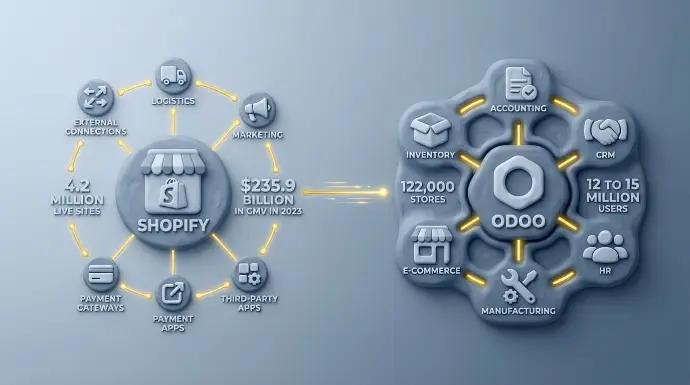
At first glance, Shopify and Odoo may seem similar. They both help you sell online. But what they’re built for is very different.
Shopify is a leading e-commerce platform, powering over 4.2 million live sites and handling $235.9 billion in GMV in 2023. It’s designed to get stores live fast with a user-friendly interface, professional themes, and built-in Shopify Payments.
Odoo runs about 122,000 stores and sits within a broader ecosystem of 12 to 15 million users. It’s more than an e-commerce solution. It’s a full ERP that unifies your operations. Inventory, order management, accounting, CRM, and storefronts all live in one connected system.
If you're a growing e-commerce business juggling apps, spreadsheets, and sync issues, Odoo can feel like a breath of fresh air. It replaces the tangled stack with one clean database, so every order, stock move, and invoice stays in sync without the usual firefighting.
For businesses ready to grow with control and clarity, this difference matters.
How Do Odoo and Shopify Differ in Market Share and Operational Depth?
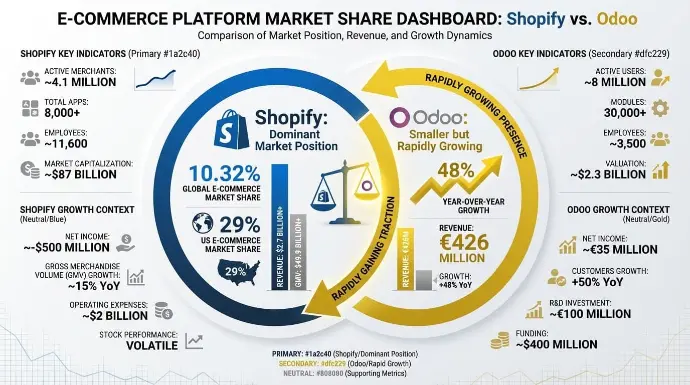
If you’re running a growing online business, it's easy to assume that market share tells the whole story. At first glance, Shopify seems like the obvious winner.
As of 2025, it holds 10.32% of the global e-commerce platform market and about 29% of the US e-commerce market. It's used on 3.67% of the world’s top 10,000 websites and processed $235.9 billion in GMV in 2023.
But volume isn’t the only thing that matters.
Odoo looks smaller on paper, powering around 122,000 stores and appearing on just 0.19% of top websites. Its global market share sits under 1 percent.
But the story shifts when you look at what’s happening behind the curtain. In Q4 2025, Odoo saw 48% year-over-year growth in store count. In 2024, it generated €426 million in revenue, intentionally keeping profits low, €314,000, to reinvest heavily in product depth and capability.
Where Shopify shines at getting stores live fast, Odoo focuses on giving businesses a stronger operational foundation. It’s not just e-commerce software. It’s a full system with accounting software, Odoo inventory management, customer relationship management, and even manufacturing, all working in sync.
The choice isn’t just about which platform is more popular. It’s about what your business really needs to grow without chaos.
Many Cudio clients reach this point, too. They start with speed and simplicity, but over time, realize they need a platform that supports the complexity of real operations, not just another sleek checkout page.
Architecture: App Ecosystem vs Unified Database
Choosing between Odoo and Shopify isn't just about features. It's about the foundation your entire business will rely on. Architecture determines whether your operations stay resilient or unravel under pressure.
Shopify: Flexible but Fragile
Shopify uses an API-first architecture. The core handles storefront operations, while everything else depends on third-party apps. From inventory tracking to customer loyalty and financial reporting, each new function means a new app, a new connector, and a new point of failure.
What starts as flexibility often turns into complexity. Sync delays lead to inventory mismatches. Discount engines miss promotions. Reports from different tools never quite align. During peak sales events like Black Friday, even small delays can lead to overselling and unhappy customers.
Odoo: Built-In Stability
Odoo uses a modular unified database. Each module, from Odoo e-commerce to CRM, accounting, inventory, and manufacturing, is natively integrated. There are no external connectors trying to stay in sync. One update reflects instantly across every function.
This dramatically reduces latency, eliminates reconciliation errors, and provides real-time accuracy across your business operations. When a customer places an order, stock levels, financials, and shipping are all updated in the same system, without lag or duplication.
Why Architecture Matters for Growth
The difference shows up when you're scaling. Shopify’s app ecosystem can feel empowering at first, but each integration increases operational risk. Odoo’s native integration helps businesses avoid these problems altogether by reducing complexity before it spirals out of control.
Cudio’s Engineering-First Approach
At Cudio, we treat ERP architecture as an engineering challenge, not just a software selection. We design Odoo implementations that eliminate sync dependency, ensure data flows are built for stability, and avoid app sprawl by using Odoo's native capabilities wherever possible.
We do this not just to reduce costs, but to give businesses the control and confidence they need to scale without chaos.
See How Cudio Eliminates App Spaghetti
Operational Capabilities Comparison
Choosing between Shopify and Odoo isn’t just about features; it’s about operational maturity. The real differentiators emerge in how these platforms support the core workflows that keep your business running: inventory, payments, and customer management.
Inventory & Order Management
Shopify supports inventory by location with standard functionality for transfers, product availability, and basic alerts. However, it lacks native support for more advanced workflows such as:
- Routing logic across multiple fulfillment centers
- Multi-step warehouse operations (e.g., pick-pack-ship)
- Batch/lot tracking for perishable or serialized goods
- Automated replenishment logic based on real-time order volumes
- Inbound shipment handling for receiving and quality checks
To handle these, most teams layer in 3PL systems or WMS apps, which means extra connectors and sync points. Delays or misalignments often surface in high-volume or multi-warehouse operations.
Odoo, by contrast, treats inventory as a native, first-class workflow integrated with sales, procurement, and manufacturing. Built-in features include:
- Multi-warehouse and multi-location stock routing
- Barcode scanning via mobile apps for picking, receiving, and internal transfers
- Advanced rules for reorder points, lead times, and vendor pricing
- Kitting and assembly (BOM-based) fulfillment
- Automated status changes on stock moves and delivery orders
- Live inventory valuation connected to accounting journals
Odoo’s modular architecture ensures inventory changes update instantly across sales orders, MRP, and financials, no sync jobs required.
Cudio deploys Odoo inventory modules with warehouse-specific routes, lead time buffers, and dynamic demand triggers based on real-time sales and procurement data. Clients operating across multiple warehouses typically reduce their spreadsheet-based reconciliation efforts by up to 80%, with fewer missed shipments and faster close cycles.
Payments & Transaction Fees
Shopify uses a bundled commerce model: a store and a payment processor. If you use a third-party processor (like PayPal or Stripe), Shopify charges an additional 0.5% to 2.0% per transaction, on top of the gateway fees. Many businesses inadvertently pay this “Shopify tax” once they outgrow Shopify Payments.
High-volume brands (e.g., $10M+ GMV) may spend $100,000 or more annually on transaction fees alone, before even considering app subscriptions or connector maintenance.
Odoo charges zero platform transaction fees. You connect directly to your preferred payment gateways using Odoo's modules or certified connectors (e.g., Adyen, Stripe, Authorize.net). You pay only the standard gateway fee, typically 1.9%–2.9%, depending on the provider.
Odoo’s native invoicing, reconciliation, and payment matching workflows also reduce manual touchpoints. Payments post directly to journals, update customer balances, and tie into automated follow-up flows.
Before implementation, Cudio builds detailed TCO models that forecast total transaction costs over a 3–5-year window, factoring in volume growth, regional gateway requirements, and multi-currency settlements. We help clients align their architecture and pricing models so they can scale without unpredictable fee creep. In many cases, this shifts the ERP decision from “cost-center” to “margin unlock.”
Show Me What’s Holding Me Back - Book ERP Assessment
CRM & Customer Data
Shopify has limited CRM capabilities. It tracks customers’ basic details, orders, and abandoned carts. For more advanced CRM, sales pipelines, B2B quoting, support case tracking, most merchants integrate apps like Klaviyo, Gorgias, Salesforce, or HubSpot.
Each app stores customer data in its own silo, which creates issues like:
- Inconsistent customer IDs across marketing, support, and finance
- Delayed attribution tracking due to API lags
- Disjointed visibility between sales reps and account managers
- Duplicate contact records caused by app sync errors
Odoo includes a fully integrated CRM, tied directly to:
- Sales pipelines and opportunity scoring
- Quotation templates with tiered pricing and discount logic
- Customer-specific invoicing, payment history, and credit limits
- Customer service tickets with SLA tracking
- Marketing automation via email/SMS campaigns connected to lifecycle data
- Customer portals for B2B order management and self-service
Because all customer data lives in one unified database, teams get full visibility into lifetime value, open issues, and financial exposure without switching between tabs or tools.
Cudio builds real-time customer dashboards that merge CRM, financial, and operational data. Sales leaders can instantly see which accounts have outstanding invoices, which reps have open quotes, and which orders are stalled in fulfillment. Support teams resolve cases faster because customer records are enriched with a complete history rather than partial syncs.
Show Me What’s Holding Me Back - Book ERP Assessment
Total Cost of Ownership: The App Tax vs System Investment
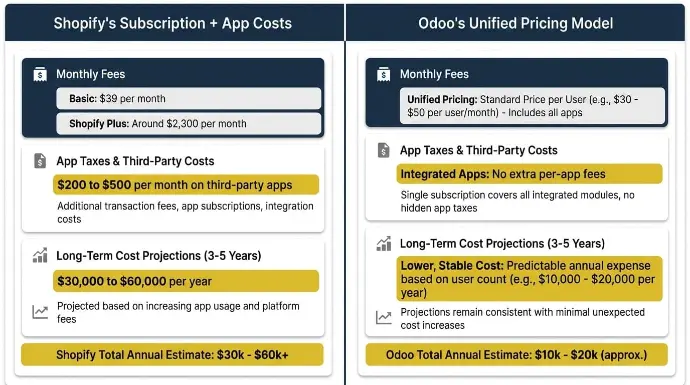
For most teams comparing Shopify and Odoo, monthly pricing is misleading. The real cost comes from stitching together infrastructure and the labor it creates to maintain it.
Shopify: Monthly Plans and App Tax
Shopify’s base pricing looks simple:
- Basic: $39 per month
- Shopify: $105 per month
- Advanced: $399 per month
- Shopify Plus: Around $2,300 per month
But this doesn't include the app tax. Brands often spend an additional $200 to $500 per month on third-party apps to fill native feature gaps, such as:
- Loyalty and rewards
- Subscription billing
- Inventory forecasting
- Advanced reporting
- B2B portals
- ERP connectors
A typical Shopify Plus brand with 8 to 12 apps can easily spend $30,000 to $60,000 per year, excluding transaction fees and labor for reconciliation and manual processes.
Odoo: Upfront Investment with Long-Term Payoff
Odoo uses a different model. You pay per user and per app, and you can choose your hosting method. The initial setup requires more time and investment, but can eliminate the need for multiple third-party systems.
Typical implementation includes:
- Business discovery and process mapping
- Technical configuration and testing
- Staff training and support
- Hosting and ongoing optimization
The upfront cost is higher than Shopify’s subscription, but it often replaces five to ten disconnected tools and reduces labor over time. Over a three to five-year window, Odoo can be significantly more cost-effective and operationally stable.
You’re not just buying software. You’re building an integrated business system your team can rely on without constant workarounds.
We at Cudio provide total cost of ownership assessments comparing fragmented SaaS stacks to unified ERP environments. We model:
- App subscription overhead
- Transaction fees
- Staff hours lost to reconciliation
- Downtime and sync failures during peak periods
- Long-term ROI of consolidation
Our clients often discover that staying with the familiar stack costs more than migrating to a system built for control.
Show Me What’s Holding Me Back - Book ERP Assessment
Which Platform Fits Which Business?
Not every platform is built for every business. As operations evolve, what once felt like a perfect fit can quickly become a constraint. Understanding which platform aligns with your current state and where you’re heading is essential for choosing systems that support your growth, not slow it down.
For Early-Stage DTC Brands: Speed Over Complexity
If your business is just getting started, simplicity matters most. You may be:
- Generating less than $1M in revenue
- Running a single warehouse or working with a 3PL
- Managing a small team with limited system needs
- Selling only through a direct-to-consumer website
- Using light or no integration across functions
In this stage, Shopify typically makes sense. Its user-friendly interface, polished templates, and plug-and-play payments help get stores online quickly. For lean teams shipping fewer than 100 orders per day, operational friction is still manageable, even if it’s handled with spreadsheets or manual reconciliation.
Unless you expect significant operational complexity in the next 6 to 12 months, Odoo might feel like more than you need at this stage.
For Scaling Omnichannel Brands: Integration Begins to Matter
As your business gains traction, your backend starts to feel the pressure. You may be:
- Crossing $1M to $20M in annual revenue
- Managing multiple departments and functions
- Running several warehouses or fulfillment partners
- Expanding into B2B alongside DTC
- Juggling multiple apps for accounting, CRM, and inventory
- Experiencing delays, miscounts, or reporting gaps
At this point, the platform you choose starts impacting your daily efficiency. While Shopify Plus can handle more volume, it often requires a growing stack of third-party apps to fill functional gaps. Each one adds cost, support complexity, and sync risk.
Odoo, on the other hand, offers an integrated system in which inventory, order management, CRM, and accounting share a single database. This is where many Cudio clients begin considering a platform shift after realizing the real problem isn’t features, it’s fragmentation.
For Operations-Heavy Manufacturers or Distributors: Control Is Non-Negotiable
When the complexity of your operation becomes business-critical, control over your data, processes, and systems is no longer optional. You might be:
- Earning $5M or more in annual revenue
- Managing manufacturing or assembly processes
- Operating multiple warehouses and supply chain partners
- Coordinating production, logistics, and procurement teams
- Facing strict compliance and audit needs
- Struggling with the cost of manual coordination across systems
Shopify is not designed to handle production planning, routing, or plant-level inventory visibility. The risk of relying on disconnected systems becomes too great.
This is where Odoo delivers its full value. It supports advanced manufacturing, multi-warehouse management, batch tracking, purchase automation, and real-time financial reporting all in one system.
Many of our clients at this stage come to us after realizing that layering tools on top of a storefront-first stack only delays the inevitable need for a system that reflects how the business actually operates.
See How We Keep ERP Projects on Track from Day One
How Cudio Helps You Make the Right Move
At Cudio, we work with scaling brands and operationally complex businesses to assess when lightweight ecommerce stacks start becoming liabilities. We don’t just evaluate features. We model workflows, risks, and costs of ownership over three to five years.
Our advisors have walked factory floors, run ERP cutovers, and managed operations at scale. We help you define what you truly need and what you don’t.
Show Me What’s Holding Me Back - Book ERP Assessment
Migration Strategy: De-Risking the Move
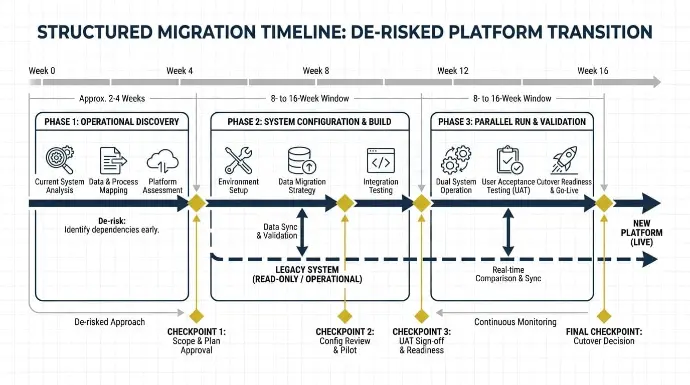
Switching platforms is a high-stakes decision. It’s not just about technology; it’s about safeguarding operations, revenue, and customer trust during transition. Many growing businesses stay on Shopify longer than they should, not because it’s still working, but because the risk of breaking things feels too high.
That risk can be managed. Migration from Shopify to Odoo isn’t a leap of faith. It’s a structured, engineering-led program built to protect what matters most.
A Realistic, Phased Migration Timeline
Most small- to mid-sized businesses can expect an 8- to 16-week migration window. This includes:
- 2 to 4 weeks for operational discovery and process mapping
- 4 to 8 weeks for system configuration, data migration, and user testing
- 2 to 4 weeks of parallel run and go-live preparation
For more complex operations, including manufacturing, B2B, or multi-company structures, timelines may extend based on scope, but the same phased logic applies.
Parallel Systems Ensure Continuity
Cudio designs migrations to minimize disruption. We run Odoo in parallel with Shopify until validation is complete, allowing your teams to:
- Process live orders in both systems
- Cross-check inventory movement and fulfillment status
- Validate customer records and financial data
- Monitor for variances without risking revenue
Only after all critical systems pass validation does the cutover proceed.
Migrating the Right Data, Not Just All the Data
We help identify which data objects must be migrated for operational continuity:
- Customers with order history and outstanding balances
- Products and variants with all active SKUs and pricing rules
- Real-time inventory levels by warehouse
- Open orders and fulfillment status
- Historical orders are required for financial reporting and customer service
We also determine what can be archived rather than carried forward, reducing noise and complexity in the new system.
Structured, Tested, and Overseen
Cudio migrations follow a clear methodology, shaped by experience in complex operational environments:
- Data validation is completed before go-live using structured testing environments
- Financial reconciliation is performed before cutover, ensuring ledger continuity
- Steering Committees provide oversight on scope, risk, and timelines at every stage
- Rollback options are always planned, just in case
Our goal is not speed at all costs. It’s to ensure stability, accuracy, and continuity.
Cudio treats ERP migration as a business-critical transformation, not a cosmetic update. We bring operational rigor, real-world planning, and deep ERP expertise to make the move predictable and safe.
Show Me What’s Holding Me Back - Book ERP Assessment
De-Risking with Structured Methodology
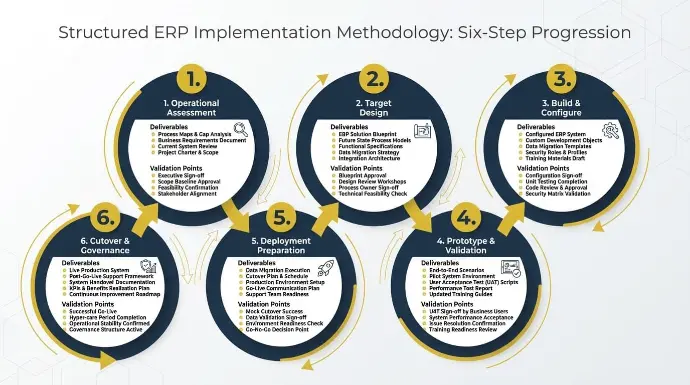
ERP migrations rarely fail because the platform is wrong. They fail when the delivery method is improvised, incomplete, or rushed. For any growing business with complex operations, structure is non-negotiable.
At Cudio, we deliver ERP implementations using a proven methodology shaped by senior operators.
This structured approach reduces risk at every step, especially for companies managing multiple warehouses, layered product management, and an expanding online business. Our focus is long-term operational stability, not short-term launch headlines.
Step 1: Operational Assessment
We start by mapping your current state. This includes how your e-commerce website, payment processing stack, and back-office tools actually function together. The goal is to expose risk areas, redundant workflows, and rising transaction fees that erode margin.
We evaluate:
- Data flows across Shopify and connected apps
- Gaps in current product management and inventory tracking
- Manual interventions and reconciliation points
- Shopify focuses that create dependencies on third-party tools
Step 2: Target Design
With a clear map of the present, we co-design the future. This involves creating a unified system blueprint that aligns operations with the ERP solution.
We define:
- Consolidated data models across inventory, CRM, and financials
- Role-based workflows that match real-world responsibilities
- A scalable Odoo website and backend structure
- SEO tools and marketing features are built into core processes
Every decision is anchored in what will work for your team on the ground.
Step 3: Prototype and Validation
Before anything is finalized, we build a working prototype. This gives your team hands-on experience with how the system will function and exposes any process misalignments early.
This phase includes:
- Real data used to simulate daily operations
- Key features comparison with legacy systems
- Feedback loops from actual users, not just project sponsors
Validation ensures the system fits your business, not the other way around.
Step 4: Test Migrations
We conduct full test migrations before go-live. No assumptions. No partial loads. We test everything in a controlled environment and audit the results.
Included here:
- Customer records, products, historical orders
- Inventory balances from multiple warehouses
- Reconciliation of financials across systems
- Validation reports are approved before progressing
This is where data integrity gets locked in, not left to chance.
Step 5: Training
Training starts early and continues through cutover. Every team receives guidance based on their tasks and workflows.
We provide:
- Department-specific training paths
- Sessions focused on daily responsibilities
- Clear documentation that supports self-sufficiency
- Change management support to ensure adoption sticks
Training is not a checkbox. It's what connects system success to business outcomes.
Step 6: Cutover and Governance
The final cutover is not a launch day scramble. It is an orchestrated handoff backed by executive governance.
Cudio leads:
- Regular Steering Committee checkpoints to confirm readiness
- Parallel run validations between systems
- Final data sign-off and rollback plans
- Post-go-live support with issue tracking and root cause reviews
Cudio migrations are engineering programs, not website redesigns. Our teams are led by former operators who understand what failure actually costs.
Show Me What’s Holding Me Back - Book ERP Assessment
Final Words
Choosing between Shopify and Odoo is not just a platform decision. It is a decision about how you want your business to operate as it grows.
Shopify makes it easy to start selling online. Odoo enables you to run inventory, accounting, manufacturing, and e-commerce in a single unified system. As complexity increases, disconnected apps and rising transaction fees can quietly limit visibility and control.
The right move depends on your growth stage, operational demands, and long-term strategy. What matters most is building an architecture that supports scale without constant reconciliation and system workarounds.
At Cudio, we help scaling and operations-heavy businesses replace fragmented stacks with structured, unified ERP environments built for long-term control and clarity.
Show Me What’s Holding Me Back - Book ERP Assessment
FAQs
Clear, direct answers to the most common questions businesses ask when evaluating Odoo vs Shopify.
Can I keep Shopify as my storefront and use Odoo as my backend?
Yes, you can keep Shopify as your e-commerce platform and use Odoo as your ERP. In this setup, Shopify focuses on online selling, professional themes, marketing features, SEO tools, and traffic analytics, while Odoo handles inventory and order management, multi-warehouse management, accounting, and other various business functions. This hybrid model works well for a growing business that wants stronger operational control without changing the storefront immediately. However, transaction fees and connector reliability must be evaluated carefully to avoid recreating complexity.
How long does a typical migration from Shopify to Odoo take?
A typical migration from Shopify to Odoo takes 8 to 16 weeks for most small- to mid-sized online businesses. This includes assessment, target design, data migration, testing, and training, especially for companies with multiple warehouses or complex operations. Larger organizations with advanced product management requirements or multi-warehouse management structures may take longer. Any promise of a very short timeline usually means that testing, financial validation, or transaction fee modeling is being rushed.
Do I need in-house developers to run Odoo effectively?
You do not always need full-time in-house developers to run Odoo effectively, but technical expertise becomes important as complexity grows. Small deployments using Odoo Online or a simple Odoo website can operate with minimal development. However, businesses with complex operations, custom product management workflows, or integration across various business functions benefit from either internal expertise or a long-term partner. Odoo is an ERP solution, not just an e-commerce software layer, so ownership and technical oversight matter.
What happens to my historical Shopify data if I move to Odoo?
Your historical Shopify data can be migrated into Odoo, including customers, orders, and core financial records. Data needed for inventory and order management, multi-warehouse management, and audit compliance is prioritized during migration. Some data from Shopify's app store integrations or marketing tools may be archived rather than fully rebuilt. A structured migration ensures your online business retains reporting continuity while reducing reliance on transaction fees and disconnected systems.
Is Odoo overkill if I’m “only” doing ecommerce today?
Odoo may be overkill if your online business is simple, has no plans for multiple warehouses, and does not anticipate complex operations. Shopify offers a strong starting point for online selling, with professional themes, marketing features, SEO tools, and built-in traffic analytics. However, if your growing business expects expansion into B2B, manufacturing, or deeper financial control, Odoo becomes a strategic ERP solution rather than just another e-commerce platform. The right choice depends on your business models, operational roadmap, and long-term cost exposur,e including transaction fees.