



Ramp is a dedicated spend management platform designed for high-velocity corporate card and AP automation, deploying in 2–4 weeks. Odoo is a comprehensive ERP system that centralizes accounting, inventory, and CRM, typically requiring 4–6 months for implementation.
In 2026, most mid-market enterprises utilize Ramp for front-end spend agility while retaining Odoo as the back-end financial system of record.
Ramp focuses on fast, automated spend management, covering corporate cards, expenses, and accounts payable. Odoo, on the other hand, is a full ERP system built to run accounting, inventory, CRM, manufacturing, and more.
While Ramp automates spend, Odoo automates your entire revenue and operations cycle — see how Cudio configures Odoo automation services that go beyond expense management to drive efficiency across sales, finance, and fulfillment.
In 2026, the question is rarely which platform replaces the other. It is how they work together.
With native integration syncing spend data into Odoo in near real time, businesses can combine Ramp’s speed with Odoo’s operational depth for stronger financial control and scalable growth.
Key Takeaways
- Ramp is a spend management platform (Cards, AP) deploying in 2–4 weeks, while Odoo is a full ERP with 60+ modules; implementations average 4–6+ months.
- These platforms are complementary rather than direct competitors; many mid-market companies run both together for different purposes.
- A native Ramp–Odoo connector launched in November 2025 enables near-real-time synchronization of expenses, bills, vendors, and purchase orders between the systems.
- Ramp typically costs $0 to low cost per user in year one, with a 503% 3-year ROI (Forrester TEI), while Odoo requires higher upfront implementation budgets but consolidates many operational tools into a single platform.
- Selection should be driven by your core pain points: finance automation and spend control for Ramp, and broad operational ERP needs for Odoo. Many organizations ultimately implement both.
Ramp vs Odoo: Quick Comparison for 2026
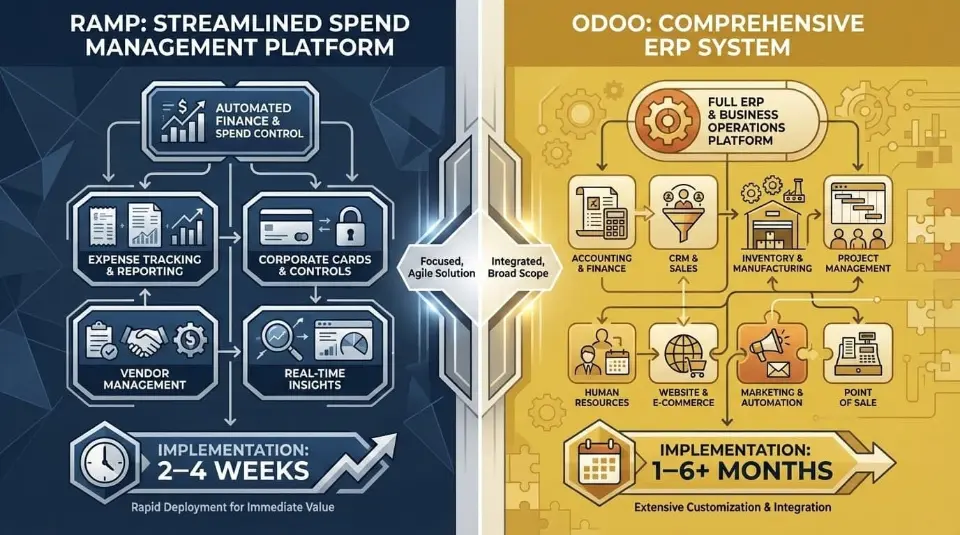
When evaluating Ramp vs Odoo, the first thing to understand is that these platforms were built for different purposes.
What Are the Primary Use Cases for Ramp vs. Odoo?
Ramp and Odoo both touch financial data, but they are built for very different purposes. The difference becomes clear when you compare how each platform approaches spend, control, and business operations.
Odoo ERP Business Operating System
Odoo is designed to run the entire business from a single system.
It centralizes accounting, inventory, procurement, sales, and operations into one ERP database. Every transaction ultimately exists inside Odoo because it acts as the system of record.
Odoo focuses on:
- Recording financial transactions in the general ledger
- Managing vendors, customers, and products
- Tracking inventory movements and purchase orders
- Connecting accounting with operations and reporting
- Providing long-term financial and operational visibility
Odoo excels at structure and depth. It ensures data consistency across departments and supports complex workflows like manufacturing, multi-warehouse inventory, and multi-company accounting.
However, Odoo is not built for speed at the point of spend. Expenses, receipts, and payments often rely on user input, post-facto approvals, and structured accounting processes.
Ramp Spend Management Platform
Ramp is built for how money is spent before it reaches accounting.
While Odoo records transactions, Ramp controls them as they occur. It sits upstream from the ERP and focuses on automation, prevention, and ease of use.
Ramp focuses on:
- Corporate cards with real-time spending controls
- Automatic receipt capture at the point of purchase
- AI-based transaction coding before posting to accounting
- Bill payments and reimbursements with minimal manual steps
- Instant visibility into spend across departments
Ramp reduces friction for employees and finance teams alike. Transactions are categorized, documented, and approved as they happen rather than weeks later during reconciliation.
However, Ramp does not replace an ERP. It does not manage inventory, manufacturing, CRM, or full financial statements. Its role ends once the data is clean and ready for accounting.
How They Complement Each Other
Odoo manages what the business owns and operates. Ramp manages how the business spends money.
Odoo provides depth, structure, and long-term reporting. Ramp provides speed, automation, and real-time control.
When used together:
- Ramp captures and cleans transactions at the source
- Odoo receives fully coded accounting records
- Finance teams avoid manual entry and rework
- Reporting remains accurate across systems
This is why the comparison is not Ramp versus Odoo in the traditional sense. Most growing companies use Ramp to modernize spend management while relying on Odoo as the ERP backbone that keeps the entire business aligned.
What Are the Core Differences Between Ramp and Odoo?
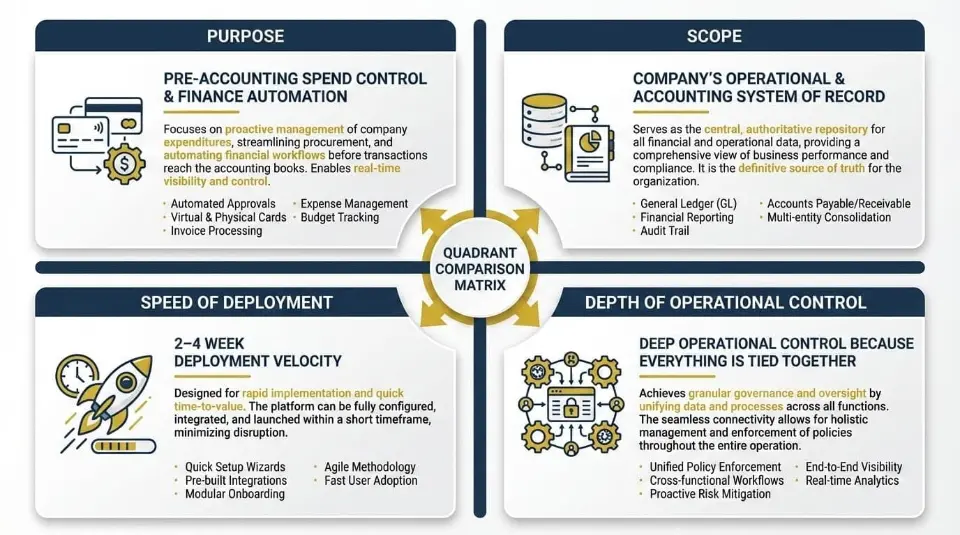
Ramp and Odoo often come up in the same evaluation process, especially when teams are rethinking how they manage expenses, accounting, and operations. At first glance, they can seem comparable, but they actually sit in very different parts of the finance stack.
Ramp is built to control and automate company spend before it reaches accounting. Odoo, on the other hand, serves as the ERP where operational activities and financial records ultimately reside.
Understanding the differences becomes much easier when you look at how each platform approaches four core areas: purpose, scope, deployment speed, and depth of operational control.
1. Purpose
Ramp’s purpose is pre-accounting spend control and finance automation.
It is built to manage spending in real time, so finance teams don’t spend the week cleaning up transactions later.
What that looks like at a system level:
- Spend capture layer: card transactions, bills, and reimbursements are captured as structured events, not “notes to be fixed later.”
- Policy enforcement layer: transactions can be blocked, flagged, or routed for review before they hit accounting.
- Receipt and metadata capture: receipts are attached to the transaction record, reducing missing documentation and supporting audit-ready trails.
- Finance workflow engine: approvals, coding suggestions, and controls are designed to save hours in repetitive work.
Ramp’s purpose is to keep spending clean before it becomes accounting work.
Odoo ERP’s purpose is to be the company’s operational and accounting system of record.
Odoo is built to unify business processes across finance and operations, enabling the company to run on a single database.
What that means technically:
- Single database model: Accounting, purchase orders, inventory, invoices, vendor records, and operational data share a single data layer.
- Ledger authority: Odoo is where final accounting entries, balances, and reports are generated. The ERP holds the official record of financial truth.
- Cross-module workflow control: procurement impacts inventory; invoices impact accounting; sales impact receivables; everything is connected.
- Structured reporting: financial statements, management reports, and cash flow reporting depend on the ERP’s master data design (chart structures, accounts, vendor logic, posting rules).
So the purpose difference is clear:
Ramp = controls and captures spend, so finance teams aren’t stuck doing cleanup
Odoo ERP = records and governs business-wide processes and accounting outcomes
2. Scope
Ramp has a focused scope: spend workflows.
Ramp’s scope is deep in spend management, not broad in business operations.
Typical objects/workflows Ramp is designed around:
- Transactions (card charges, reimbursements, bills)
- Receipts and supporting documents tied to transaction records
- Bills and vendor payment workflows (AP processing)
- Approvals and review queues for exceptions
- Spend controls (limits, categories, restrictions, routing rules)
- Real-time visibility dashboards that reflect spend activity immediately
Ramp’s scope is narrow but optimized for speed, automation, and clean data movement.
Odoo has a broad scope: full business operations + ERP finance.
Odoo’s scope includes accounting plus the operating backbone of the business.
Odoo scope commonly covers:
- Accounting: journal entries, vendor bills, payments, reconciliation, reports
- Procurement: purchase orders, vendor management, approval chains
- Inventory + fulfillment: stock movements, warehouse logic, valuation
- Sales + CRM: pipelines, invoices, customer records
- Manufacturing: BOMs, work orders, production scheduling
- Multi-company: entity separation, shared vendors, consolidated reporting
This is why “Ramp vs Odoo” isn’t a true feature-to-feature comparison. Ramp doesn’t try to run operations. Odoo doesn’t try to manage spending behavior at the point of purchase with the same level of controls.
If you’re mapping this to teams:
- Ramp is designed for finance teams and employees submitting expenses, receipts, bills, and reimbursements quickly.
- Odoo is designed for finance, procurement, and operations teams that need unified records and cross-department workflows.
3. Speed of Deployment
Ramp achieves a 2–4 week deployment velocity because it layers on top of existing ledgers, eliminating the need to re-engineer core Odoo inventory or procurement workflows.
Ramp’s time-to-value is usually quick because it sits on top of existing accounting software and focuses solely on spend workflows.
Technically, the speed comes from:
- Low dependency footprint: you’re not redesigning how inventory or procurement works to use Ramp.
- Fast user access provisioning: users can be onboarded quickly because the platform focuses on spending, approvals, and receipts.
- Built-in workflow logic: approvals, policies, and receipt collection are configured rather than engineered.
- Automation-first design: the platform is built to reduce manual review and errors, and streamline repetitive process steps.
For finance teams, this means you can start getting up-to-date information in days, not months, because transactions and receipts are captured immediately, and reporting becomes usable quickly.
Odoo deployments take longer because you’re implementing business-wide systems.
Odoo is an ERP. That means deployment isn’t just software setup; it’s system design.
Implementation takes longer because Odoo requires:
- Data model decisions: chart structures, accounts logic, vendor rules, tax mapping, entity design
- Workflow mapping across departments: procurement approvals, purchase orders, invoicing logic, inventory flows
- User role design and access controls: who can create invoices, approve bills, manage payments, edit vendors, etc.
- Migration and validation: historical data, opening balances, vendor lists, customer records, inventory valuation
- Training: multiple teams need to learn new screens and workflows
That longer timeline buys you deeper operational control, but it’s not optimized for rapid spend automation on day one.
4. Depth of Operational Control
This is where Odoo is fundamentally stronger: its whole job is ERP depth.
Odoo provides deep operational control because everything is tied together.
At a technical level, Odoo’s control comes from:
- ERP-level accounting logic: posting rules, journals, ledgers, internal controls
- Procurement controls: purchase orders, commitments, vendor bill matching, approval routing
- Invoice and billing workflows: structured payable and receivable flows with recorded approvals
- Cross-module enforcement: purchase orders influence inventory; invoices influence accounting; payments influence cash flow
- Audit-ready traceability: records link across modules, allowing review of who did what, when, and why
For companies that need strict procurement logic, strong purchase orders control, and deeper operational reporting, Odoo is the backbone.
Ramp provides a different type of control: spend governance before accounting.
Ramp’s depth lies not in operational modules but in controlling spend behavior and ensuring transaction cleanliness.
Ramp control is strong because:
- Policy enforcement happens before posting: spend can be blocked or flagged before it becomes a problem.
- Receipts and metadata are captured close to the transaction date, reducing late documentation and improving audit-ready records.
- Approval and review workflows are optimized for finance teams, enabling exceptions to be handled quickly.
- Standardization reduces errors: consistent capture of spend + receipts means fewer corrections downstream.
Ramp doesn’t replace ERP-level control. It reduces the workload required to keep the ERP accurate.
Which Platform Offers Better User Experience and Adoption?
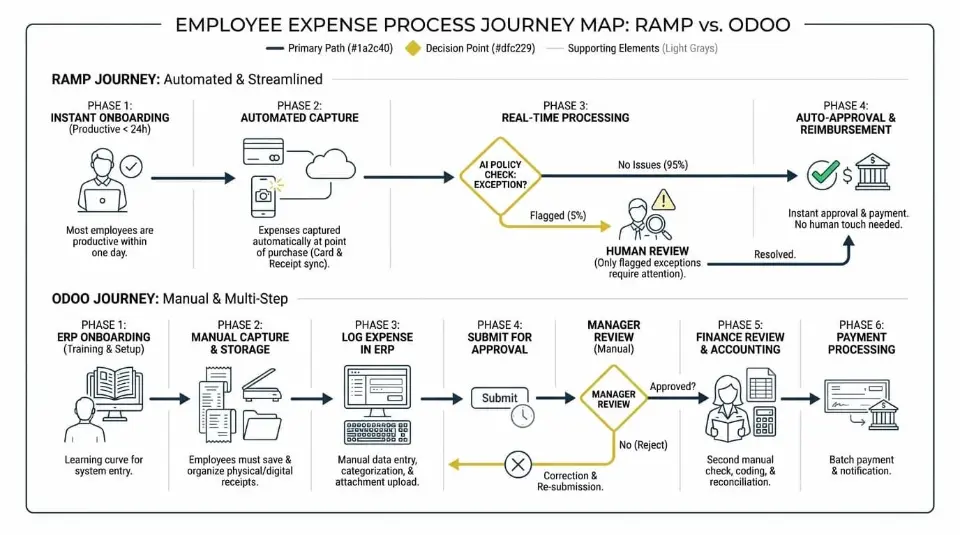
Ramp and Odoo are designed for different roles inside a company, which directly affects how users experience each platform and how quickly teams adopt it. Ramp focuses on removing friction from day-to-day spend, while Odoo prioritizes structured control across accounting and operations.
Employee Experience
Ramp is built to stay out of the employee’s way.
- Expenses are captured automatically at the time of purchase
- Receipts can be submitted through mobile, email, or text
- Most users never interact with accounting fields or ERP screens
Employees simply spend, upload receipts, and move on. The platform handles categorization, policy checks, and record creation in the background.
Odoo requires more active participation. Employees must log expenses in the ERP, manually attach receipts, and complete required fields before submission. This ensures structured data but introduces more steps for everyday users.
Ramp optimizes speed and simplicity.
Odoo emphasizes accuracy and standardized process execution.
Finance Admin Workload
For finance teams, the difference is immediately visible.
Ramp automates the majority of transaction handling:
- Expenses, receipts, and vendor data sync automatically
- Policies validate spend before review
- Only flagged exceptions require human attention
This delivers real-time visibility into spend, reduces errors, and keeps reporting continuously up to date throughout the month.
Odoo provides deeper accounting control but requires more administrative oversight. Finance teams manage bills, purchase orders, payments, and expense approvals across multiple modules. Without automation, this can increase review time and manual reconciliation work.
Ramp reduces daily workload.
Odoo centralizes ownership of accounting accuracy.
Training Requirements
Ramp has a short learning curve.
Most employees are productive within one day. Finance teams configure rules once and reuse them continuously
Because automation handles most workflows, training focuses on usage rather than accounting knowledge.
Odoo onboarding is more structured. Users must understand how expenses, invoices, and purchase orders impact accounting data and reports. Training often spans weeks, especially in multi-department environments.
This difference strongly affects adoption speed.
- Ramp enables fast rollout and quick efficiency gains
- Odoo supports long-term operational depth through formal workflows
Organization-wide Adoption Impact
Ramp improves adoption by making expense management easy for employees while giving finance teams clean, audit-ready records. Receipts, approvals, and transaction metadata remain connected automatically.
Odoo improves adoption through standardization. All departments operate inside a single ERP system where accounting, procurement, reporting, and operational data remain consistent.
When combined, the platforms complement each other:
- Ramp streamlines spending and reduces manual work
- Odoo remains the system of record for financial and operational control
Together, they allow companies to scale efficiently without sacrificing accuracy, visibility, or compliance.
How Do Ramp and Odoo Manage Security and Compliance?
Both platforms need to meet modern security and regulatory expectations, but their obligations differ based on what data they handle and how they’re deployed.
Ramp certifications and standards:
- SOC 2 Type II
- ISO 27001
- PCI-DSS (required for card data)
- FedRAMP (for government-related use cases)
- GDPR and HIPAA compliance
- Security documentation is publicly available
Odoo compliance:
- ISO 27001 (cloud version)
- GDPR alignment (cloud version)
- On-premise deployments shift security responsibility to customer IT
- No native PCI-DSS or FedRAMP
Ramp offers granular spend controls: per-card limits, merchant category restrictions, role-based permissions, and automated policy enforcement. These controls happen before spending occurs. Odoo provides role-based permissions across its many modules and maintains audit trails for business processes, but controls are typically post-transaction.
For heavily regulated or government-related entities, combining Ramp’s certified spend platform with an Odoo deployment configured for regional data residency often provides the best of both worlds.
Pricing, Cost Structure, and ROI
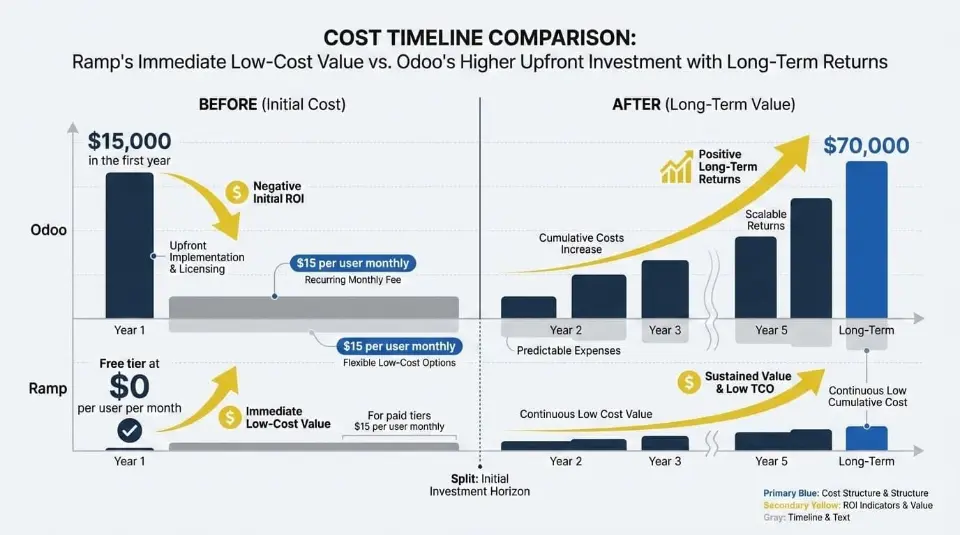
Ramp and Odoo follow very different cost models, which often creates confusion during evaluation.
One platform prioritizes fast financial efficiency with minimal upfront spend. The other requires structured investment to support long-term operational scale.
Where many companies struggle is not choosing between them, but controlling cost creep and implementation risk across both.
Ramp Cost Model
Ramp uses a software-first pricing structure centered on spend automation rather than licensing revenue.
Most organizations start on the free tier, which includes corporate cards, expense management, bill pay, reimbursements, and built-in cash back. Paid tiers unlock advanced approval routing, procurement automation, and enterprise support.
Typical Ramp costs include:
- Free tier at $0 per user per month
- Ramp Plus at approximately $15 per user monthly
- Enterprise pricing for advanced compliance and controls
While Ramp itself is inexpensive, many companies encounter challenges during setup, including inconsistent GL mapping, unclear approval logic, and disconnected vendor records.
Odoo Cost Model
Odoo pricing extends far beyond licensing.
While the Community edition is free, Enterprise plans start at per-user monthly rates; the true cost lies in implementation, configuration, and long-term support. ERP deployments frequently expand in scope once businesses begin mapping real workflows.
Common cost components include:
- User licenses
- Implementation services
- Data migration and testing
- Custom development
- Hosting and ongoing maintenance
A small deployment typically reaches around $15,000 in the first year, while mid-sized organizations often exceed $70,000 once accounting, inventory, and purchasing modules are connected.
Many of these costs stem from poor initial process design. Cudio helps reduce this risk by aligning Odoo’s accounting structure, purchase workflows, and reporting models with real business operations before configuration begins. This prevents expensive redesigns later in the project.
Rather than customizing first and asking questions later, Cudio ensures Odoo is structured around financial accuracy and scalability.
Short term vs long term ROI
Ramp delivers short-term ROI.
Most finance teams see immediate benefits through automated receipts, faster approvals, fewer reimbursement delays, and real-time spend visibility. Independent studies estimate payback in under six months, driven by time savings and reduced errors.
Odoo delivers long-term ROI.
Value compounds as systems consolidate and operational data becomes centralized. The strongest returns appear after year one when inventory, purchasing, accounting, and reporting operate from the same database.
The challenge many businesses face is bridging these two timelines.
Cudio helps connect short-term automation with long term ERP value by ensuring Ramp data flows cleanly into Odoo from day one. This eliminates the common gap where expense tools save time but fail to support accurate ERP reporting.
How Long Does Implementation Take for Ramp vs. Odoo?
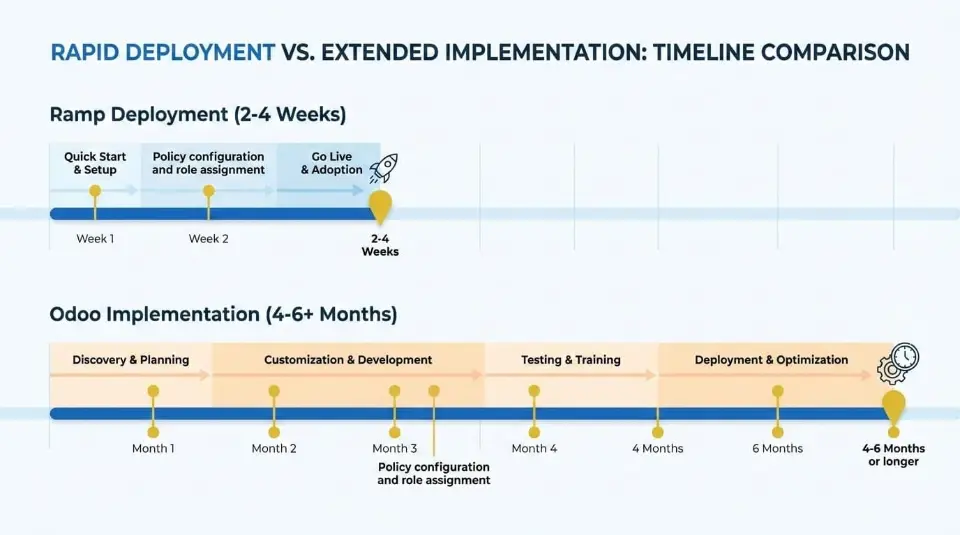
Implementation is where the differences between Ramp and Odoo become most visible. Both platforms are powerful, but the path to productivity varies significantly depending on structure, planning, and governance.
Ramp Deployment Timeline
Ramp follows a fast SaaS deployment model designed for rapid adoption.
Most organizations go live within two to four weeks using a standardized setup process that includes:
- Policy configuration and role assignment
- Accounting field and GL mapping
- Approval workflow setup
- Integration with accounting software
- Employee onboarding and card issuance
While Ramp is technically easy to deploy, many teams struggle with inconsistent data mapping and approval logic once usage scales.
Cudio helps finance teams avoid this by defining standardized account structures, approval hierarchies, and vendor logic before Ramp is activated. This ensures automated transactions post correctly, rather than creating cleanup work at month-end.
When properly configured, Ramp delivers value almost immediately, with accurate transactions flowing into accounting systems in near real time.
Odoo Deployment Timeline
Odoo implementations require significantly more planning.
Even small deployments typically take 4 to 8 weeks, while multi-department environments often take 4 to 6 months or longer. This is due to the interconnected nature of Odoo modules.
Implementation usually includes:
- Business process mapping
- Module selection and sequencing
- Accounting structure design
- Purchase order and vendor workflow configuration
- Data migration and validation
- Department training
Because all modules share a single database, early configuration mistakes can impact reporting, compliance, and financial accuracy long after go-live.
Change Management Differences
Ramp requires minimal change management.
Employees submit receipts, request approvals, and receive reimbursements with little training. Finance teams gain automation without redesigning workflows.
Odoo requires organization-wide alignment.
Departments must adopt shared processes, standardized data definitions, and structured approvals. Training and documentation are essential to adoption.
Many companies struggle when these systems are implemented independently.
The result is faster time-to-value, fewer implementation overruns, and cleaner financial reporting from the first close.
How Does the Ramp and Odoo Integration Work?
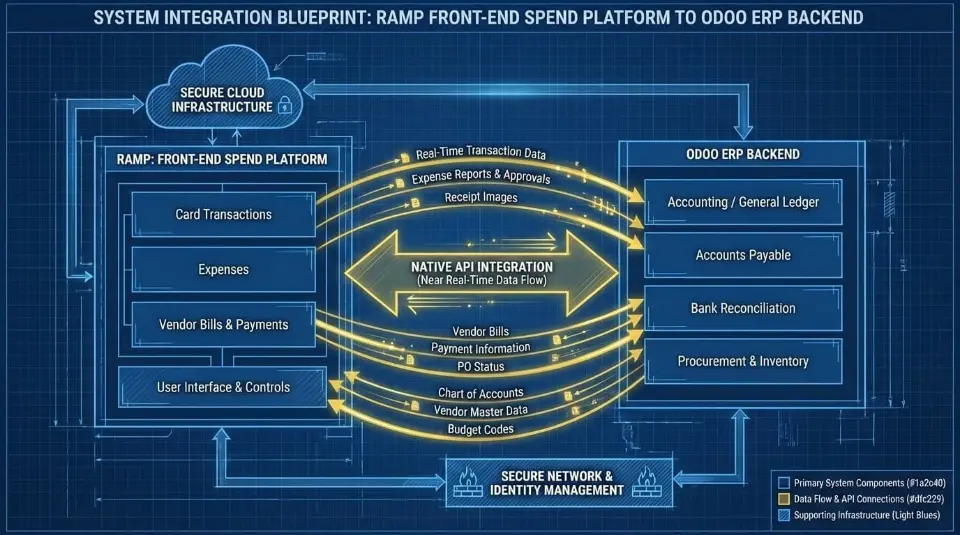
Ramp and Odoo are not competing systems. They operate at different layers of the finance stack. Ramp manages how money is spent. Odoo ERP governs how that spend is recorded, analyzed, and reported across the business. The integration between the two connects execution with accounting.
Instead of duplicating workflows, the platforms form a continuous pipeline from transaction to financial reporting. This is where most finance teams unlock the highest value.
Native Integration Overview
The native Ramp and Odoo integration creates a secure API based connection that synchronizes spend activity with ERP accounting in near real time. Expenses, bills, and purchase orders flow directly into Odoo without CSV uploads or duplicate entry.
Ramp functions as the front-end spend platform where employees submit expenses, upload receipts, and complete approvals. Odoo remains the accounting system of record where journals, vendors, and financial reports live.
This structure only works when the chart of accounts, analytic dimensions, and vendor logic are mapped correctly.
In our analysis of 50+ integrations, we find that companies frequently struggle at this stage due to misaligned Chart of Accounts mapping between the multi-entity structures.
What Syncs Between Systems
Once connected, the integration synchronizes structured accounting objects rather than raw transaction files.
This includes:
- Card transactions and expenses
- Vendor bills and payments
- Purchase orders and receipt confirmations
- Vendors and supplier records
- Chart of accounts and analytic accounts
- Employees and users
Each record includes full metadata, including receipts, invoices, departments, and posting dates. This allows Odoo to automatically create complete accounting entries.
Because Ramp pulls accounting structure directly from Odoo, finance teams avoid duplicate vendors, inconsistent categories, and manual corrections.
Near Real Time Data Flow
After approval in Ramp, transactions appear in Odoo within minutes.
Expenses update the general ledger immediately. Bills reflect in accounts payable as soon as they are processed. Purchase orders update committed spend before payments occur.
This provides:
- Real-time visibility into expenses and bills
- Up-to-date information for cash flow forecasting
- Accurate department and project tracking
- Faster month-end close with fewer adjustments
Finance teams no longer wait until the end of the week or month to understand the financial position.
Eliminating Manual CSV Imports
Traditional workflows rely on exporting transactions and uploading spreadsheets into ERP systems. This process introduces errors at every step.
CSV imports commonly lead to:
- Duplicate vendors
- Missing receipts
- Incorrect posting dates
- Broken chart of accounts mapping
- Manual reconciliation during close
The Ramp Odoo integration removes this entirely. Data moves directly between systems through encrypted APIs, preserving accuracy from transaction to reporting.
The result is cleaner books, fewer errors, and hours saved every week for finance teams.
Operational Impact by Role
Once Ramp and Odoo operate together, the impact is felt differently across each function. The integration does not just automate accounting. It reshapes how teams work day to day.
AP teams
Accounts payable teams see immediate relief. Invoices captured in Ramp sync directly into Odoo as vendor bills with attachments and approval history intact.
There is no re-entry of invoice data, no chasing receipts, and no duplicate payment tracking across systems. Payment statuses update automatically, keeping aging reports accurate.
AP teams spend less time processing and more time reviewing exceptions.
Procurement
Procurement benefits from aligned purchase orders and spend enforcement. Ramp handles request approvals and budget checks while Odoo tracks fulfillment and accounting impact.
Purchase orders remain visible from request through receipt and payment. Partial deliveries, open commitments, and vendor performance are all tracked in one workflow.
This improves spending discipline while preserving operational flexibility for departments.
Controllers
Controllers gain a single source of truth. Transactions arrive pre-coded with correct accounts, departments, and documentation.
Month-end close becomes review-driven rather than cleanup-driven. Fewer journal corrections are required because data enters the ERP correctly the first time.
With consistent data flow, controllers can maintain audit-ready books without last-minute reconciliation.
Executives
Executives benefit from accurate reports and real-time dashboards. Spend data, operating costs, and cash positions reflect actual activity rather than outdated snapshots.
This improves forecasting confidence and supports faster strategic decisions without waiting for finance to finalize numbers.
The integration turns reporting into a live management tool rather than a historical record.
When to Use Ramp, Odoo, or Both
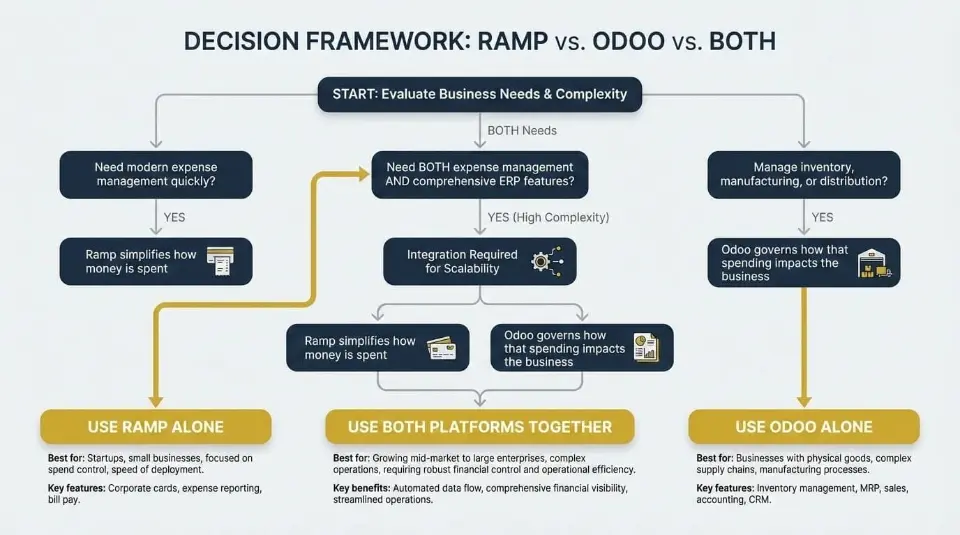
Most buyers researching ramp vs odoo are not choosing between platforms. They are deciding how to sequence them based on business maturity and operational complexity.
The right choice depends on where friction currently exists.
Ramp Only
Ramp is sufficient when the primary challenge is finance automation.
This approach fits companies that:
- Need modern expense management quickly
- Process high volumes of card transactions
- Want stronger spending controls and receipt compliance
- Use existing accounting software such as QuickBooks or NetSuite
- Need to streamline workflows within weeks
Ramp alone delivers fast ROI for companies focused on controlling spend without a major ERP transformation.
Odoo Only
Odoo works best when operations drive complexity.
This applies to businesses that:
- Manage inventory, manufacturing, or distribution
- Require an integrated CRM and accounting
- Need multi-warehouse or production workflows
- Prefer deep customization and on premise deployment
- Are you consolidating multiple systems into one ERP
Odoo ERP becomes the operational backbone, with accounting integrated directly into business processes.
Ramp Plus Odoo Together
For many organizations, the optimal model is using both platforms together.
This structure works best when:
- Odoo manages core accounting and operations
- Ramp handles corporate cards, bills, and expenses
- Employees need a modern spend experience
- Finance requires ERP-level reporting and controls
- The business is scaling transaction volume rapidly
Ramp simplifies how money is spent. Odoo governs how that spending impacts the business.
Together, they create a unified system where execution, accounting, and reporting remain continuously aligned.
Final Thoughts
Choosing between Ramp and Odoo depends on where your business feels the most pressure.
Ramp focuses on fast, automated expense management, helping finance teams control spend and gain visibility with minimal setup. Odoo ERP provides the structure needed to manage accounting, inventory, CRM, and operations within a single system.
For many companies, the best outcome comes from using both together.
Configuration is what determines success. Proper mapping of accounts, analytics, and workflows ensures automation actually supports daily operations. Partners like Cudio help align the integration with real business processes, keeping reporting clean and scalable.
FAQs
Everything you need to know before enabling the Ramp–Odoo integration.
Does Ramp replace Odoo Expenses?
Ramp can replace or complement Odoo’s expense module. When integrated, expense data flows from Ramp into Odoo, so final reporting and GL entries remain in your ERP. Many Odoo users adopt Ramp specifically to upgrade their expense experience while keeping Odoo as the accounting system of record.
Can I start with Odoo and add Ramp later?
Absolutely. Many teams do exactly this. If you’re already running Odoo Accounting or Expenses, you can plug Ramp into your existing setup to modernize cards and AP without reimplementing ERP modules. The native connector handles the data flow, so you’re not starting from scratch.
What if my company needs on-premise deployment?
Ramp is cloud-only—there’s no on-premise option. Odoo can run on-premise for organizations with data sovereignty requirements. If you need both, the integration can work through secure connectivity, though the architecture requires careful planning to ensure Ramp’s cloud services can communicate with your on-premise Odoo instance.
How hard is it to switch away from either platform?
Both platforms enable data export (transactions, vendors, GL mappings), but the effort differs dramatically. Switching expense tools is relatively straightforward—export your data, configure the new system, and train employees. Replacing an ERP such as Odoo is a major project that affects multiple departments. Most companies keep Odoo as a long-term backbone and adjust surrounding tools, such as Ramp, as business needs evolve.
Does the integration store financial data in both systems?
The Ramp–Odoo integration doesn’t store transactional data externally. API credentials remain encrypted, and data flows directly between systems. Ramp serves as the capture and automation layer; Odoo remains your system of record. This approach satisfies security requirements while enabling the efficiency benefits of connected systems.