SAP ECC supports about 35,000 organizations globally but will lose standard maintenance on December 31, 2027. For many mid-market manufacturers, distributors, and operationally complex businesses, the decision window is closing faster than migration timelines allow.
Odoo has emerged as a serious contender. No longer just a budget option for small businesses, mid-market operators now consider it alongside SAP S/4HANA as a viable path forward.
At Cudio, we've implemented Odoo for companies transitioning from SAP ECC. We've seen firsthand what works, what doesn't, and how the fit depends on specific business needs.
This comparison covers total cost of ownership, deployment flexibility, integration depth, customization, and operational continuity on each platform. As Odoo specialists, we’ll be candid about where Odoo fits—and where it doesn’t.
Key Takeaways
- SAP ECC loses standard maintenance on December 31, 2027, after which SAP stops issuing security patches, legal updates, and compliance fixes
- As of the end of 2024, only 39% of SAP's 35,000 ECC customers had purchased S/4HANA transition licenses, and Gartner projects 17,000 holdouts by 2027
- SAP ECC and Odoo are built for fundamentally different business profiles. Fit depends on operational complexity and compliance obligations, not company size alone
- Mid-market companies typically save $1M to $5.5M over five years by switching from SAP to Odoo
- The data migration from SAP ECC to Odoo is technically complex. Field mapping, data cleansing, and validation routinely take longer than initial plans allow
- The businesses that land well in this transition make it a fit decision first and a timeline decision second
SAP ECC vs Odoo at a Glance
The table below puts the most decision-critical differences side by side. These are the dimensions that matter most at this stage of evaluation.
Dimension | SAP ECC | Odoo |
Deployment Model | On-premise (primary) | Cloud, on-premise, or hybrid |
Licensing Model | Perpetual license plus maintenance fees | Subscription-based, per user |
Total Cost of Ownership | High upfront, significant ongoing IT overhead | Lower entry cost, scales with usage |
Customization Approach | ABAP development, partner-dependent | Modular architecture, Python-based extensions |
Integration Ecosystem | Broad but complex, SAP-centric middleware required | Open API, flexible third-party connectivity |
End-of-Support Status | Mainstream support ends December 31, 2027 | Actively developed, current release cycle |
Best-Fit Company Size | Large enterprise (1,000+ employees) | SMB to mid-market (10 to 500 employees) |
The table reflects a fundamental difference in design philosophy. SAP ECC was built for large, complex enterprises willing to invest heavily in infrastructure and customization. Odoo was built to scale incrementally for businesses that need flexibility without that overhead.
Talk to Us About Your ERP Decision
SAP ECC's 2027 Deadline: What It Actually Means
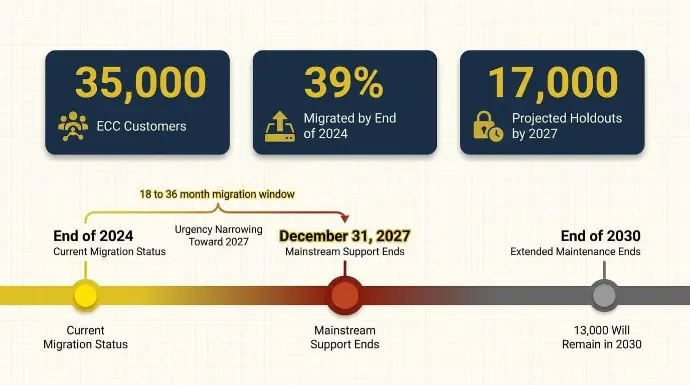
SAP has officially confirmed that mainstream support for SAP ECC 6.0 and SAP Business Suite 7 will end on December 31, 2027, with optional extended maintenance available until the end of 2030. Extended maintenance comes at an estimated additional cost of approximately two percentage points, roughly a 9% cost increase, through December 31, 2030.
The platform's being wound down. SAP's endorsed path forward is migration to SAP S/4HANA, though that's not the only viable option for businesses evaluating their next move.
The Scale of the Problem
At the end of 2024, only 39%, about 14,000, of the 35,000 SAP ECC customers had migrated to S/4HANA.
At the current rate, Gartner projects that there will still be 17,000 holdouts, or nearly half of the ECC customer base, by 2027. More than a third of ECC customers, 13,000, will remain with the legacy ERP in 2030.
This isn't a niche problem. According to IDC, between 40% and 45% of organizations will still be running ECC through 2027. Most of them haven't finalized their migration plans.
The Security and Compliance Risk
Once ECC moves past its support window, the operational consequences are specific and serious. Here's what staying on unsupported ECC past 2027 actually means:
- SAP ceases to issue patches and corrections, leaving known vulnerabilities unaddressed as threat landscapes evolve
- No regulatory compliance updates, meaning tax law changes and industry mandates won't be reflected in the software
- Companies running ECC EHP 0 through 5 are already in Customer Specific Maintenance, which means no regular support, no legal updates, and only limited security updates
- Escalating support costs as internal teams or third-party providers carry the maintenance burden SAP no longer covers
- Vendor lock-in risk increases as the ABAP talent pool shrinks over time
The Planning Window Is Compressing
Migrations take 18 to 36 months on average, and by late 2026, demand for SAP talent, hyperscaler capacity, and migration partners will surge.
Those who wait risk rushed projects, inflated costs, and reduced leverage with SAP. Starting evaluation now isn't cautious. Waiting until 2026 is a constraint.
A Genuine Look at Both Platforms
Evaluating SAP ECC and Odoo honestly means looking past the marketing positioning of both.
These aren't just two versions of the same thing. They're built on fundamentally different assumptions about who's buying, how they deploy, and what they're willing to spend.
Total Cost of Ownership
SAP ECC carries a high upfront cost profile. SAP S/4HANA implementations often require a significant investment, with projects typically ranging from $150,000 to over $1 million and timelines stretching from 12 to 24 months, while licensing usually falls between $3,200 and $7,500 per user per year.
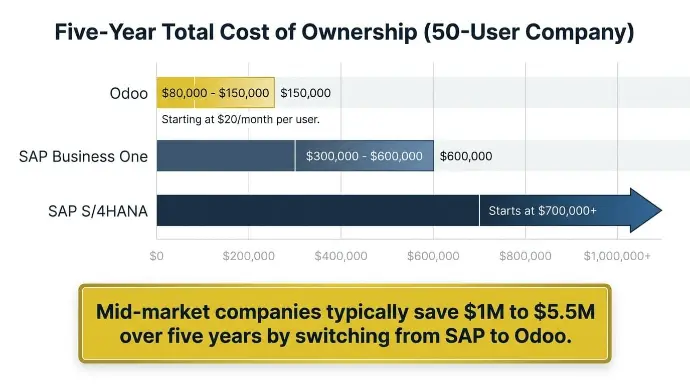
Odoo's cost structure is fundamentally different, with subscriptions starting at $20/month per user.
For a 50-user company, a conservative five-year TCO for Odoo (covering licensing, implementation, annual support, and ongoing maintenance) runs $80,000 to $150,000, making it a cost-effective solution for smaller businesses and teams with limited resources. The equivalent SAP Business One TCO is $300,000 to $600,000, and SAP S/4HANA starts at $700,000.
Mid-market companies typically save $1M to $5.5M over five years by migrating from SAP to Odoo. Odoo's current pricing and module structure reflect a per-user subscription model that supports cost-efficiency. Odoo also offers a free Community edition for additional savings. Its modular pricing lets businesses pay only for the features they need.
Deployment Flexibility
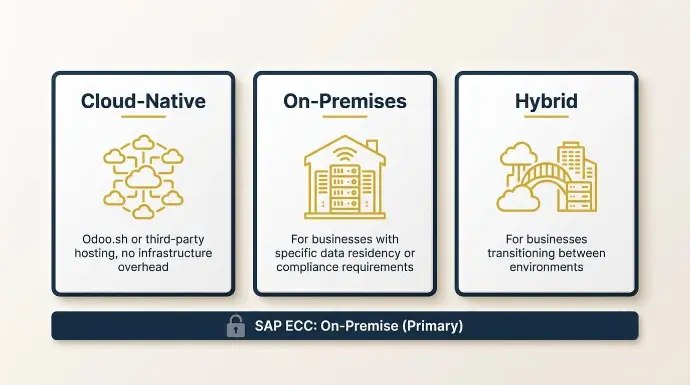
SAP ECC is one of the more resource-intensive ERP systems because its on-premises infrastructure needs make hardware, maintenance, and internal IT capacity built-in costs. Odoo gives you three deployment paths, a flexibility that supports future growth without locking teams into one hosting model:
- Cloud-native (Odoo.sh or third-party hosting): available out of the box, no infrastructure overhead
- On-premises: for businesses with specific data residency or compliance requirements
- Hybrid: for businesses transitioning between environments
That flexibility gap compounds as organizations grow and infrastructure needs shift.
Integration Capabilities: Odoo vs SAP and API Architecture
SAP ECC's integration ecosystem is mature.
It connects to a wide range of enterprise systems, but those connections often rely on certified partners and middleware layers. That depth comes with complexity and lead time.
Odoo was built API-first. Integrations with third party tools can be built faster with a broader developer pool. We connect our clients' Odoo environments to Rithum for multi-marketplace e-commerce across 420+ channels, Avalara for automated multi-jurisdiction tax compliance, and Crossfire for fully managed EDI and supply chain data exchange.
One caveat worth flagging: Odoo's ecosystem includes a large library of OCA modules maintained by the Odoo Community Association. They extend functionality significantly, but governance varies. If you're relying heavily on OCA modules, you'll want a clear strategy for version compatibility before you deploy them, and to keep that aligned with your broader erp strategy.
Customization: ABAP vs Python
SAP ECC customization uses ABAP, a proprietary language powerful within SAP but reliant on a shrinking, costly talent pool. In contrast, Odoo’s open-source Python-based customization taps a broader developer base, enabling faster builds, more options, and lower talent costs.
Cudio’s developers bring over 14 years of experience in Odoo customization and development using Python, PostgreSQL, and RESTful APIs. This allows us to build exactly what a business needs without the vendor lock-in ABAP creates. Our approach favors configuration first, customizing only when necessary, minimizing technical debt and keeping upgrade costs manageable.
What Odoo Gets Right and Where It Can Work Against You
Odoo ERP's reputation as a flexible, cost-effective solution for businesses that need flexibility is well-earned.
Its open-source model provides a comprehensive suite with modular design, while Python-based customization gives businesses genuine options that SAP ECC simply doesn't offer at comparable cost.
For mid-market operators, Odoo's user friendly approach supports faster staff adoption and stronger operational efficiency than a platform as infrastructure-heavy as SAP ECC.
The Governance Risk Behind Odoo's Flexibility
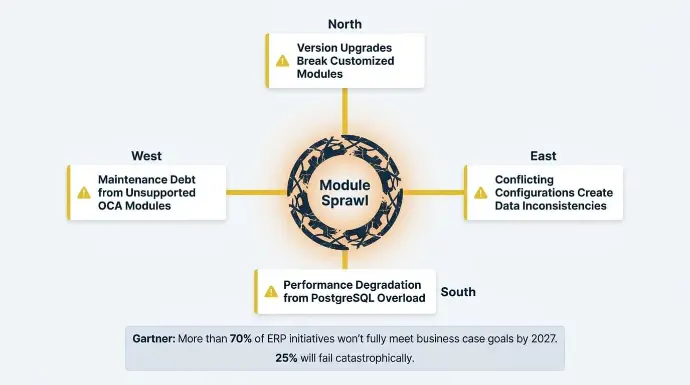
Here's the honest part: The flexibility that makes Odoo appealing is also where implementations quietly break down. Businesses install modules faster than they can govern them. Without disciplined internal governance or a capable implementation partner, module sprawl becomes a compounding problem. The operational symptoms are recognizable:
- Version upgrades that break customized modules, stalling the entire update cycle
- Conflicting configurations between modules are creating data inconsistencies across departments
- Performance degradation as unmanaged modules add to the PostgreSQL database load
- Maintenance debt is accumulating when OCA modules fall out of active community support
Gartner projects that by 2027, more than 70% of recently implemented ERP initiatives won't fully meet their original business case goals, and as many as 25% will fail catastrophically. That statistic doesn't apply to well-governed Odoo implementations. It describes what happens when ERP is treated as a technology project rather than an operational transformation.
We've built our rescue practice around the 35 environments we've been brought in to fix after governance failures. None of those failures was Odoo's fault. They were predictable and preventable.
Assess Your Migration Fit With Our Team
Where Odoo's Ceiling Is Real
Odoo scales well for smaller businesses and medium sized businesses, but its ceiling should still be pressure-tested for very large organizations.
For extremely large, multi-entity enterprises with complex compliance requirements embedded in years of SAP-specific configuration, the ceiling considerations are real and worth pressure-testing before you commit, since SAP remains stronger for global operations and large scale operations with deeply embedded complexity.
When Migrating from SAP ECC to Odoo Makes Sense
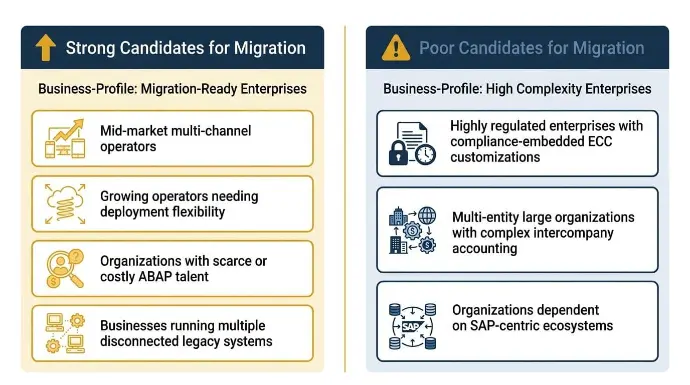
The 2027 deadline creates real urgency. It shouldn't create bad decisions. Not every business running SAP ECC belongs on Odoo, and the fit question matters more than the timeline pressure.
Strong Candidates for ECC-to-Odoo Migration
The following business profiles tend to be strong fits:
- Mid-market operators with multi-channel operations who do not need SAP's enterprise-grade complexity
- Growing operators that need deployment flexibility without committing to on-premises infrastructure, especially when Odoo supports multi-company and multi-location setups
- Organizations where ABAP talent is scarce, cost-prohibitive, or not worth maintaining for the level of customization actually in use
- Businesses running multiple disconnected legacy systems that Odoo can consolidate into a single environment to streamline operations and reduce data silos
Case Study: Almac Imports
Almac Imports came to us running 10 separate software platforms across a multi-lingual, multi-currency global distribution operation. We replaced all 10 with a single Odoo deployment, configuring native multi-currency and multi-lingual modules and building automated distribution and replenishment logic on standard Odoo inventory and purchasing workflows.
Results:
- 40% increase in sales with no additional customer service headcount through automation
- Estimated 60% annual reduction in software costs
- 24-hour delivery SLA achieved
- Dedicated on-site IT professional no longer required
Case Study: R&W Rope
R&W Rope came to us running three separate platforms with no unified reporting, manual invoicing, and 40 to 60 hours of administrative overhead every week. We rebuilt their e-commerce site on Odoo's native modules and implemented inventory, manufacturing, purchasing, sales, and accounting in a single environment.
Results:
- Over $35,000 in annual software cost savings
- 40 to 60 hours of weekly administrative work is fully automated
- Real-time data visibility across all sales channels
Read More Client Success Stories
Poor Candidates for ECC-to-Odoo Migration
The following profiles are generally a poor fit:
- Highly regulated enterprises where compliance reporting is deeply embedded in ECC customizations that would need rebuilding from scratch
- Multi-entity large organizations and global corporations with complex organizational structures, complex intercompany accounting and years of SAP-specific configuration, where SAP is often the safer fit and switching costs exceed the benefits
- Organizations whose operational continuity depends on SAP-centric ecosystems, integrations and adjacent SAP products that would require significant re-engineering outside the SAP ecosystem
The Data Migration Reality
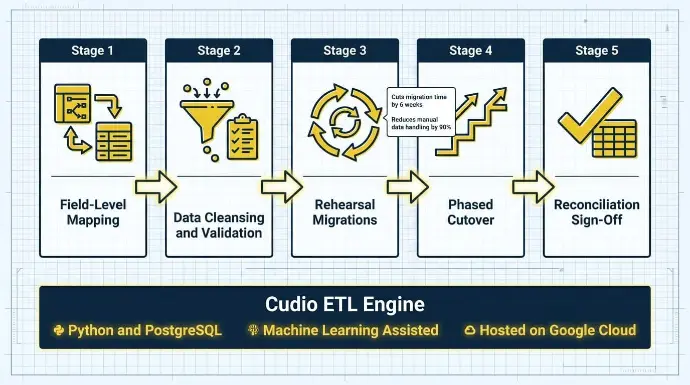
SAP ECC and Odoo use fundamentally different data models. Field mapping, data cleansing, and validation between them aren't optional steps. They're the work. Anyone describing this migration as straightforward hasn't done it at scale.
What the Migration Actually Involves
Here's what consistently surfaces in SAP ECC to Odoo migrations, especially since SAP ECC is designed for high transaction volumes, which is one reason its data model differs so much from Odoo's:
- Master data mismatches between SAP's data model and Odoo's PostgreSQL schema, requiring field-level transformation, not simple export and import
- Open transaction handling at cutover: mid-flight purchase orders, open invoices, and in-progress manufacturing orders all need a defined strategy before go-live, particularly in inventory management and production planning
- Historical data decisions: how much transactional history migrates, and in what form, have direct implications for reporting continuity and audit readiness
- Multi-currency and multi-entity structures require careful mapping to Odoo's chart of accounts and intercompany transaction logic
The Horváth study of 200 SAP user companies found projects running 30% longer than planned, only 8% finishing on schedule, and more than 60% exceeding budget. Those numbers reflect what happens when migration is treated as a technical project rather than a risk management exercise.
How We Handle Migration at Cudio
We use a proprietary ETL engine built on Python and PostgreSQL, powered by machine learning, and hosted on Google Cloud for every migration engagement. It cuts average migration time by six weeks compared to manual approaches and reduces manual data handling by 90%. Multiple rehearsal migrations run before the final cutover. Nothing goes live until reconciliation reports confirm data integrity across every module.
Phased cutover strategies protect order flow and reporting continuity during the transition. We run parallel systems briefly before full cutover to catch data integrity issues before they become operational problems.
How We Help Businesses Make This Call
We built Cudio after scaling our own omnichannel business on Odoo, consolidating what had been 14 separate systems into one. We've hit every implementation wall our clients now describe to us, which is why we give an honest answer on fit rather than a platform-driven one.
When a business comes to us weighing SAP ECC against Odoo, the first question we ask isn't which platform is better. It's whether Odoo is actually the right fit given the client's operational structure, compliance obligations, and growth trajectory. If it isn't, we say so directly.
Our Approach to This Transition
For businesses that have made the decision to migrate, our Odoo migration service provides a structured path from planning through go-live. Every engagement includes:
- A 140-point diagnostic that maps business processes and business requirements before a single line of configuration is written
- Fixed-fee pricing with no surprise invoices after go-live
- Dedicated post-launch support through our 30/60/90-day hypercare model, helping protect ERP value after go-live
- Integration setup across Rithum, Avalara, and Crossfire, where applicable
Explore Our Odoo Migration Service
Which Platform Fits Where Your Business Is Headed
The following framework helps businesses in active evaluation match ERP solutions to current business needs and future growth.
If Your Business Looks Like This | The Better Path Is Likely |
Mid-market manufacturer or distributor, 50 to 500 employees, multi-channel operations, growth-driven infrastructure needs | Odoo via a structured migration engagement |
Large enterprise, 1,000+ employees, deeply embedded SAP configuration, multi-entity compliance requirements | SAP S/4HANA migration within the SAP ecosystem |
Mid-market business running 5+ disconnected legacy systems, high admin overhead, limited IT team and limited resources | Odoo consolidation with a phased implementation |
Highly regulated business where ECC compliance logic is core to operations | Evaluate S/4HANA before committing to an alternative |
Growing business where ABAP talent is expensive or scarce | Odoo with Python-based customization where needed |
Conclusion
SAP ECC and Odoo are different enterprise resource planning platforms built for different businesses at different stages, and the 2027 deadline does not change that.
Urgency is not a fit assessment. If you are a mid-market manufacturer, distributor, or multi-channel operator spending more than you should on aging infrastructure and ABAP talent, Odoo offers a more user-friendly, cost effective solution for the right business.
If you are a highly regulated, multi-entity enterprise with complex business requirements and years of SAP-specific configuration baked into your operations, the honest answer might be S/4HANA. The window to plan this properly is closing.
At Cudio, we've lived this decision from the operator side before we ever advised anyone else through it. We scaled our own omnichannel business on Odoo and built our practice around giving honest answers rather than platform-driven ones. That's not a marketing line; it's why businesses trust us with decisions this size.
Get My Free ERP Fit Assessment
Frequently Asked Questions
The questions below reflect what businesses most commonly ask when they're evaluating SAP ECC and Odoo as part of an active migration decision.
Can Odoo replace SAP for large enterprises?
In some cases, yes. Odoo has matured significantly and can work for some large organizations, but it is typically a more natural fit for medium sized businesses than the biggest enterprises. However, large enterprises with deeply embedded SAP ECC configurations and multi-entity compliance requirements, especially across global operations, will find Odoo's ceiling considerations real. Gartner predicts more than 70% of recently implemented ERP initiatives won't fully meet their original business goals by 2027, which underscores why fit assessment matters more than platform preference. We'll tell you directly if we think Odoo isn't the right fit for your situation.
What is replacing SAP ECC as the go-to enterprise ERP?
SAP S/4HANA is SAP's official successor, with advanced features such as real time analytics and advanced analytics, and the endorsed migration path for existing SAP customers. Migration can be done via a brownfield approach (technical conversion of the existing system), a greenfield approach (a fresh implementation), or a bluefield approach (a selective data transition), with these enhanced capabilities forming part of SAP's modernization path. Mid-market businesses are also evaluating Odoo where SAP S/4HANA's cost and complexity exceed what their operations actually require. Both are legitimate paths. The question is which fits the business's actual operational profile.
How long does a SAP ECC to Odoo migration take?
Odoo can often be implemented in weeks, while SAP usually takes 6 to 18 months, though full migrations may still take longer depending on scope. The specific timeline depends on data volume, the complexity of SAP-specific configurations, integration requirements, master data quality, and project management discipline. Our ETL engine, built on Python and PostgreSQL with machine learning-assisted field mapping and hosted on Google Cloud, cuts average migration time by six weeks compared to manual approaches. View Odoo's official documentation for technical context on Odoo's data architecture.
Is the data migration from SAP ECC to Odoo complicated?
Yes, and anyone who tells you otherwise hasn't done it at scale. SAP ECC and Odoo use fundamentally different data models. Field mapping, data cleansing, and validation require structured ETL work, rehearsal migrations, and reconciliation sign-off before cutover. A Horváth study of 200 SAP migration projects found only 8% finishing on schedule, with more than 60% exceeding budget. The complexity scales with transaction history volume, entity count, and the depth of SAP-specific customizations that need redesigning in Odoo.
What happens to my SAP ECC data after the 2027 deadline?
After December 31, 2027, organizations that don't opt into extended maintenance are placed into customer-specific maintenance, which introduces significant operational and compliance risk for businesses running ECC to support core functions such as finance, logistics, and human resources. After 2030, SAP's standard on-premises support for ECC ends completely. Getting data out cleanly before the support window closes is the right time to do it. Review Odoo's current release notes to understand what migrating to the current Odoo version would involve, since unsupported systems can also weaken protection for sensitive data.
Where can I evaluate Odoo's full module library?
Odoo's official pricing and module overview is the most accurate and current reference for understanding what's available in Community versus Enterprise editions and how modules are priced. Odoo's module library reflects its comprehensive suite of business apps and includes options that can support niche industries when properly scoped. We'd recommend reviewing it alongside a conversation with our team, since the right module selection depends heavily on operational structure, integration requirements, and resource allocation decisions during implementation.