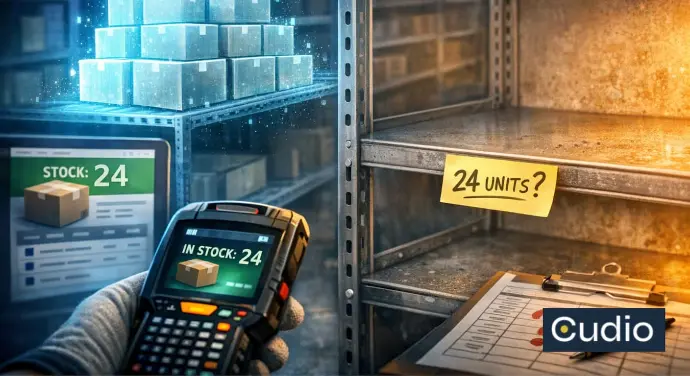
Ghost stock, or phantom inventory, is a systemic discrepancy where an inventory management system reports units as available, but the physical items are missing from the warehouse shelf.
This data failure inflates financial forecasts, triggers artificial stockouts, and directly disrupts omnichannel fulfillment.
The order comes in.
The picker walks to the bin.
It’s empty.
Because fragmented data silos obscure the point of failure, order discrepancies trigger a cascade of internal blame—from receiving docks to ecommerce teams—while expedited freight costs simultaneously crush operational profit margins.
Finance starts questioning why expedited freight keeps crushing margins. Customer service sends another apology email.
If you’re a founder, COO, or operations leader, this isn't a small inventory discrepancy. It feels like a loss of control.
Ghost stock quietly drains cash. Ghost stock silently drains working capital by actively inflating demand forecasts with non-existent units, which subsequently triggers artificial stockouts that drive high-intent customers directly to competitors. And because your reports still show available, the problem hides in plain sight.
Based on Cudio's 2025 proprietary system audits of 150+ omnichannel brands and manufacturers, we have documented that 85% of phantom inventory stems from legacy systems architecture failures (like one-way API syncs), not human warehouse error.
Book My Free ERP Impact Assessment with Cudio
This guide explores the architectural failures behind phantom inventory, including:
- Why does ghost stock occur and drain working capital?
- What are the structural causes behind persistent data mismatch?
- Why do traditional cycle counts fail to solve root issues?
- How does a double-entry inventory model eliminate data gaps?
If your team is constantly reconciling numbers that should already match, this is where you start.
Key Takeaways
- Ghost stock is more expensive than it looks. Ghost stock and phantom inventory typically cost retailers 1 to 3 percent of annual revenue and account for up to 8 percent of total inventory losses. With 78 percent of U.S. shoppers experiencing out-of-stocks in the last 12 months, ghost inventory is directly driving lost sales and damaging on-shelf availability in ways most inventory data never clearly shows.
- Phantom inventory is an architecture issue, not a people issue. When inventory records live across disconnected systems, spreadsheets, and manual data entry points, ghost stock becomes inevitable. Inconsistent inventory levels, fragmented inventory management, and poor synchronization across supply chain management tools create ghost inventory inside your entire inventory management system.
- The fix is structural, not cosmetic. Odoo’s double-entry model records every stock movement from one location to another, protecting inventory records and preventing phantom inventory from silently distorting inventory levels. Disappearing stock becomes visible and traceable instead of buried in mismatched inventory data.
- Solving the ghost stock problem requires a phased approach. Diagnose where ghost inventory originates, centralize inventory management under a single source of truth, then strengthen controls with barcodes, RFID, and disciplined cycle counting to protect on-shelf availability and eliminate preventable lost sales.
What Is Ghost Stock and Why Does It Keep Blindsiding Your Team
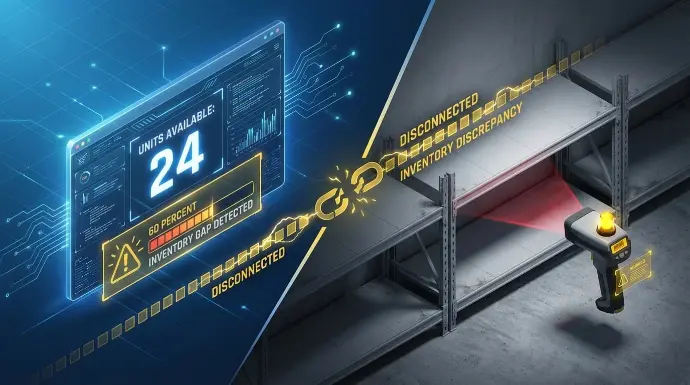
Ghost stock, also called phantom inventory or ghost inventory, refers to units that exist in your inventory records but do not exist in your physical inventory. The opposite scenario is just as damaging: a product sitting on a shelf that your system cannot see, blocking replenishment and distorting inventory levels.
This is not rare.
- Average inventory accuracy across retailers hovers around 60 percent
- Phantom inventory accounts for roughly 8 percent of total inventory losses
- Retailers lose 1 to 3 percent of annual revenue directly to ghost stock
But the real damage is not just shrinkage. It is lost sales and declining on-shelf availability.
Recent research shows that 78 percent of U.S. shoppers experienced out-of-stocks in the past year. Up to 80 percent of those stockouts are tied to phantom inventory rather than true supply shortages. Customers see “In Stock,” complete the purchase, then receive a cancellation email. Or they drive to pick up an order that is not actually there. Nearly three-quarters say experiences like this reduce loyalty.
Ghost stock blindsides teams because the inventory management system appears healthy. Reports reconcile. Inventory data looks balanced. Yet the physical reality does not match the digital record.
When inventory records and physical stock diverge, your entire inventory management system becomes unreliable. Forecasting weakens. Replenishment misfires. Supply chain management decisions get made on distorted data.
And the most dangerous part is this: the system does not warn you. It simply lets the gap widen until a customer finds it first.
The True Causes of Ghost Stock: Beyond “People Make Mistakes”
In our experience working with growing ecommerce, retail, and distribution businesses, ghost stock is rarely caused by one careless action. It is the predictable result of weak inventory management architecture.
If your systems allow inventory levels to be edited without controlled transactions, if multiple tools hold their own inventory records, or if stock movements are not enforced in real time, phantom inventory will appear. Not occasionally. Consistently.
The issue is structural.
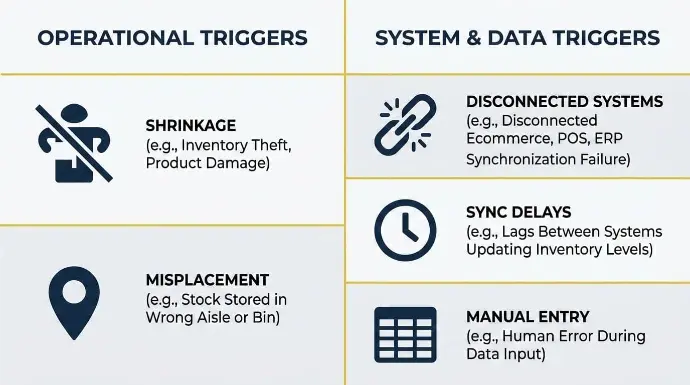
Operational Triggers
Operational triggers are the physical breakdowns that create discrepancies between what your warehouse holds and what your system believes.
Shrinkage
Shrinkage includes theft, internal loss, administrative errors, and unrecorded damage. Retail shrinkage in the U.S. has reached over $112 billion annually, according to the National Retail Federation’s Retail Security Survey.
The real ghost stock problem occurs when shrinkage is not logged immediately. If 10 units are stolen but remain marked as available in your system, your inventory records are already wrong. Every order placed against those units becomes a future fulfillment failure.
Misplacement
Misplacement is one of the most common causes of ghost inventory.
A pallet sits in inbound staging rather than in bulk storage. A case gets shelved in the wrong aisle. Returns are placed on a temporary rack and forgotten.
Your system shows inventory levels for Location A, but the product is physically in Location B. The result is identical to a stockout. Pickers cannot find the item. Orders fail. Customers receive cancellation emails.
Unlogged Damage
Damaged or expired goods often sit in bins because no one has formally moved them to a non-sellable location.
If the product remains marked as available, your system continues selling it. This artificially inflates shelf availability and creates phantom inventory that will never ship.
Weak Receiving Discipline
Receiving is where many ghost stock issues begin.
Goods arrive late Thursday, and the team stacks pallets and plans to enter quantities on Monday morning. Meanwhile, weekend orders ship against inventory that technically does not exist in the system.
Inventory data becomes misaligned before the product even reaches the shelf.
Process Gaps
What happens when a picker cannot find stock?
If there is no required system action, no documented move to an adjustment location, and no immediate escalation, the discrepancy remains hidden.
Process gaps allow ghost stock to persist quietly.
System & Data Triggers
Operational issues are visible. System issues are more dangerous because they are invisible until customers complain.
Disconnected Ecommerce, POS, and ERP
Selling across Shopify, Amazon, POS systems, and B2B portals without real-time integration guarantees inventory divergence.
Each platform maintains its own version of inventory levels. A sale on one channel may take minutes or hours to reflect in another. During promotions, this creates oversells and phantom inventory.
Sync Delays
Even with integrations, batch updates every 15 or 30 minutes create risk.
High velocity SKUs can sell out in minutes. Lag between systems turns accurate inventory into ghost inventory almost instantly.
Manual Data Entry
Manual data entry introduces delay and human error.
Goods receipts are entered at the end of the shift. Numbers copied from spreadsheets into ERP. Digits transposed.
Even in well‑run operations, manual data entry and barcode environments often cap at 65–75% accuracy without enforced validation, contributing to phantom inventory.
Shadow Spreadsheets
Excel files used for trade shows, wholesale orders, or special promotions often operate outside the main system. If those quantities are not reconciled in real time, you now have multiple inventory records competing for truth.
Multiple Inventory Records
When ecommerce, ERP, WMS, and spreadsheets all hold editable quantities, there is no authoritative ledger. Your entire inventory management system becomes fragmented.
No Single Source Of Truth
This is the root cause beneath all others.
If your organization cannot clearly answer, “Which system is the master inventory record?” then ghost stock is not an anomaly. It is inevitable.
Phantom inventory thrives in environments where inventory data is decentralized, manual, or loosely controlled. The fix is not more counting. It is a stronger architecture.
Why Traditional Fixes (More Counts, More Training) Don’t Hold
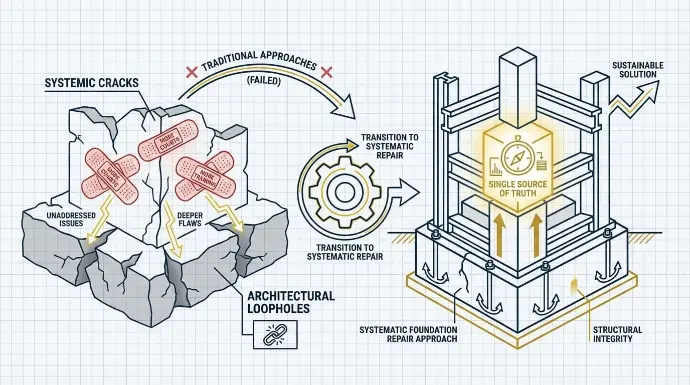
Let’s break this down at a system level, not just a process level.
1. They Reconcile Quantities, Not Transaction Logs
A wall-to-wall physical inventory updates the quantity field in your database. It does not validate whether historical stock moves were properly recorded, whether negative stock was temporarily allowed, or whether backdated entries distorted timing.
If your ERP permits manual quantity adjustments instead of forced location-to-location transfers, you are correcting totals without correcting transaction logic. Within days, timing gaps between receiving validation, pick confirmation, and shipment posting start to distort inventory records again.
2. They Do Not Close Architectural Loopholes
Many systems allow:
- Direct quantity edits in product master screens
- Backdated journal entries
- Inventory imports via CSV without validation
- Negative stock confirmations
Each of these creates phantom inventory at the database level. Human error is not the root problem. The absence of enforced controls is. Unless you disable free-form edits and require structured stock moves with source and destination locations, discrepancies will continue to form.
3. They Ignore Integration Latency And Data Sync Risks
If ecommerce orders sync every 15 minutes via API batch, high-velocity SKUs can oversell before the ERP reflects updated inventory levels.
Likewise, POS systems that post sales at the end of the day create artificial on-shelf availability during peak hours. Even if you conduct regular inventory audits, integration latency will continue generating inaccurate inventory records.
This is an architectural integration issue, not a counting issue.
4. They Fail To Control Multi-Location Logic
In many warehouses, internal transfers are informal. Staff move product physically, but do not execute a system transfer between bin locations.
Technically, the database still shows stock in Location A, while it physically sits in Location B. Pick waves are then generated against empty bins, creating operational inefficiencies and fulfillment failures.
Inventory accuracy depends on enforcing bin-level movement validation, not simply counting more frequently.
5. They Do Not Establish A True Single Source Of Truth
When Shopify, Amazon, POS, WMS, and ERP all store inventory levels, you effectively maintain parallel ledgers.
At Cudio, this is one of the most common root causes we see. We step in by consolidating all inventory write operations into Odoo’s double-entry stock model, disabling external quantity overrides, and restructuring integrations so Odoo becomes the authoritative ledger.
We also configure mandatory location-based moves, restrict manual quantity edits, and implement barcode-enforced validation to eliminate uncontrolled adjustments. This shift moves companies from reactive counting to engineered transaction integrity. The result is sustained inventory accuracy above 97 percent rather than recurring phantom inventory cycles.
Book My Free ERP Impact Assessment with Cudio
The Architectural Solution: Odoo’s Double-Entry Inventory Model
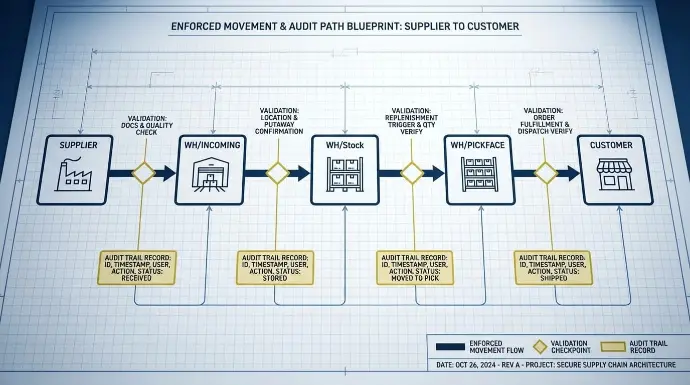
If ghost stock keeps resurfacing, the issue is a lack of counting discipline. It is a system design.
Odoo approaches inventory like accounting. Every movement must balance. Just as a financial ledger requires a debit and a credit, Odoo’s inventory management system requires every unit to move from one defined location to another. There is no “quantity edit” floating in isolation. There is only a transfer between locations.
Instead of adjusting stock levels loosely, Odoo creates a traceable chain:
Supplier → WH/Incoming → WH/Stock → WH/PickFace → Customer
Each move is timestamped, user-validated, and recorded in system logs. Stock cannot sit in an undefined storage space. It cannot disappear silently. If 100 units are received and only 85 remain across all locations, the discrepancy is immediately visible.
This structure turns inventory into an auditable asset register, not a guess. It protects shelf availability, stabilizes cash flow, and prevents phantom inventory from distorting purchasing decisions or creating excess stock.
Most importantly, it eliminates hidden costs tied to inaccurate inventory levels that quietly erode financial health.
How Double Entry Makes Ghost Stock Mathematically Impossible
In traditional systems, someone can overwrite quantities. In Odoo, adjustments require documented moves to defined locations such as “Inventory Loss” or “Damage.”
That means:
- Inventory shrinkage becomes explicit, not invisible
- Misplaced goods must be transferred, not assumed
- Internal transfers require confirmation, often via barcode validation
- Recording sales automatically triggers a stock move
If a picker cannot find a product, they cannot simply ignore it. The workflow can require logging a move to a loss location. That creates visibility instead of allowing phantom inventory to continue undetected.
Total stock levels must always reconcile across locations. The database enforces conservation of quantity. Either the units exist somewhere in the warehouse, or they were moved with documentation. There is no third state.
This is how you prevent ghost inventory by design.
From Receiving Dock To Customer: A Concrete Flow
Let’s walk through how this prevents inaccurate inventory in practice.
On February 3, 2026, 500 units of SKU ABC-123 arrive.
A receiving associate scans cartons using Odoo’s barcode app.
System records:
Supplier → WH/Incoming (500 units)
After inspection:
WH/Incoming → WH/Stock (500 units)
Before fulfillment operations begin, 50 units move to the pick face:
WH/Stock → WH/PickFace (50 units)
When recording sales from ecommerce or POS data:
WH/PickFace → Customer (40 units)
If 2 units are returned:
Customer → WH/Returns (2 units)
After inspection:
WH/Returns → WH/Stock (1 unit)
WH/Returns → WH/Damage (1 unit)
Every movement updates stock levels in real time. Management can instantly see how many units exist, where they sit, and whether all the expected SKUs are physically available.
If inaccurate inventory is detected, do not wait for the next physical count to correct it. The move history highlights anomalies immediately. Lot and serial tracking extend this down to individual units if needed.
When implemented correctly, this model does more than prevent phantom inventory. It improves shelf availability, strengthens inventory management discipline, reduces excess stock, protects cash flow, and gives leadership a strategic advantage.
Instead of reacting to inaccurate inventory after it creates lost sales, the management system prevents it from forming in the first place.
Building a Ghost-Stock-Proof Operation with Odoo
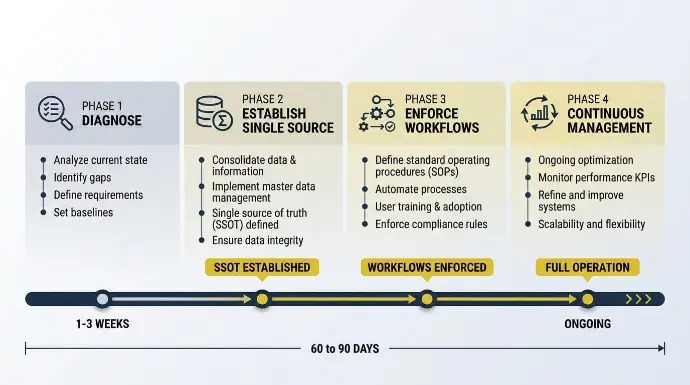
Eliminating ghost stock is not a feature toggle. It is a structured rebuild of how inventory flows through your business.
At Cudio, we approach this as a staged transformation inside Odoo. We do not just “install modules.” We redesign workflows, integrations, permissions, and reporting so Odoo becomes the single source of truth across ecommerce, POS, purchasing, and fulfillment.
Book My Free ERP Impact Assessment with Cudio
The goal is simple: Move from discovering errors during a physical count to preventing errors at the transaction level.
Here is how we implement that over 60 to 90 days.
Phase 1: Diagnose Where Your Ghost Stock Is Coming From
Before reconfiguring anything in Odoo, we run a structured diagnostic.
First, we conduct targeted physical counts of high-velocity, high-value SKUs across selected locations. We compare system quantities against reality and classify discrepancies:
Gap Type | What It Signals | Example |
Shrinkage | Inventory left the system without documentation | Product missing |
Misplacement | Incorrect location tracking | Pallet in staging, system shows pick face |
Data Error | Manual or sync issue | Received 100, entered 10 |
Process Gap | No workflow enforced | Damage not logged |
Then we analyze 6 to 12 months of Odoo inventory adjustments, negative stock validations, backorders, and emergency purchase orders.
We look for:
- SKUs with recurring adjustments
- Locations with repeated discrepancies
- Timing patterns tied to fulfillment spikes
At Cudio, we also map your full process flow from PO creation to shipment confirmation. Every spreadsheet, manual override, and email-based step is identified. These are your phantom inventory factories.
Phase 2: Establish a Single Source of Truth with Odoo
Next, we consolidate authority.
We integrate Shopify, Amazon, POS systems, marketplaces, and B2B portals directly into Odoo via real-time or near-real-time APIs. All orders must originate in or sync instantly to Odoo.
Then we disable:
- External quantity edits
- Manual stock overrides in channel backends
- Uncontrolled CSV imports
All stock movements must pass through Odoo’s double-entry model.
We configure warehouse locations to mirror physical flow:
- WH/Incoming
- WH/Stock
- WH/PickFace
- WH/Returns
- WH/Damage
- WH/Adjustment
At Cudio, we also restrict user permissions so staff cannot directly edit quantities. They must execute stock moves. This enforces discipline at the system level.
We deliver clear SOP documentation and hands-on warehouse training so teams understand that inventory is no longer edited. It is transferred.
Book My Free ERP Impact Assessment with Cudio
Phase 3: Enforce Scanned Workflows and Real-Time Validation
Barcode and QR scanning with Odoo’s mobile barcode app eliminates most transcription errors that create phantom inventory.
Roll out scanning across:
- Receiving (scan product and bin on put-away)
- Internal transfers (scan source bin, product, destination bin)
- Picking (scan bin and product to confirm)
- Packing (scan products going into each shipment)
Configure Odoo to require scans for critical steps. You cannot validate a picking operation without scanning the bin and product. You cannot complete a receiving without scanning each line item. What was previously “good practice” becomes system-enforced behavior.
Odoo’s mobile interface allows real-time updates directly on the warehouse floor. The lag between physical moves and system entries—where ghost stock breeds—shrinks to seconds rather than hours or days.
For operations with thousands of SKUs, this phase alone can improve inventory accuracy to 95–98% before any RFID investments. Scanning, combined with a double-entry architecture, catches most human errors at the moment they occur rather than weeks later during a count.
Phase 4: Continuous Cycle Counting and Exception Management
Architecture without governance eventually decays.
We configure dynamic ABC cycle counting inside Odoo:
Category | Criteria | Frequency |
A Items | High value/velocity | Weekly |
B Items | Moderate turnover | Monthly |
C Items | Slow movers | Quarterly |
In Odoo, counts are recorded as controlled stock moves. No silent quantity edits.
We then build dashboards tracking:
- SKU variance above 3 percent
- Units off by more than 5
- Repeat discrepancy locations
- Negative stock occurrences
At Cudio, we assign role-based accountability. Inventory controllers receive automated alerts. Discrepancies are reviewed within 24 to 48 hours.
Inventory accuracy becomes a managed KPI, not an annual crisis.
The Outcome
When Odoo is configured properly and integrated correctly:
- Ghost stock becomes structurally difficult to create
- Misplacements surface immediately
- Oversells drop sharply
- Emergency purchase orders decline
- Inventory accuracy becomes measurable and sustainable
This is not just software configuration. It is an operational architecture.
And when implemented correctly, your team shifts from firefighting stock issues to managing a controlled, auditable, scalable inventory system built for growth.
Advanced Tools: RFID, Analytics, And Anomaly Detection
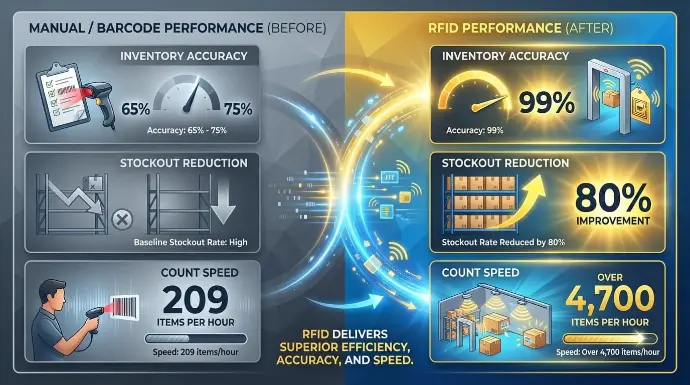
Once Odoo’s double-entry inventory backbone is stable, advanced tools can significantly amplify performance. But they are accelerators, not replacements. If your core transactions are weak, RFID and analytics will simply measure chaos faster.
When the foundation is solid, however, the results can be dramatic.
RFID performance benchmarks consistently show:
- Up to 99 percent inventory accuracy versus 65 to 75 percent in manual or basic barcode environments
- Stockout reductions as high as 80 percent
- Count speed improvements of 96 percent, from roughly 209 items per hour to over 4,700
Those gains matter. But RFID data still needs a structured ERP core like Odoo to translate raw reads into validated stock moves and reliable stock positions.
When And How To Layer RFID On Top Of Odoo
RFID makes the most sense in environments with:
- High SKU counts and rapid assortment turnover
- Aggressive shelf availability targets
- Fashion, electronics, or omnichannel fulfillment operations
- Distribution centers processing high daily volumes
At Cudio, we never recommend full-scale deployment first. We design a controlled pilot.
We tag a defined SKU category, map RFID readers to specific Odoo warehouse locations, and configure reads to trigger validation events or controlled stock moves. Over 8 to 13 weeks, we compare discrepancy rates against pre-implementation baselines.
The University of Arkansas study at Bloomingdale’s showed RFID improving item-level accuracy by more than 27 percent, while a comparable non-RFID store saw accuracy decline by 4.24 percent. The difference was structural visibility.
Critical detail: RFID zones must map directly to Odoo location hierarchies. Antennas and handheld readers must reconcile to defined warehouse locations so the Odoo ledger remains authoritative. RFID validates faster. Odoo remains the system of record.
Using Analytics And Alerts To Detect Ghost Stock Early
Technology is about hardware and intelligence.
Inside Odoo, we configure dashboards and automated alerts that compare expected behavior against actual data:
- Sales velocity versus current inventory levels
- Return rates by SKU relative to sales volume
- Adjustment frequency by warehouse location
- Time lag between receipt validation and put-away
We also implement rule-based triggers. For example, if a SKU has high website traffic but no recorded sales for 14 days, that pattern often signals phantom inventory or a shelf availability issue.
Monthly KPIs should include:
- Inventory accuracy percentage with a target above 97 percent
- Shrinkage by location
- Adjustment frequency trends
- Average time to resolve discrepancies
Over time, analytics reveal patterns. You may discover most discrepancies originate at one dock door, one shift, or one product category. That insight enables targeted corrective action instead of broad retraining.
When RFID, analytics, and Odoo’s double-entry architecture work together, ghost stock shifts from a surprise crisis to a detectable signal. And that changes how your entire operation performs.
From Firefighting to Guardianship: Redefining the Inventory Manager’s Role
We see it all the time.
Inventory managers are stuck in reactive mode.
Chasing missing pallets.
Re-running physical counts.
Explaining oversells to sales.
Approving rush freight that destroys margin.
The issue is not effort. It is a system design.
When Odoo is properly implemented using its double-entry inventory model, the role shifts from firefighting to governance. Instead of reacting to ghost stock after it damages shelf availability and customer trust, you oversee a system that enforces transaction discipline automatically.
At Cudio, we architect Odoo environments where inventory behaves like a financial ledger. Every move is recorded. Every discrepancy is traceable. Every adjustment is controlled. Sales trusts are available to promise. Finance trusts valuation. Purchasing stops over-ordering to compensate for inaccurate data.
With 75+ global implementations and 30+ years of tech experience, we focus on building inventory systems that hold up under real operational pressure.
Ghost stock elimination is not a cleanup task. It is a strategic upgrade.
If you are ready to stop reacting and start controlling your inventory environment:
Book My Free ERP Impact Assessment with Cudio
FAQs
Got more questions about fixing ghost stock and improving inventory accuracy?
How long does it realistically take to get ghost stock under control with Odoo?
It realistically takes about 60 to 90 days to get ghost stock under control in one warehouse or distribution center when Odoo is properly configured. In that time, you can move to real-time inventory, reduce manual processes, and stop most inaccurate data caused by delayed data entry or poor data habits. Multi-site or multiple warehouses projects take longer, but early improvements in inventory visibility usually appear within weeks. As inventory stabilizes, you reduce lost revenue, improve product availability, and support positive cash flow across the supply chain. Ongoing cycle counts and regular inventory audits maintain high inventory efficiency without constant disruption.
Can I reduce ghost stock without replacing all of my existing systems?
Yes, you can reduce ghost stock without replacing every system, but Odoo must become the inventory master. Ecommerce, POS, and marketplace platforms can remain in place as long as they sync sales data into Odoo and stop direct data entry, which can lead to inaccurate data. Spreadsheets and manual processes must be removed from anything that changes inventory balances. If you operate multiple warehouses, each distribution center must reconcile against one real-time inventory ledger. That is how you protect product availability and prevent lost revenue to a competing retailer.
How often should we run physical counts once Odoo and cycle counting are in place?
Once Odoo cycle counting is in place, you do not need constant full physical inventory shutdowns. High-value SKUs should be counted weekly or biweekly, while slower items can follow monthly or quarterly schedules supported by regular inventory audits. The goal is fast exception resolution, not counting for the sake of counting. When discrepancies are resolved within 24 to 48 hours, inventory visibility remains strong across the supply chain. This also reduces carrying costs and improves your ability to accurately forecast demand without inflating safety stock.
What if my biggest issue is misplaced inventory rather than theft or data errors?
If your biggest issue is misplaced inventory, it is still an inventory control failure. The system may show units as located in one storage location while they are physically in another, damaging real-time inventory accuracy and fulfillment. Odoo enforces documented internal transfers so items cannot move between bins without being recorded. This prevents inaccurate data caused by informal moves on the warehouse floor. Stronger location discipline also helps isolate true employee theft or vendor fraud from simple process gaps.
How do we get staff buy-in for stricter processes and scanning?
You get staff buy-in by showing how better inventory control reduces stress, not by adding rules without context. When scanning reduces picking errors, improves inventory visibility, and prevents emergency recounts, teams see immediate benefits. Cleaner inventory data also improves marketing strategy, demand planning, and the ability to forecast demand accurately with reliable sales data. Involving warehouse leaders in redesigning workflows builds ownership and reduces resistance to change. When employees see fewer firefights and fewer inventory audits triggered by inaccurate data, adoption follows naturally.