



Data silos are isolated repositories where inconsistent versions of customer, inventory, and financial data reside, preventing a unified view of the enterprise.
In an Odoo implementation, these silos cause critical migration failures because the ERP requires a single source of truth to execute shared logic across modules.
Without resolving these inconsistencies pre-migration, Odoo amplifies existing fragmentation rather than resolving it, often leading to stalled rollouts.
When this fragmented information is pulled into Odoo during implementation, everything slows down. Migrations break, workflows fail, and user trust disappears. Instead of solving the problem, your new ERP ends up reinforcing it.
This article will help you get ahead of that risk. You’ll learn:
- What data silos are and how they form across teams and tools
- Why do they quietly derail ERP projects like Odoo
- How to spot the early signs before they impact your rollout
- What to fix before migration begins
- What a fully aligned, high-trust Odoo environment actually looks like
If you're planning an Odoo rollout and want to avoid costly rework, start by assessing your data landscape. Our team at Cudio can help you map out hidden silos before they impact your implementation.
Book a Data Readiness Assessment with Cudio
Key Takeaways
- Data silos occur when customer data, inventory, financials, and product details reside in separate systems, such as legacy ERPs, spreadsheets, or disconnected CRMs. These disparate systems hinder data sharing and lead to mismatches across departments. Over time, they create data silos that slow processes and harm decision-making.
- 68% of organizations report data silos as a major issue. Fragmented enterprise data is a top reason behind the 70% ERP failure rate. Poor data quality and lack of data governance lead to broken migrations and stalled adoption. Odoo cannot perform without clean, connected company data.
- In Odoo projects, siloed data leads to incorrect stock, inconsistent data, and failed reconciliations. Different departments struggle with data access, trust breaks down, and reporting becomes unreliable. These gaps hurt users and increase operational inefficiencies.
- Breaking down data silos is not just about better visibility. It’s about building a unified data environment where accurate information flows across the organization. Strong data architecture and data management practices help ensure every team works from the same truth.
- To eliminate silos, focus on aligning data systems early in your Odoo project. Replace legacy systems that fragment business data. Use structured data management systems to support secure data access and consistent rules across all tools. This lowers compliance risks and supports long-term growth.
What Are Data Silos? (Clear Definition + Odoo Examples)
Data silos occur when business data is isolated inside specific systems, departments, or workflows and cannot be consistently accessed or trusted across the organization. The problem is not where the data lives. The problem is that different teams operate with different versions of the truth.
The most effective way to eliminate silos is to connect your existing tools to a single source of truth — see how Cudio's Odoo integration services that eliminate disconnected business systems unify your tech stack without a full rip-and-replace.
When sales, operations, manufacturing, and finance each rely on their own systems, the organization loses data consistency.
Data inconsistency causes financial reporting failures, forcing finance teams to rely on manual reconciliation in Excel, which ultimately delays executive decision-making cycles.
What appears to be “multiple systems” is actually fragmented data ownership.
In Odoo projects, this issue becomes critical. Odoo is designed to run on shared data models across sales, inventory, manufacturing, and accounting. If siloed data is migrated or loosely integrated, Odoo does not fix the problem. It exposes it.
Below are common examples of siloed data sources that undermine Odoo implementations:
System | Data Held | Owner | Odoo Impact |
Customer records, leads, opportunities | Sales | Duplicate customers, inconsistent billing data | |
Orders, products, inventory levels | eCommerce | Stock mismatches, failed order sync | |
Production data, work orders | Manufacturing | BOM conflicts, incorrect production actuals | |
Inventory counts, pricing, forecasts | Individuals | Manual overrides, reconciliation risk | |
Legacy ERP (SAP, Sage) | Financials, AP, AR, GL | Finance | Chart of accounts conflicts, unreconcilable balances |
Technical integrations cannot eliminate data silos if the underlying data governance is flawed. If multiple systems retain 'write access' to the same records, Odoo becomes a participant in the conflict rather than the solution.
If multiple systems can create, modify, or override the same records, Odoo becomes one more participant in the conflict.
Until data ownership, structure, and consistency are resolved, Odoo cannot function as a single source of truth.
How Do Data Silos Form in Growing Organizations?
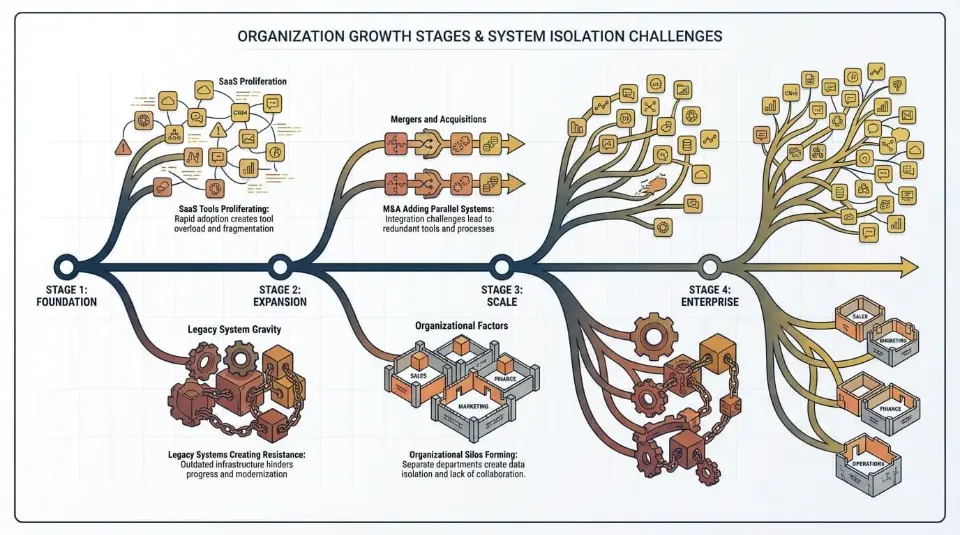
Data silos rarely emerge from deliberate decisions. They grow organically over years of expansion, acquisitions, and quick fixes. Understanding how they form helps you identify data silos before they derail your Odoo project.
SaaS Proliferation Creates Fragmented Data Ownership
In most organizations, departments adopt new tools to quickly solve specific problems. Over time, this leads to a buildup of isolated systems that don't communicate well with each other.
The rapid expansion of the SaaS ecosystem accelerates data fragmentation. With $207 billion in VC investment driving niche tool adoption in 2024, organizations increasingly adopt specialized apps that lack native interoperability.
This proliferation creates incompatible database schemas across the enterprise. A marketing automation tool and a warehouse management system may both store 'Customer Data,' but without a unified unique identifier (UUID), Odoo cannot reconcile the two records, resulting in duplicate profiles and broken reporting.
Each platform, whether a marketing automation tool, warehouse management system, or production scheduling app, still operates with its own database and schema, compounding data fragmentation as the ecosystem expands.
This fragmentation happens because each department has different operational needs:
- Sales uses CRM systems and pipeline tracking tools to manage leads and opportunities
- Operations rely on real-time inventory tracking, order management, and logistics systems
- Manufacturing depends on production planning, machine scheduling, and quality control tools
- Finance needs platforms that support accrual accounting, financial reporting, and regulatory compliance
These tools are often best-in-class for their specific functions, but without a deliberate integration architecture, they remain disconnected. As a result, critical data such as customer orders, inventory levels, or financial forecasts becomes trapped in department-specific systems. This makes it difficult to share information across the business and slows down decision-making.
In short, every new tool solves a short-term need, but without proper integration, it contributes to long-term data silos.
Legacy System Gravity
Many organizations are still tied to on-premises databases and proprietary ERP platforms that were heavily invested in years ago and continue to run mission-critical operations. These legacy systems often rely on denormalized data models, custom schemas, and proprietary communication protocols, all of which make them resistant to modern integration approaches.
Because these systems weren’t built with APIs, cloud-native connectivity, or real-time data access in mind, integration becomes a major challenge. Engineers typically have to rely on:
Batch exports, scheduled at intervals to move data out of legacy systems. Middleware connectors that are brittle, complex, and hard to troubleshoot
These workarounds introduce latency, increase the risk of errors, and add long-term maintenance overhead. Instead of supporting agility, legacy systems often slow down innovation and create bottlenecks across departments.
Mergers and Acquisitions
Few events accelerate data fragmentation as quickly as a merger or acquisition. When two companies come together, they often bring entirely different systems. You might end up with multiple ERPs, CRMs, MES platforms, and other applications operating in parallel. Each system has its own structure and definitions for key data such as customers, products, and vendors.
This leads to immediate complexity:
- The same customer might be defined in two or more ways
- Reporting logic often conflicts across systems
- Integration becomes a long-term initiative, not a quick win
A clear example is LVMH, which manages operations across 75 luxury brands. Each brand uses a different mix of SAP systems, marketing platforms, and supply chain tools. The outcome is fragmented reporting that is both slow and inconsistent, making enterprise-level visibility difficult.
Without a clear data integration plan following a merger or acquisition, these silos can become entrenched, blocking long-term scalability.
Organizational and Cultural Factors
Data silos aren’t always caused by technology. Often, they emerge from the organization's structure. Departments tend to focus on their own goals, tools, and definitions, which naturally leads to fragmentation over time.
Common drivers include:
- Each team uses its own KPIs, terminology, and internal processes
- Departments build and protect separate reporting systems
- A reluctance to share data stems from fear of losing control
- Decentralized IT purchasing leads to incompatible tools and platforms
When business units aren’t held accountable for the quality and consistency of enterprise-wide data, silos form by default. No one sets out to block collaboration, but without a shared governance model and cross-functional alignment, fragmentation becomes the path of least resistance.
Why Data Silos Are a Problem for Odoo Implementations
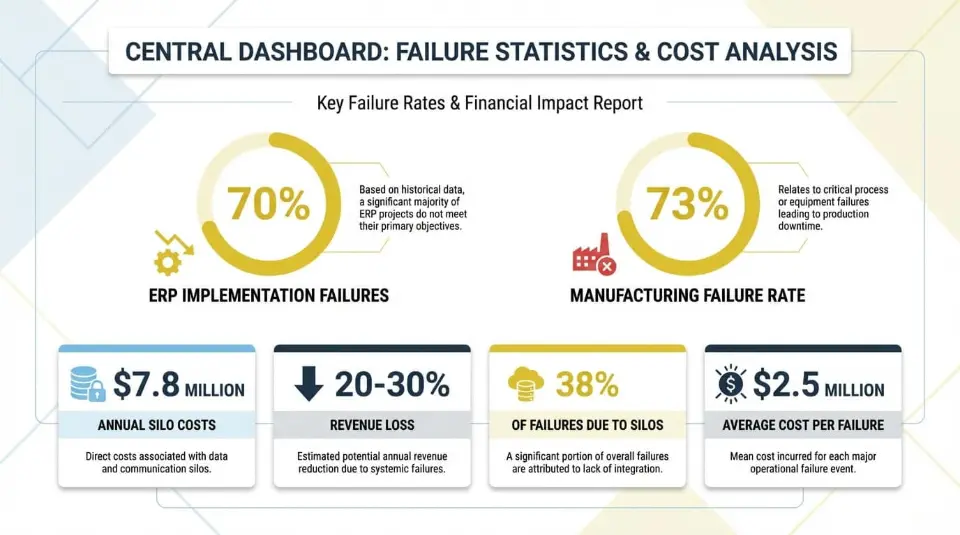
Here’s the uncomfortable truth: 70% of ERP implementations fail to meet objectives. In manufacturing environments, that failure rate climbs to 73%. And 38% of these failures are directly attributed to poor data migration.
Data silos are the root cause of “poor data.”
How Silos Break Odoo’s Integrated Design
Odoo is designed to operate as a unified system. Its modules, such as Sales, Inventory, Manufacturing, and Accounting, are tightly connected and share data, workflows, and business logic by default. This integration enables automation across the business:
- When a user confirms a Sales Order, the Odoo Inventory module automatically reserves the required stock.
- When production is completed, product costs are recorded in Accounting
- When an invoice is paid, accounts receivable updates automatically
This model depends on a critical assumption: every module uses the same accurate, consistent data. When siloed systems introduce conflicting information such as inconsistent product definitions, outdated BOMs, duplicate customers, or inaccurate inventory levels, that assumption no longer holds.
As a result, different parts of Odoo begin producing different answers to the same basic questions:
- How much inventory is available?
- What is the true cost of this product?
- Which customer placed this order?
When users compare Odoo reports to their own spreadsheets and see discrepancies, trust in the system erodes. Teams fall back on legacy tools, and Odoo becomes just another disconnected system rather than the central source of truth it was designed to be.
The Financial Reality
The financial impact of data silos and failed ERP implementations is well documented:
Impact Category | Cost/Impact |
Annual cost of data silos | $7.8 million or more |
Direct costs from failed integrations | $2.5 million on average |
Revenue loss due to silo inefficiencies | |
Annual cost of poor data quality | $12.9 million per organization |
Average cost of a failed ERP project |
These are not theoretical figures. They reflect real business consequences: lost revenue, unplanned downtime, failed audits, and reputational damage. When an Odoo implementation fails, the financial loss is only part of the story. The accountability often falls on the leadership team responsible for the rollout.
Operational Impacts: Inventory, Orders, and Customer Experience
For teams managing retail or eCommerce, siloed data creates daily problems that slow operations and frustrate customers.
Stockouts and Overselling
When inventory lives in separate systems such as Odoo, online storefronts, and spreadsheets, the numbers no longer match. Teams oversell unavailable items and miss out on sales of in-stock products. Retail inventory accuracy averages just 70 percent, meaning 30 percent of records are incorrect across channels.
Omnichannel Inconsistency
eCommerce platforms, marketplaces, and POS systems often maintain their own product and customer data. Without alignment, Odoo reports appear incorrect even when the system is functioning as designed. Teams lose trust and rely on manual workarounds.
Broken Customer Experience
Support teams using Odoo cannot see orders placed in other systems. Marketing lacks visibility into service issues. Customers repeat information, experience delays, and lose confidence.
Instead of creating a connected operating model, siloed data turns Odoo into a reflection of existing fragmentation rather than a system that resolves it.
Manufacturing & Production Impacts: BOMs, Routing, and Downtime
In manufacturing, data issues don’t stay hidden; they show up on the floor. When production stalls or quality slips, it's often not a system problem. It’s a data problem. And for teams moving to Odoo, unresolved silos carry real risk.
BOM Errors Surface at the Worst Time
According to a 2025 Data Quality Study by the Manufacturing Institute, 25% to 40% of legacy Bills of Materials (BOMs) contain structural errors that cause Odoo migration failures.
In many cases:
- BOMs live in CAD or PLM systems
- Routings are in spreadsheets
- Production data flows through a legacy MES
None of these systems is fully connected. When you try to pull them into Odoo without reconciling them first, conflicts trigger delays, rework, or full production stops.
Downtime Gets Expensive Fast
Unplanned downtime can cost up to $260,000 per hour. When data is missing or mismatched, issues take longer to find and fix. Siloed systems slow root cause analysis and stretch recovery timelines.
Quality Signals Get Lost
When quality data is stored in lab systems or tracked offline, key trends remain invisible. Without integration into Odoo Quality, early warning signs are missed. That leads to scrap, customer complaints, or compliance failures that could have been prevented.
Odoo is built to unify these processes, but it only works when the data is ready. If you migrate silos as-is, you don’t just carry the problems forward. You lock them into your core system, where they’re harder to spot and fix.
Financial & Reporting Impacts: The CFO’s Perspective
For finance leaders, data silos are more than a technical issue. They directly impact reporting accuracy, audit readiness, and leadership trust. During an Odoo rollout, siloed financial data creates risks that can escalate quickly.
Reconciliation Breaks Down
When financial records are split across legacy ERP systems, Odoo, and Excel, it becomes difficult to provide a clear view of the business. This affects:
- Profit and loss statements
- Cash flow tracking
- Forecasting and budgeting
Reconciliation between the general ledger, subledgers, and operational reports becomes slow and unreliable, especially during the migration period.
Bad Data Gets Expensive
According to Gartner, poor data quality costs organizations an average of $12.9 million per year. In an Odoo implementation, these costs increase as siloed or conflicting data is imported into the new system. Reports lose credibility, and finance teams spend more time fixing numbers than delivering insights.
Audit and Compliance Risks Grow
When there are multiple sources of financial truth, audit trails break. Missing continuity during data migration can trigger compliance issues and raise concerns with auditors or the board. Without a consistent financial record, explaining variances becomes difficult and stressful.
For CFOs, trust in the data is non-negotiable. If the numbers in Odoo cannot be validated and reconciled, the system cannot support confident decision-making. Clean, aligned financial data is the foundation for success—both during rollout and in ongoing operations.
IT & Architecture Impacts: Creating New Silos with Odoo
From a technical perspective, pushing everything into Odoo without fixing the underlying data can create new silos inside the system. They may not be visible at first, but they introduce long-term risks that are difficult to unwind later.
Cascading Business Logic Failures
Odoo is designed around shared logic across modules. If core data is inconsistent, that logic starts to break. For example:
The supply chain team may define a product one way, while finance uses another structure. CRM records may not align with the customer data in the ERP layer.
These mismatches lead to broken workflows, failed automations, and unreliable reports.
Integration Without a Clear Architecture
When point-to-point integrations are built between Odoo and legacy systems without a structured data model, multiple data flows emerge. Each connection solves a short-term need but introduces long-term inconsistency. The result is technical debt hidden inside the integration layer.
Customizations That Introduce Risk
Hardcoding siloed logic into Odoo through custom fields or workflows creates fragile systems. During upgrades, these customizations can break data relationships or cause module failures. Teams end up spending more time fixing the system than improving it.
Solving these problems starts with unified, consistent master data. Without that, Odoo can replicate the same silos it was brought in to eliminate, only now they are harder to find and even harder to fix.
How to Spot Data Silos Before (and During) an Odoo Project
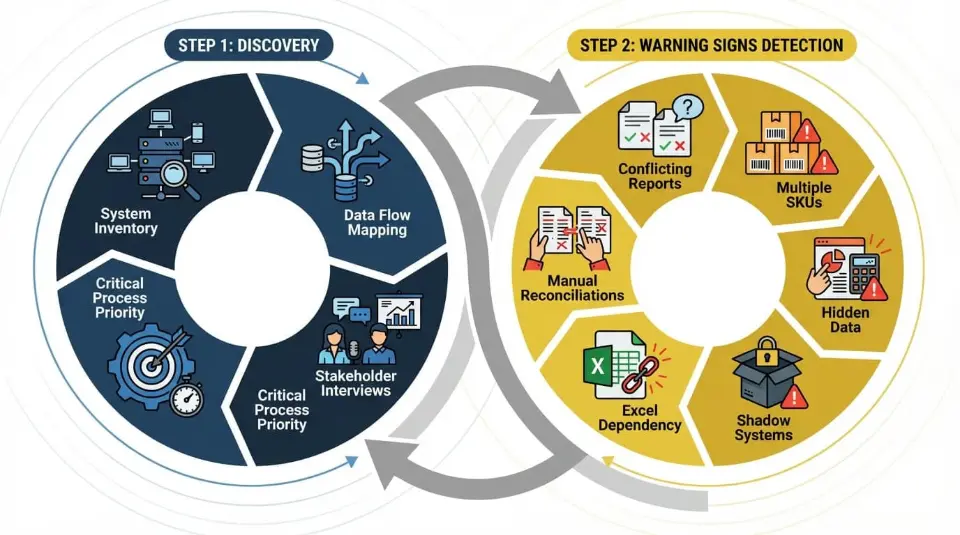
One of the biggest predictors of success in any Odoo implementation is how early you identify your existing data silos. This process should begin before the project kicks off—not halfway through migration when inconsistencies start causing real problems.
The goal is simple: identify every system that holds key master or transactional data and understand which ones each team trusts as their source of truth. This includes data for customers, products, BOMs, inventory, suppliers, financials, and more.
Step 1: Discovery Techniques
Use the following methods during pre-implementation planning to uncover hidden silos.
1. System Inventory
List every system that stores critical business data. This includes:
- Core enterprise platforms (ERP, CRM, MES)
- Department-specific SaaS tools
- Local solutions like Access databases or Excel workbooks
2. Data Flow Mapping
Create simple diagrams that show how data moves between systems. Ask questions like:
- Where is the original source of truth for a customer record?
- How is that data passed into Odoo?
- Who has permission to change it, and how often does that happen?
3. Stakeholder Interviews
Ask users across departments a key question:
“When you need the real number, where do you go?”
Their answers will quickly reveal which systems are actually trusted—regardless of what’s officially in use.
4. Prioritize Critical Processes
Don’t try to capture every single data source upfront. Focus on core business flows first:
- Order to cash
- Procure to pay
- Plan to produce
Start where the impact of bad data is highest—revenue, cost, and production.
Step 2: Watch for Silo Warning Signs
Here are some of the most common red flags that data silos exist in your organization:
Warning Sign | What It Indicates |
Teams argue over which report is accurate | Competing systems claiming to be the source |
Multiple versions of SKU or product lists | Fragmented product master data |
Finance manually reconciles Odoo with the old ERP | No trusted financial system |
Planners rely heavily on offline Excel files | Low confidence in system data |
Users request frequent manual data exports | Poor access and lack of visibility |
Routine manual reconciliations across systems | Underlying data quality issues |
“Shadow systems” used by power users | Critical data not visible or governed by IT |
A Special Warning About Shadow Systems
That last item deserves extra attention.
Shadow systems, like Access databases, heavily customized Excel spreadsheets, or locally maintained macros, often seem harmless. But when one power user controls a critical data set that no one else sees or governs, that becomes a major risk.
These unofficial systems are rarely documented, unmonitored by IT, and nearly impossible to integrate. If your Odoo implementation depends on data trapped in shadow systems, you are building on a fragile foundation.
How Do You Break Down Data Silos During an Odoo Implementation?
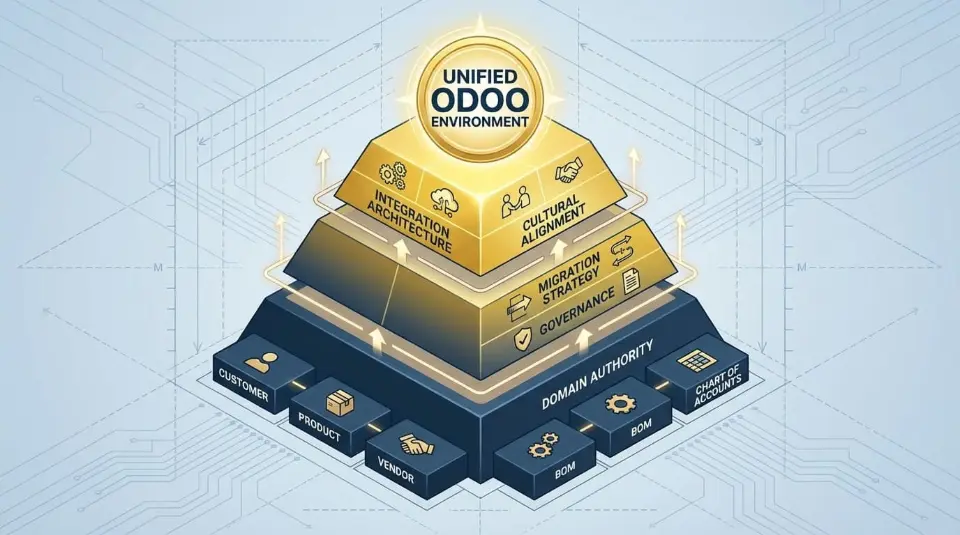
Breaking down data silos in an Odoo implementation is a structural problem, not a tooling problem. Treating it as a one-time ETL activity almost guarantees failure. Effective silo reduction requires aligned data governance, migration architecture, integration design, and organizational incentives that work together across the entire lifecycle of the ERP program.
The strategic objective is to ensure that Odoo becomes the authoritative operational system, not another consumer of inconsistent upstream data.
Define Authoritative Sources of Truth at the Domain Level
Before any data is loaded, each master data domain must have a formally defined system of record. In Odoo projects, the most critical domains are:
- Customer master
- Product master
- Vendor master
- BOM structures and routings
- Chart of accounts
This does not imply immediate decommissioning of legacy systems. In practice, multiple ERPs, PLMs, MES platforms, and financial systems may remain active. What matters is that data ownership, write authority, synchronization frequency, and validation rules are explicitly documented so Odoo receives reconciled data from controlled pipelines.
At Cudio, our 2025 audit of 50+ ERP implementations revealed that projects defined by clear 'Domain-Level Authority' had a 60% faster time-to-value than those attempting to migrate all data simultaneously.
Our implementations begin with cross-functional domain mapping sessions that establish which system owns each data entity and how that ownership is enforced technically through Odoo models, access controls, and integrations.
Talk to a Cudio ERP Expert Today
Treat Data Governance as a Risk-Control Mechanism
Data governance is often dismissed as overhead, but the numbers tell a different story. Organizations with formal governance frameworks achieve 82 percent data quality compliance, compared to 41 percent without governance, and experience 68 percent fewer post-implementation data issues.
In an Odoo context, governance must address concrete, technical questions:
- Who owns each data model and field mapping?
- What naming conventions, required fields, and validation constraints apply?
- How are conflicts resolved when finance, supply chain, and sales define the same entity differently?
- How are data transformations logged for auditability?
Governance also requires audit trails across the migration and integration layers so that finance teams can trace balances, valuations, and transactional changes back to source systems during reconciliation and audits.
Design Migration Strategy Around Reconciliation, Not Just Load Success
The data migration was not successful because records still appear in Odoo. It is successful when outputs reconcile.
Strong migration strategies incorporate profiling, deduplication, standardization, and multi-pass validation, but the defining factor is reconciliation by design. Inventory valuation, accounts receivable, accounts payable, and work-in-progress must match legacy systems within defined tolerances before Odoo is trusted.
Parallel runs are critical here. Running Odoo and legacy systems side by side through at least one full operational and financial cycle is often the only way to expose hidden data issues before they impact production or close processes.
At Cudio, we treat reconciliation as a first-class requirement, not a post-migration check. Our ETL pipelines maintain transformation lineage and support CFO-level validation, enabling financial stakeholders to sign off with confidence before go-live.
Talk to a Cudio ERP Expert Today
Prevent Silo Re-Creation Through Intentional Integration Architecture
Many silo failures occur after go-live, not before. The most common cause is an uncontrolled integration design.
Point-to-point integrations that allow multiple external systems to write directly to the same Odoo master data models create silos within the ERP. These conflicts are harder to detect because they are embedded in code rather than visible in user workflows.
A sound integration strategy enforces:
- A documented enterprise data model
- Clear read and write directionality per domain
- Near real-time APIs or message queues for inventory and order data
- Strong write protections that prevent dual ownership of master data
- Defined failure handling and rollback procedures
Without these controls, integration complexity increases, data trust erodes, and Odoo becomes an orchestration layer for inconsistency rather than a system of record.
Align Culture, Incentives, and Measurement with Odoo Data
Technical controls alone do not eliminate silos. Teams continue to maintain shadow systems when they do not trust enterprise data.
Breaking this pattern requires tying performance measurement to Odoo outputs. When KPIs, dashboards, and reporting are driven from Odoo rather than spreadsheets or legacy tools, behavior changes.
Cross-functional data definition workshops help align teams on terms like “available inventory,” “order,” and “customer.” Targeted training reduces fear by showing how unified data lowers rework, speeds decision-making, and reduces individual accountability risk when numbers are challenged.
What a De‑Siloed Odoo Environment Looks Like
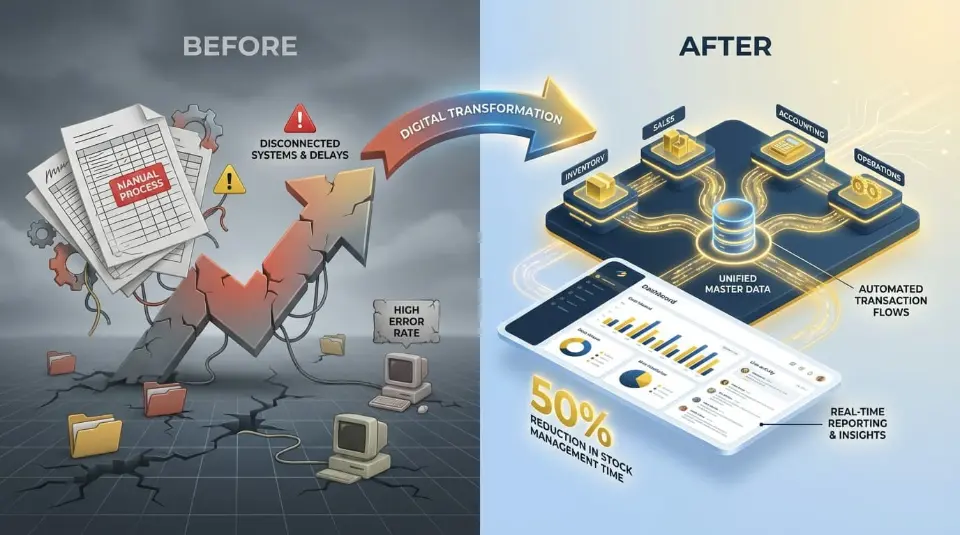
In a de-siloed environment, teams no longer rely on disconnected spreadsheets, outdated exports, or manual reconciliations. Instead, they trust the platform because it reflects a single source of truth across every business domain.
Unified Master Data Across the Enterprise
At the heart of a healthy Odoo system is consistent, validated master data. In a de-siloed setup, which includes:
- A single product catalog with standardized naming, units of measure, and product attributes
- Harmonized customer and vendor records across CRM, Sales, Purchase, and Accounting modules
- BOM structures and routings that are fully validated and integrated with Manufacturing
- A consistent chart of accounts and analytic tags that align financial reporting with operational activity
With this level of alignment, system-wide reporting and automation become reliable, because Odoo no longer has to resolve conflicts between competing data sources.
Operational Impact: Real, Measurable Gains
Once data silos are resolved, the impact on operations is immediate and measurable. Research and field data from Odoo implementations show:
- Up to 50% reduction in stock management time, thanks to unified inventory and real-time availability
- Full elimination of duplicate data entry and record-keeping across sales, support, and finance
- Real-time reporting replaces end-of-day summaries or manual month-end closeouts
- Automated transaction flows between modules reduce coordination delays and human error
This kind of transformation is what Refreshed Tech experienced after working with Cudio. Before implementation, their inventory visibility depended on disconnected systems and delayed updates.
With Cudio’s help, they implemented Odoo modules for Inventory, Accounting, CRM, and Manufacturing, and gained real-time insight into unprocessed inventory across locations. This visibility enabled them to intelligently prioritize production and scale to support 15+ marketplaces without increasing administrative overhead.
Talk to a Cudio ERP Expert Today
Advanced Capabilities That Depend on Clean Data
Many of Odoo’s most powerful features are only unlocked in a de-siloed environment. These include:
- Accurate MRP planning, which depends on up-to-date demand forecasts and real-time inventory levels
- Reliable profitability analysis at the product, customer, or channel level, based on unified accounting and sales data
- AI/ML features that require clean, contextual historical data, such as demand prediction, churn modeling, or price optimization
When data is fragmented or inconsistent, these tools cannot function as designed. But once silos are eliminated, the full value of Odoo's integrated platform is realized—driving smarter decisions and faster execution.
Simons Shoes, a multi-channel retailer, illustrates this well. Their challenge was fragmented inventory and vendor data across in-store POS and e-commerce platforms. With Cudio, they implemented Odoo’s Inventory, POS, Sales, and Purchasing modules—along with our Rithum-Odoo connector. The result was a unified data layer across physical and digital channels, allowing them to launch products on new marketplaces in one to two weeks and access real-time sales and stock data from a single dashboard.
Talk to a Cudio ERP Expert Today
The Big Picture
In a de-siloed Odoo environment, you don’t just gain better tools—you gain clarity, speed, and alignment across the business. From reducing operational delays to improving financial confidence, the system becomes a trusted asset rather than another workaround.
At Cudio, we’ve seen the shift firsthand. Across industries like manufacturing, retail, and e-commerce, we’ve helped clients transition from fragmented systems to streamlined, integrated Odoo environments that scale with confidence.
If you're ready to eliminate silos and unlock the full value of your ERP investment, we’re ready to help.
Talk to a Cudio ERP Expert Today
Implementing a Long-Term Strategy to Keep Data Silos from Returning
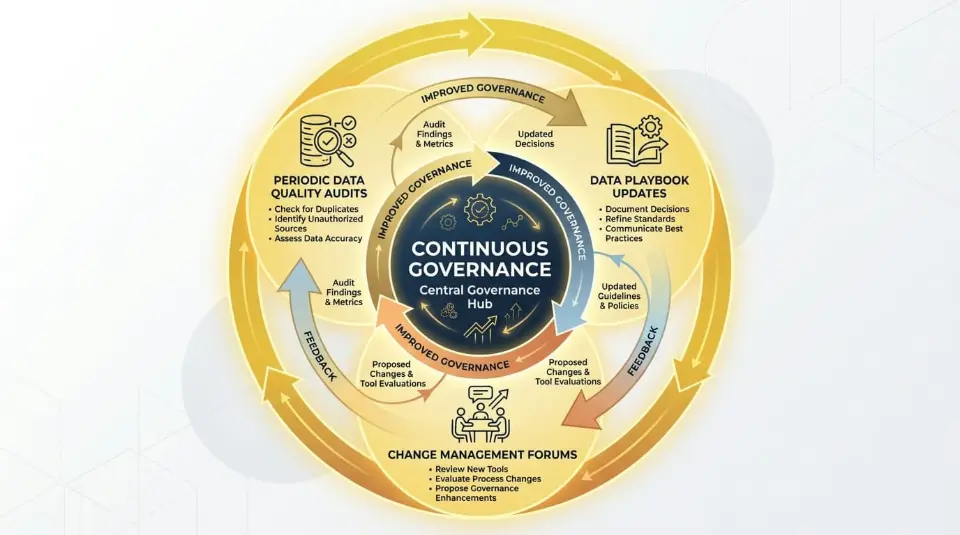
Eliminating existing data silos is only the beginning. The greater challenge is preventing new ones from forming as the business evolves.
Growth initiatives such as acquisitions, new sales channels, regional expansions, and additional software tools all introduce opportunities for fragmentation if data discipline is not maintained.
A de-siloed Odoo environment requires ongoing attention, not periodic cleanup.
Continuous Governance Around Change
As systems and processes change, governance must remain active. Establish recurring forums to review proposed tools, integrations, and major workflow changes, with a focus on their impact on Odoo’s data architecture.
Before approving a new system, teams should be required to answer a few core questions:
- Which Odoo data models will this system read from or write to?
- Is it authoritative for any master data, or is Odoo still the system of record?
- How will data conflicts be prevented and monitored?
This ensures that new tools strengthen the ecosystem rather than quietly reintroduce silos.
Periodic Data Quality Audits
Even with strong controls, data drift happens. Duplicate records emerge, validation rules get bypassed, and shadow systems appear over time. Quarterly data quality audits help surface these issues early.
Audits should focus on:
- Master data duplication across customers, products, and vendors
- Inconsistent naming or attribute usage
- Unauthorized data sources feeding or extracting from Odoo
Issues identified early are far less costly to resolve than those discovered during audits, system upgrades, or financial close.
Codify Decisions in a Data Playbook
To sustain consistency, organizations should document their data strategy in a formal playbook. This becomes the reference point for future Odoo enhancements, new site rollouts, and onboarding of acquired entities.
A strong playbook defines:
- Authoritative systems per data domain
- Integration and write rules
- Validation standards and naming conventions
- Required reconciliation and testing practices
By applying the same de-siloed principles repeatedly, the organization avoids relearning hard lessons with every expansion.
Final Thoughts
Eliminating data silos is not about connecting tools. It is about creating unified, reliable data, data flows, and real-time access that teams can trust. When data duplication, poor data collection, and disconnected systems persist, organizations face operational inefficiencies and growing compliance risks.
A strong Odoo environment depends on how you store data, govern ownership, and maintain consistency as the business evolves. Techniques like data virtualization can support visibility, but long-term success comes from intentional architecture and disciplined execution.
At Cudio, we help organizations replace fragmented systems with unified, scalable data models. Through proven Odoo implementations, we reduce silos, streamline operations, and restore confidence in reporting. If your business needs clarity, control, and growth without chaos, Cudio is ready to help.
Book a Strategy Call with Cudio
FAQs
Quick answers to common questions about data silos, Odoo, and managing unified data across systems.
Are data silos always bad, or can they sometimes be necessary?
Not all silos are inherently bad. Some isolated data sources are required to manage security and compliance risks, such as HR, payroll, or regulated health information. Data silos become problematic when they create barriers between different teams and lead to inconsistent data across business data domains. Even restricted data should align with Odoo's unified data definitions and data governance policies.
Can we implement Odoo first and clean up data silos later?
This is technically possible but very risky. Migrating siloed business data from different systems introduces inconsistent data, data duplication, and operational inefficiencies inside Odoo. Reports fail to match expectations, trust erodes, and operational costs rise quickly. A focused pre-migration effort to unify critical data collection domains is strongly recommended.
How do we know if our data is too messy for a successful Odoo migration?
Messy data is common and expected across different systems. What matters is whether you can analyze it through structured data analysis and validation cycles. Profiling customers, products, BOMs, and financial data reveals inconsistencies early. A proper migration improves unified data quality instead of degrading it.
Will integrating Odoo with existing systems just create more silos?
Integration can either eliminate silos or create barriers, depending on design. When different teams allow multiple systems to write the same business data, data silos become problematic and hard to control. Clear ownership, consistent data governance policies, and monitored data flows prevent fragmentation. Odoo should either be the master or consume from a clearly defined master.
How long does it typically take to break down major data silos before an Odoo go-live?
Timelines vary based on complexity and the number of different systems involved. Single-entity environments may take weeks, while multi-entity organizations often require several months to unify data and remove inconsistent data. Delays usually come from unresolved ownership decisions, not technology. Early alignment reduces operational inefficiencies and compliance risks while enabling real-time data access.