



An ERP system in accounting is a unified software platform that integrates core financial functions—general ledger, AP, AR, and cash management—directly with operational data from sales, inventory, and procurement. Unlike standalone accounting tools, ERPs automate the flow of transaction data in real-time, eliminating manual reconciliation.
Industry data from 2024–2025 indicates that 89% of organizations rank accounting as the most critical ERP function, with 74% reporting measurable productivity gains post-implementation due to reduced data entry and fewer audit errors.
At Cudio, we have successfully guided 75+ ERP implementations globally. Our finance-first methodology has delivered a 96% client retention rate, helping accounting teams across manufacturing and retail migrate from manual workarounds to scalable Odoo systems.
In this article, you’ll learn what ERP in accounting really means, how it transforms the finance function, and what it takes to implement one without disrupting the flow of business.
Learn More About Our Odoo Implementation Solutions
Key Takeaways
- An ERP system in accounting is a single platform that unifies general ledger, accounts payable, accounts receivable, cash management, and financial reporting with operational data from sales, inventory, projects, and human resources, eliminating the need to reconcile data across disconnected systems.
- The primary value for finance and accounting teams is real-time, company-wide financial visibility, reduced manual data entry, and fewer spreadsheet-driven errors that cause restatements and audit failures.
- According to 2024–2025 industry data, 89% of organizations identify accounting as the most critical ERP function, and 74% report productivity gains after going live, but these benefits only materialize with proper implementation.
- ERP in accounting is fundamentally about de-risking growth: preventing financial misstatements, failed audits, and month-end chaos as transaction volumes and business complexity scale beyond what manual processes can handle.
- ERP implementations carry real risk; 68% of projects are reported as challenged or failed. This article shows how finance leaders can avoid common pitfalls through careful data migration, change management, and phased rollouts.
What Is an ERP System in Accounting?
An ERP system in accounting connects financial management with the rest of your business—capturing transactions as they happen across sales, inventory, purchasing, payroll, and beyond.
Instead of working from disconnected spreadsheets or standalone accounting software, ERP embeds finance into your daily operations. When a sale is confirmed, inventory is updated, and the correct journal entry is posted automatically. Accounting is no longer playing catch-up. It’s integrated into the business in real time.
Integrating accounting into an ERP platform eliminates reconciliation delays, reduces errors, and creates a reliable foundation for financial reporting. Finance teams can close faster, forecast with confidence, and answer critical questions without waiting on manual fixes.
At Cudio, we’ve implemented over 75 ERP projects globally, helping businesses across manufacturing, e-commerce, healthcare, and retail integrate Odoo with full financial visibility. Our team brings 30+ years of technology and finance experience, with a 96% client retention rate—because we deliver systems that work, not just go live.
This kind of transformation is why ERP adoption is accelerating. Cloud ERP now accounts for more than 70% of global spend. Companies that integrate ERP across their business report more than 90% improvement in inventory accuracy, streamlined audits, and significantly faster month-end closes.
The acceleration in ERP adoption is driven by the need for integrated financial visibility. As of 2025, the global ERP market is projected to reach $165.55B, with cloud-based solutions now accounting for 70.4% of global spending.
Companies that sustain ERP usage for over one year report 91% optimized inventory levels, directly impacting working capital efficiency ***, cloud ERP already represents 70.4% of global spending, and companies live on ERP for over a year report 91% optimized inventory levels.
Whether you're upgrading from QuickBooks or replacing fragmented legacy systems, Cudio helps you implement Odoo with the finance-first focus needed to scale.
Start a Tailored Odoo Trial with Cudio Today
How Does an ERP System Differ from Traditional Accounting Software?
As finance leaders grow beyond basic bookkeeping, the question shifts from “Which tool records transactions?” to “Which system reflects how the business actually runs?”
The graph below shows how the two approaches diverge once operations, data flow, and scale are taken into account.
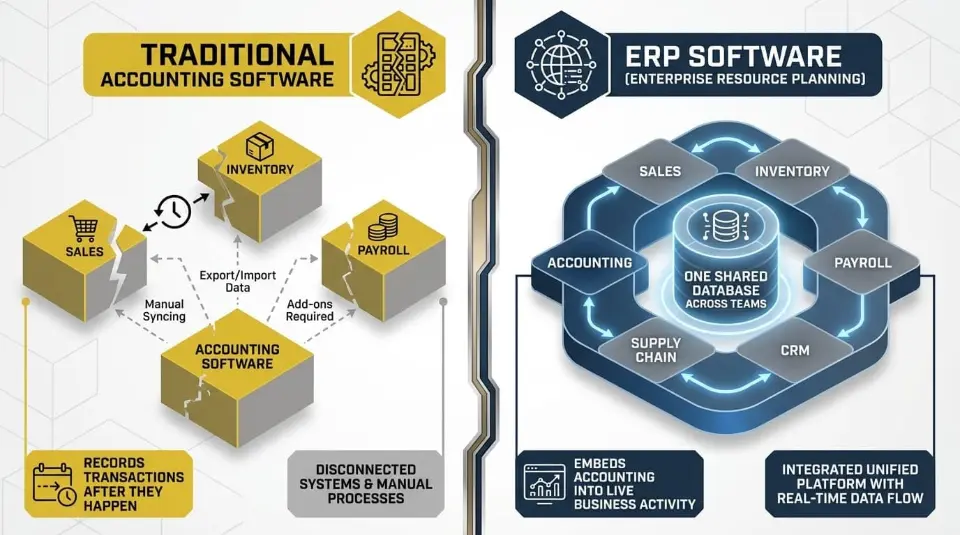
Traditional accounting software is built for record-keeping. It captures financial data once sales, inventory movements, or payroll activities are already complete. For small or stable teams, this can be enough. Finance closes the books, produces reports, and moves on.
ERP software, by contrast, changes when accounting happens. In enterprise resource planning systems, accounting is triggered by the business itself. A sale, shipment, or inventory adjustment is immediately reflected in the ledger. Finance no longer chases numbers. It reviews them as they form.
This is why ERP reshapes financial operations. Instead of reconciling multiple tools, finance and accounting teams work from a single system that reflects reality as it happens. That shift is why 89% of organizations identify accounting as the most critical ERP function, and why 74% report productivity gains and 62% reduced costs after implementation.
The trade-off is risk. ERP projects are complex, with 68% challenged or failed and average cost overruns of 189%. ERP is not about better bookkeeping. It is about redesigning how accounting and the business operate together.
How ERP Creates Value for Finance Teams
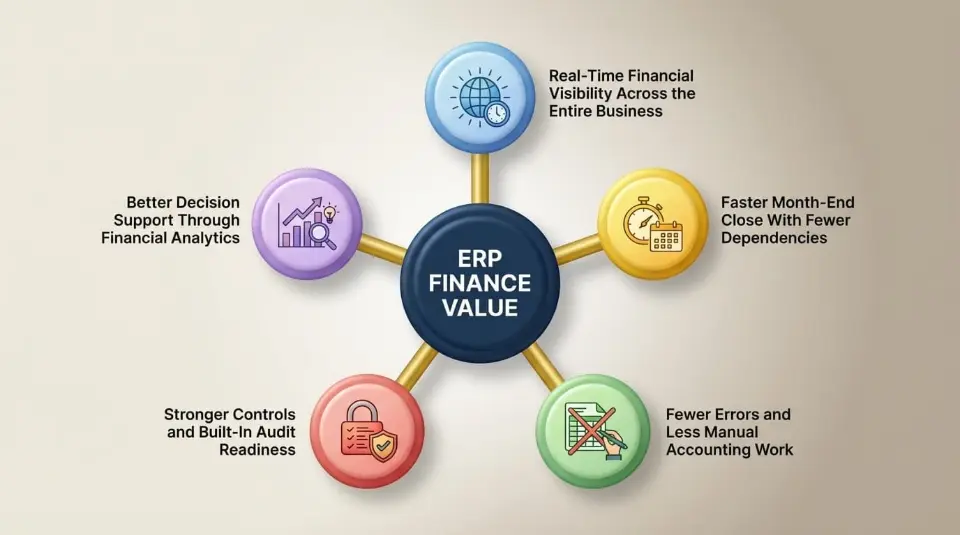
ERP value for finance teams is not theoretical. It shows up in how reliably numbers close, how quickly issues surface, and how confidently finance can support decisions across the organization.
The difference is not just better reporting. It is a structural change in how financial information is created, validated, and used.
Real-Time Financial Visibility Across the Entire Business
ERP establishes a centralized data repository that continuously synchronizes financial data with operational activity. Transactions from sales, procurement, inventory, and fulfillment are posted directly to the general ledger rather than batch-updated days later.
For finance and accounting teams, this means:
- Financial aspects like revenue, cost of goods sold, and accruals reflect real operational events, not estimates
- Business data from the supply chain updates inventory valuation and margin in near real time
- Executives see consistent numbers across multiple departments instead of conflicting reports
Real-time synchronization replaces the traditional lag of batch updates. A 2025 study by Latif et al. confirms that ERP implementation significantly improves accounting information quality by embedding live routines into daily operations, allowing finance teams to review numbers as they form rather than waiting for month-end data dumps.
Finance teams no longer waited for operations to “send numbers.” The system itself became the shared source of truth across the entire business.
Faster Month-End Close With Fewer Dependencies
ERP reduces close time because accounting tasks happen continuously, not in a compressed end-of-period window. Entries are validated at the moment transactions occur, rather than corrected later.
Key drivers of faster close include:
- Automated Posting Logic: Applies consistent GAAP/IFRS treatment at the transaction level, removing the need for batch review.
- Journal Entry Reduction: Minimizes manual reclassifications by validating coding at the source (PO/Invoice).
- Reconciliation Automation: Eliminates spreadsheet-based matching between sub-ledgers and the General Ledger.
Instead of finance acting as a clean-up function, ERP embeds accounting logic directly into core business processes. The same study mentioned above showed that standardized data entry significantly reduced reconciliation workload, allowing finance to close faster without adding staff.
Fewer Errors and Less Manual Accounting Work
Manual data entry introduces risk through duplication, timing gaps, and inconsistent logic. ERP minimizes these risks by allowing a single transaction to flow across the software system without rekeying.
In practice, this reduces:
- Posting errors caused by copying data between systems
- Timing mismatches between operational activity and financial recognition
- Inconsistent treatment of similar transactions across teams
From the same study mentioned above, standardized inputs and automated routines reduced error rates and improved confidence in reported numbers. This directly impacts the quality of accounting and financial management, especially as transaction volumes scale.
Stronger Controls and Built-In Audit Readiness
ERP strengthens control by design, not by policy reminders. Role-based access, approval hierarchies, and audit trails are enforced consistently across the entire business.
For finance, this means:
- Clear segregation of duties across purchasing, payments, and posting
- Automatic documentation of approvals, changes, and overrides
- Reduced reliance on manual evidence gathering during audits
Instead of retroactively proving compliance, finance operates inside a system that documents compliance as part of normal work. This reduces audit fatigue and lowers the risk of control failures that often surface during growth or staff turnover.
Better Decision Support Through Financial Analytics
ERP enables financial analytics that connect numbers to operational drivers. Finance can analyze performance across customers, products, regions, and supply chain flows using the same underlying dataset.
From the same study mentioned above, ERP adoption allowed teams to:
- Link cost structures directly to pricing decisions
- Move from intuition-based budgeting to data-backed forecasts
- Support fair and consistent pricing strategies using reliable cost data
Because financial data and operational data live together, finance can answer questions faster and with more credibility. Decision-making improves not because reports are prettier, but because the data behind them is complete, timely, and trusted.
Core ERP Accounting Modules and How Finance Uses Them?
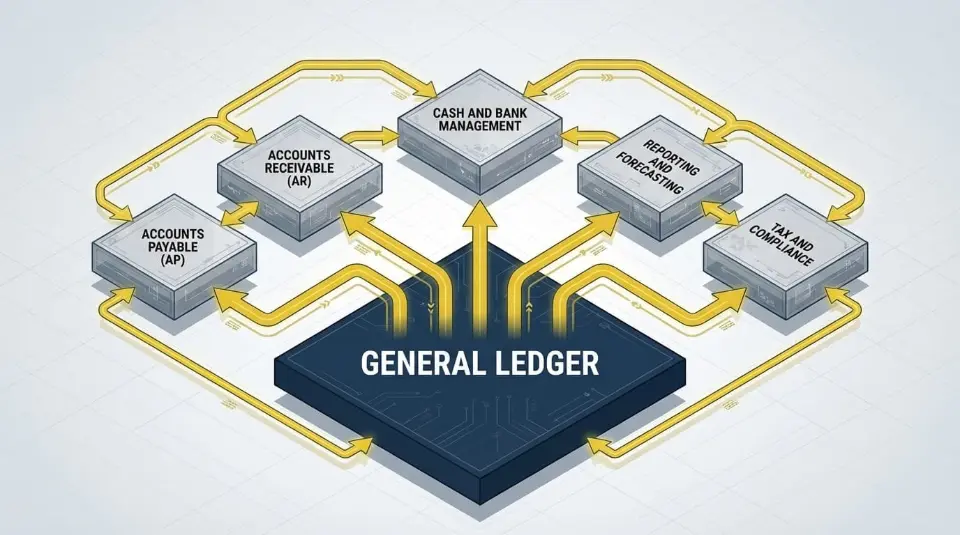
At Cudio, we see ERP success or failure determined less by feature lists and more by how accounting modules are designed, governed, and used in real finance operations.
Each module below plays a specific role in protecting data integrity, enabling scale, and reducing long-term risk for finance teams.
General Ledger
The general ledger is the financial backbone of the ERP. Every transaction from sales, purchasing, inventory, payroll, and banking ultimately posts here, which makes structure far more important than volume.
A well-designed ledger avoids overloading the chart of accounts and instead relies on dimensions such as departments, cost centers, products, or locations. This allows finance to report flexibly without the need for constant reclassifications. When transactions are coded correctly at the source, the ledger stays balanced throughout the month, not just at close.
We, at Cudio, design general ledgers to remain stable as businesses scale. We focus on clarity, audit readiness, and long-term reporting needs so finance teams are not forced to redesign the ledger every time complexity increases.
Talk to a Cudio ERP Expert Today
Accounts Payable
Accounts payable is often where process breakdowns first appear. Manual invoice handling, inconsistent approvals, and off-system tracking introduce risk well before cash leaves the business.
In a properly configured ERP, purchase orders, receipts, and invoices are automatically aligned. Approval workflows enforce policy systematically. Finance teams detect exceptions immediately, allowing them to intervene before errors process into payments.
Exceptions are visible immediately, allowing finance to intervene before errors are processed into payments.
This creates predictable liabilities, cleaner accruals, and stronger cash forecasting. AP stops being a volume problem and becomes a controlled financial process.
Accounts Receivable
Receivables are where operational delays turn into financial strain. When invoicing is disconnected from fulfillment or service delivery, cash flow suffers, and reporting becomes unreliable.
ERP-driven receivables tie billing directly to real business events, such as shipments, milestone completions, or subscription cycles. Credit limits are enforced consistently, and customer payment behavior becomes visible in real time rather than after aging reports are reviewed.
At Cudio, we help finance teams configure AR workflows that reduce billing lag, improve collections discipline, and surface customer risk early without adding administrative burden.
Talk to a Cudio ERP Expert Today
Cash and Bank Management
Cash management is where ERP replaces guesswork with certainty. When bank activity lives outside the system, reconciliation becomes time-consuming, and daily cash positions are unreliable.
Integrated bank feeds automatically match transactions against receivables and payables. True exceptions stand out instead of being buried in volume. Finance gains continuous visibility into balances across accounts, entities, and currencies.
This supports better decisions around payment timing, short-term liquidity, and working capital without relying on manual tracking.
Reporting and Forecasting
Reporting determines whether ERP empowers finance or sends teams back to Excel. Static reports and delayed data undermine confidence in the numbers.
When reporting is built on a single, validated dataset, finance can move from summary to transaction level instantly. Forecasts reflect live operational inputs rather than outdated assumptions. Variances are explainable because the underlying data is consistent.
This shifts finance work away from reconciliation and toward analysis, planning, and decision support.
Tax and Compliance
As transaction volume and geographic complexity increase, tax and compliance risks grow quickly. Manual handling creates exposure that often surfaces during audits or due diligence.
ERP enforces consistent tax logic, maintains documentation alongside transactions, and automatically records approval histories. Audit trails become a byproduct of normal operations rather than a year-end reconstruction exercise.
For finance teams, this reduces compliance risk and significantly lowers audit disruption.
How ERP Improves Cash Flow and Financial Control?
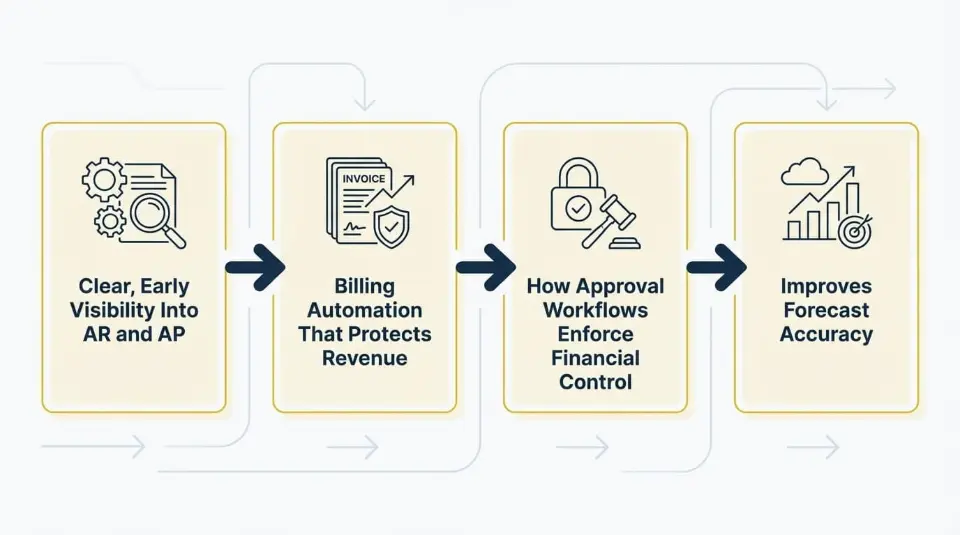
ERP improves cash flow by changing how financial transactions are created, validated, and surfaced, not just by reporting them faster. The mechanics matter.
Clear, Early Visibility Into AR and AP
In an ERP system, accounts receivable and accounts payable are not standalone ledgers. They are continuously updated by upstream business operations. When a sales order ships, AR is created immediately. When a purchase order is approved, AP exposure is visible before the invoice arrives.
This tight coupling eliminates timing gaps that distort cash forecasts. Finance teams see:
- Open receivables tied directly to shipment and billing status
- Approved but unpaid liabilities tied to procurement workflows
- Inventory purchases are already reflected in expected cash outflows
Cash visibility becomes forward-looking instead of reactive.
Billing Automation That Protects Revenue
ERP billing automation is rule-driven, not manual. Invoice generation is triggered by predefined events, such as shipment confirmation, milestone completion, or subscription cycles. Pricing logic, taxes, and discounts apply consistently across customers and entities.
The result is fewer billing delays, fewer disputes, and faster collections. Revenue is recognized when it should be, and cash inflows align more closely with operational reality.
How Approval Workflows Enforce Financial Control
ERP embeds approval logic directly into accounting processes. Vendor payments, credit memos, write-offs, and journal entries follow role-based authorization paths. Every action is logged with the user, timestamp, and source transaction.
This reduces reliance on after-the-fact reviews. Finance controls move upstream, lowering fraud risk while maintaining operational speed.
Improves Forecast Accuracy
ERP forecasts draw from live operational inputs. Payroll projections reflect current human resources plans. Inventory purchases update cash requirements instantly. Customer payment behavior continuously adjusts expected inflows.
Cudio helps finance teams configure ERP forecasting models that align AR, AP, payroll, and inventory into a single cash view. This replaces spreadsheet-driven forecasts with models grounded in real transaction flows, improving confidence and decision quality.
Talk to a Cudio ERP Expert Today
Which ERP Deployment Model Is Best for Accounting?
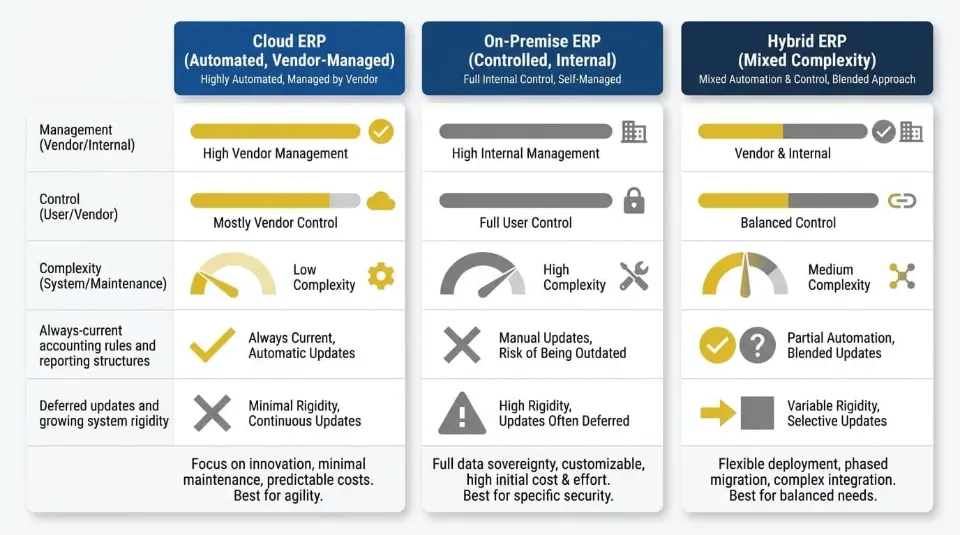
Deployment choice determines how finance accesses data, manages risk, and absorbs change over time. The accounting impact is structural.
Cloud ERP
Cloud ERP centralizes accounting data in a vendor-managed environment. Updates, tax logic changes, and security patches deploy automatically. Finance teams gain continuous compliance without planning upgrade projects.
From an accounting perspective, cloud ERP enables:
- Always-current accounting rules and reporting structures
- Secure access for approvals, close, and audits from any location
- Lower internal IT dependency for backups and system availability
This model supports faster closes and more resilient financial operations.
On-Premise ERP
On-premises ERP gives the organization full control but shifts responsibility to internal teams. Accounting upgrades require scheduled downtime, testing cycles, and IT coordination. Over time, this often leads to deferred updates and growing system rigidity.
Finance teams in on-premise environments frequently rely more on manual data entry and reconciliation as systems age.
Hybrid ERP
Hybrid ERP combines cloud and on-premise components, often due to legacy systems or acquisitions. While sometimes necessary, it increases data governance complexity.
Without disciplined integration, financial risks:
- Inconsistent posting timing across systems
- Duplicate or conflicting financial records
- Weakened controls across approval workflows
Hybrid models demand strong ownership and clear data standards to avoid reintroducing fragmentation into accounting processes.
When a Business Needs ERP for Accounting?
Most companies don’t decide they “want” ERP. They reach a point where their current accounting setup can no longer support how the business actually operates.
The earliest signals usually appear in finance operations, not in IT.
Operational and Finance Pain Signals
If your close process keeps stretching, it’s rarely a resourcing issue. It’s a systems one. Businesses that need ERP often experience:
- Month-end close is pushing beyond 5–7 business days due to late or inconsistent inputs
- Finance teams reconciling numbers manually across sales, inventory, and accounting systems
- Heavy spreadsheet dependency to “fix” gaps in accounting data or reporting logic
Audit pressure follows quickly. Missing documentation, inconsistent balances, and version-control issues increase audit stress and rework.
Complexity That Accounting Software Can’t Absorb
ERP becomes necessary when the business structure outgrows flat ledgers:
- Multiple legal entities or intercompany transactions that require manual consolidation
- Inventory-driven models where valuation, cost of goods sold, and fulfillment timing must align
- Business models with higher inherent risk profiles, such as:
- Make-to-Stock: 65/100 risk score
- Make-to-Order: 78/100
- Configure-to-Order: 85/100
- Engineer-to-Order: 92/100
At this stage, accounting accuracy depends less on effort and more on system design.
Supporting evidence reinforces this shift. A 2024 Vietnamese SME study using a t-test found that ERP implementation had a statistically significant positive impact on accounting information quality (p < 0.05), confirming that ERP materially improves reliability once complexity exceeds a threshold.
What Are the Primary Implementation Risks for Finance Teams?
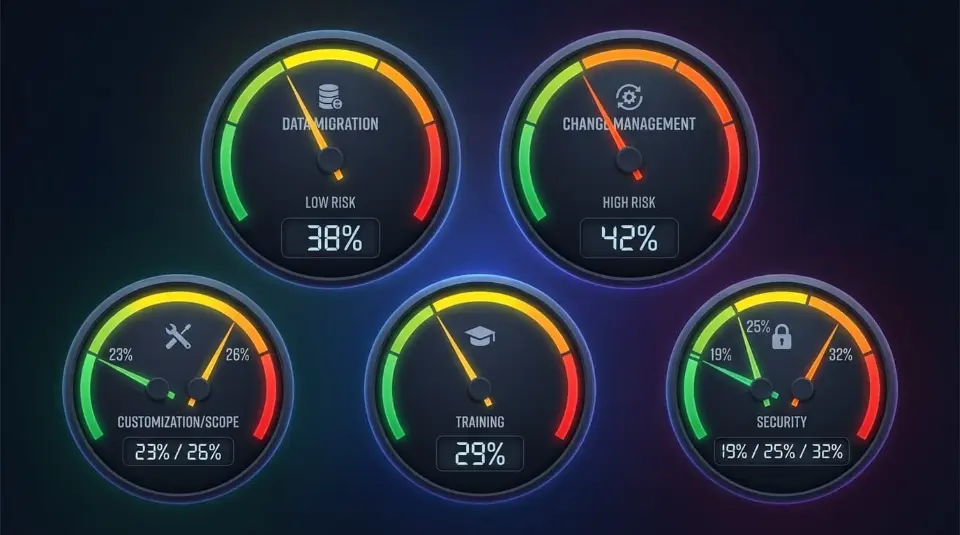
ERP improves accounting outcomes, but the associated risks are real and well-documented. For finance teams, most failures stem from execution misalignment, not software capability.
Data Migration Risk
Poor data migration is the primary cause of 38% of ERP failures. The problem is not moving data. It’s moving the right data in the right structure. Legacy charts of accounts, inconsistent customer and vendor records, and undocumented adjustments often carry hidden assumptions that break reporting after go-live.
This is where we see many finance teams struggle. At Cudio, we treat migration as a finance-led exercise, not a technical handoff. Balances, master data, and reporting structures are validated against real close and audit scenarios before cutover, so finance teams are not reconciling surprises under a deadline.
Talk to a Cudio ERP Expert Today
Change Management and Adoption Gaps
Change management failures drive 42% of unsuccessful implementations. Accounting teams revert to spreadsheets when workflows feel unclear or unsafe. Without strong adoption, ERP becomes an expensive reporting layer rather than a system of record.
Customization and Scope Risk
Over-customization accounts for 23% of failures, while scope creep accounts for 26%. Adding custom logic to preserve legacy habits often increases audit risk and future upgrade complexity.
Our approach is deliberately restrained. At Cudio, customization is limited to areas with a genuine impact on accounting, compliance, or reporting. This keeps the ERP controllable over time and prevents finance teams from inheriting fragile logic they didn’t ask for.
Talk to a Cudio ERP Expert Today
Training and Capability Gaps
29% of failures are tied to insufficient end-user training. Finance users may understand accounting rules but struggle with system workflows, approvals, and data dependencies.
We focus training on how data moves, where controls apply, and how finance can independently diagnose issues. The goal is confidence, not dependency.
Security and Integration Concerns
Cloud ERP avoidance is frequently driven by perceived risk, including:
- Security breaches: 32%
- Integration challenges: 25%
- Potential data loss: 19%
When these risks aren’t addressed early, finance teams resist full system adoption, weakening control and data integrity.
How to De-Risk ERP for Accounting?
De-risking ERP for accounting is not about moving slower. It is about moving deliberately, with finance in control of the decisions that affect financial integrity, cash flow, and reporting accuracy. A stable ERP environment is built on a few foundational choices made early and consistently reinforced.
1. Lead With Finance Ownership
ERP risk drops sharply when finance owns accounting data definitions, posting logic, and financial processes. This ensures financial transactions remain consistent across the accounting system even as inventory, supply chain, and customer payments scale. When finance leads, the accounting system reflects how the business actually operates.
2. Roll Out in Controlled Phases
Stabilizing core accounting functions first protects close cycles and audit readiness. Once the general ledger, accounts payable, and accounts receivable are reliable, additional business functionality can be introduced without disrupting financial operations or cash flow visibility.
3. Standardize Before Customizing
Standard workflows reduce manual tasks, simplify system maintenance, and preserve long-term financial integrity. Excess customization increases future costs, complicates upgrades in cloud-based ERP environments, and weakens governance across financial systems.
4. Focus on User Adoption Early
Accounting tasks must feel intuitive to finance teams. Clear ownership, consistent workflows, and minimal manual data entry increase trust in the system and reduce workarounds that silently undermine accounting data quality.
Should You Choose ERP or Accounting Add-Ons?
Before committing to ERP, many organizations consider extending their accounting system with add-ons and point solutions. On paper, this looks flexible. In practice, it introduces long-term risk that finance teams often absorb quietly.
Below is a direct comparison.
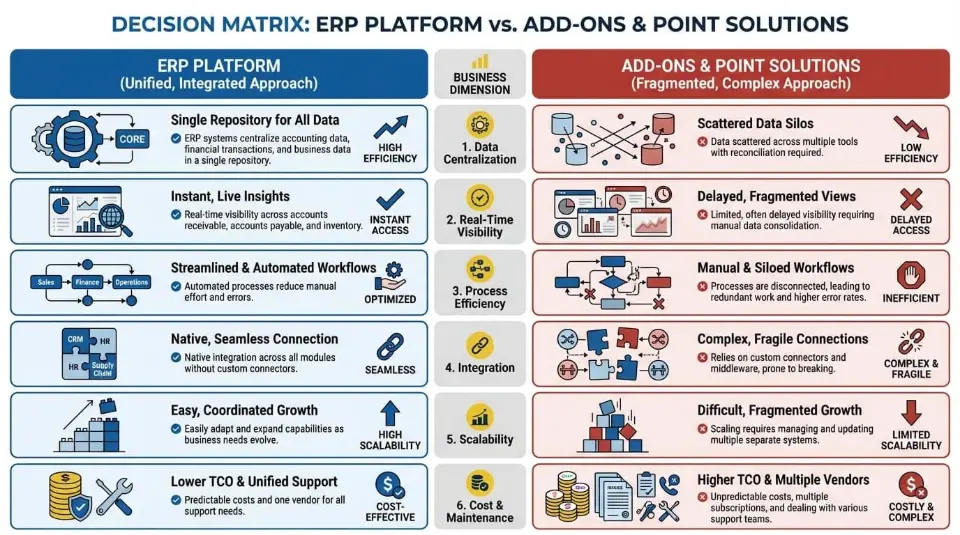
Add-ons often solve isolated problems but create hidden complexity. Each integration becomes another point of failure affecting accounting data, financial analytics, and close timelines. Over time, finance teams spend more effort validating numbers than analyzing them.
ERP consolidates accounting modules, financial systems, and operational data into a single software system. This reduces reconciliation effort, improves decision confidence, and supports sustainable growth across multiple departments without rebuilding the stack every year.
Conclusion
An ERP system in accounting is not about adding software. It is about restoring trust in the numbers as your business grows more complex. When accounting lives inside real business activity, finance stops chasing data and starts guiding decisions with confidence.
The shift to ERP matters most when manual work, spreadsheet fixes, and late closes begin to create risk rather than control. Done well, ERP strengthens financial integrity, improves cash flow visibility, and gives finance teams the stability they need to support growth without disruption. Done poorly, it introduces avoidable complexity and frustration.
That is why execution matters as much as the system itself. If you are evaluating ERP or struggling with an existing one, Cudio helps finance-led teams design accounting systems that scale cleanly, stay audit-ready, and actually work in practice.
Talk to a Cudio ERP Expert Today
FAQs
The essentials you need to know before moving accounting into an ERP.
How much does an ERP system for accounting typically cost?
An ERP system for accounting typically includes software fees, implementation services, data migration, training, and ongoing support. For cloud-based ERP, small teams (10–25 users) often spend $150–$500 per user per month plus $30,000–$100,000 for implementation, while mid-market organizations (25–100 users) usually fall between $200–$400 per user per month with $75,000–$300,000 in implementation costs. Larger organizations vary widely and can exceed $500,000 for full deployments. The real comparison is not just price, but the cost avoided in manual work, audit rework, and decision delays.
How long does it take to implement an ERP for accounting?
ERP implementation timelines depend on scope and complexity. Finance-only implementations can take 1–3 months, mid-market multi-module projects typically run 4–6 months, and complex multi-entity environments often require 9–12 months or more. Timelines extend when historical data is messy, integrations are numerous, or customization is heavy. Most organizations start with accounting modules to stabilize closing and reporting before expanding further.
Can an ERP integrate with our existing CRM, payroll, and banking tools?
Most modern ERP systems integrate with common CRM, payroll, banking, and e-commerce platforms through APIs or prebuilt connectors. This allows sales activity, payroll costs, and bank transactions to flow automatically into the accounting system without manual data entry. Integration design should be evaluated early to avoid unnecessary custom builds. A phased approach, connecting core systems first, reduces risk and improves data reliability.
How does ERP adoption affect our audit and regulatory compliance?
ERP adoption generally strengthens audit and compliance by enforcing standardized processes, role-based access, and complete audit trails. Every transaction records who created, approved, or modified it, allowing auditors to trace it end-to-end. This reduces reliance on spreadsheets and manual evidence gathering during audits. Many ERPs also support regulatory standards such as revenue recognition and lease accounting, out of the box.
Do we still need spreadsheets if we move to an ERP accounting system?
Spreadsheets still play a role in ad hoc analysis, modeling, and presentations. The difference is that they no longer act as the system of record for accounting data. ERP provides validated, reconciled data that can be exported safely without creating conflicting versions. This reduces reconciliation errors and restores confidence in the numbers in the finance reports.