



A successful enterprise resource planning (ERP) implementation depends on more than just software. Achieving a smooth and effective Odoo ERP implementation requires strategic planning, strong user adoption, careful data migration, and disciplined project management. With studies showing that the average Odoo project runs 56% over budget due to hidden costs, understanding these risks early is critical. A comprehensive Odoo implementation cost breakdown helps organizations plan effectively and avoid budget overruns.
This guide is designed for CFOs, COOs, CIOs, and other key stakeholders involved in digital transformation. It outlines the most common Odoo implementation challenges and provides practical solutions for each stage of the implementation process, from planning and execution to post-launch optimization. By addressing these factors proactively, organizations can ensure a successful Odoo implementation that enhances business performance and long-term growth.
Key Takeaways
- Effective Odoo ERP implementation requires strategic planning, user engagement, and comprehensive training aligned with business goals.
- Technical challenges such as data migration, customization, and system integration must be proactively managed to ensure data integrity and smooth transitions.
- Continuous post-implementation support, testing, and user feedback are essential for maintaining performance and adapting to evolving business needs.
Challenge 1: Strategic Planning and Requirements Clarity
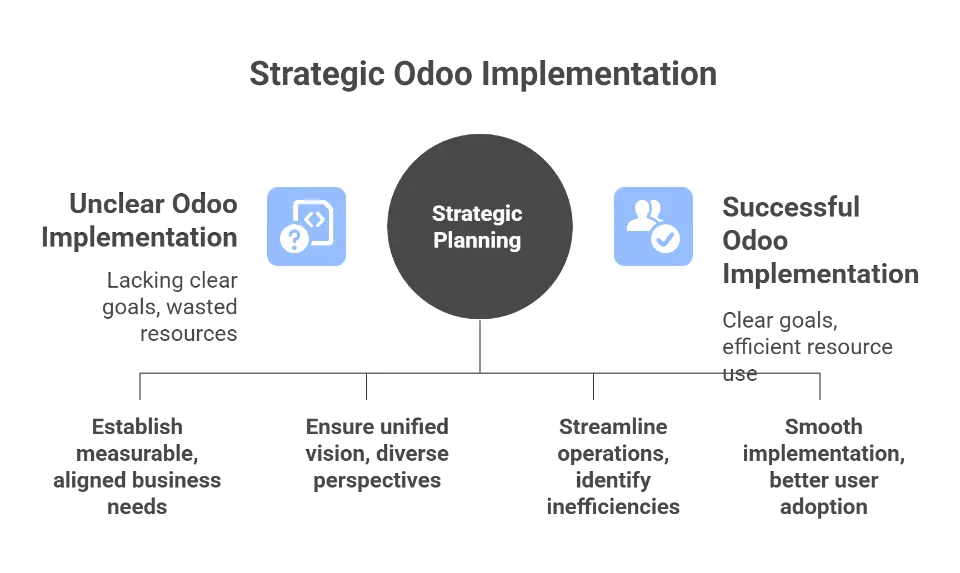
Proper planning is the foundation of any successful Odoo implementation. Without clear goals or alignment with business processes, projects quickly lose focus. A lack of direction during the implementation process leads to wasted resources, unmet expectations, and scope creep.
Navigating ERP complexity doesn't have to be a solo effort — you can speak with a certified Odoo ERP consultant to map out a strategy tailored to your business's specific challenges and growth goals.
Common Issues:
- Undefined objectives and KPIs
- Lack of clarity among key stakeholders
- Overambitious scope or unclear ERP requirements
- Weak link between business operations and ERP objectives
Solution:
The first step to implement Odoo effectively is to establish measurable objectives aligned with your business needs. Conduct workshops to identify key stakeholders and document business requirements thoroughly. Create a roadmap that connects each business goal to a specific Odoo ERP module or configuration.
Revisit objectives throughout the ERP implementation process to ensure alignment with evolving business needs. Incorporate a formal requirements document that includes performance goals, business process maps, and compliance requirements to provide a solid foundation for the entire project.
Engaging Key Stakeholders
Identifying and involving key stakeholders early helps ensure a unified vision. Include department heads from finance, human resources, supply chain, and sales to capture diverse perspectives. Engaging different user groups through meetings and surveys allows the project team to gather valuable insights and anticipate user adoption challenges.
Business Process Mapping and Module Scope
Map existing processes before configuring the system. Identify inefficiencies such as redundant data entry or disconnected workflows between departments. Document current-state and future-state processes to determine how Odoo ERP can streamline operations, particularly in areas like inventory management, project management, and financial reporting.
Start with essential Odoo modules like Accounting, CRM, and Inventory before expanding to advanced features. This phased approach ensures smooth implementation and better user adoption.
Pro Tip: Revisit your objectives throughout the implementation process to stay aligned with evolving business needs.
Challenge 2: User Adoption and Change Management
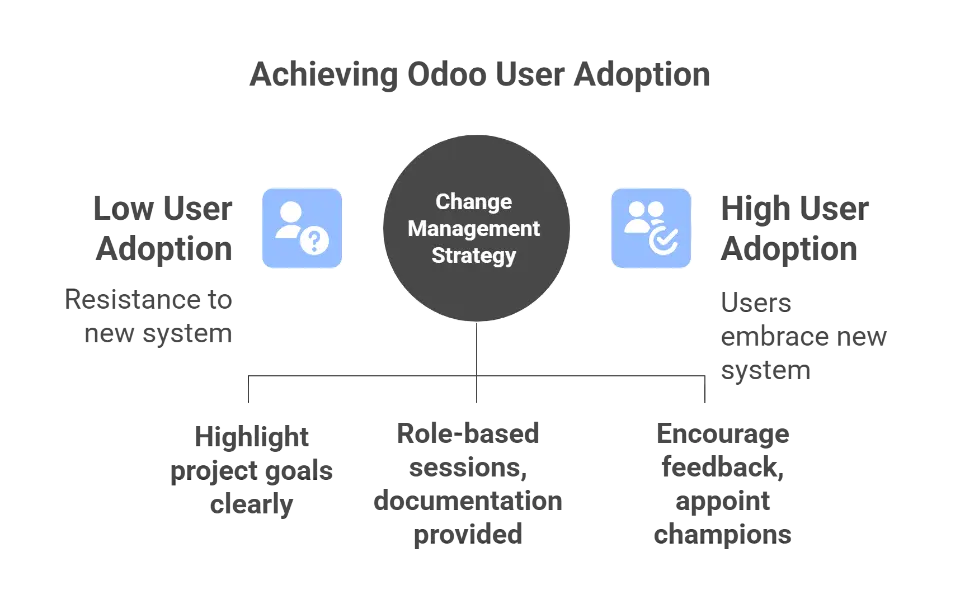
User adoption remains one of the most critical factors in achieving a successful Odoo implementation. Even the most advanced ERP software fails without user engagement. Resistance often arises from fear of change, inadequate training, or a lack of visible benefits.
Common Issues:
- Inadequate training and limited user engagement
- Resistance to replacing legacy systems
- Poor communication about the value of the new system
- Absence of change champions
Solution:
Develop a robust change management strategy that prioritizes communication, collaboration, and user empowerment. Demonstrate how Odoo ERP improves workflows, reduces manual data entry, and integrates multiple systems to streamline operations.
Build a structured user training plan with role-based sessions, documentation, and sandbox testing environments. Encourage hands-on training sessions tailored to specific user groups, ensuring they gain confidence with the new ERP system functions.
Reinforce these efforts with strong leadership communication explaining how Odoo aligns with larger business objectives.
Pro Tip: Encourage feedback early in the process and appoint “Odoo champions” within departments to maintain momentum and encourage adoption.
Managing Change Effectively
Change management is a critical factor in any ERP implementation project. Establish a clear communication plan that highlights project goals, expected outcomes, and how each employee’s role will evolve. Provide frequent progress updates through internal channels, addressing concerns and maintaining trust throughout the entire project.
User Training and Empowerment
Comprehensive training empowers employees to use the system efficiently. Offer refresher courses after go-live to sustain knowledge retention and create a user support portal for ongoing learning. Training should emphasize the benefits of automation, reporting improvements, and workflow optimization within the Odoo platform.
Challenge 3: Data Migration and Accuracy
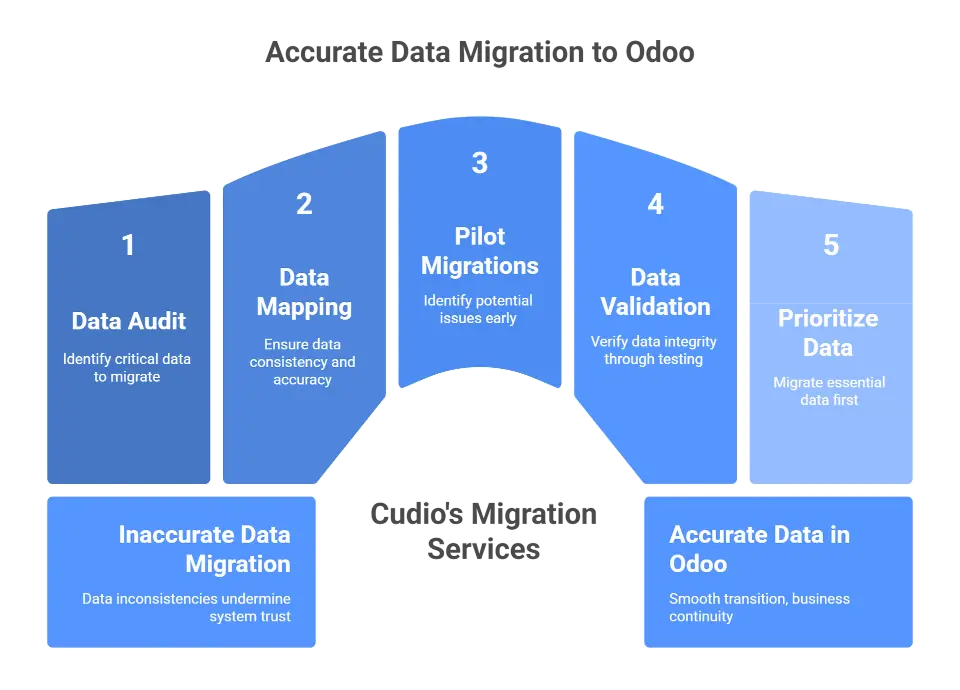
Data migration is one of the most technically demanding aspects of Odoo ERP implementation. Poor data migration leads to inaccurate reports, operational disruptions, and data inconsistencies that undermine trust in the system.
Common Issues:
- Poor data migration planning
- Data integrity problems due to corruption or duplication
- Legacy data that lacks standardization
- Inadequate testing before deployment
Solution:
Conduct a complete audit of legacy systems to identify critical data and remove redundant information. Establish clear data mapping procedures between existing systems and the Odoo ERP system to ensure data consistency and accuracy.
Perform pilot migrations in a sandbox environment to identify potential issues early. Validate data integrity through parallel testing before deploying Odoo live. This step ensures a smooth transition while maintaining business continuity.
Focus on migrating only relevant historical data that contributes to ongoing business processes. Verify imported data with end users across different departments to confirm its accuracy and reliability.
Pro Tip: Prioritize essential data first and validate results collaboratively between departments such as finance, logistics, and operations.
How Cudio Helps
For many organizations, data migration is the most stressful stage of an ERP implementation. Cudio’s migration specialists bring deep technical expertise and structured methodologies that ensure complete data accuracy. Their hybrid automation and manual QA framework prevents data inconsistencies and guarantees smooth transition from legacy systems to the Odoo ERP platform.
Ensure data accuracy in your Odoo migration with Cudio’s expert migration services
Challenge 4: Technical Integration and Custom Development
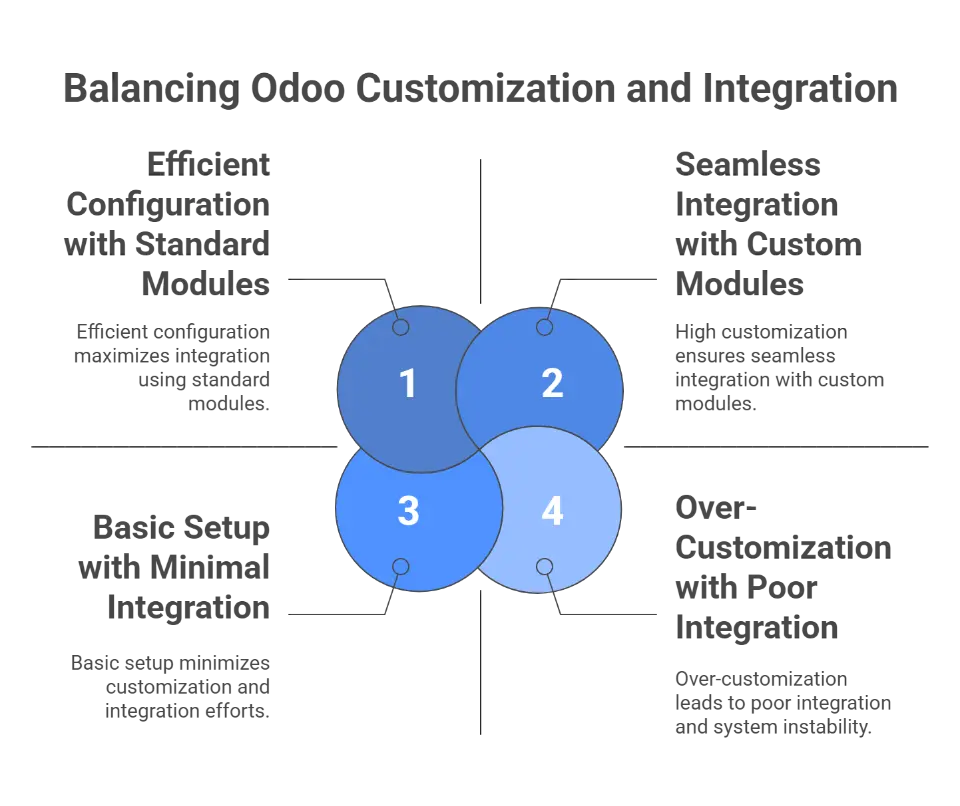
Odoo’s modular architecture empowers businesses with flexibility, but excessive or poorly executed customization can complicate upgrades and impact system performance. Balancing configuration and customization is essential to maintain scalability and long-term stability.
Common Issues:
- Extensive modifications that complicate maintenance
- Incompatibility with existing systems or processes
- Lack of documentation for custom modules
- Performance issues in the new system
Solution:
Leverage Odoo’s built-in configuration tools before turning to custom development. Many organizations underestimate the native features that Odoo ERP offers, resulting in unnecessary modifications. Use existing modules and adjust them through configuration to align with business processes.
When custom development is required, ensure all code is fully documented, version-controlled, and reviewed for compatibility with future Odoo versions. Establish test environments to evaluate new features before deployment to the live system.
To ensure seamless integration, develop standardized API connectors between Odoo and other systems such as accounting, CRM, or third-party logistics tools. A well-planned integration approach prevents data loss and ensures real-time data flow across platforms.
Pro Tip: Avoid unnecessary code rewrites. Rely on modular development that supports easy maintenance and future upgrades.
How Cudio Helps
Cudio specializes in scalable, future-proof Odoo implementations. Their development team focuses on minimizing extensive modifications while ensuring seamless integration with third-party systems. By prioritizing configuration over over-customization, Cudio helps maintain system performance, data integrity, and long-term flexibility.
Simplify your Odoo integrations with expert guidance from Cudio
Challenge 5: Project Management and Timeline Control
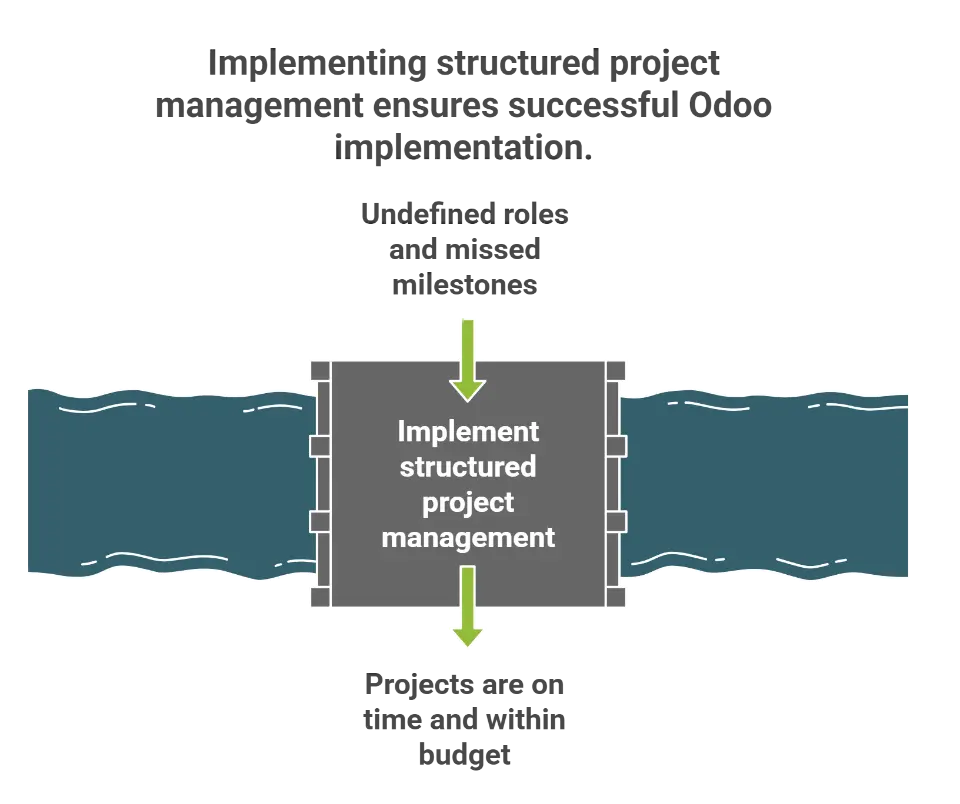
Strong project management determines whether an Odoo implementation succeeds or stalls. Without clear governance, defined roles, and transparent communication, even the most well-planned ERP system can go off track.
Common Issues:
- Undefined roles or weak project governance
- Budget overruns and missed milestones
- Lack of accountability across teams
- Poor communication among key stakeholders
Solution:
Establish a structured project management framework with defined roles and responsibilities. Assign an experienced project manager and form an ERP project team that includes IT specialists, functional leads, and executive sponsors.
Choose a project methodology suited to your organization’s needs. Agile approaches work best for flexibility and iterative development, while a Waterfall model suits projects requiring predictable, linear phases. Track milestones, deliverables, and dependencies through centralized dashboards to ensure transparency.
Hold regular review meetings to assess progress, address risks, and maintain alignment with the overall implementation process. Each milestone should have clear acceptance criteria approved by key stakeholders.
Pro Tip: Consistent communication is key. Weekly updates and progress reports keep teams accountable and reduce misunderstandings.
How Cudio Helps
Cudio applies proven ERP project management practices that combine technical precision with operational clarity. Their milestone-based approach keeps projects transparent and measurable, helping businesses achieve successful Odoo implementation outcomes on time and within budget.
Stay on track with Cudio’s proven Odoo project management framework
Challenge 6: Cost Overruns and Budget Control
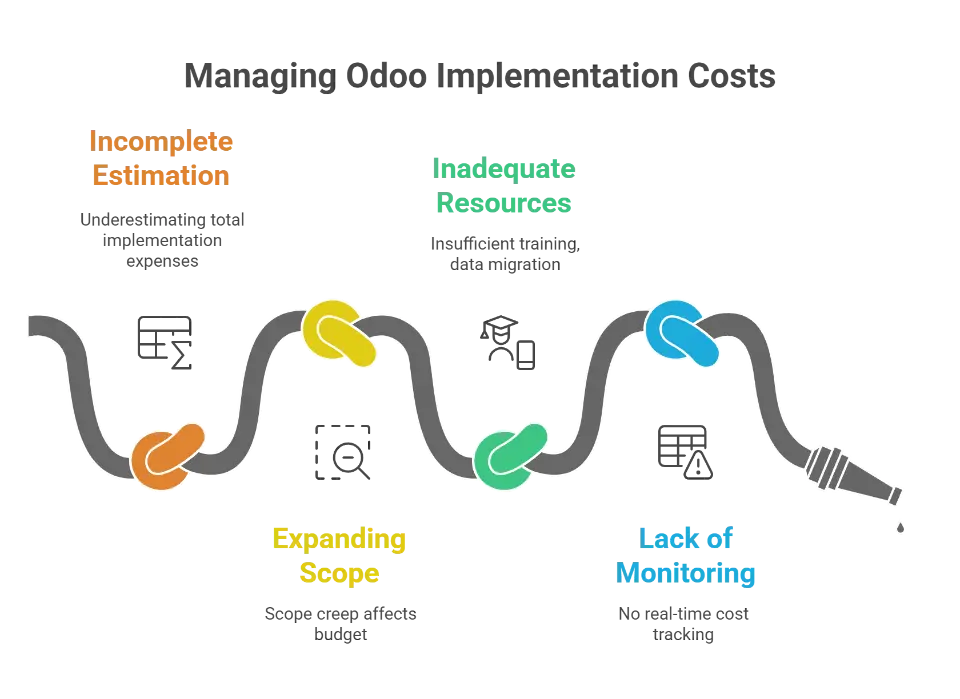
Many businesses underestimate the true Odoo implementation cost. Hidden expenses such as integrations, user training, and post-launch support can quickly drive up the total project budget.
Common Issues:
- Incomplete cost estimation and hidden expenses
- Expanding project scope without financial oversight
- Inadequate resource allocation for training and data migration
- Lack of monitoring tools to track real-time costs
Solution:
Develop a comprehensive budget plan early in the implementation process. Include every possible cost component, such as software licensing, user training, custom development, data migration, and ongoing support.
Create a contingency reserve of 10–20 percent to manage unforeseen challenges like scope changes or integration issues. Use project management tools that provide real-time visibility into expenses and progress against budget.
To prevent scope creep, implement a formal change request process that includes justification, cost impact, and management approval.
Pro Tip: Regularly compare projected costs against actuals to detect variances early and make adjustments before they escalate.
Challenge 7: Quality Assurance and Testing
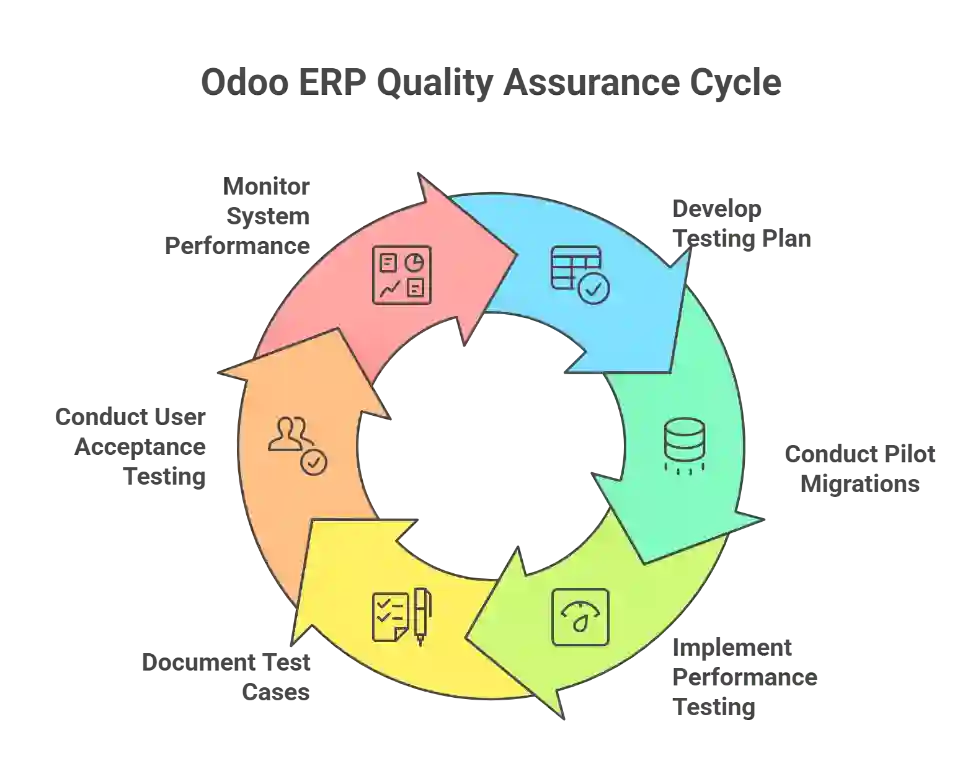
Testing and quality assurance form the backbone of a successful Odoo ERP implementation. Without proper validation, even the most technically sound deployment can encounter errors that disrupt business operations.
Common Issues:
- Inadequate testing of configurations and customizations
- Data inconsistencies after migration
- Performance degradation under real-world loads
- Overlooking user acceptance testing before go-live
Solution:
Build a structured testing plan that includes unit testing, integration testing, system testing, and user acceptance testing (UAT). Conduct pilot migrations in a sandbox environment to verify system behavior using real transaction data.
Implement performance testing to simulate actual workloads and assess system performance under stress. This ensures that Odoo can handle the required number of concurrent users and complex transactions without delays or errors.
Document all test cases, expected results, and discovered issues to create a traceable testing history. Re-test after each update or configuration change to maintain consistency and stability.
Pro Tip: Conduct User Acceptance Testing (UAT) with real end users to ensure that the new system meets operational requirements and enhances day-to-day productivity.
Continuous Improvement
Quality assurance does not end at go-live. Establish continuous monitoring practices that track data integrity, system performance, and user feedback. Regularly review KPIs such as response time, error frequency, and user adoption rates to maintain efficiency and accuracy.
By embedding testing and quality assurance into the entire project lifecycle, organizations can ensure a successful Odoo implementation that minimizes downtime and maximizes reliability.
Challenge 8: Post-Implementation Support and Optimization
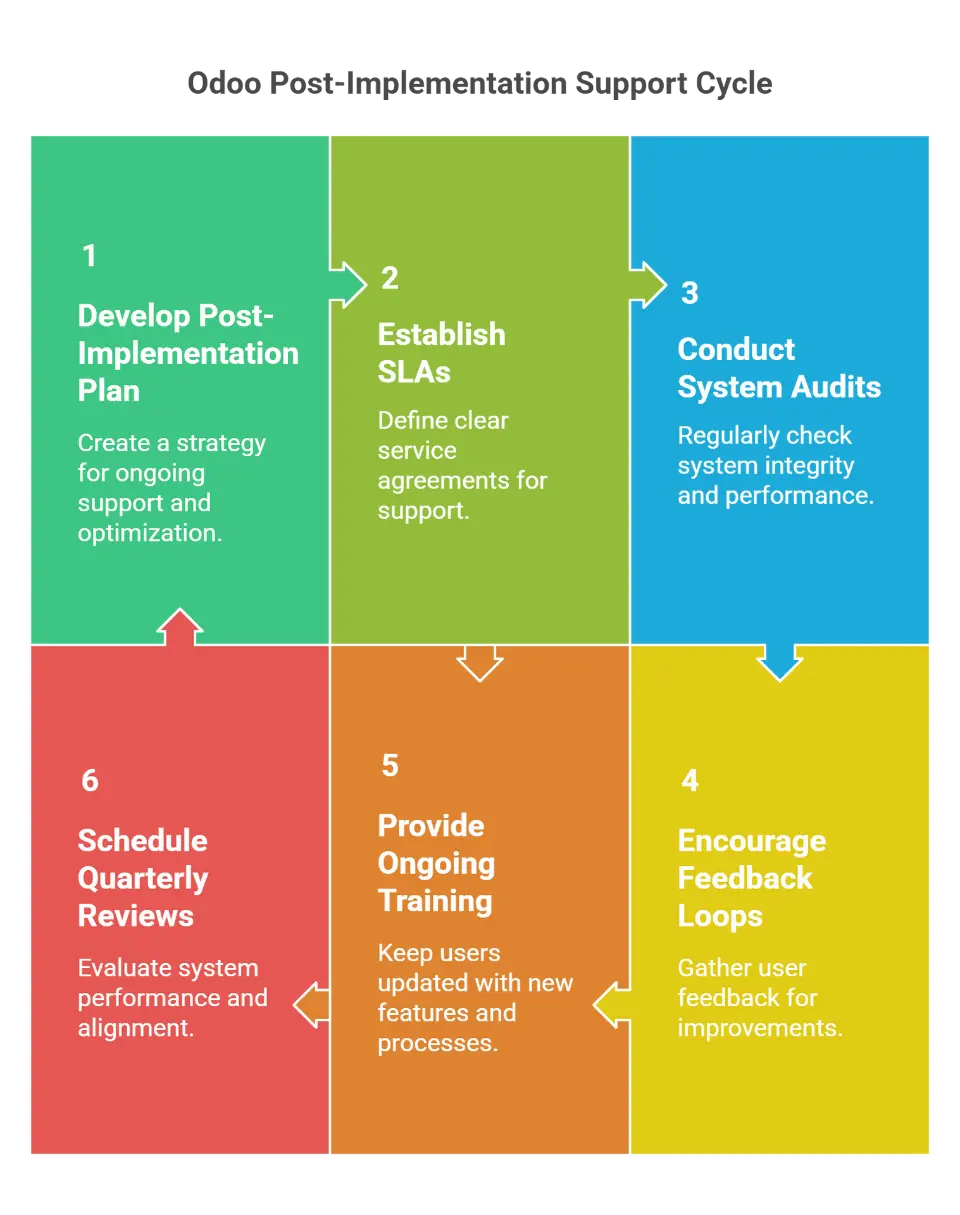
The journey toward a successful Odoo ERP implementation does not end at go-live. Continuous support, performance monitoring, and process optimization are essential for long-term success. Neglecting these areas can lead to decreased user adoption, security risks, and system inefficiencies.
Common Issues:
- Lack of ongoing support after deployment
- Neglected system maintenance and data security practices
- Insufficient testing before applying updates
- Declining user adoption and missed optimization opportunities
Solution:
Develop a post-implementation plan that prioritizes operational continuity and continuous improvement. Establish clear Service Level Agreements (SLAs) for support requests and resolution times. Conduct regular system audits to ensure data integrity, compliance, and performance optimization.
Encourage feedback loops between end users and system administrators. Create structured mechanisms such as quarterly surveys, feedback sessions, and ticketing systems to capture issues and identify areas for improvement.
Include ongoing user training to accommodate new hires, new features, and process updates. Keeping users engaged through refresher courses and updated documentation ensures long-term success and sustainable adoption.
Pro Tip: Schedule quarterly reviews of system performance and business alignment to ensure that Odoo continues to meet evolving business needs and regulatory standards.
Keys to Odoo Implementation Success
A successful Odoo ERP implementation requires balancing technology, people, and process management. Each stage, from planning and user training to data migration and quality assurance, contributes to overall success.
Here are the key highlights to ensure a smooth and effective implementation:
- Clear Objectives and Alignment: Define measurable goals that align ERP functionality with business objectives. Every module should support a specific organizational need.
- Engaged Stakeholders: Identify key stakeholders early and involve them in the decision-making process to secure buy-in and reduce resistance.
- Data Quality and Integrity: Audit existing data to eliminate redundancies and ensure consistent data formats. Validate data accuracy throughout the migration process.
- Comprehensive Training and Change Management: Empower employees through user training programs and a robust change management strategy. This is vital to build confidence and improve user adoption.
- Phased Implementation Process: Adopt a phased rollout strategy that allows testing and adjustments before company-wide deployment, minimizing risk.
- Continuous Monitoring and Support: Establish ongoing maintenance routines, post-launch performance tracking, and user feedback systems.
- Technical Expertise and Integration: Work with an experienced Odoo implementation partner who understands both business operations and technical nuances.
- Value-Driven Investment: Treat Odoo implementation as a strategic investment that delivers measurable returns through cost savings, improved efficiency, and better decision-making.
By combining strong leadership, technical expertise, and user engagement, organizations can achieve a successful Odoo ERP implementation that streamlines operations and drives business growth.
Final Words
Every ERP implementation faces challenges, but with proper planning and expert guidance, businesses can turn potential risks into opportunities for growth. From strategic planning and data migration to user adoption and cost management, each stage requires careful coordination and continuous improvement.
Cudio stands as a trusted Odoo development company and implementation partner with over 30 years of operational expertise. Their proven approach to Odoo ERP implementation helps organizations achieve seamless integration, data integrity, and sustainable business operations. With Cudio’s guidance, you can implement Odoo confidently, reduce complexity, and unlock lasting value.
Start your Odoo ERP transformation with Cudio’s experts today
Frequently Asked Questions
Got Questions? Find quick answers to common Odoo implementation questions and learn how to ensure a smooth, successful rollout.
What are common reasons for Odoo ERP implementation failure?
Common reasons for Odoo ERP implementation failure are poor planning, user resistance, data migration errors, challenges with customization, and integration issues with existing systems. Addressing these factors upfront can significantly improve the chances of a successful implementation.
How much does the average ERP implementation exceed its budget according to Panorama Consulting?
The average ERP implementation exceeds its budget by 56%, according to Panorama Consulting. This underscores the importance of careful planning and management in the implementation process.
What role does user adoption play in Odoo ERP implementation success?
User adoption is vital for Odoo ERP implementation success, as employee resistance due to lack of understanding can result in inefficiencies and project failure. Ensuring thorough training and support fosters greater acceptance and effective use of the system.
What is a significant risk regarding data security in Odoo implementation?
A significant risk in Odoo implementation is data breaches, particularly if the system lacks proper security measures. Ensuring robust security protocols is essential to protect sensitive information.
What challenge does integrating Odoo with existing tools present?
Integrating Odoo with existing tools often necessitates costly and time-consuming customization or special connectors. This can be a significant challenge for organizations looking to streamline their operations.