
You’re already deep enough into this decision that you know Odoo is on your shortlist.
What you haven’t yet figured out is whether the partner sitting across from you can actually deliver. That’s the question that breaks most ERP projects, and it rarely gets answered before the contract is signed.
At Cudio, we’ve rescued 32 failed or stalled Odoo implementations, and almost every one of them had the same origin story: A buyer who evaluated the platform carefully, and a partner barely at all.
This guide gives you a practical evaluation framework for choosing an Odoo implementation partner. It covers what partner tiers actually tell you, the criteria that predict whether an implementation succeeds, the red flags most buyers miss until it is too late, and what to require in writing before you sign anything — but if you're also ready to explore Odoo implementation services directly, that context will help you evaluate what's on offer.
Key Takeaways
- Odoo partner tiers measure scale and volume across all clients, not fit for your specific operation. Use them as a starting filter, not a final answer.
- Industry experience in your vertical predicts implementation quality far better than certification level. A Silver Partner with your industry background will often outperform a Gold Partner fielding generalists.
- The bait-and-switch from sales team to junior delivery team is the single most common and least discussed risk in ERP services. Get team composition in writing before you sign.
- Partners who default to custom development before exhausting native Odoo functionality are a long-term cost liability. The right partner has a principled position on when customization is and is not warranted.
- Post-go-live support is where vague contract language becomes expensive. Require severity-tiered SLAs, a named point of contact, and a defined hypercare period before day one.
What Odoo Partner Tiers Actually Tell You
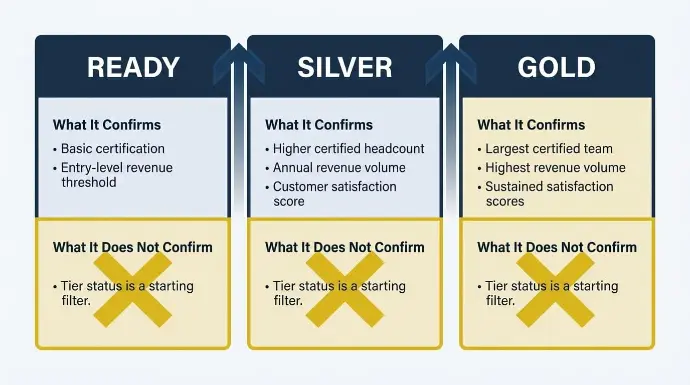
The Odoo partner ecosystem has grown to over 3,300 certified firms worldwide. That number creates a false sense of security. Certification tells you a partner passed a test and met specific volume thresholds for Odoo ERP. It does not tell you whether they can handle your inventory complexity, hit a go-live date, or recover when something breaks mid-project.
Odoo S.A. groups partners into three tiers: Certified, Silver, and Gold. Each tier reflects a partner's performance against specific thresholds, including the number of certified employees on staff, annual revenue processed through Odoo projects, and customer satisfaction scores.
You can verify any partner's current standing through the Odoo official partners directory rather than relying on documentation a partner provides directly.
This is also the best way to confirm whether a firm is an official Odoo partner or a certified Odoo partner. Tier status is a starting filter. The table below shows where it stops being useful.
The three partner tiers and what they do and do not confirm:
Tier | What It Confirms | What It Does Not Confirm |
Ready | Basic certification, entry-level revenue threshold | Project management quality, industry experience, delivery reliability |
Silver | Higher certified headcount, annual revenue volume, customer satisfaction score | Fit for complex or multi-channel operations; domain depth |
Gold | Largest certified team, highest revenue volume, sustained satisfaction scores | Vertical expertise, customization judgment, your specific delivery quality |
Gold Partner status signals scale and volume across all clients and often reflects experience with large-scale Odoo projects. It does not signal that a firm has handled your specific industry, your integration complexity, or a project of your scope.
Silver Partners regularly outperform Gold Partners in niche verticals when their team carries deeper domain experience.
Odoo certification at the individual level, covering both functional and technical exams, is a separate signal from the company tier. A firm can hold Gold status while fielding uncertified consultants on your project. Check both, because certifications reduce execution risk but do not replace verification of the actual project team.
The Criteria That Actually Predict a Successful Implementation
Tier status gets you a shortlist. The criteria below get you to the right answer.
Industry Experience vs. General ERP Competence
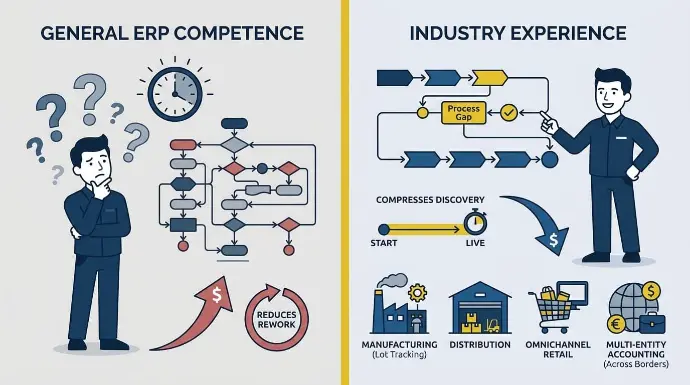
A technically strong partner who has never worked in your vertical will spend the first several weeks of your project learning how your business operates. You are paying for that education.
A partner with genuine industry expertise already understands your process gaps before you explain them, which helps surface business challenges earlier, compresses discovery, and reduces the rework that quietly inflates project costs.
The distinction matters most in industries with non-standard workflows: omnichannel retail, distribution, manufacturing with lot tracking, or businesses running multi-entity accounting across borders.
Generic ERP competence does not transfer cleanly into these environments. Ask for case studies in your specific vertical, not a general portfolio.
Look for a proven track record in projects that closely resemble your operation. If a partner cannot point to at least two or three implementations that resemble your operation, that is useful information.
There’s also a subtler signal worth looking for: the difference between a team that has configured ERP systems and a team that has actually worked inside businesses that run on them.
Consultants who have only ever been on the services side tend to over-engineer solutions. Teams with operator backgrounds bring process intuition and deep expertise that keep implementations grounded and right-sized.
At Cudio, we serve manufacturers, distributors, retailers, e-commerce operators, logistics companies, and healthcare organizations across North America. Before we scope a project, we run a 140-point diagnostic that maps your specific workflows into tailored solutions, not a generic ERP checklist.
That process surfaces the gaps a generalist firm misses in the first conversation. Our team has over 30 years of combined experience in IT, finance, and operations, and most of us have run the kinds of businesses we now implement for.
See Our Client Success Stories
Implementation Methodology: Agile, Waterfall, or Hybrid
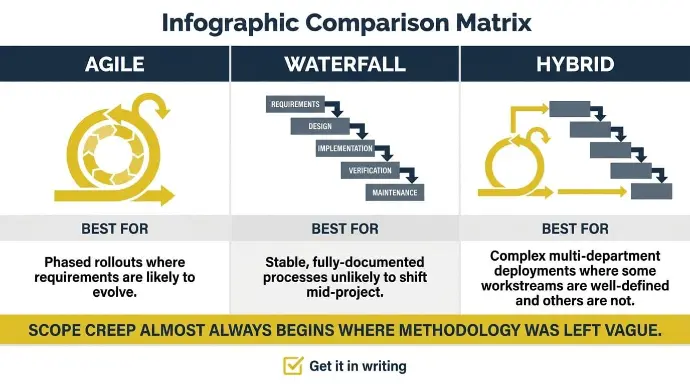
Implementation methodology is one of the strongest predictors of scope creep and user adoption outcomes because the implementation process shapes scope control, milestones, and adoption from the start, and most buyers never ask about it.
Agile works well for phased rollouts where requirements are likely to evolve. Waterfall suits organizations with stable, fully-documented processes that are unlikely to shift mid-project.
Hybrid is common for complex multi-department deployments where some workstreams are well-defined and others are not.
The methodology itself matters less than whether it is agreed upon in writing before the project starts, because this is one of the key factors in evaluating fit. Verbal alignment on approach isn’t enough. Scope creep almost always begins where methodology was left vague. Ask these questions directly before you move forward if you want a partner that has successfully implemented Odoo in a structured, repeatable way:
- What implementation methodology do you use, and why is it the right fit for a project of our complexity?
- How do you handle scope changes that come up mid-project?
- Is the methodology documented in the project agreement, or is it a verbal understanding?
- How do you manage user adoption risk during and after rollout?
- What does your project management structure look like week to week?
A vague or defensive answer to any of these is a red flag worth taking seriously.
Customization Philosophy: Where Sound Judgment Shows Itself
How a partner thinks about customization is one of the clearest windows into their long-term reliability.
Over-customization feels like a win during implementation. You get exactly what you asked for. The problem shows up 18 months later when an Odoo version upgrade breaks half your custom code and the remediation costs more than the original build.
A partner who defaults to custom development before exhausting native Odoo functionality is a long-term cost risk, not a value-add. Heavy customization creates fragile systems that are expensive to maintain, difficult to upgrade, and harder for your internal team to support independently.
One question cuts through the noise quickly: When do you recommend customization versus configuring standard Odoo?
A partner with sound judgment will give you a specific, principled answer. A partner who defaults to building whatever you need is telling you something important.
When Odoo modules are genuinely warranted, the right approach is to build them in a way that survives version upgrades cleanly.
We start every customization conversation by exhausting what standard Odoo can do natively. When custom development is truly warranted, we build modules in Python using Odoo's ORM framework so they reflect real technical expertise, integrate cleanly with the Odoo platform, and survive version upgrades without breaking.
We document every customization decision in writing and make upgrade path responsibility explicit in the contract before we write a single line of code. Firms that over-build on day one create expensive rescue jobs two years later, and we’ve seen enough of those to know what the pattern looks like.
Review Our Customization Approach
Red Flags That Buyers Usually Miss Until It’s Too Late
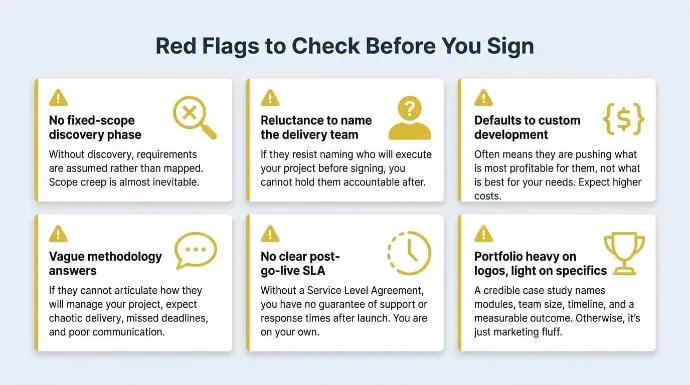
Most buyers evaluate implementation partners on the right criteria but miss the risks that only surface after the contract is signed.
The patterns below cause the most damage, and none of them gets enough attention during the selection process; the red flags buyers miss often show up later as delays, rework, and hidden costs.
Weak training plans also slow user adoption and increase support ticket volumes after go-live.
The Bait-and-Switch: Sales Team vs. Delivery Team
Bait-and-switch team composition is one of the most common and least discussed risks in ERP services.
A senior consultant leads your discovery calls, asks sharp questions, and builds confidence.
Then the project kicks off and you’re handed to a junior team you have never met. This isn’t rare.
It’s a standard operating model for many firms, while a good Odoo partner names the actual delivery team before you sign. Protect yourself before you sign by:
- Asking in writing who specifically will be assigned to your project, not who is available in principle.
- Requesting CVs or LinkedIn profiles of the consultants, developers, and project manager who will actually execute the work, including whether they are certified consultants.
- Confirming whether any delivery work will be handled by offshore staff not present in your sales conversations.
- Getting team composition written into the contract, not left as a verbal understanding.
If a partner resists this request, that resistance is the answer.
The table below summarizes the red flags worth building into your evaluation checklist when comparing vendors to identify the best Odoo implementation partner:
Red Flag | Why It Matters |
No fixed-scope discovery phase | Without discovery, requirements are assumed rather than mapped. Scope creep is almost inevitable. |
Reluctance to name the delivery team | If they resist naming who will execute your project before signing, you cannot hold them accountable after. |
Defaults to custom development | A partner who custom-builds before exhausting native Odoo functionality is a long-term cost and upgrade liability. |
Vague methodology answers | Verbal alignment on process is not binding. Scope creep almost always starts where methodology was left undefined. |
No clear post-go-live SLA | Vague support language becomes expensive when something breaks 60 days after go-live. |
Portfolio heavy on logos, light on specifics | A credible case study names modules, team size, timeline, and a measurable outcome. Logos without detail are not evidence. |
How to Validate a Partner Before You Sign Anything
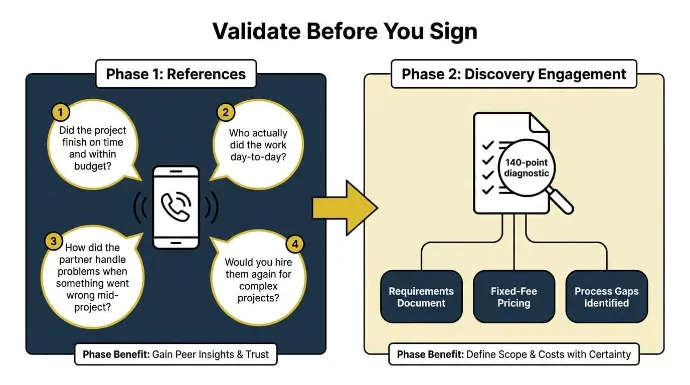
Choosing the right implementation partner means evaluating the provider’s implementation services, not just comparing proposals and pricing.
Before signing a contract, take the time to verify their track record, evaluate how they approach planning, and confirm they can deliver what they promise; this due-diligence stage in Odoo partner selecting is where weak fits usually become obvious.
These steps can help you avoid costly surprises and make a more informed decision.
References: The Fastest Shortcut to the Truth
References are the fastest shortcut to the truth.
Ask for two or three contacts from completed projects in a similar industry, and actually call them. Most buyers request references and never follow through.
The ones who do consistently surface information that no proposal or case study would reveal. When you get someone on the phone, ask:
- Did the project finish on time and within budget?
- Who actually did the work day-to-day, and were they the same people from the sales process?
- How did the partner handle problems when something went wrong mid-project?
- Would you hire them again for complex projects?
- What would you do differently if you were starting the selection process over?
Case studies deserve the same scrutiny. A credible case study names the modules implemented, the team size, the timeline, a measurable outcome, and evidence of successful projects. If a partner's portfolio is heavy on brand names and light on specifics, treat that as a gap.
References can also confirm whether training was effective enough to accelerate user adoption and reduce support ticket volumes after go-live.
For Almac Imports, Cudio’s work delivered 40% business growth and an 80% reduction in inventory write-offs. That’s the level of specificity that separates verified outcomes from marketing copy.
What a Proper Discovery Engagement Looks Like
The most useful pre-commitment tool available to buyers is a paid discovery or scoping engagement, because it helps when implementing Odoo and reduces planning ambiguity before a full contract is signed.
This is a structured phase where the partner maps your requirements, documents process gaps across your business operations, and demonstrates how they think before a full implementation contract is signed. A well-run discovery phase is not overhead. It is the mechanism that makes fixed-fee pricing possible.
Every Odoo implementation we do starts with a 140-point diagnostic that maps every operational workflow before a single line of configuration is written.
We scope projects with fixed-fee pricing so there are no surprise invoices after go-live. If a partner resists offering a discovery phase or deflects scoping conversations entirely, that tells you something specific about how they manage uncertainty. Pay attention to it.
Our discovery process starts with 140 diagnostic questions covering every operational workflow, integration dependency, data migration risk, and configuration decision before we scope a single module. This is also where we identify the external systems involved in integrating Odoo, including dependencies with CRM, ecommerce platforms, or accounting software, so the work is visible early. The output is a written requirements document with fixed-fee pricing attached, so you know exactly what you are getting before you commit. Most clients tell us this phase alone surfaces three to five process gaps their previous partners never asked about. The diagnostic conversation takes about 30 minutes and carries no obligation.
Team Composition and Post-Go-Live Support: What to Lock In Before Day One
Most buyers spend their evaluation energy on a partner's reputation and methodology, then sign a contract that says almost nothing about who will actually show up on day one or what happens when something breaks after go-live.
Both gaps are fixable, but only if you address them before you sign.
Who Should Be on a Qualified Implementation Team
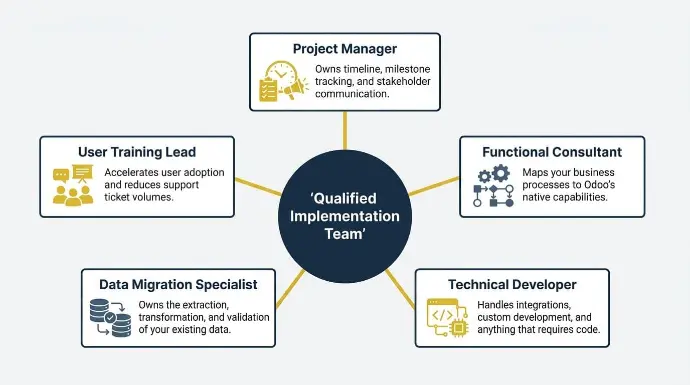
A complete delivery team of qualified Odoo ERP consultant professionals covers five distinct functions. Not every partner resources all five, and some bundle roles in ways that create coverage gaps.
Ask directly how each function is staffed on your specific project, since strong teams are usually a mix of Odoo experts rather than generalists, and ask who is specifically responsible for your Odoo systems:
- Project Manager: Owns timeline, milestone tracking, and stakeholder communication. This role should be dedicated, not shared with a billable consulting function.
- Functional Consultant: Maps your business processes to Odoo's native capabilities, leads configuration decisions, and often becomes central to post-live functional support.
- Technical Developer: Handles integrations, custom development, and anything that requires code. This role is distinct from the functional role.
- Data Migration Specialist: Owns the extraction, transformation, and validation of your existing data. Treating data migration as a general task rather than a specialized one is a common source of go-live delays.
- User Training Lead: Designs and delivers end-user training, which accelerates user adoption and reduces support ticket volumes. User adoption does not happen automatically after go-live, and this role is frequently under-resourced.
Ask directly how many simultaneous projects the assigned team is managing. Overloaded consultants are one of the most consistent sources of delays, and the answer is rarely volunteered.
We don't start configuring on day one. We spend the first two weeks just listening.
That investment in understanding your operation is what makes the rest of the project go faster, not slower.
What Post-Implementation Support Should Actually Cover
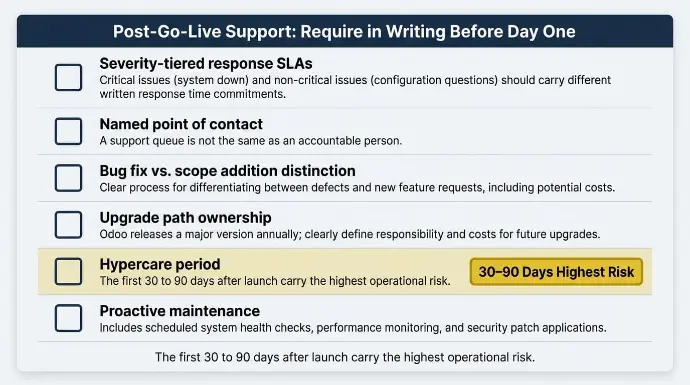
Post-go-live support for an odoo erp system needs explicit Service Level Agreements, not vague contract language. The first 30 to 90 days after launch carry the highest operational risk, and most buyers discover this only after they experience it. Require specifics on the following before signing:
- Severity-tiered response Service Level Agreements (SLAs): Critical issues (system down) and non-critical issues (configuration questions) should carry different written response time commitments.
- Named point of contact: A support queue is not the same as an accountable person.
- Bug fix vs. scope addition distinction: Clarify in writing what qualifies as a covered defect versus a billable change request.
- Upgrade path ownership: Who is responsible for version migrations after the project closes? Odoo releases a major version annually. This question needs a written answer before you sign.
- proactive maintenance: Confirm it includes system monitoring, timely updates, and security patches to maintain stability after launch.
- Hypercare period: The first 30 to 90 days post-go-live carry the highest risk. Confirm this phase is explicitly defined in the contract, separate from ongoing managed services, with 24/7 support for critical issues where business continuity requires it.
Cudio’s ongoing Odoo services cover bug fixes, module updates, user training, and configuration changes as your business evolves. Every support engagement includes a named point of contact, severity-tiered response SLAs in writing, and a clear distinction between covered defects and billable change requests. We maintain a 100% client retention rate because we treat go-live as the beginning of the relationship, not the end of the engagement. If your current system is live but underperforming, our support team can step in without requiring a full re-implementation.
Why Operator-Led Implementation Changes the Outcome
Most ERP implementation failures trace back to the same root cause: A partner who understood the technology but not the business or the ERP software being deployed. That gap is a perspective problem, and it shows up earliest in the discovery phase, where the wrong questions get asked and process gaps go unnoticed until they become project problems.
We built Cudio because we lived with the problem ourselves. We scaled an omnichannel business on Odoo and hit every wall that our clients now describe to us, which gave us real-world operating experience across the Odoo ecosystem.
When the people implementing your ERP have actually run businesses on ERP, they bring a different kind of intuition to the table. They know which process assumptions break under real operational load. They flag the edge cases that only surface after go-live, not during it.
A simplicity-first philosophy reinforces this. Defaulting to standard Odoo functionality over custom development is not a limitation. It is a deliberate choice that reduces upgrade risk, lowers long-term maintenance burden, and keeps your system supportable by your own team over time. Firms that lead with technical capability tend to over-build. Firms that lead with process understanding tend to right-size the solution.
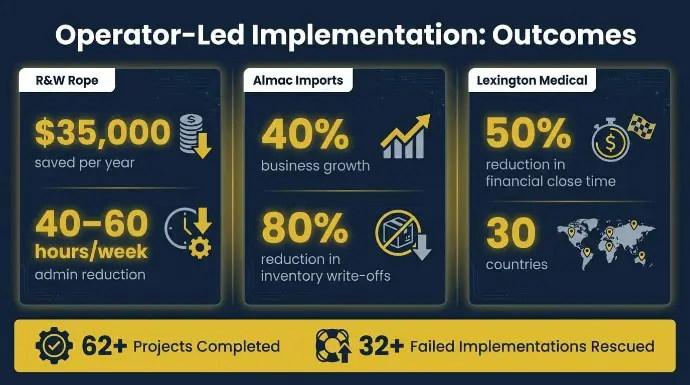
The outcomes are concrete. For R&W Rope, we saved $35,000 per year and cut administrative work by 40 to 60 hours per week. For Almac Imports, we delivered 40% business growth and an 80% reduction in inventory write-offs with a 24-hour delivery SLA. For Lexington Medical operating across 30 countries, we cut financial close time by 50%. These results came from a structured approach that supports a successful Odoo implementation.
We begin every project with two weeks of listening before we configure anything. Our 140-point diagnostic maps your workflows, identifies integration dependencies, and surfaces the process gaps that cause go-live failures.
We scope with fixed-fee pricing so there are no surprise invoices after we start. And because we have run businesses on Odoo ourselves, we know which edge cases to pressure-test before we deploy Odoo and before they become your problem at 11pm on launch night.
Final Words
Tier status, certifications, and proposal decks tell you what a partner has achieved across all their clients.
They don’t tell you what will happen on your project. The right Odoo implementation partner is the one whose team composition, methodology, post-implementation support commitments, and history of successful implementations hold up under direct questioning before you sign anything.
We have completed 62+ Odoo ERP projects and rescued 32+ failed implementations. We know what a poorly scoped ERP project costs because we have lived it from both sides. If you want a direct conversation about fit before committing, we are ready when you are as an official Odoo partner.
Buyers evaluating Odoo partners consistently ask the same questions. Here are direct answers to the ones that matter most.
Frequently Asked Questions
Choosing the right Odoo partner is a major decision, and the details can have a lasting impact on your implementation's success. Here are quick answers to the most common questions businesses ask before starting an Odoo project.
How long does a typical Odoo implementation take from contract to go-live?
Most Odoo implementations take between 3 and 6 months, depending on project complexity and business requirements. Larger deployments with multiple entities, integrations, or custom workflows can take significantly longer. Clean data and fast decision-making often help keep projects on schedule. A thorough discovery phase is usually one of the biggest factors in accurate timeline planning.
Can a smaller Ready Partner deliver a better outcome than a Gold Partner for my project?
Yes, sometimes. Partner tiers include Certified, Silver, and Gold levels, and tier reflects overall sales volume and scale more than fit for your industry or business model.
An Odoo Gold Partner often brings experience from large-scale Odoo projects, but that does not automatically make them the best fit for every business.
A smaller certified team with deep experience in your specific sector may provide more value than a larger generalist partner. Industry knowledge and implementation experience are often more important than partner status alone.
What happens to our Odoo system when a new version is released after go-live?
Your Odoo system will continue working after a new version is released, but upgrades are not automatic. Businesses must decide whether and when to migrate to a newer version. Systems with extensive customizations often require additional planning and testing during upgrades. Understanding upgrade responsibilities before implementation can help avoid unexpected costs later.
How do we handle data migration from our existing system during an Odoo implementation?
Data migration involves extracting, cleaning, validating, and importing information into Odoo before go-live. The process usually includes multiple rounds of testing to ensure data accuracy and system performance. Poor data quality is one of the most common causes of implementation delays. Working with a partner that has dedicated migration expertise can significantly reduce risk.
What should our internal team be responsible for versus the implementation partner?
Your internal team should typically own business decisions, process validation, user testing, and change management. The implementation partner is responsible for system configuration, technical development, integrations, and training. Clear ownership helps prevent delays and confusion during the project. Assigning an internal project leader often improves communication and decision-making.
How do we know if a failed Odoo implementation is recoverable?
Most failed Odoo implementations can be recovered with the right assessment and remediation plan. Recovery depends on factors such as data quality, system configuration, and the extent of custom development already completed. An experienced partner can usually identify quick improvements while evaluating the broader recovery strategy. The earlier issues are identified, the easier and less costly recovery tends to be.