
Healthcare ERP Solutions That Unify Operations From Billing to Patient Care
Official Odoo Partner · 95% client retention · 30+ years experience · Free ERP assessment
Billing in one system. Scheduling in another. Supply orders somewhere else.
For many healthcare organizations, disconnected tools slow operations and create costly inefficiencies.
Cudio implements healthcare ERP solutions built on Odoo that integrate finance, operations, and the supply chain into a single platform. Our healthcare ERP systems replace fragmented software with a unified healthcare ERP designed for modern healthcare providers and the evolving healthcare industry.

Is Your Current System Secretly Stalling Your Business Growth?
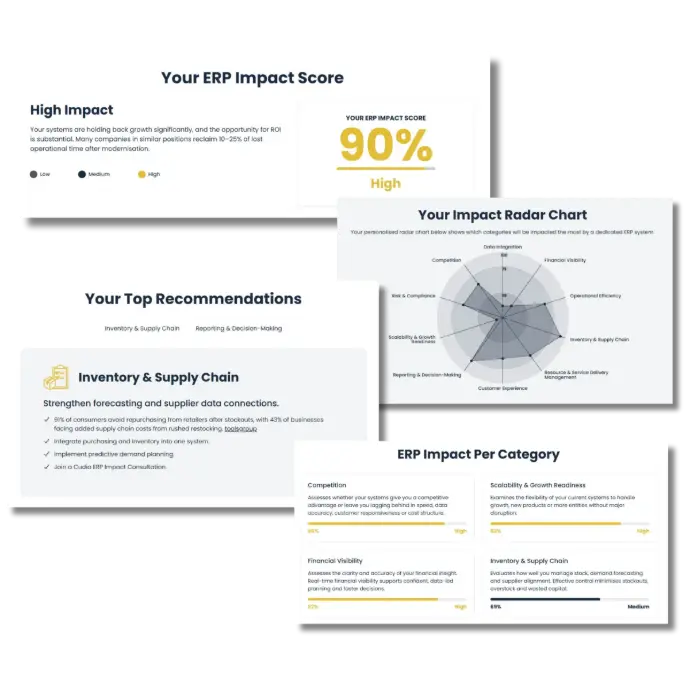
Take the free 3-minute ERP Impact Assessment to uncover the unseen costs, bottlenecks and missed opportunities inside your current systems. Receive a personalised Impact Report showing where an ERP like Odoo could deliver the biggest transformation, and your next steps.
Real Problems Demand Real Solutions
Successful Odoo implementation starts with solving the real challenges businesses face every day.
Problem: Data Silos Are Killing Your Efficiency
Multiple systems. Zero visibility. Your team wastes hours transferring data between platforms that don’t talk to each other.
Our Solution
We consolidate everything into one powerful Odoo platform where every department works from the same real-time data.
Problem: Manual Processes Are Burning Cash
Spreadsheets, paper workflows, and repetitive data entry keep your team stuck in admin work instead of growing your business.
Our Solution
We automate your workflows and eliminate manual bottlenecks, saving your team precious time.
Problem: Your Current System Can’t Scale
Growth should be exciting, not terrifying. But your legacy ERP slows you down with expensive upgrades and rigid limits.
Our Solution
Odoo’s modular design grows with you. Start with what you need, then add features as you expand. No costly overhauls.
Problem: Past Implementation Disasters Left Scars
If you’ve been burned by failed ERP projects, you know the pain: cost overruns, missed deadlines, and systems that never worked right.
Our Solution
We’ve rescued 32+ failed implementations. We know exactly where projects go wrong and how to get them right.
Why Healthcare Organizations Struggle With Disconnected Systems

Across the healthcare industry, we see the same challenge again and again.
Most healthcare providers do not run a single system. They are juggling many. Billing and financial management live in one tool, scheduling in another, while inventory management and medical supply chain purchasing often sit in spreadsheets or disconnected apps.
For many healthcare organizations, this creates everyday friction.
- Teams cannot see the full operational picture
- Billing cycles slow down, and revenue slips through the cracks
- Compliance records become harder to track
- Medical supply chain visibility is limited
- Staff spend too much time switching systems
From our experience implementing ERP systems, the issue is rarely the people or the process. It is the technology behind it that is disconnected.
A well-implemented healthcare ERP brings finance, operations, and the supply chain into one place. With the right healthcare ERP systems, healthcare organizations finally get the clarity and control needed to operate smoothly.
Real Results, Real Businesses
Our successful projects are our proof that the right Odoo implementation can transform challenges into measurable growth.
Global Operations, Unified in Odoo
"Reduced days to close by 50%, error rate slashed. Odoo now handles global complexity that our legacy system couldn't."
Operating across 30 countries, Lexington Medical struggled with complex BOMs and business structures. We migrated them to Odoo with custom modules built for global scale and manufacturing complexity.

QuickBooks, Fishbowl, and Shopify? Gone.
"$35K saved annually. 40-60 hours back each week. Full visibility achieved."
R&W Rope was juggling multiple disconnected systems. We unified everything into Odoo (ERP, e-commerce, and inventory), cutting costs and saving hundreds of hours monthly.

Disconnected No More
"40% business growth. 80% fewer inventory write-offs. We now ship within 24 hours."
Almac struggled with inefficiencies from siloed systems. We implemented a fully integrated B2B/B2C Odoo solution, streamlining operations and enabling rapid delivery at scale.

Why Healthcare Providers Choose Cudio for ERP Implementation
Implementing a healthcare ERP is not just a software project. It changes how your entire organization operates. That is why many healthcare providers choose to work with a team that understands both technology and the realities of running complex healthcare organizations.

Operators, Not Just Implementers
At Cudio, many of us have actually run businesses on Odoo before becoming consultants. Several members of our team implemented Odoo inside their own companies, and our leadership team has held C-suite roles in operating businesses.
So when we design healthcare ERP solutions, we are not just configuring software. We are thinking about revenue cycle management, compliance workflows, and operational complexity the same way an operator would. Our background in management consulting helps healthcare organizations translate strategy into systems that actually work day-to-day.

Senior Experts From Day One
We keep our implementation teams intentionally small and experienced. There are no junior developers assigned to critical projects and no handoffs to offshore teams halfway through.
Every engagement is led by senior consultants with deep experience in implementing healthcareand complex ERP systems across industries. From the first discovery call to final rollout, you work directly with the same experienced team.
Proven Data Migration and System Integration
Healthcare data migration carries real risk. Patient records, billing history, compliance documentation, and operational financial data all need to move safely into the new healthcare ERP.
Our team uses a structured migration framework with multiple validation stages to ensure accuracy and continuity. We also have extensive experience integrating healthcare ERP platforms with existing systems, including EHRs, billing tools, and supply chain applications.
A Proven Track Record
Organizations choose Cudio because we focus on results, not just implementation.
- 96% client retention rate
- 75+ global ERP implementations delivered
- 35+ failing ERP projects successfully rescued
- 30+ years of combined technology and leadership experience
If your healthcare organization is evaluating healthcare ERP systems, our team is happy to walk you through your requirements and share a realistic implementation roadmap.
How Lexington Medical Cut Close Time by 50% Across 30 Countries
When Lexington Medical came to us, its operations were already global. The company operates in 30 countries, managing complex bills of materials, strict traceability requirements, and high volumes of intercompany transactions. Their legacy systems simply could not keep up with the scale.
Our team implemented Odoo ERP with fully integrated modules for inventory, accounting, manufacturing, CRM, and financial reporting. By consolidating multiple systems into one platform, Lexington Medical gained a single operational and financial view across its global organization.
The results were immediate:
- 50%+ reduction in financial close time
- Significant reduction in operational errors across global teams
- Scalable infrastructure without adding new software systems
As Rowan from Lexington Medical explains:
"Through our partnership with Cudio, we improved existing workflows in Odoo and built custom solutions that reduced our days to close by over 50% while lowering our error rate."
And Lexington Medical is not the only example.
Other organizations working with Cudio have seen similar improvements:
- Almac Imports: 40% business growth and 80% fewer inventory write-offs
- R&W Rope: $35,000 annual savings and 40–60 hours per week eliminated from administrative work
For many growing organizations, the biggest advantage of Odoo is not just automation. It has one platform that can support operations as the business scales.
We start by understanding how your organization actually works. Our team reviews existing systems, maps workflows, and documents operational requirements across finance, clinical operations, and the supply chain. This ensures the healthcare ERP is designed around real processes, not assumptions.
Next, we configure the right ERP solution for your environment. This includes selecting modules, designing workflows, and planning integrations with existing EHR systems or electronic health records so daily healthcare operations remain uninterrupted.
We build required customizations, connect APIs, and migrate critical patient data and operational information. Every component is tested thoroughly before anything goes live.
We train teams based on their roles, whether they manage scheduling, finance, or patient management. A phased rollout ensures healthcare professionals can adopt the system without disrupting patient care.
After launch, we continue refining the ERP solution through performance monitoring, reporting improvements, and operational guidance.
Most healthcare ERP implementations are complete within 3–6 months, though simpler environments can often be deployed in 6–12 weeks.

Frequently Asked Questions About Healthcare ERP Solutions
A healthcare ERP system is software that integrates core business functions, finance, supply chain, HR, procurement, and operations into a single platform. Unlike standalone tools that handle one function each, an ERP connects these processes so data flows automatically between departments. Cudio implements healthcare ERP solutions on Odoo, which offers 75 core modules configurable to healthcare workflows.
ERP manages the business side of healthcare: finance, HR, procurement, supply chain, and operations. EHR (Electronic Health Records) manages clinical patient data, charts, diagnoses, and treatment plans. They complement each other. Cudio's healthcare ERP implementations integrate with existing EHR systems like Epic and Cerner rather than replacing them.
With Cudio, most implementations are complete in 3–6 months, depending on complexity. Simple configurations can go live in 6–12 weeks. Complex multi-site implementations with extensive customizations and data migration may take longer. We provide a detailed timeline during your free initial assessment.
Odoo ERP includes data encryption, role-based access controls, and comprehensive audit trails that track every user action. Automated compliance workflows reduce the risk of human error in documentation. These features support HIPAA and HITECH requirements, though compliance ultimately depends on proper implementation and organizational policies.
Most Cudio projects range from $15,000 to $100,000+, depending on the number of users, modules, customizations, and integrations required. Odoo's open-source foundation means lower licensing costs compared to SAP, Oracle NetSuite, or Microsoft Dynamics 365. We provide a no-cost, high-level estimate to help you plan with confidence.
Yes. Cudio has experience connecting 100+ systems. We build direct API integrations with EHR platforms, practice management systems, and specialty clinical tools. Our integration approach supports both real-time and batch data synchronization, connecting your clinical systems to a unified financial and operational data without disrupting clinical workflows.