


The best Odoo development companies do more than change screens. They know when Odoo Studio is enough, when a custom module is justified, and how to extend Odoo without weakening security, performance, or version compatibility. For U.S. businesses, the right developer should also understand high-volume operations, specialized reporting, regulated data access, multi-state requirements, and U.S.-specific workflows.
This guide compares seven companies that serve U.S. businesses exclusively for Odoo development. It does not rank their broader services. The assessment focuses on the code and features each company can create, its Odoo framework skills, its U.S. relevance, and the safeguards buyers should expect around testing, documentation, and maintainability.
Key Takeaways
Development fit matters more than company size. A strong match depends on the feature being built, the module involved, the required business logic, and the level of technical specialization.
Odoo Studio handles many low-code changes, including fields, views, reports, approval rules, and automations. Custom Python, XML, JavaScript, and Owl work should be reserved for requirements that exceed the capabilities of these tools.
Cudio is the strongest fit in this comparison for complex custom modules, inherited code cleanup, advanced operational logic, and businesses that want senior developers working directly on the codebase.
Bista Solutions stands out for finance-oriented modules, Open Source Integrators for manufacturing and field-service extensions, Captivea USA for balanced low-code and coded customization, OneStopOdoo for broad application development, Novobi for reusable accelerators and U.S.-specific extensions, and Ciranta for lean module work with a documented testing process.
Every shortlisted company should be asked to show how it handles model inheritance, access controls, automated tests, performance profiling, source control, technical documentation, and version compatibility.
Hosting determines what can be developed. Odoo Online does not support custom Python modules, so coded modules require Odoo.sh or an on-premise environment.
Why Odoo Development Matters in the United States
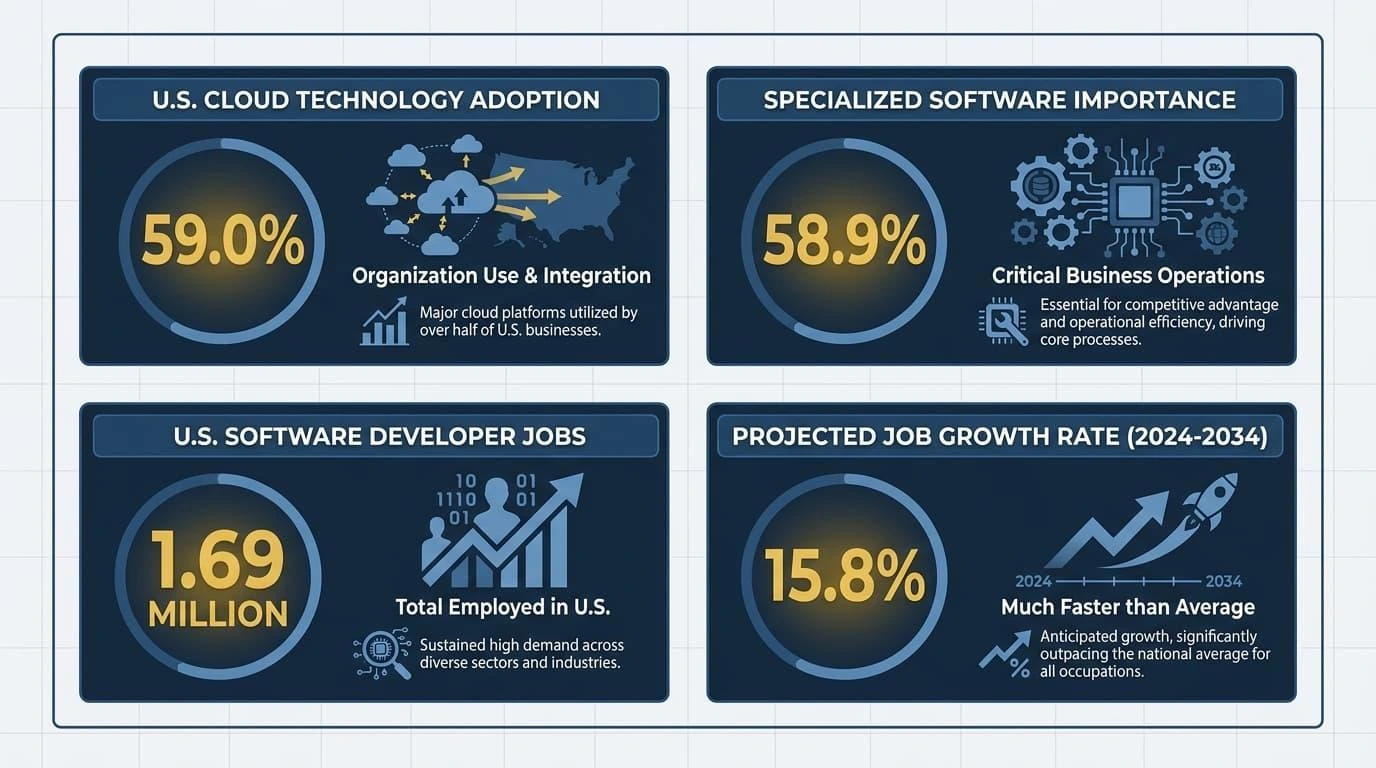
U.S. businesses increasingly depend on cloud platforms and specialized software, but that does not mean every company needs a heavily customized Odoo database. The data below show why maintainable software matters. Custom code is justified only when a requested feature creates enough operational value.
In the United States, the U.S. Census Bureau’s 2023 Annual Business Survey found that 59.0% of businesses using cloud-based technology considered it very important to their processes or methods. Specialized software was almost identical at 58.9%. That makes maintainable business software a material operating concern, not a minor IT preference.
The U.S. Bureau of Labor Statistics counted about 1.69 million software developer jobs in 2024 and projects employment to grow by 15.8% between 2024 and 2034. That national demand makes assigned-developer experience, code review, testing, and maintainability practical hiring concerns for U.S. companies buying custom ERP development.
These are U.S. business and labor-market figures, not Odoo market-share statistics. They show why U.S. buyers should treat custom business software as a long-lived asset. Code quality, security, and maintainability determine how safely that asset can evolve.
Odoo ERP is both ERP software and a framework for extending business applications. Used well, the ERP system can support digital transformation, business growth, and more consistent business processes without replacing every operating rule with custom code. The real question is not whether an ERP solution can empower businesses, but whether custom work makes Odoo suitable for the requirement while remaining cost-effective. The Odoo Community and Enterprise comparison matters here because Studio availability, hosting options, and access to enterprise features change what a developer can build and maintain.
What Odoo Development Actually Includes
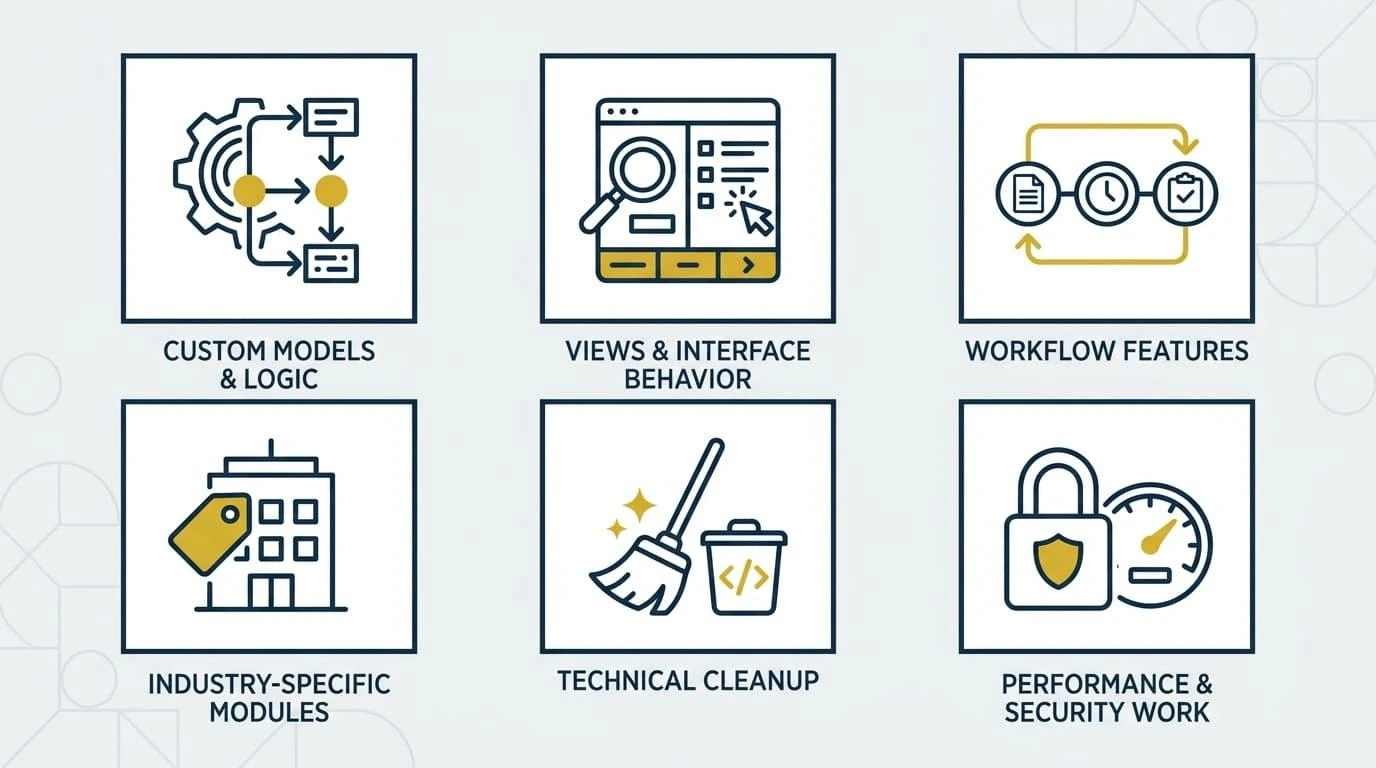
Odoo development begins where standard settings and low-code tools stop. The platform is modular, so developers can extend existing applications or create new ones without rewriting the entire system. The exact development path should align with the technical requirements.
Odoo’s module documentation explains that an Odoo module is a Python package declared through a manifest file. In practice, a development company may work across the following layers:
Custom models and business logic: New data structures, computed fields, validations, scheduled actions, and business rules written primarily in Python.
Views and interface behavior: Forms, lists, Kanban boards, search views, dashboards, and reports defined with XML, QWeb, JavaScript, and Owl components.
Workflow features: Automated approvals, exception handling, role-specific actions, and domain-specific processes that standard apps do not cover.
Industry-specific modules: Purpose-built capabilities for manufacturing, distribution, finance, field service, retail, construction, or another specialized operating model.
Technical cleanup: Refactoring fragile inheritance, removing unsafe overrides, consolidating duplicate logic, and documenting undocumented modules.
Performance and security work: Optimizing ORM usage, queries, batch operations, record rules, access control lists, and user permissions.
Common feature requests include custom module development for specialized rules, workflow automation for approvals and exception handling, inventory management controls, and reporting across business operations. Odoo integration often connects the ERP with CRM and eCommerce systems, a common component of broader Odoo solutions.
More interface-heavy work can include web app development, Odoo website features, and web development for customer or supplier portals. E-commerce platforms may also require Odoo modules that manage product data, order statuses, or fulfillment logic within core business workflows, especially when they rely on Odoo as the operational source of truth.
The strongest tailored solutions are not necessarily the largest. Good custom solutions isolate the exact gap, reuse native business applications, and add innovative solutions only where the standard Odoo ecosystem cannot meet the business needs. That discipline produces tailored ERP solutions without turning the database into a separate software product that happens to run on Odoo.
Odoo Studio or Custom Code
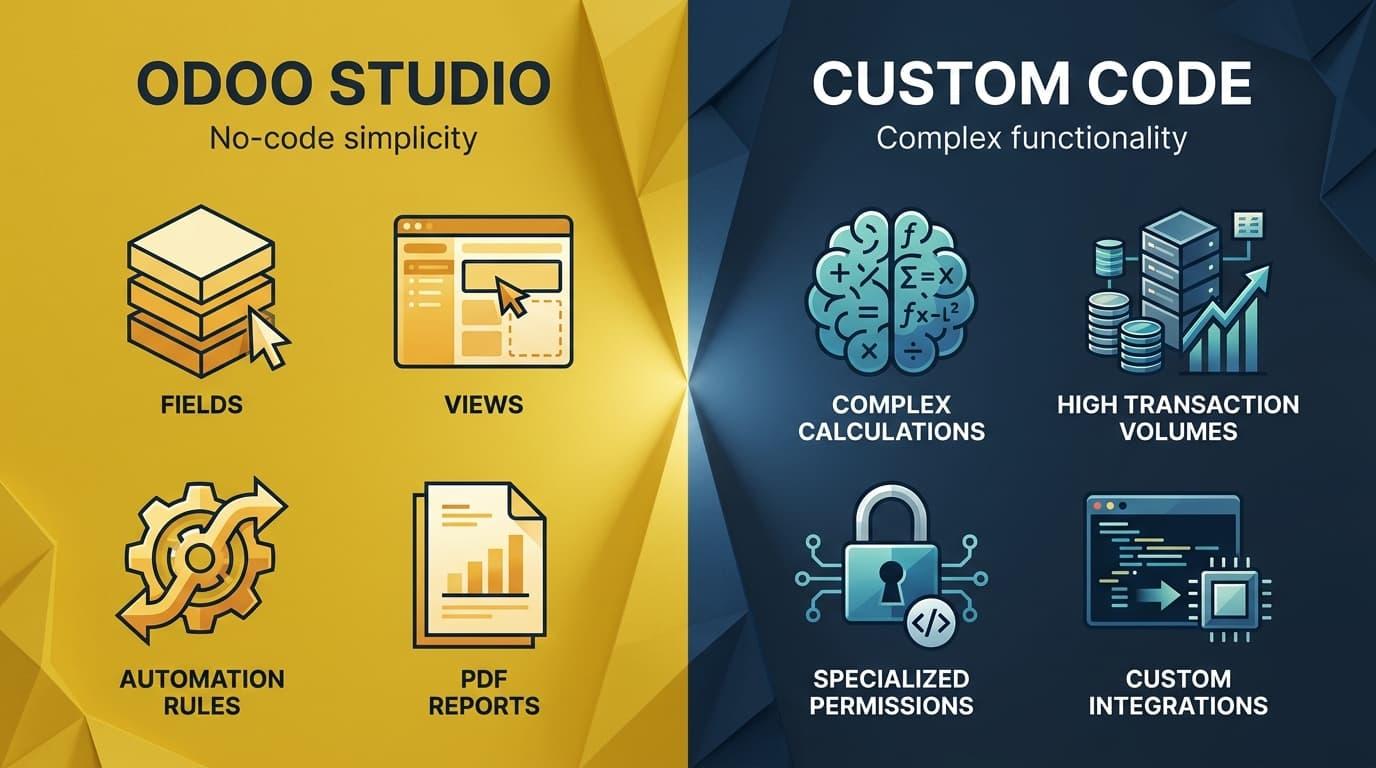
Odoo Studio can create or change fields, models, views, automation rules, approval rules, and PDF reports without conventional programming. It is often the most proportionate option for a straightforward interface change or an internal workflow change.
Custom code is appropriate when the requirement involves complex calculations, high transaction volumes, specialized permissions, reusable logic, advanced user interface behavior, or an entirely new application. A credible development company should explain why code is necessary and which standard or low-code options were ruled out.
The choice between standard Odoo and custom development should be made at the feature level. Odoo Community may permit extensive source-level changes in a self-hosted environment, while Enterprise adds Studio and other proprietary applications. Neither option automatically makes Odoo suitable for a complex requirement. The architecture, hosting model, and maintenance responsibility still determine whether the result remains supportable.
How We Evaluated the Best Odoo Development Companies
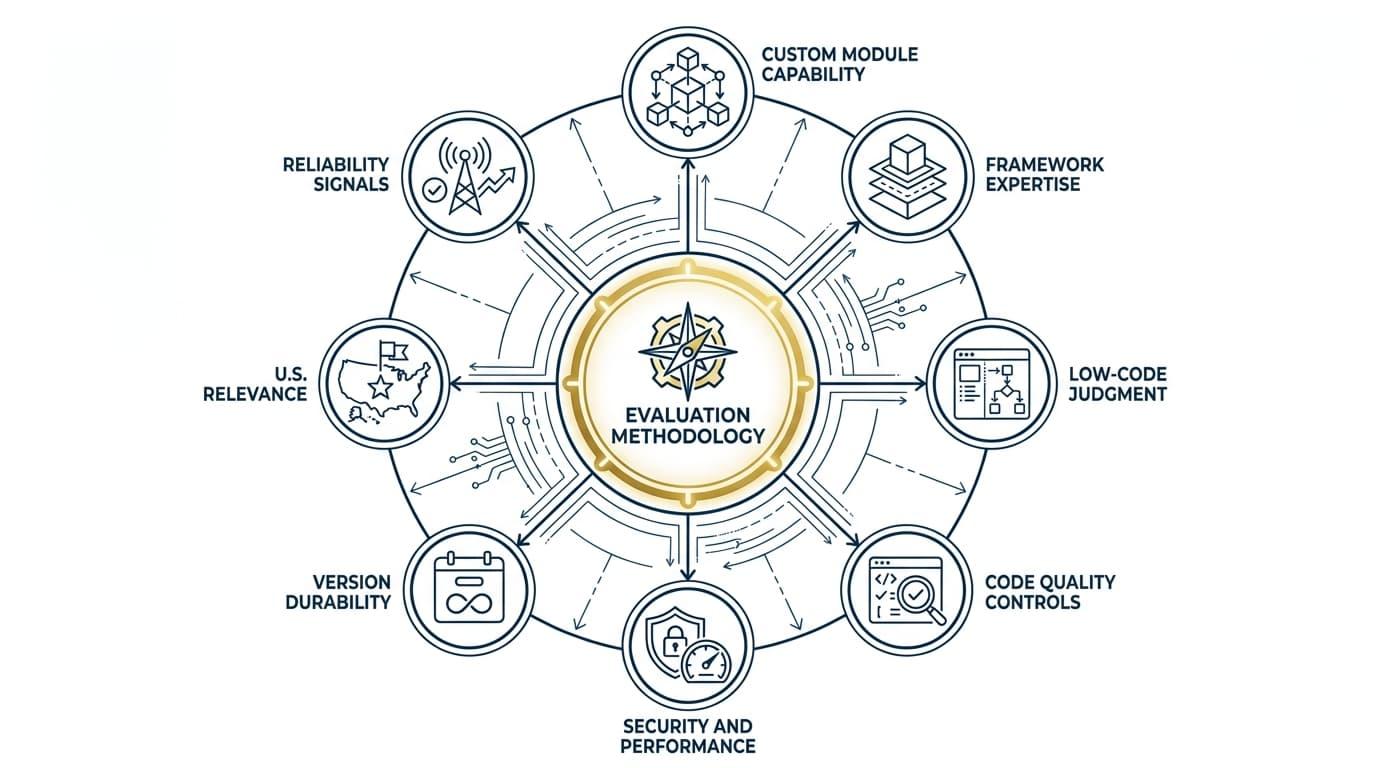
This comparison uses development-only criteria.
Odoo partner status is treated as a useful verification point, not proof of code quality, because partner tiers reflect sales volume, retention rates, and certified staff numbers more than coding skill alone.
Odoo development partners can be certified as Ready, Silver, or Gold. Each company was assessed using publicly available technical evidence from its own website, Odoo’s official directory, and development materials. There are 240 official Odoo partner listings in the USA, which is why filtering criteria matter.
Custom module capability: Evidence that the team creates new models, logic, workflows, reports, interfaces, or full Odoo applications.
Framework expertise: Familiarity with Python, the Odoo ORM, XML, QWeb, JavaScript, Owl, inheritance, manifests, and module structure.
Low-code judgment: Ability to distinguish between Odoo Studio changes and requirements that warrant a coded module.
Code quality controls: Testing, source control, review practices, staging, documentation, and reproducible releases.
Security and performance: Awareness of access rights, record rules, ORM-safe patterns, query behavior, profiling, and scalable code design.
Version durability: A clear approach to avoiding changes to Odoo core and keeping custom modules maintainable across later releases.
U.S. relevance: A U.S. office, official U.S. partner-directory listing, or documented development work for American businesses.
Reliability signals: Review client reviews and delivery history to assess partner reliability.
References should be checked for fit by industry, user count, and operational complexity, and a certified Odoo partner should still be validated against those specifics.
Best Odoo Development Companies at a Glance
The table provides a development-focused shortlist. The “best for” labels describe technical fit, not an absolute ranking for every Odoo project.
Company | Best Development Fit | Demonstrated Strength | Verify Before Hiring |
|---|---|---|---|
Cudio | Complex modules and inherited codebases | Senior-only team, staging tests, custom modules, code cleanup | Requested feature scope and module-level acceptance tests |
Bista Solutions | Finance and reporting development | Module, website, theme, and finance-oriented customization | Named developers and current-version coding examples |
Open Source Integrators | Manufacturing and field-service extensions | Developer education, models, fields, and operational modules | Exact test coverage and ownership of custom source code |
Captivea USA | Balanced Studio and coded customization | Custom modules, automated workflows, reports, Python, ORM, and JavaScript | Depth of the assigned U.S. development team |
OneStopOdoo | Broad module, website, theme, and mobile development | Custom workflows and functional and technical development | Evidence behind scale claims and code-review standards |
Novobi | Reusable accelerators and U.S.-specific extensions | Technology accelerators, accounting and payroll enhancements, senior Odoo depth | Module-level documentation and test coverage for the selected accelerator |
Ciranta IT Services | Lean extensions, reports, and dashboards | No-core-edit policy, Studio-or-module judgment, unit and functional testing | Assigned team depth and performance testing for high-volume features |
7 Best Odoo Development Companies in the USA
Each company profile uses the same development parameters. The emphasis stays on what the team builds inside Odoo, how that work fits the framework, and what a buyer should verify before granting access to a production codebase.
1. Cudio for Complex Custom Modules and Codebase Cleanup

Best For
U.S. businesses that need advanced operational logic, substantial custom modules, performance-sensitive features, or repair of fragile and undocumented Odoo code.
About
We built Cudio’s Odoo development services for businesses whose requirements exceed standard applications and simple Studio changes. Our public development page describes a senior-only team with more than a decade of Odoo experience and proven expertise, with custom development alongside Odoo implementation services. It also outlines a structured delivery model with specifications, project management, staging, and testing.
Development Parameters
Core work: Custom modules, module extensions, workflow logic, reports, dashboards, interface changes, and codebase refactoring that lead to customized ERP solutions.
Technical approach: Configuration and Studio are considered before Python, XML, QWeb, JavaScript, or Owl development.
Quality controls: Written specifications, staging-based testing, senior developer ownership, technical documentation, and ongoing support.
Best-fit constraint: A tiny field or layout change may not require Cudio’s more structured development model.
2. Bista Solutions for Finance-Oriented Odoo Development
Best For
U.S. companies that need finance-specific modules, complex reporting behavior, accounting workflow extensions, or custom Odoo website and theme work.
About
Bista Solutions’ customization and development page positions the company as a specialist in Odoo customization and Odoo ERP implementation when standard applications cannot fully support reporting, compliance, or workflow requirements. Its published materials also position Bista as an Odoo implementation company, identifying module development, website development, theme development, and broader Odoo customization as core capabilities. The company also presents itself in ways some buyers may read as a best Odoo implementation company for finance-heavy needs, though that is a claim worth verifying against your own requirements.
Development Parameters
Core work: Custom modules, finance features, reporting logic, ERP consulting, websites, themes, and application enhancements.
Technical advantage: Broad exposure to Odoo application areas and finance-oriented requirements, backed by the team’s technical expertise.
Evidence to request: A current code sample, test strategy, module documentation example, and explanation of supported inheritance patterns.
Best-fit constraint: Buyers seeking a smal,l senior-only team should confirm who will write and review the code.
3. Open Source Integrators for Manufacturing and Field-Service Development
Best For
Manufacturers, distributors, and field-service organizations that need custom models, forms, data structures, or user actions grounded in production and service workflows.
About
Open Source Integrators’ Odoo development materials demonstrate hands-on knowledge of developer mode, fields, models, views, and the structure behind Odoo applications to support seamless integration across deployments. Its published customization guidance also distinguishes between Studio-based changes and more advanced work using Python and XML, including third-party integrations.
Development Parameters
Core work: Custom models, fields, views, manufacturing logic, warehouse functions, and field-service extensions.
Technical advantage: Public developer education demonstrates familiarity with both low-code changes and coded modules, giving buyers more confidence in working with experienced Odoo developers.
Evidence to request: Automated test coverage, performance benchmarks for transaction-heavy features, and the source-code handoff standard; if your manufacturing or field-service workflow relies on moving legacy records into new modules, ask how they handle data migration.
Best-fit constraint: Its clearest public evidence of development centers on manufacturing, distribution, and service operations.
4. Captivea USA for a Balanced Low-Code and Custom-Code Approach
Best For
Businesses that want one provider to evaluate Odoo Studio changes, automated workflows, custom reports, and fully coded modules without defaulting immediately to a large custom build.
About
Captivea’s customization page describes three development paths: standard configuration, Studio-based personalization, and Odoo implementation, as well as new applications when existing features and available apps do not cover the requirement. Its public Odoo developer description adds new fields, complete modules, and framework knowledge to that broader Odoo services scope.
Development Parameters
Core work: Studio customization, custom modules, automated workflows, personalized reports, backend logic, and interface development.
Technical advantage: A clear distinction between low-code customization and full-stack development, which matters even more when a skilled team decides what should stay simple and what should be built properly.
Evidence to request: Names and experience of the assigned developers, code-review responsibilities, current-version examples, and proof that the company delivers quality services through the team actually assigned to your project.
Best-fit constraint: Global capability does not automatically confer experience on the specific U.S. project team.
5. OneStopOdoo for Broad Odoo Application Development
Best For
Businesses seeking a broad range of Odoo development services, including custom modules, workflows, websites, themes, mobile applications, and technical enhancements.
About
OneStopOdoo’s development page presents the firm as a U.S.-serving Odoo Silver Partner and odoo service provider with broad development coverage, offering functional and technical development, custom modules and workflows, website and theme development, mobile apps, server management, and wider odoo solutions. This breadth makes it useful for a buyer whose feature request touches several Odoo surfaces.
Development Parameters
Core work: Custom modules, workflows, websites, themes, mobile apps, and functional and technical enhancements.
Technical advantage: Broad coverage across Odoo backend, web, and mobile development needs; some vendors also position themselves as a leading Odoo development company, which should still be weighed against delivery evidence.
Evidence to request: A proven track record, verifiable team credentials, peer-review standards, automated tests, and source ownership terms.
Best-fit constraint: Buyers should validate public scale claims and confirm senior oversight of the assigned developers.
6. Novobi for Reusable Accelerators and U.S.-Specific Extensions
Best For
U.S. businesses that want proven Odoo extensions for accounting, payroll, manufacturing, retail, or field-service requirements instead of commissioning every feature from a blank specification.
About
Odoo’s official Novobi profile describes an Austin-based Odoo Gold Partner with more than 500,000 hours of Odoo work, positioning the firm as a trusted Odoo partner for U.S. businesses that need reliable ERP development and custom solutions, as well as a library of Technology Accelerators that augment, extend, or bundle Odoo applications. The same profile identifies U.S. accounting and payroll enhancements, including multi-state tax, benefits, withholding calculations, and accounting functionality aligned with U.S. GAAP.
Development Parameters
Core work: Reusable Technology Accelerators, enhanced Odoo applications, U.S. accounting and payroll features, manufacturing tools, and field-service applications.
Technical advantage: A mature library of prebuilt extensions can reduce the need for new code when the requirement matches an existing accelerator.
Evidence to request: Manifest dependencies, access-control design, automated tests, release history, source ownership, and version support for the selected accelerator.
Best-fit constraint: Reuse creates value only when the accelerator fits the actual requirement without forcing unnecessary behavior.
7. Ciranta IT Services for Lean Module Extensions and Reporting Features
Best For
U.S. small and mid-sized businesses that need focused fields, workflows, printable documents, dashboards, or new Odoo modules built without altering Odoo’s base code.
About
Ciranta’s Odoo customization page makes several technically specific commitments. It says the company does not modify Odoo base code, extends standard functionality through separate modules, and chooses between Odoo Studio and coded modules based on the depth of the change. Its published workflow includes requirement and use-case documents, impact analysis, module development, test-case preparation, unit testing, and functional testing by QA.
Development Parameters
Core work: New modules, extensions to existing modules, Studio-based field changes, workflows, printable documents, dashboards, and scheduled reports.
Technical advantage: A published no-core-edit policy and a documented sequence covering impact analysis, unit testing, and functional QA.
Evidence to request: Current Odoo version examples, query-count or profiling results, access-rule tests, repository standards, and named developer experience.
Best-fit constraint: The public evidence is strongest for focused customization; buyers should validate capacity for unusually large or frontend-heavy modules.
Questions to Ask an Odoo Development Company
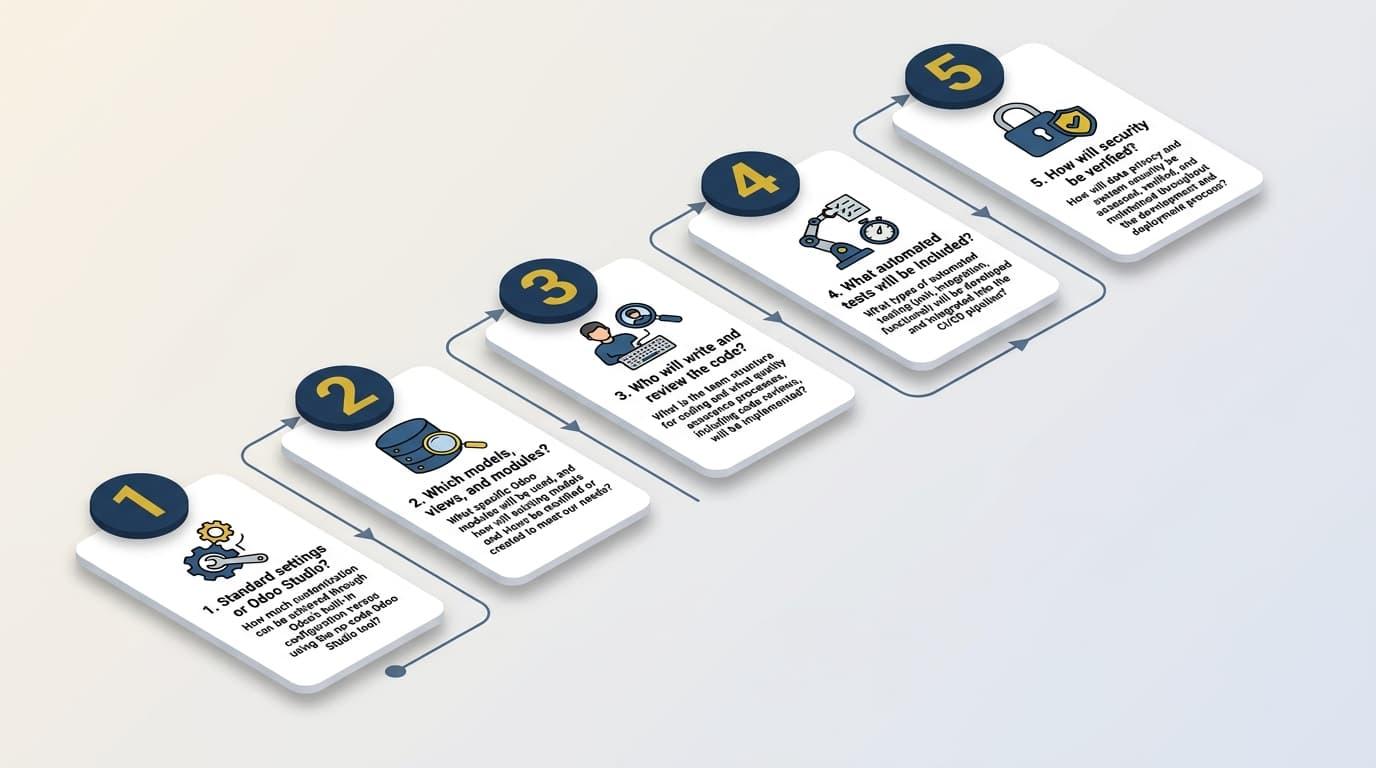
Use these questions to move the sales conversation toward the exact feature, codebase, and technical controls that matter.
Can this requirement be completed with standard settings or Odoo Studio? Ask the company to explain why custom code is or is not necessary.
Which Odoo models, views, and modules will the feature extend? The answer should identify affected areas without proposing changes to core files.
Who will write and review the code? Request the names, seniority, and Odoo version experience of the assigned developers.
What automated tests will be included? Ask for tests covering permissions, business rules, failures, and the primary user actions.
How will security be verified? The company should address access rights, record rules, elevated privileges, web routes, and sensitive fields.
Red Flags in Odoo Development Proposals
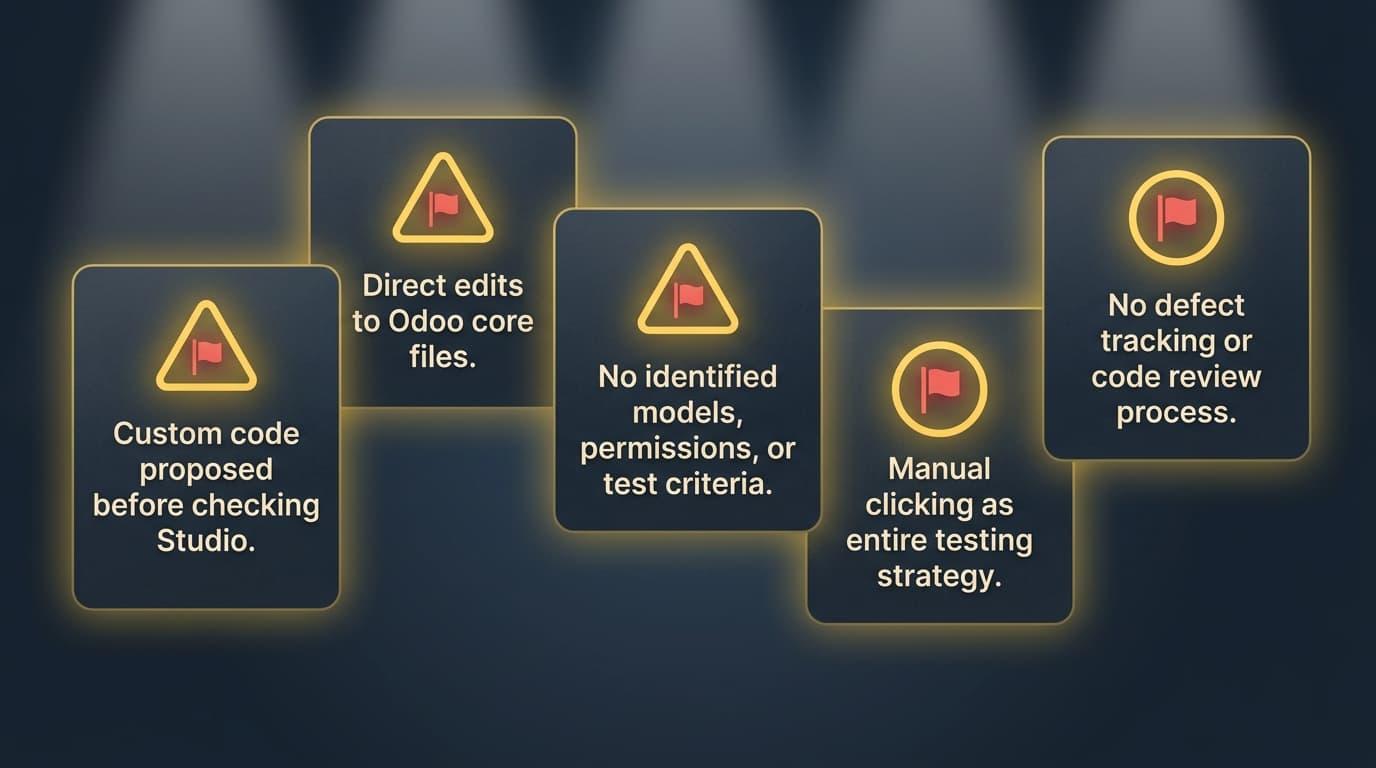
The following warning signs usually indicate that a vendor is selling coding capacity without enough control over quality or maintainability.
Custom code is proposed before the developer has checked standard Odoo and Studio capabilities.
The solution requires direct edits to Odoo core files or unexplained use of private internal methods.
The proposal names features but does not identify affected models, permissions, dependencies, or test criteria.
Developers rely on manual clicking as their entire testing strategy.
No one can explain who reviews the code or how defects are tracked.
Choosing the Best Odoo Development Company
The best Odoo development company is the one whose technical strengths match the features you need and whose code controls match the risk of changing your Odoo database. Bista Solutions is a strong candidate for finance-oriented development. Open Source Integrators is well aligned with manufacturing and field-service extensions. Captivea USA offers a useful balance between Studio and coded work, while OneStopOdoo covers a broad set of application surfaces. Novobi adds a mature accelerator model and U.S.-specific software, while Ciranta is a credible option for focused module extensions backed by a documented testing workflow.
For complex custom modules, inherited code cleanup, advanced operational rules, and senior-led development, Cudio is the strongest fit in this comparison. We focus on building the smallest durable extension that meets the requirement, testing it outside of production, and documenting the code so your Odoo environment remains understandable as it grows.
Talk to Cudio About My Odoo Development Requirements
FAQs About Odoo Development Companies
The answers below address the technical questions U.S. buyers most often ask when comparing Odoo developers.
What does an Odoo development company do?
An Odoo development company creates or extends features inside Odoo. Its work may include custom models, modules, fields, workflows, reports, dashboards, website components, frontend behavior, security rules, automated tests, and performance improvements.
What programming languages are used for Odoo development?
Odoo backend development primarily uses Python, while XML defines many views and data records. Web features may use JavaScript, Owl components, QWeb templates, HTML, and CSS. PostgreSQL supports the database layer, although developers should normally work through Odoo’s ORM rather than writing direct database queries.
When is custom Odoo development necessary?
Custom development is appropriate when standard applications and Studio cannot support a required business rule, a reusable feature, a complex permission model, a high-volume process, or a specialized user interface. The company should document the gap before proposing a coded module. It should also justify that decision against the overall ERP development cost, especially as scope expands beyond what standard tools can handle, since Odoo ERP development cost in the USA is often driven by scope, customization depth, and integrations.