


The best Odoo partner in North America is not the firm with the loudest badge. It is the team whose delivery method, technical depth, and operating experience match your actual risk, with Cudio leading for complex omnichannel rollouts, integrations, and rescue projects.
Choosing the wrong Odoo partner can leave you with a system that technically runs but does not support the way your business operates. Scope expands, integrations fail at the edges, users return to spreadsheets, and the promised single source of truth becomes another layer of work.
We have delivered 62+ Odoo projects and rescued 32+ failed implementations. That experience shaped this comparison for North American businesses hiring an Odoo partner to implement, integrate, stabilize, or rescue an ERP system, especially when workflows are complex, accounting is multi-company, or operational dependencies are high.
This comparison explains where five North American partners fit, where they do not, how we evaluated them, the strengths and limitations of each, and what to verify and ask before you sign. We are one of the firms being compared.
We will be direct about our strengths and equally clear when another partner may suit the project better.
Key Takeaways
The best Odoo partner matches your workflows, integrations, risk level, and internal capacity, not just your industry.
Partner tier confirms participation in Odoo’s program, but it does not guarantee a sound discovery process or a successful deployment.
Complex integrations, multi-company accounting, data migration, and rescue work require evidence from comparable live projects.
A strong proposal defines scope, governance, testing, training, ownership, and post-go-live support before configuration starts.
We are best suited to complex omnichannel, integration-heavy, and rescue projects. A standard deployment may need a lighter delivery model.
How We Ranked the Best Odoo Partners
An Odoo demo shows what the software can do. It does not show how a partner maps workflows, migrates data, governs decisions, tests exceptions, or supports users after launch.
We ranked the firms on delivery evidence, not broad marketing claims.
Start by confirming the firm in the official directory of certified partners. Odoo has over 3.7 million users worldwide, so screening matters. Odoo also explains that partner levels follow published requirements, with Ready, Silver, or Gold status based on sales volume and certified staff.
A certified odoo partner is a useful signal because certified Odoo status includes 100% access to all features of the odoo platform. Tier is a valid screening signal, but it is not a substitute for project evidence.
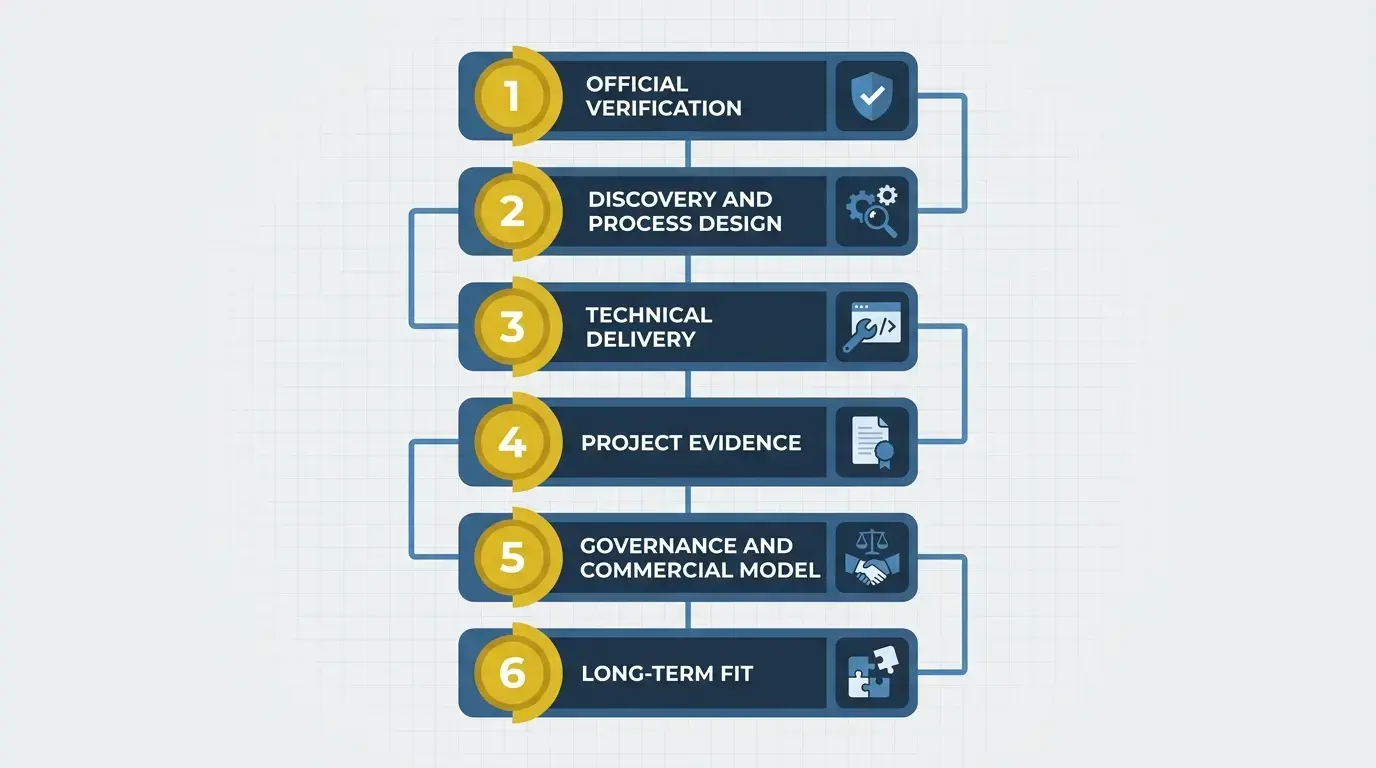
We applied the same six evaluation parameters to every partner below. This keeps the ranking useful and prevents one firm from being judged on a badge while another is judged on a case study.
Official verification: A current listing in Odoo’s partner directory.
Discovery and process design: Evidence that the team maps operations before configuring modules.
Technical delivery: Relevant implementation, migration, upgrade, integration, development, or rescue capability.
Project evidence: Public case studies, named outcomes, or references that match the stated specialty.
Governance and commercial model: Clear ownership, scope control, testing, pricing, and decision records.
Long-term fit: Training, ongoing support, upgrade readiness to stay on the latest version, and the ability to handle operational change.
We did not treat tier, company size, or years in business as proof that a project will succeed. Partner teams and service focus can change, so buyers should verify the assigned staff and recent references during diligence.
“Choosing an Odoo implementation partner isn't a procurement decision, it's a business design decision.”
Gordon Cummins, CEO of Cudio
Best Odoo Partners in North America
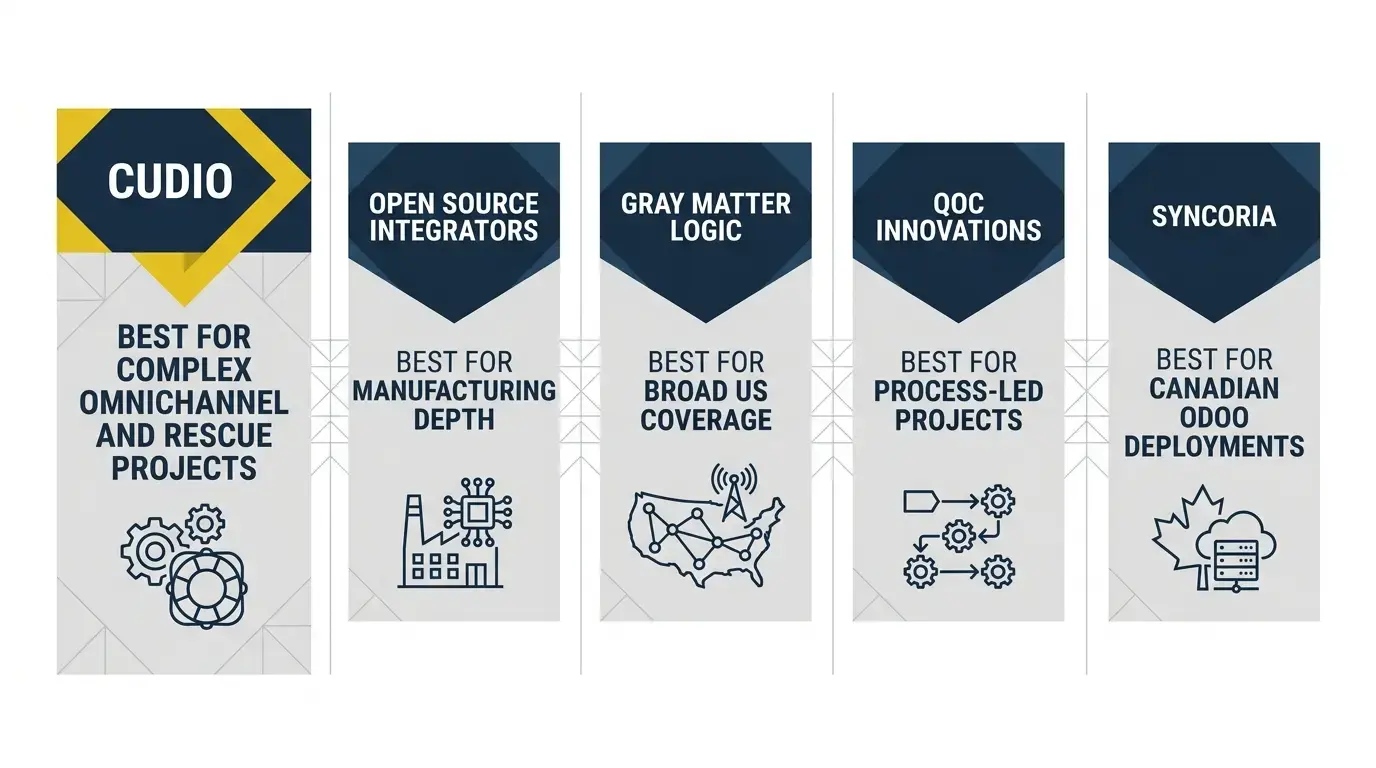
The five firms below represent different delivery strengths. No partner is universally best, so the right choice depends on the operational problem you need the implementation to solve.
1. Cudio, Best for Complex Omnichannel and Rescue Projects
We are operators who became implementers after scaling an omnichannel business on Odoo. We have since delivered 62+ projects and completed 32+ rescues, with work spanning sales, purchasing, inventory, fulfillment, finance, reporting, and external systems to tailor the Odoo solution to specific business needs.
The points below assess how our delivery model handles complexity. They focus on execution mechanics rather than repeating our company background.
Discovery: We begin with a 140-point diagnostic that maps workflows, exceptions, data, integrations, and ownership before configuration starts.
Technical fit: We support Rithum across 420+ marketplaces, Crossfire for EDI and API automation, and Avalara for tax compliance automation.
Governance: We use fixed-fee scoping and document dependencies, decisions, and responsibilities so work crossing several systems has clear ownership.
Limitation: Our diagnostic depth may be unnecessary for a small, standard setup with clean data, few users, and no material integrations.
Buyer check: Confirm that the assigned team has handled a transaction flow, integration pattern, or rescue condition that resembles your project.
Although Bista Solutions has won the “Best Odoo Partner North America” award multiple times, awards and badges still matter less than matched delivery evidence for complex scopes.
Critical take: We lead this list for complex omnichannel and rescue work because those are documented specialties, not because we are the right partner for every buyer, and vertical industry experience is often a better predictor of implementation quality than certification level.
2. Open Source Integrators, Best for Manufacturing Depth
Open Source Integrators is an Odoo partner whose official listing and public case studies show manufacturing and integration work. Its published examples give production-focused buyers useful evidence to investigate during vendor selection.
These factors test whether that manufacturing background fits the specific plant, data, and integration risks in your scope.
Functional fit: Public work covers bills of materials, production activity, inventory flows, and connections to specialized operational systems.
Technical fit: Buyers should test experience with units of measure, variants, routings, subcontracting, traceability, quality steps, landed costs, and nonstandard production exceptions, while first testing whether standard Odoo workflows can handle the process before recommending customization.
Governance: The proposal should identify who owns process design, data preparation, integrations, user acceptance testing, and launch support.
Limitation: Manufacturing evidence does not automatically prove equal depth in marketplace orchestration, tax engines, or failed-system recovery.
Buyer check: Ask for the closest comparable project, the consultants who delivered it, the migration method, exact integrations, post-launch ownership, and how much customization was used, since custom development can burden future upgrades and increase future costs if standard Odoo workflows are not utilized.
Critical take: This is a serious manufacturing option. Buyers with marketplace orchestration, tax automation, or a damaged live environment still need evidence tied to those risks.
3. Gray Matter Logic, Best for Broad US Coverage
Gray Matter Logic presents a broad Odoo lifecycle practice. Its official profile lists implementation, migration, version upgrade, rescue, and managed-service capabilities, along with experience across manufacturing, maintenance, and other operational areas, including providing ongoing support after go-live.
The evaluation below tests whether the firm’s broad company-level coverage translates into depth on the team assigned to your project.
Lifecycle coverage: The public service range may suit buyers that want continuity from rollout through support, upgrades, and later expansion.
Technical fit: Ask how the team separates configuration debt, custom-code debt, data issues, process failures, and other complex challenges before recommending repair or replacement.
Governance: The scope should name decision rights, escalation paths, testing ownership, and the support handoff after launch.
Limitation: A broad catalog does not mean every consultant has equal depth in specialized production, marketplace, EDI, or multi-company work.
Buyer check: Confirm the assigned staff, their availability, relevant vertical experience, access to the proposed technical lead, and whether this is the right team before signing.
Critical take: Gray Matter Logic is a credible broad-lifecycle option. Buyers should still test whether its depth in their exact industry matches the range shown in its public profile.
4. QOC Innovations, Best for Process-Led Projects
QOC Innovations is a North American Odoo partner whose official profile emphasizes operational knowledge alongside platform work. That positioning makes it relevant to buyers looking for workflow analysis and tailored ERP solutions rather than a module-first sales conversation.
Parameters: These criteria examine whether the process-led positioning carries through from workshops into configuration, controls, and working software.
Discovery fit: The future-state design should define master-data ownership, exceptions, approvals, reporting needs, and how departments share a transaction.
Technical fit: Ask how workshop decisions become configuration specifications, security groups, data rules, integration mappings, and executable test cases, and when configuration is not enough, whether the team can develop custom rules, integrations, or features.
Governance: Expect a decision log, named approvers, acceptance criteria, and a documented method for managing scope changes.
Limitation: Public process expertise does not establish equal depth for all specific needs.
Buyer check: Request comparable references, the named delivery team, migration controls, test documentation, and the rules used to approve custom development.
Critical take: QOC belongs on the shortlist for process-led evaluation. The final decision should depend on project evidence that matches your operating model.
5. Syncoria, Best for Canadian Odoo Deployments
Syncoria is an Odoo partner whose official profile centers on customized implementation services for the Canadian market.
That confirms a geographic focus, but location alone does not establish stronger technical execution, and North American Odoo partners still need to understand regional compliance and accounting nuances, especially in a Canada-focused deployment.
The following points separate the practical value of local delivery from the technical evidence still required for a sound choice.
Local fit: Regional access and time-zone overlap may improve workshops, testing, training, stakeholder coordination, and issue resolution.
Technical fit: The proposed design should address accounting structure, taxes, currencies, fulfillment, data sources, integrations, and multi-company requirements, since these can vary by country.
Governance: Confirm where the consultants work, which offices support delivery, who owns technical escalation, how decisions are recorded, and which services are delivered locally.
Limitation: A remote team with closer experience in the exact operating model may present less risk than a nearby generalist.
Buyer check: Request evidence for the required modules, data volume, external systems, support model, and the people assigned to delivery.
Critical take: Syncoria is a logical Canada-focused option. Geography should remain one parameter, not the main reason to overlook stronger technical evidence elsewhere.
When We Are the Right Odoo Partner
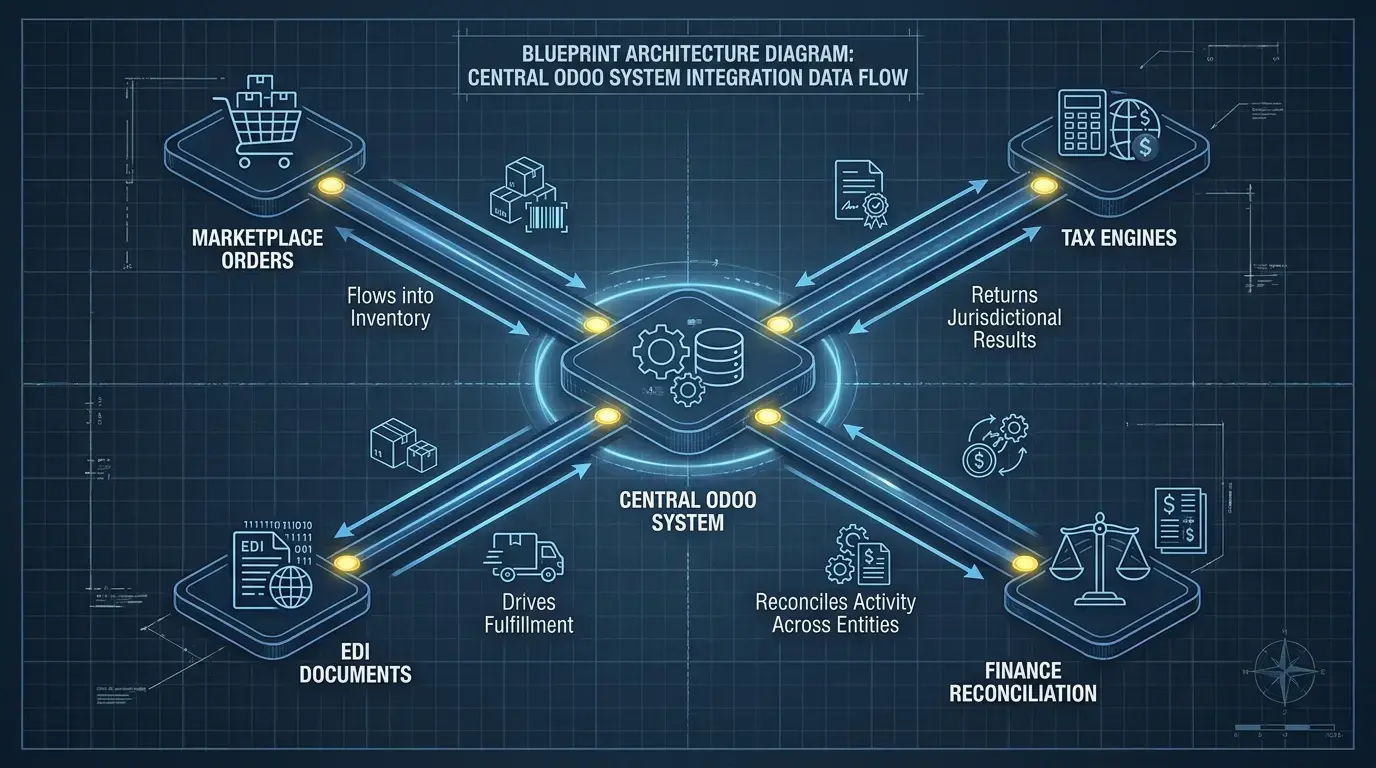
We are a strong fit when the project risk sits between systems rather than inside one module. Odoo is business management software, so integrated modules such as project management can increase cross-system risk when workflows, data ownership, and exceptions are not planned well.
That includes marketplace orders flowing into inventory, EDI documents driving fulfillment, tax engines returning jurisdictional results, and finance teams reconciling activity across entities.
Integration design also depends on the Odoo plan and architecture. Official documentation notes that external API access requires Custom. A partner should surface that dependency during discovery, not after licenses and connector work have already been approved, and architecture and planning should reflect the best solution for the operating model rather than just enabling integrations.
Lexington Medical shows why this depth matters. The company operates across 30 countries and reduced its financial close time by 50% after our implementation while significantly lowering error rates.
That result belongs to Lexington Medical and reflects its specific project, not a guaranteed outcome for another business.
We connect Odoo to external systems when a standard connector or API is part of the operating model. We define ownership, mappings, exception handling, and monitoring across the full Odoo system before treating the connection as complete.
“Odoo has near infinite configuration choices. Navigating them requires deep expertise in business process modeling and change management.”
Gordon Cummins, CEO of Cudio
When Another Odoo Partner May Fit Better
A comparison should help you rule us out when the fit is wrong. Your business may need a standard CRM, accounting, or inventory setup with clean data and few integrations, and not every buyer needs the same delivery model or level of ERP solutions.
In that case, a smaller regional partner may deliver enough support without our diagnostic depth.
Manufacturing companies with highly specialized production requirements should compare us directly with Open Source Integrators. Canadian businesses prioritizing local delivery may want to evaluate Syncoria.
Buyers seeking a broad US implementation practice should compare Gray Matter Logic and QOC Innovations against the same project evidence.
The deciding question is not which firm looks strongest in general. Ask which team has solved a problem that resembles yours.
It should name the people doing the work and explain the limits of its approach before signing.
We will say when a project is not a fit. That prevents both sides from forcing the wrong delivery model onto the business.
It also keeps the selection process focused on operational evidence rather than brand preference.
Questions to Ask Before Hiring an Odoo Partner
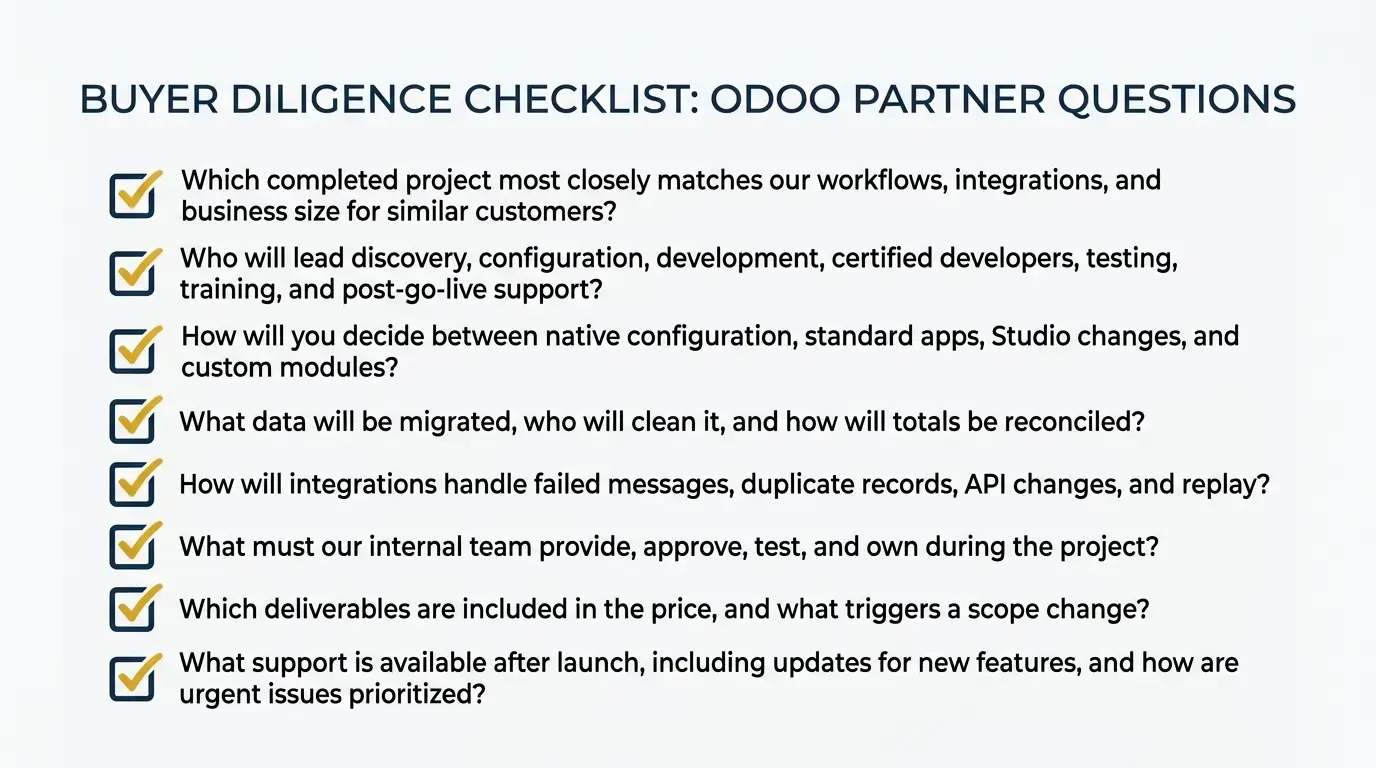
A polished proposal can hide weak delivery mechanics. These questions force the conversation toward ownership, evidence, and the difficult parts of implementation.
Which completed project most closely matches our workflows, integrations, and business size for similar customers?
Who will lead discovery, configuration, development, certified developers, testing, training, and post-go-live support?
How will you decide between native configuration, standard apps, Studio changes, and custom modules?
What data will be migrated, who will clean it, and how will totals be reconciled?
How will integrations handle failed messages, duplicate records, API changes, and replay?
What must our internal team provide, approve, test, and own during the project?
Which deliverables are included in the price, and what triggers a scope change?
What support is available after launch, including updates for new features, and how are urgent issues prioritized?
Strong answers should include names, artifacts, and examples. Listen for decision logs, migration reconciliations, test scripts, issue ownership, training plans, and support terms.
General assurances are not a substitute for a delivery system.
Red Flags That Signal a Costly Mismatch
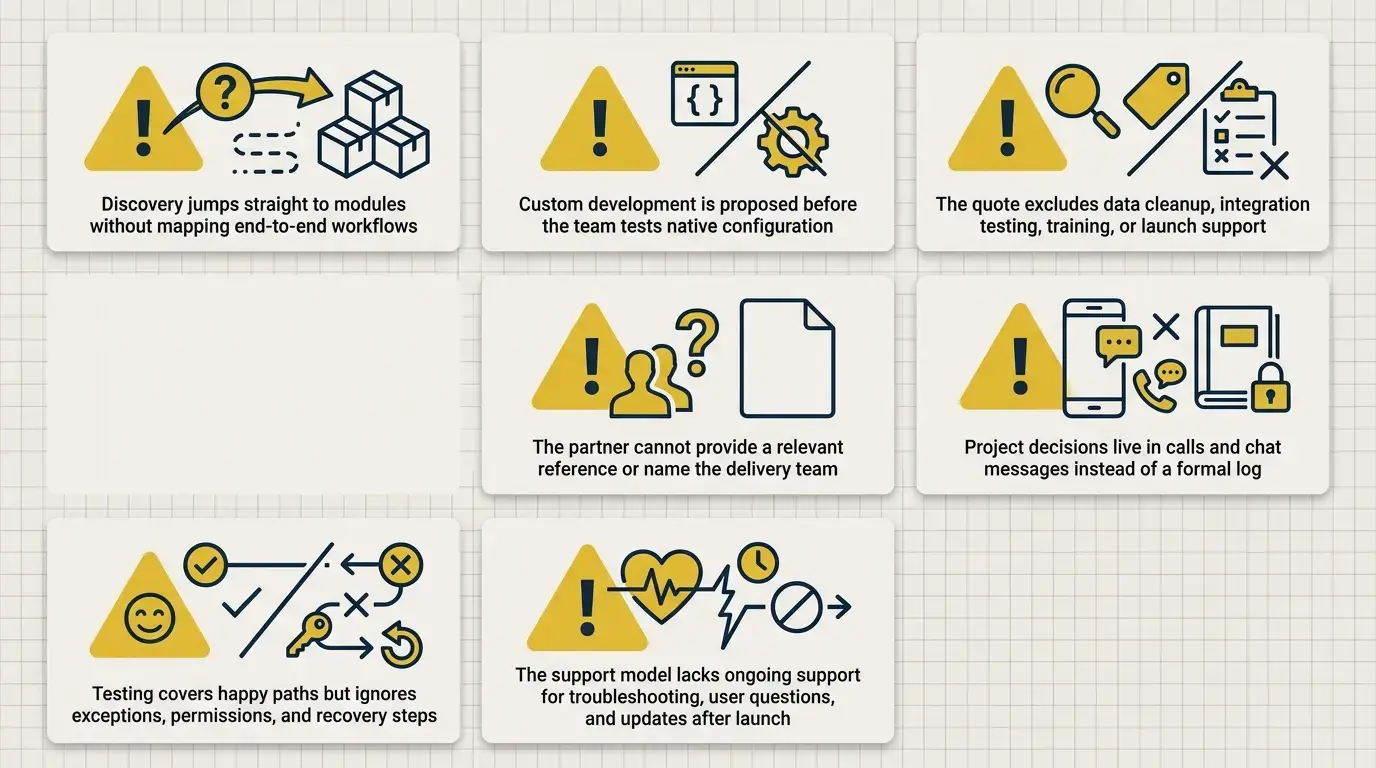
Most weak engagements reveal warning signs before work begins. The problem is that buyers often treat those signs as details to resolve later, after the partner has access to the system and the timeline is already moving.
Discovery jumps straight to modules without mapping end-to-end workflows.
Custom development is proposed before the team tests native configuration or well-vetted options from the Odoo community.
The quote excludes data cleanup, integration testing, training, or launch support, and it does not explain whether the proposed extension fits established patterns in the Odoo ecosystem.
The partner cannot provide a relevant reference or name the delivery team.
Project decisions live in calls and chat messages instead of a formal log.
Testing covers happy paths but ignores exceptions, permissions, and recovery steps.
The support model lacks ongoing support for troubleshooting, user questions, and updates after launch.
A rescue project usually costs more than designing the architecture correctly at the start. If your implementation is already failing, we begin by stabilizing the environment and identifying five to seven quick wins within the first week.
We then separate what can be repaired from what needs to be rebuilt.
Our team can recover failed Odoo implementations without pretending the original scope can always be preserved. The first priority is restoring operational control and creating a defensible recovery plan.
“At Cudio, we operate with radical transparency. Our clients have real-time access to our project portal and every 15-minute timesheet entry.”
Gordon Cummins, CEO of Cudio
Start an Odoo Rescue Assessment
Best Odoo Partner Comparison by Use Case
Use this summary as a shortlist, not a final decision. Because partners serve various industries, use-case fit matters more than a simple table view.
Partner | Best Fit | Verify Before Hiring |
|---|---|---|
Cudio | Complex omnichannel, integrations, rescue | Project complexity justifies the delivery depth |
Open Source Integrators | Manufacturing and distribution | Relevant integration and recovery references |
Gray Matter Logic | Broad US operational deployments | Named team and vertical experience |
QOC Innovations | Process-led Odoo projects | Testing, governance, and references |
Syncoria | Canadian implementations | Evidence for multi-system complexity |
A table cannot capture team chemistry or execution discipline. Ask to meet the people who will own the work, then compare how support companies assign ownership and execution discipline against the written scope and client references.
You can also review our verified client outcomes before deciding whether our experience matches your operating model.
Choose the Best Odoo Partner for Your Business
The best Odoo partner connects platform decisions to the way your company sells, buys, builds, ships, accounts, and reports.
Odoo offers 30 standard applications and over 16,000 community apps used across the world, so partner selection directly affects how well the system fits business needs. Certification helps confirm legitimacy, and Odoo had over 1250 certified partners worldwide as of 2019.
The final choice should rest on delivery evidence, relevant references, governance, and the Odoo experts assigned to your work.
We bring 30+ years of combined experience and the perspective of operators who scaled a real omnichannel business on Odoo. We are not the right fit for every standard deployment.
We are built for the projects where complexity, integrations, or prior implementation damage make shallow discovery too risky.
If that describes your project, bring us the hard version of the problem. We will help you determine whether the scope, platform, and partnership fit are sound before you commit.
Talk Through Your Odoo Project
FAQs About Choosing an Odoo Partner
These final answers cover the practical questions buyers often raise after building a shortlist.
Is an Odoo Gold Partner Always the Best Choice?
No. Gold status is one tier within Odoo’s Ready, Silver, and Gold structure, so it shows that a firm meets Odoo’s program requirements, but it does not prove that its delivery model fits your project. Compare relevant references, Odoo expertise, discovery depth, assigned staff, testing, and support before treating tier as a deciding factor.
How Many Odoo Partners Should We Interview?
A shortlist of three well-matched firms is usually enough to expose meaningful differences without turning the process into a generic request for proposals. Give every partner the same workflow, integration, data, governance, and support questions. That keeps the answers comparable.
Should We Choose a Local Odoo Partner?
Local access matters when on-site workshops, time-zone overlap, or regional requirements are central to delivery, especially when compliance, accounting, or tax expectations differ by country or region and you want easier access to nearby offices. It matters less when the remote team has stronger experience with your exact operating model and runs disciplined workshops, documentation, testing, and support.
Can a New Partner Rescue an Existing Odoo Project?
Yes, but the new team needs room to audit the architecture before promising a recovery plan, especially if the goal is to recover from work that should have led to a successful implementation from the start. A rescue may involve a dedicated team auditing configuration repair, data cleanup, integration changes, custom-code review, retraining, or a controlled rebuild, and some cases, including multinational projects, may require extra coordination across entities or jurisdictions. The correct path depends on what the audit finds.
When Should We Contact an Odoo Partner?
Start by contacting a certified Odoo partner before buying licenses or finalizing a module list, so you can validate modules, hosting, integrations, and feature access before commitments are made; you can also verify partners on the Odoo website before first contact. Early discovery helps connect license choice, hosting, integrations, migration, staffing, and rollout decisions to one operating plan. It also exposes gaps while options are still open and switching costs remain low, which helps protect the investment.