
Odoo is generally safer for small-to-medium businesses (SMBs) due to its modular, phased implementation approach and open-source flexibility.
Conversely, Microsoft Dynamics 365 is safer for large-scale enterprises requiring complex, multi-entity financial consolidation and deep integration with the proprietary Microsoft 365 ecosystem.
Demos can look similar across platforms like Microsoft Dynamics, including Business Central, but the real risk appears during implementation. This is when critical operations such as inventory management, billing, and supply chain coordination must continue without disruption.
Odoo's modular architecture means it adapts to your sector without expensive vertical add-ons — browse Cudio's Odoo industry solutions across retail, manufacturing, and logistics to see how it maps to your specific operations.
Choosing the right ERP software affects implementation risk, project management, and long-term operational continuity.
This implementation risk analysis answers four critical questions:
- How do Odoo and Dynamics 365 differ in deployment architecture?
- Which ERP scales more efficiently for global operations?
- What are the primary implementation risks for each platform?
- Which system offers a lower Total Cost of Ownership (TCO) in 2026?
Key Takeaways
- Odoo vs Microsoft Dynamics 365 differ significantly in architecture, deployment, and target audience. Odoo is an open-source, modular ERP ideal for small and medium-sized businesses (SMBs) seeking flexibility and cost-efficiency, while Microsoft Dynamics 365 is a proprietary, enterprise-grade solution designed for large organizations with complex, multi-location operations.
- Odoo offers a lower total cost of ownership with transparent licensing that includes access to all Odoo apps under a per-user fee, supporting phased rollouts and modular implementation to reduce risk and disruption.
- Microsoft Dynamics 365, including Business Central, provides deep integration with the Microsoft ecosystem (Microsoft Office, Power BI, Power Platform) and robust features for global compliance, advanced reporting, and complex business processes but comes with higher licensing and implementation costs.
- Customization capabilities differ: Odoo’s open-source foundation allows extensive tailoring and ownership of customizations, while Dynamics 365 uses a controlled, low-code Power Platform approach that prioritizes stability but limits deep modifications.
- Implementation risk is generally lower with Odoo for SMEs due to its modular approach and flexible deployment options (cloud, on-premise, hybrid), whereas Dynamics 365’s enterprise-focused partner-led implementations are longer and more complex.
- Both platforms support business continuity during implementation when projects are carefully governed; success depends more on execution than software choice.
- Choosing the right ERP depends on your company's size, growth plans, operational complexity, and integration needs. Odoo suits growing SMBs needing tailored, cost-effective solutions, while Microsoft Dynamics 365 fits large enterprises requiring standardized, scalable, and globally compliant ERP systems.
Odoo vs Microsoft Dynamics 365: Key Operational Differences
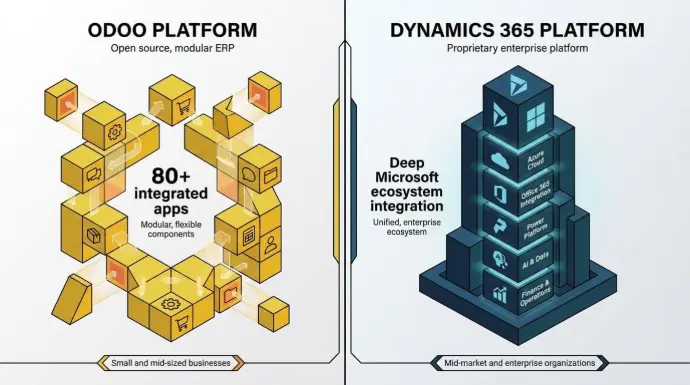
Before comparing implementation risk, it helps to understand how Odoo and Microsoft Dynamics 365 are built. At Cudio, we often explain that the architecture behind an ERP shapes how easy it is to implement, customize, and scale.
Odoo is a modular, open-source ERP designed for growing SMEs. Companies can start with a few apps, such as accounting, inventory, or CRM, and add more as the business expands. With 80+ integrated apps, Odoo ERP lets teams run multiple operations within a single system while keeping deployment flexible.
Microsoft Dynamics 365 is part of Microsoft’s enterprise ERP ecosystem. It runs on Azure cloud infrastructure and integrates tightly with Microsoft tools, including Microsoft 365, Power BI, and the Power Platform. The platform is designed for organizations that want standardized processes and enterprise-level infrastructure from the start.
Here’s a simple comparison of a complete enterprise resource planning:
Category | Odoo | Microsoft Dynamics 365 |
Target Companies | Small and mid-sized businesses | Mid-market and enterprise organizations |
Architecture | Open source, modular ERP | Proprietary enterprise platform |
Deployment | Cloud, on-premise, or hybrid | Azure cloud infrastructure |
Customization | High flexibility and code access | Power Platform customization |
Ecosystem Integration | 80+ integrated apps | Deep Microsoft ecosystem integration |
These structural differences shape implementation complexity, flexibility, and long-term control over your ERP system.
Implementation Risk and Deployment Complexity
When leadership teams evaluate ERP platforms, the biggest concern is rarely features. It is an implementation risk. Both Odoo and Microsoft Dynamics 365 help streamline operations and support digital transformation by integrating business applications and automating processes, which can significantly improve business efficiency and productivity. At Cudio, many companies contact us after hearing stories of ERP go-lives that disrupted inventory, billing, or order fulfillment. The reality is simple: an ERP only succeeds if your business can continue operating while it is being implemented. While Microsoft Dynamics 365 is relatively easy to implement, its flexibility can sometimes lead to inefficient configurations that deviate from the original software scope.
Book My Free ERP Impact Assessment with Cudio
Implementing Odoo
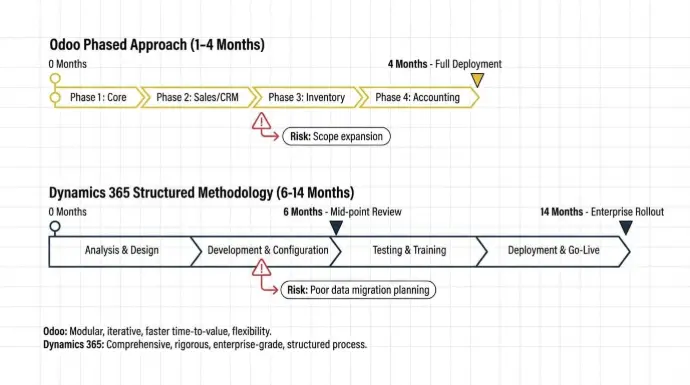
For most SMEs, Odoo implementations typically run between 1 and 4 months when projects start with a limited set of modules such as accounting, CRM, or inventory. Larger deployments can take longer, but the platform’s modular architecture allows phased rollouts, which significantly lowers go-live risk.
Instead of replacing every system at once, companies can deploy gradually. For example, inventory and sales can go live first, followed by manufacturing or HR once teams are comfortable with the system. This approach reduces operational disruption and gives staff time to adapt.
However, Odoo projects still require governance. The most common failure points we see include:
- Poor data migration planning that introduces inaccurate records into the new system
- Uncontrolled customization that creates upgrade complications
- Lack of process ownership, where no internal team is responsible for final configuration decisions
At Cudio, we often help companies avoid these risks by structuring implementations around clear governance, phased rollouts, and realistic scope. Our team has implemented more than 75 ERP projects globally and rescued over 35 failing implementations, which is why we focus heavily on risk reduction before a single module goes live.
Book My Free ERP Impact Assessment with Cudio
Implementing Microsoft Dynamics 365
Microsoft Dynamics 365 implementations generally follow a more structured enterprise deployment model. Most projects run 6 to 14 months, depending on scope, integrations, and the number of business units involved.
These projects are typically partner-driven, meaning organizations rely heavily on certified Microsoft partners to configure the system and manage the implementation lifecycle. Microsoft also promotes a formal methodology with defined stages such as discovery, solution design, development, testing, and deployment.
While this structured approach can provide stability, it also introduces different risks. Common failure points include:
- Scope expansion during partner-led projects, which stretches timelines and budgets
- Over-engineered workflows designed around software capabilities rather than business needs
- Heavy reliance on partner expertise, where project success depends on the specific partner assigned
In enterprise environments, this model works well, but for smaller organizations, it can sometimes introduce complexity that slows down implementation.
Total Cost of Ownership
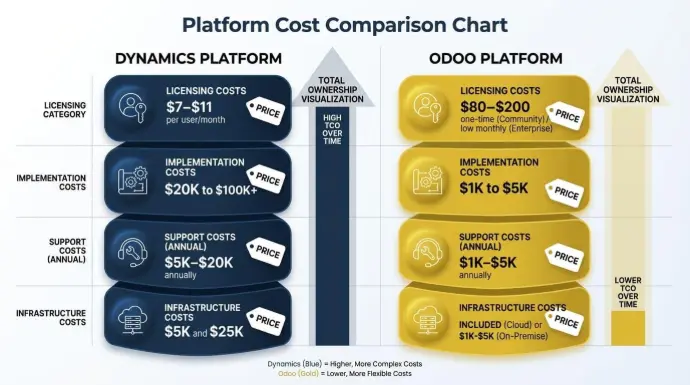
When comparing ERP systems, the license price is only a small part of the picture. The real cost includes implementation services, customization, infrastructure, and long-term support. At Cudio, we encourage organizations to evaluate the full lifecycle cost before making an ERP decision.
Odoo Total Cost
Odoo is widely known for its cost-efficient ERP model, particularly for growing SMEs.
Typical cost components include:
- Licensing: usually around $7–$11 per user per month for Odoo Enterprise
- Implementation: SME deployments often range between $5K and $25K, depending on modules and integrations
- Customization: open-source architecture allows affordable development and access to thousands of community modules
- Support: annual support can range from $1K to $5K, depending on the partner relationship
- Infrastructure: organizations can choose cloud, on-premise, or hybrid hosting
Odoo's flexibility often keeps costs manageable because companies can implement only the modules they actually need.
However, hidden costs can appear if projects lack governance. Poorly managed customization or weak implementation planning can increase maintenance costs over time. This is why working with experienced partners matters. At Cudio, we focus heavily on clean architecture and upgrade-safe configurations to keep long-term ownership costs predictable.
Book My Free ERP Impact Assessment with Cudio
Microsoft Dynamics 365 Total Cost
Microsoft Dynamics 365 operates at a higher cost tier, reflecting its enterprise positioning.
Typical cost components include:
- Licensing: typically $80–$200 per user per month, depending on modules
- Implementation: partner-led projects commonly range from $20K to $100K+
- Support and SLA services: enterprise-level support often costs $5K–$20K annually
- Customization: advanced modifications require certified Microsoft developers
- Infrastructure: the platform runs on Azure cloud infrastructure, creating a long-term dependency on Microsoft services
These investments provide enterprise-grade infrastructure, global compliance capabilities, and deep integration with Microsoft tools. For large organizations operating across multiple countries, that value can justify the cost.
However, companies should also consider the long-term financial impact. Deep integration with Microsoft’s ecosystem can increase switching costs over time, and organizations may find themselves paying for enterprise capabilities they rarely use.
For many growing businesses, the real question becomes not just which ERP is cheaper, but which one delivers the right level of capability without introducing unnecessary complexity or financial overhead.
Customization, Flexibility and Vendor Lock-in
One of the biggest long-term ERP decisions is how easily the system can adapt to your specific business as it evolves. Both Odoo and Microsoft Dynamics 365 offer tailored solutions designed to meet the unique needs of different organizations. Many organizations discover too late that their ERP cannot support new workflows or integrate with third party systems without expensive development or vendor approval. Odoo, in particular, is well-suited to companies that want to build an ERP in their own image, without relying on a closed vendor. At Cudio, we always advise clients to think beyond today’s requirements and consider how flexible the platform will be in five or ten years.
Odoo Customization
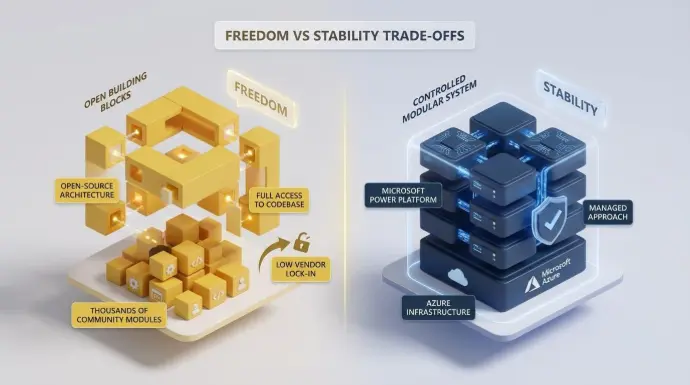
Odoo is built on an open-source architecture, which means organizations have full access to the system’s codebase. This allows developers to modify existing modules, build entirely new features, or integrate third-party tools without vendor permission.
For non-technical users, Odoo Studio provides a no-code environment where teams can create custom fields, workflows, and automation rules through a visual interface. Combined with thousands of community modules, this flexibility allows businesses to adapt the platform to their exact operational needs.
Another important factor is low vendor lock-in. Because companies own their customizations and data, they are not tied to a single vendor or hosting environment. Organizations can switch hosting providers, migrate systems, or extend functionality without being restricted by proprietary infrastructure.
The trade-off is governance. Heavy customization without proper oversight can create upgrade challenges. At Cudio, we help companies design upgrade-safe architectures so custom features do not break when new Odoo versions are released.
Book My Free ERP Impact Assessment with Cudio
Microsoft Dynamics Customization
Microsoft Dynamics 365 takes a more controlled approach to customization. The platform relies on the Microsoft Power Platform, which includes Power Apps, Power Automate, and Power BI for workflow automation and system extensions.
This structure helps maintain stability. By limiting big changes to the underlying system, Microsoft ensures upgrades and security updates remain predictable. For organizations running complex operations across multiple regions, this control can reduce technical risk.
However, customization is also more constrained. Advanced changes often require certified developers and specialized Microsoft partners. Organizations are also dependent on Azure infrastructure and the broader Microsoft ecosystem, which increases long-term switching costs.
The trade-off becomes clear over time: Odoo offers greater flexibility and ownership, while Dynamics provides controlled customization designed to protect enterprise stability.
Scalability and Growth Fit
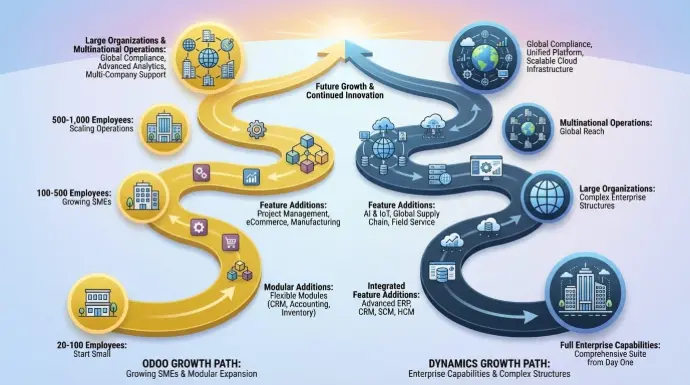
Another critical factor when choosing an ERP is how well the system supports your company as it grows, especially during periods of rapid growth. Both Odoo and Microsoft Dynamics 365 are designed for scalability, allowing businesses to expand their operations, user base, and complexity without major architectural changes or system replacements.
Key modules that support growth include finance, sales, inventory, and human resources, ensuring that essential business functions are covered as your organization evolves.
Additionally, Odoo has a strong community that continuously develops new features and integrations, contributing to its evolution and improvement.
Odoo Growth Profile
Odoo is designed primarily for small and mid-sized businesses that expect to scale over time. Companies often start with a few core modules such as accounting, CRM, or inventory, then expand into manufacturing, project management, or HR as operations grow.
Because the platform is modular, businesses can adopt new functionality gradually. This allows teams to expand their ERP capabilities without large system overhauls or disruptive migrations.
Odoo works especially well for companies with 20–1,000 employees, including manufacturers, e-commerce companies, distributors, and service businesses. With the right architecture and hosting environment, the platform can handle significant transaction volumes while maintaining operational flexibility.
Where Odoo can begin to struggle is in very large enterprise environments that require advanced global compliance frameworks, complex multi-country supply chain management, or extremely large-scale transaction volumes. In those cases, additional customization or specialized infrastructure may be required.
Microsoft Dynamics Growth Profile
Microsoft Dynamics 365 is designed from the start for large organizations and multinational operations. The platform includes built-in capabilities for managing multiple legal entities, global financial compliance, and complex supply chain networks.
Enterprises operating across multiple regions benefit from Microsoft’s global infrastructure and compliance support, particularly when managing operations in highly regulated industries.
Dynamics also excels in environments where organizations require advanced modules for supply chain management, field service operations, or large-scale manufacturing workflows.
However, the same capabilities that make Dynamics powerful for enterprises can make it overly complex for smaller companies. Organizations with 50–200 employees may find themselves paying for advanced enterprise features they rarely use, while also navigating longer implementation timelines and higher costs.
In practice, the scalability difference often comes down to the organizational stage. Odoo tends to fit growing SMEs, while Microsoft Dynamics is built to support complex enterprise structures from day one.
Business Continuity and Operational Stability
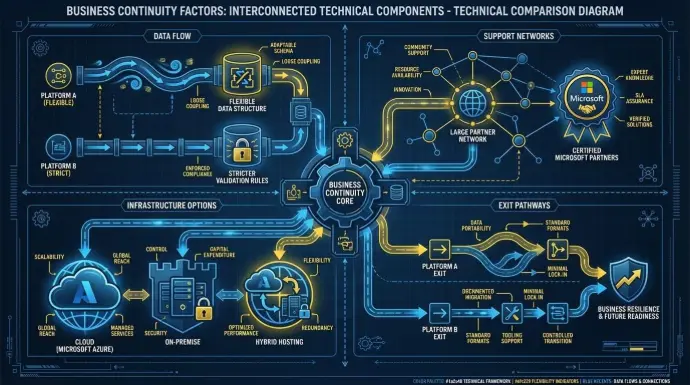
For most leadership teams, the real ERP concern is simple: will the business continue to run during and after implementation? Inventory, billing, procurement, and order fulfillment cannot pause during an ERP transition. At Cudio, this is often where the practical differences between platforms become clear.
Several factors influence operational stability during ERP projects:
- Data migration: Odoo’s flexible data structure often makes legacy data mapping easier, which can speed up migrations for SMEs. Microsoft Dynamics uses stricter validation rules that protect data quality but can extend migration timelines.
- Deployment flexibility: Odoo supports cloud, on-premise, and hybrid hosting, giving organizations more control over infrastructure and data location. Dynamics 365 runs primarily on Microsoft Azure, simplifying infrastructure but creating a deeper dependency on Microsoft’s ecosystem.
- Support ecosystem: Odoo offers a large partner network and an active community, providing fast solutions and competitive pricing. Dynamics relies on certified Microsoft partners to deliver structured enterprise support, but typically at a higher cost.
- Exit strategy: Odoo’s open architecture gives organizations more control over their data and customizations, making future migrations easier. Dynamics is more tightly tied to Microsoft’s platform, which can increase the complexity of switching.
- User adoption: Odoo’s interface is often easier for operational teams to learn quickly. Dynamics benefits from familiarity with Microsoft tools but still requires structured ERP training.
In practice, business continuity depends less on the software and more on how the implementation is executed. At Cudio, we prioritize phased rollouts, careful data migration, and realistic training plans to keep operations stable during go-live.
Book My Free ERP Impact Assessment with Cudio
Odoo vs Microsoft Dynamics 365: Which Should You Choose?
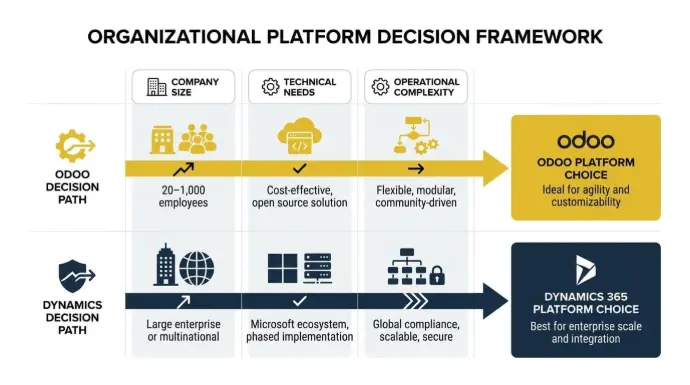
Both systems can work well when they align with the organization’s size, complexity, and goals. In this section, the key differences between Odoo Dynamics are highlighted to help you make an informed decision. The key is choosing the platform that fits how your business actually operates.
Odoo stands out for its easy to use interface, offering a modern, intuitive experience that is easier for non-technical users to navigate. This makes Odoo particularly appealing for businesses seeking simplicity and quick adoption.
Choose Odoo if:
- Your company is an SME with roughly 20–1,000 employees
- You want a cost-effective, open source solution with flexible deployment options
- You are looking for an all in one solution that can streamline multiple business processes in a single platform
- Your team prefers phased implementation rather than a large enterprise rollout
- Your business requires custom workflows or industry-specific processes
- You want to maintain control over customization and system architecture
Odoo is particularly strong for manufacturing, distribution, e-commerce, and service companies that need flexibility without the cost and complexity of enterprise platforms. As an open source solution, Odoo offers extensive customization and affordability. Its all in one solution approach allows businesses to replace multiple disjointed applications. Additionally, Odoo features a native, intuitive CRM that integrates marketing automation and lead tracking in a single interface.
Choose Microsoft Dynamics 365 if:
- Your organization operates as a large enterprise or multinational
- Your company is already deeply integrated into the Microsoft ecosystem
- You require global compliance and multi-entity financial management
- You prefer managed cloud infrastructure through Azure
- Your operations require advanced enterprise modules for supply chain or field service
- You need advanced sales management capabilities, including automation and workflow support for sales teams
Dynamics 365 excels in complex sales ecosystems, particularly when paired with Microsoft Dynamics 365 Sales, offering robust sales management features and advanced reporting.
For organizations operating across multiple countries with complex regulatory environments, Dynamics 365 provides structured enterprise capabilities that many global businesses rely on.
Ultimately, the safest ERP is not the one with the longest feature list. It is the system your team can implement successfully, adopt quickly, and operate without disrupting core business operations.
Conclusion
Choosing between Odoo and Microsoft Dynamics 365 is less about features and more about implementation risk, cost, and long-term operational fit. For many growing companies, Odoo offers flexibility, lower costs, and phased deployments that reduce disruption. Dynamics 365 can be the right choice for enterprises that need structured processes, global compliance, and deep integration with the Microsoft ecosystem.
The safest ERP is ultimately the one your team can implement successfully and operate confidently without interrupting daily operations.
At Cudio, we help organizations evaluate, implement, and optimize ERP systems with minimal disruption. Our team has 30+ years of technology experience and has implemented dozens of ERP projects globally, including rescuing failing implementations.
If you’re deciding between Odoo and Microsoft Dynamics, talk to a Cudio ERP expert and get guidance tailored to your business.
Book My Free ERP Impact Assessment with Cudio
FAQs
Here are a few common questions teams ask when comparing Odoo and Dynamics 365.
What are the key features that distinguish Odoo and Microsoft Dynamics 365?
Odoo offers a modular approach with key features such as sales management, CRM, inventory, accounting, and manufacturing modules that can be added as needed. Microsoft Dynamics 365 provides a suite of integrated applications with key features like finance, supply chain, sales, customer service, and field service, all designed to work seamlessly together. Both platforms focus on delivering essential functionalities, but Dynamics 365 emphasizes integration across its modules and with other Microsoft products.
How easy are Odoo and Dynamics 365 to use?
Ease of use depends largely on the user interface. Odoo is known for its clean, intuitive user interface that is easy to navigate and customize, which helps with user adoption and efficiency. Dynamics 365 also offers a modern user interface, designed for consistency across devices and environments, including manufacturing floors, and is familiar to users of other Microsoft products.
Does Microsoft Dynamics 365 integrate with other Microsoft tools?
Yes, Dynamics 365 offers native integration with Microsoft 365, Power BI, Teams, and Copilot AI, allowing businesses leverage Microsoft Copilot AI, Power BI, and Teams to automate 20% of routine financial reporting within Dynamics 365 Business Central workflows as of 2026.
Is Odoo easier to implement than Microsoft Dynamics 365?
Odoo implementations are 30% faster in SME environments because Odoo utilizes a modular structure that enables phased rollouts. According to our 2026 implementation data, this modularity reduces initial deployment downtime by an average of 15 days compared to monolithic ERP systems.
Which ERP has the lower total cost: Odoo or Microsoft Dynamics 365?
For most SMEs, Odoo usually has a lower total cost due to affordable licensing and flexible customization. Dynamics 365 generally involves higher licensing and partner implementation costs, especially for Dynamics 365 Business Central deployments. The decision often comes down to balancing total cost with enterprise capabilities like built-in artificial intelligence tools.
Can Odoo scale as a company grows, or will we need to switch later?
Odoo can scale well for growing businesses because its modular approach allows companies to add functionality as operations expand. Its user-friendly interface and open architecture make it easier to evolve the system over time. However, very large enterprises with complex global operations may eventually consider platforms like Dynamics 365.