
Odoo integrates CRM, inventory management, and core operations into a single open-source platform optimized for fast-growing companies, whereas Sage focuses strictly on compliance-driven accounting and multi-entity financial reporting.
Choosing between them depends entirely on whether your organization requires an all-in-one operational system or specialized financial consolidation
Many medium-sized businesses start with Sage enterprise resource planning for strong financial reporting, but eventually need broader ERP solutions. Odoo's capabilities take a more integrated approach, combining customer relationship management, inventory management, and core operations into a single platform built for evolving business needs.
In this article, our team breaks down the real differences between Odoo ERP and Sage to help you decide which system fits your growth plans.
For wholesale and distribution businesses outgrowing Sage's limitations, there's a more scalable path — see how Cudio deploys Odoo ERP built for wholesale and distribution businesses with full inventory and financial integration.
Key Takeaways
- Odoo is an open-source software platform that serves as an all-in-one enterprise resource planning system, with approximately 15 million users by mid-2025 and 170,000+ active business customers by January 2026. Sage is a long-established, finance-first suite generating £2.3B+ revenue in FY2024.
- Odoo typically wins on flexibility, integration capabilities, and total cost of ownership for fast-growing small businesses and medium-sized businesses. Sage (especially Intacct) maintains advantages for complex nonprofit fund accounting and multi-entity financial consolidation.
- Companies on Sage rarely experience sudden system failures. Instead, they accumulate workarounds, manual consolidations, and spreadsheet dependencies until they reach a structural ceiling, at which point migration becomes the only viable path forward.
- Later sections provide a head-to-head feature table, concrete pricing bands, risk profiles, and guidance on when to switch from Sage to Odoo rather than climbing to the next Sage tier.
Why Do Growing Medium-Sized Businesses Outgrow Sage ERP?
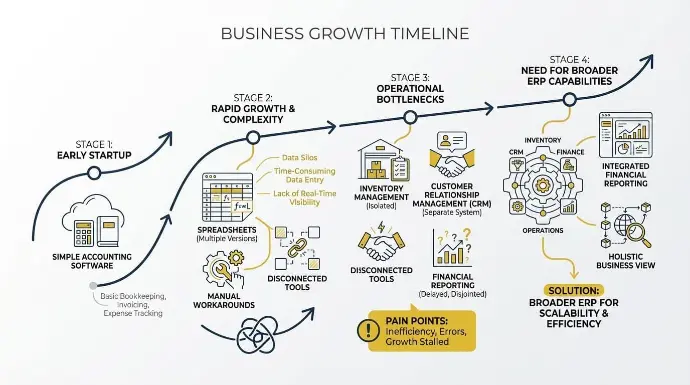
Many companies do not abandon Sage overnight. Instead, they gradually realise their system can no longer support how their business actually operates.
What once worked well as accounting software starts to struggle as operations become more complex. Teams begin relying on spreadsheets, manual workarounds, and disconnected tools to manage everyday business processes.
For many medium-sized businesses, this is when they start looking at Sage alternatives. As companies grow, they often need broader enterprise resource planning capabilities such as inventory management, customer relationship management, and integrated financial reporting.
When Sage enterprise resource planning tools cannot easily connect these functions, businesses begin exploring more flexible ERP solutions, such as Odoo ERP, that better support evolving business needs.
How Do the Odoo and Sage ERP Platforms Compare Architecturally?
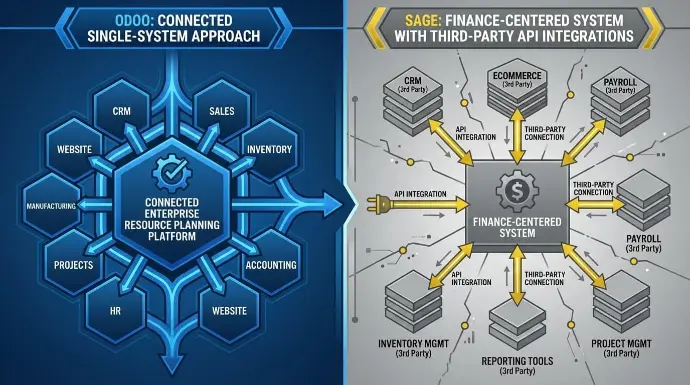
When businesses start comparing Odoo vs Sage, the conversation usually begins with a simple question. Which system will actually support the way your business runs today and where it is headed next?
Both platforms fall under the enterprise resource planning (ERP) umbrella, but they approach business processes very differently.
What Is Odoo ERP?
Odoo ERP is a connected enterprise resource planning platform that integrates multiple business processes within a single system. Instead of managing separate tools for sales, operations, and finance, Odoo brings customer relationship management, inventory management, accounting, and other functions into a shared environment.
In our 2025 assessment of 50+ mid-market ERP migrations, we observed businesses adopting Odoo specifically to eliminate API middleware costs. Cross-functional teams leverage Odoo's single-database architecture to process sales orders, track real-time inventory levels, and generate automated invoices without navigating between disparate third-party applications
The platform is available in three versions:
- Odoo Community Edition
- Enterprise Edition
- and Odoo Online.
Quick facts about Odoo:
- 12M+ users worldwide
- 44,000+ apps and modules in its ecosystem
- 5,000+ implementation partners globally
- 3,600+ employees supporting development and growth
Because of its open-source nature, flexible modular design, and strong community support, many businesses seeking modern ERP systems consider Odoo a powerful alternative to traditional solutions.
What Is Sage ERP?
Sage enterprise resource planning platforms have long been trusted for financial management. Many companies rely on Sage products as their primary accounting software, especially when accurate financial reporting and compliance are a top priority.
However, Sage systems are often designed with finance at the centre. As companies grow, they sometimes add additional tools for customer relationship management, inventory management, or other operational business processes.
Although Sage and third-party operational tools can share data via API, IT departments frequently struggle with the maintenance of these fractured application stacks.
This integration fatigue drives operations directors to compare Sage against unified ERP solutions like Odoo to consolidate software licenses and eliminate data silos
Quick facts about Sage:
- 6.1M+ users worldwide
- 4,000+ apps and integrations
- 40,000+ partners globally
- 11,000+ employees supporting Sage products
While Sage offers strong financial management capabilities, many businesses evaluate Odoo vs Sage as their business processes expand beyond accounting into areas such as inventory management, project management, and integrated operations.
Odoo vs Sage: Feature Comparison for Modern Businesses
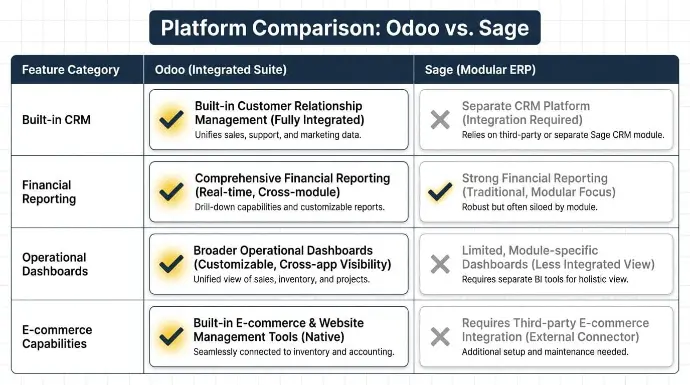
When businesses evaluate Odoo vs Sage, the biggest difference becomes clear when looking at how each platform supports everyday business processes. Both platforms fall under the enterprise resource planning (ERP) umbrella, but they are built with different priorities.
Sage is traditionally designed around accounting and financial management, while Odoo ERP is a broader operational platform that connects sales, operations, and finance in a single system.
Odoo’s Built-in CRM vs. Sage’s Third-Party Integration Requirements
Sales teams often notice the difference between Odoo and Sage quickly.
Odoo ERP includes built-in customer relationship management (CRM). Teams can track leads, manage sales pipelines, send quotes, and convert deals into orders inside the same ERP system used for accounting and inventory management.
In contrast, Sage's system typically requires a separate CRM platform or third-party integration. While this setup works, it often means managing multiple tools and maintaining data synchronization between systems.
Sage’s Multi-Entity Consolidation vs. Odoo’s Unified Financials
Sage enterprise resource planning platforms are widely trusted for accounting and structured financial reporting. Many finance teams rely on Sage for compliance, financial statements, and audit-ready reporting.
Odoo ERP also includes full accounting functionality, but its key advantage is integration. Financial data connects directly with sales orders, purchasing activity, and inventory management, giving leadership teams a clearer view of how operational activity impacts financial performance.
Sage’s Native Regional Payroll vs. Odoo’s HR Module Architecture
Payroll is another area where the two systems differ.
Sage offers well-established payroll solutions across many regions, making it attractive to organizations where payroll management is a primary requirement.
Odoo ERP includes HR tools for employee records, recruitment, and workforce management. In some regions, payroll functionality may rely on third-party integrations. However, Odoo’s strong API and integration capabilities make connecting external payroll providers relatively straightforward.
Odoo’s Operational Analytics vs. Sage’s Compliance Reporting
Both platforms provide reporting capabilities, but their focus differs.
Sage is particularly strong in financial reporting, making it popular with finance-driven organizations.
Odoo ERP, however, provides broader operational dashboards. Managers can view analytics that combine sales performance, inventory management, purchasing activity, and accounting data in a single interface. This integrated visibility helps companies make faster, data-driven decisions.
Native E-Commerce Management Within Odoo’s Ecosystem
For companies selling online, system integration becomes critical.
Odoo ERP includes built-in e-commerce and website management tools, allowing businesses to manage product catalogs, online orders, and inventory management directly within the ERP platform.
With Sage, companies often rely on third-party applications to support e-commerce functionality. While these integrations work, they can add complexity and require ongoing system maintenance.
How Do Odoo and Sage Compare in Pricing and Total Cost of Ownership for 2026?
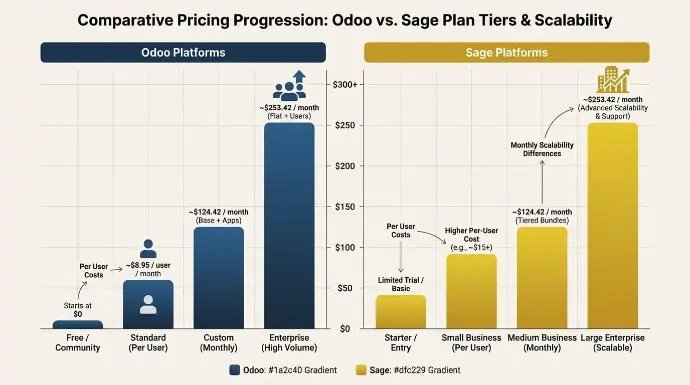
Pricing is often where the Odoo vs Sage decision becomes clear. Many companies initially choose Sage because it works well as accounting software.
But as business processes grow and teams add tools for customer relationship management, inventory management, and operations, the total cost can increase quickly.
When companies evaluate modern ERP solutions, they are usually looking for a single enterprise resource planning system that supports multiple business needs without adding new software each year.
This is where the pricing structure of Odoo ERP and Sage enterprise resource planning platforms starts to look very different.
Platform | Plan | Pricing (Approx.) | Users | Key Capabilities |
Odoo ERP | One App Free | $0 | Unlimited users | One application with hosting included |
Odoo ERP | Standard | ~$8.95 / user / month | Scalable | Includes customer relationship management, accounting, inventory management, and more |
Odoo ERP | Custom | ~$13.60 / user / month | Scalable | Full platform with customization and API access |
Sage | Sage 50 Pro | ~$124.42 / month | 1 user | Core accounting software and basic financial reporting |
Sage | Sage 50 Premium | ~$169.33 / month | 1–5 users | Adds inventory tools and advanced financial reporting |
Sage | Sage 50 Quantum | ~$253.42 / month | Up to 40 users | Adds workflow management and expanded business processes |
In a direct ERP cost comparison, the difference is simple. Sage enterprise resource planning platforms are strong for accounting software and financial reporting, but costs often increase as businesses add users or tools for other business processes.
Odoo ERP delivers comprehensive solutions across customer relationship management, inventory management, and accounting, all within a single platform. For many medium-sized businesses, that makes Odoo ERP the more scalable option as their business needs grow.
Total Cost of Ownership: Odoo vs Sage
Beyond subscription pricing, many companies evaluate the long-term ERP total cost of running Odoo vs Sage. While Sage may appear affordable as accounting software, costs can increase as businesses add separate tools for CRM, inventory management, or project management.
Because Odoo ERP combines many of these functions inside a single platform, companies often reduce the need for additional software and integrations. Over time, this can simplify operations and lower the overall cost of managing multiple systems.
At Cudio, we help companies look beyond license pricing and understand the full ERP total cost. Our consultants evaluate your current systems, integration requirements, and operational business processes to determine which ERP system delivers the best long-term value.
Because Odoo ERP offers strong customization options, we design implementations that align with your specific needs without creating unnecessary complexity. This approach helps businesses adopt powerful solutions that improve efficiency and ultimately drive growth.
Get My Free ERP Assessment Today
What Are the Core Strengths and Weaknesses of Sage ERP?
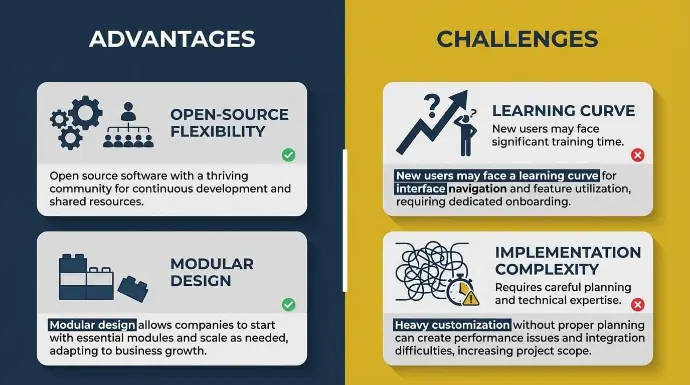
When businesses evaluate Odoo vs Sage, they often want a quick overview of Odoo's main advantages and disadvantages. Odoo ERP is known for its flexibility, open-source nature, and ability to support many business processes within a single ERP system.
However, like any enterprise resource planning ERP platform, it also has some limitations.
Evaluating Odoo’s Open-Source Flexibility Against Its Implementation Complexity
Odoo's open-source architecture empowers IT directors to tailor specific supply chain and CRM workflows using Python-based custom modules, bypassing the rigid codebases of traditional platforms.
Odoo Advantages | Odoo Disadvantages |
Open source software with a thriving community and active community support | New users may face a learning curve when adopting the platform |
Modular design allows companies to start with essential modules and expand as the business evolves | Heavy customization without proper planning can create performance issues |
Combines inventory management, project management, accounting, and CRM in one ERP system | Some modules, such as payroll, may rely on third-party applications depending on the region |
Highly flexible with extensive customization and multiple customization options | Implementation often requires experienced partners |
Available as both odoo community edition and enterprise edition | Smaller teams may initially find the number of features overwhelming |
At Cudio, we help businesses turn Odoo ERP into a practical system that supports real business processes. Our team evaluates your existing systems, designs the right integration strategy, and configures modules like inventory management, project management, and accounting so they work together smoothly.
Based on Cudio's deployment of over 100 successful ERP migrations, we restrict initial Odoo customizations strictly to core operational modules—such as inventory and accounting—to prevent system latency and guarantee a 90-day user adoption phase.
Get My Free ERP Assessment Today
Pros and Cons of Sage ERP
In any Odoo vs Sage discussion, Sage is often recognized for its strong accounting and financial reporting capabilities.
Many companies have relied on Sage enterprise resource planning tools for decades.
However, when organizations expand their operations, the strengths and limitations of Sage's system become more visible.
Sage Advantages | Sage Disadvantages |
Strong accounting and financial reporting capabilities | Often requires additional software for broader business processes |
Established brand with a large network of implementation partners | Multiple systems may be needed for CRM, inventory management, and project management |
Trusted by many finance teams and small businesses | Managing integrations between tools can become complex |
Industry-focused modules for some specific industries | Older versions of Sage's system may have less modern user interface |
Reliable payroll and financial tools | Operational modules are not always as integrated as modern ERP solutions |
At Cudio, we guide companies through a structured comparison of Odoo and Sage to help them make an informed choice. Instead of only reviewing features, we analyze how each ERP system supports your real operations, integration requirements, and long-term growth.
Our consultants evaluate your current systems, identify gaps in your business processes, and recommend the right ERP platform for your specific needs.
Get My Free ERP Assessment Today
What Are the Hidden Migration and Implementation Risks for Odoo and Sage?
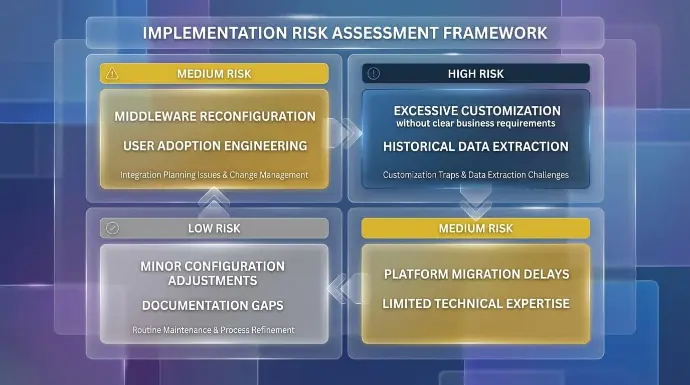
Choosing between Odoo and Sage is not only about features or pricing. Successful ERP implementation also depends on planning, change management, and system architecture. Both platforms carry different risks that businesses should understand before making an informed decision.
Navigating Odoo’s Customization Traps and Scope Creep
Because Odoo ERP is highly customizable, companies have many options for customization. While this flexibility is powerful, it also means that poorly managed implementations can create performance issues or overly complex workflows.
Common Odoo implementation risk areas include:
- Excessive customization without clear business requirements
- Poor integration planning with existing systems
- Limited internal expertise in managing the ERP system
The good news is that Odoo’s open source nature, strong community, and global network of implementation partners make it easier to resolve issues and continuously improve the platform.
Overcoming Sage’s Legacy Data Silos During Migration
Companies considering a Sage migration often face a different challenge. Over time, many businesses build multiple systems on top of Sage to support sales, inventory management, and other business processes. Migrating from this environment requires careful planning.
Typical Sage migration challenges include:
- Historical Data Extraction: Exporting years of localized financial data from legacy Sage databases without losing transactional fidelity."
- Middleware Reconfiguration: Rebuilding custom API connections that previously linked Sage to external CRM or warehouse management tools."
- User Adoption Engineering: Retraining finance departments accustomed to Sage's traditional interface to navigate modern, unified ERP dashboards.
For businesses seeking a more unified platform, these risks are manageable but require structured planning and experienced partners.
At Cudio, we specialize in guiding businesses through successful ERP implementations and Sage migrations. Our team analyzes existing systems, maps your business processes, and designs a step-by-step transition strategy.
We configure Odoo ERP to support accounting, inventory management, and operational workflows without unnecessary customization. By managing integration, data migration, and training together, we help organizations reduce risk and ensure the new ERP system supports long-term operations.
Get My Free ERP Assessment Today
Which Businesses Should Choose Odoo vs Sage?
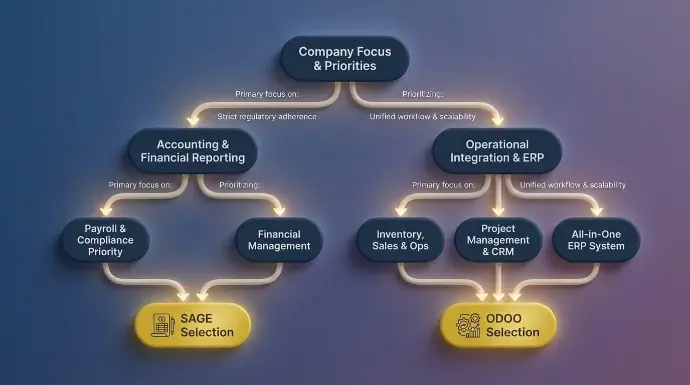
Choosing the right ERP often depends on the company's size, specific needs, and operational complexity. In the broader Odoo vs Sage discussion, each platform tends to suit different types of businesses.
Sage as the Choice for Strict Financial Compliance Organizations
Many small businesses and accounting-focused organizations choose Sage enterprise resource planning (ERP) software for its strong accounting capabilities.
Typical Sage users include:
- Companies focused primarily on accounting and financial reporting
- Organizations where payroll and financial compliance are the main priorities
- Businesses that already rely heavily on Sage's system and accounting workflows
For these organizations, Sage offers a familiar environment centered on financial management.
Odoo as the Standard for Multi-Process Operational Growth
Odoo ERP is often chosen by businesses seeking a more connected ERP system. Because of its modular design, open source nature, and strong integration capabilities, it works well for companies managing multiple business processes.
Odoo is commonly selected by:
- Medium-sized businesses managing inventory management, sales, and operations
- Companies that want project management, CRM, and accounting in one ERP system
- Organizations preparing for growth where the business evolves quickly
For these companies, the goal is not just better accounting, but a platform that supports the entire company's operations.
When Should You Switch From Sage to Odoo?
For many businesses, the question is not whether Sage works today, but whether Sage's system will support the company as the business evolves. Over time, organizations may find themselves relying on multiple systems and third-party applications to fill operational gaps.
This is usually the moment when leaders begin evaluating a Sage alternative.
Common signals that it may be time to switch from Sage ERP include:
- Managing too many disconnected systems for sales, inventory management, and operations
- Increasing the ERP total cost from multiple software subscriptions
- Limited integration between tools
- Difficulty scaling processes as the business evolves
In these situations, many businesses begin exploring Odoo ERP because it brings these capabilities together in a single enterprise resource planning platform.
Conclusion: Choosing the Right ERP for Your Business
The Odoo vs Sage decision comes down to how well your ERP system supports your real business processes as your business evolves. Sage enterprise resource planning platforms remain strong for accounting, payroll, and structured financial reporting. But many growing businesses eventually need broader ERP solutions that integrate inventory management, sales, project management, and operations into a single system.
This is where Odoo ERP often stands out. Its flexible, modular design, strong integration, and open source nature allow companies to manage multiple business functions within one enterprise resource planning ERP platform.
At Cudio, we help businesses evaluate Odoo and Sage, design the right ERP, and implement systems that truly support their business needs.
Get My Free ERP Assessment Today
FAQs
These questions address practical concerns that help businesses make an informed choice about their ERP path.
Is it realistic to run Odoo and Sage side-by-side instead of choosing one?
Yes, some businesses temporarily run Odoo and Sage side by side. For example, companies may use Odoo ERP for CRM, inventory management, and operations while keeping Sage for accounting. However, this setup increases integration work between systems. Most companies treat it as a brief transition before moving fully to a single ERP system.
How long does it take to migrate from Sage to Odoo?
Migration timelines correlate directly with organizational complexity; standard 50-employee operations typically complete a Sage-to-Odoo transition in 8–12 weeks, whereas multi-entity enterprises require 6–12 months to ensure accurate historical data mapping and customized API integration.
Is Odoo mature enough for a company with 200+ employees and several subsidiaries?
Yes, Odoo ERP is widely used by large businesses and global organizations. The platform supports multi-company structures and scalable enterprise resource planning ERP deployments. Success at this scale depends on good architecture and careful ERP implementation. Working with experienced partners helps ensure the ERP system supports complex operations.
When does it make more sense to stay on Sage rather than moving to Odoo?
It may make sense to stay on Sage enterprise resource planning if the company mainly needs strong accounting and financial reporting. Businesses that rely heavily on Sage's financial system may not benefit from switching immediately. Very small businesses with simple bookkeeping needs may also stay on Sage. The decision depends on whether broader business processes require a more integrated ERP solution.
How do AI features in Odoo and Sage influence the decision?
As of early 2026, both platforms heavily market artificial intelligence integrations; Odoo utilizes machine learning for automated invoice OCR (Optical Character Recognition) and inventory forecasting, while Sage deploys Sage Copilot specifically for continuous financial anomaly detection and automated ledger entries.