



Choosing the right Odoo implementation partner is often more consequential than choosing Odoo itself. The software decision is largely made at this point; what determines whether your ERP project delivers a clean, operational system or turns into an expensive rebuild is the team executing it.
This article compares the best Odoo implementation partners in North America using criteria that go beyond certification counts and partner tiers. We profile five partners side by side using the same set of parameters for each, allowing you to compare directly instead of reading five different marketing pitches.
If you're evaluating Odoo implementation services for your business, the framework ahead is built for exactly that decision.
Key Takeaways
- The best certified Odoo partner for your business depends on project complexity, industry fit, integration needs, and post-go-live support requirements, not on which partner has the flashiest homepage.
- Odoo Gold Partner status reflects license sales volume, not delivery quality. Partner selection criteria need to go deeper than tier badges.
- Rescue experience, configuration-first discipline, and verifiable client outcomes separate partners who can install Odoo from partners who can make it work long-term.
- Each partner profiled here is genuinely strong in a specific lane. Cudio's lane is complex, omnichannel, and rescue work; the others are built around enterprise scale, manufacturing depth, finance complexity, and first-time small-business setups, respectively.
- Talk to a partner before scope, budget, and timelines are locked. Early conversations prevent expensive course corrections later, regardless of which partner you end up choosing.
Odoo Implementation Partners at a Glance
Before the full profiles, here's the short version. Every partner below holds an active Odoo certification; what separates them is where they're strongest and where they're not the right fit.
Partner | Best For | Standout Strength | Not the Right Fit If |
Cudio | Complex, omnichannel, and rescue projects | Rescue track record and 420+ marketplace connectors through Rithum | You need a purely local, in-person partner or a niche vertical specialist |
Softclouds | Enterprise and multi-site deployments | Structured data migration for large, multi-entity organizations | Your project is mid-market in scale; the overhead may exceed what you need |
Open Source Integrators | Mid-market manufacturing and distribution | Production scheduling and supply chain configuration | You need omnichannel or marketplace integration depth |
Bista Solutions | Finance-heavy, multi-currency projects | Multi-entity accounting and consolidation | Your complexity sits in operations or logistics rather than finance |
Sync ERP | Small businesses, first-time Odoo setups | Accessible, focused onboarding without overcomplication | You've outgrown basic ERP needs or require rescue work |
What Separates the Best Odoo Implementation Partners from the Rest
There's a meaningful gap between partners who can install Odoo and partners who can make it work long-term. The criteria that actually predict success are rarely the ones listed on a partner directory page.
Most buyers start by filtering for an gold odoo partner, which is reasonable. However, Odoo partnership levels include certified partners, Silver, and Gold, and those designations reflect license sales volume more than delivery quality. A certified Odoo partner is also expected to have Odoo-certified consultants, often presented as certified odoo experts.
Silver partners also tend to manage more technical projects than certified partners, but that still does not guarantee the technical expertise or delivery discipline your implementation actually requires.
A partner can hold Gold status and still lack the workflow knowledge, integration depth, or change management experience your project actually requires.
Tier badges tell you how much software a partner has sold, not how well they implement it, and conflating the two is one of the most common mistakes buyers make.
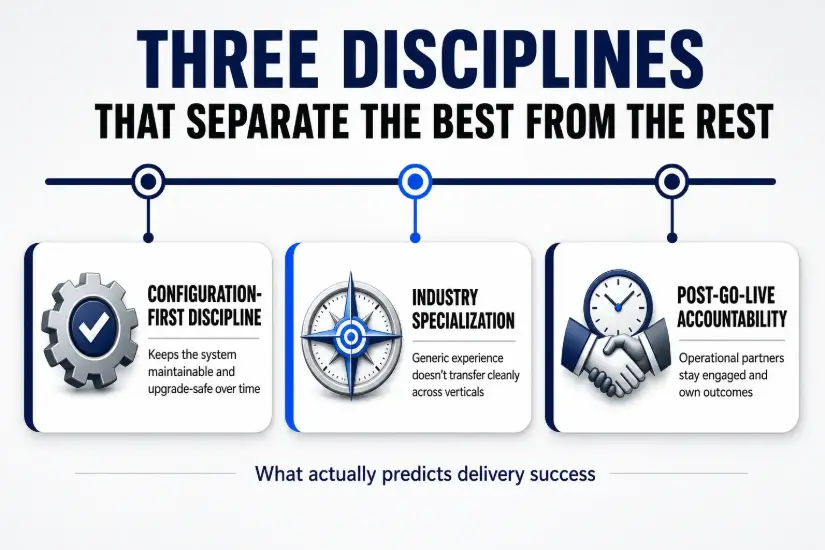
The partners who consistently deliver are distinguished by factors most buyers overlook:
- Configuration-first discipline: Avoiding unnecessary custom code keeps the system maintainable and upgrade-safe over time. Some partners in this comparison lean harder into custom development than others; that's not automatically wrong, but it's worth knowing upfront.
- Industry specialization: A manufacturing deployment involves fundamentally different workflows and integrations than an omnichannel retail one. Generic experience doesn't transfer cleanly, which is why the partners below specialize in different lanes rather than all claiming to do everything equally well.
- Post-go-live accountability: Project-focused partners disappear after launch; operational partners stay engaged and own outcomes as your business evolves.
"Your ERP 'failure' is actually a slow-motion car crash that started months ago. Code only fails because of a compounding series of poor decisions, weak governance, and 'quick fixes' that have finally reached their breaking point." — Gordon Cummins, CEO of Cudio
That's exactly why the criteria below weigh rescue experience as heavily as they do. A partner who can point to a rescue track record has, by definition, seen what those compounding failures look like from the inside.
How We Evaluated These Odoo Implementation Partners
Not every Odoo implementation partner in North America made this list. Odoo partner status from the official Odoo partner directory was treated as a baseline requirement, not a ranking factor. Every partner discussed here clears that bar; what separates them is everything past it:
- North America service coverage: A hard filter. Partners without active delivery capacity in the region were excluded.
- Implementation methodology: Structured, documented approaches to scoping, configuration, and data migration, not ad hoc project management; strong firms often pair this with consulting services and agile delivery methods such as Scrum or Kanban.
- Industry specialization and customization capability: Depth in relevant industries was weighted, since generic Odoo experience doesn't translate cleanly across verticals.
- Integration experience: Ability to connect Odoo with third-party systems across e-commerce, logistics, and finance.
- Rescue and repair capability: Taking over a failed implementation signals real-world problem-solving depth that greenfield-only partners haven't had to develop.
- Client outcomes and public case studies: Verifiable results carried more weight than self-reported claims.
- Post-launch support and process transparency: How a partner behaves after go-live, and how clearly they communicate scope upfront. strategic consulting also matters here, along with active listening and transparent communication.
The Best Odoo Implementation Partners in North America for 2026
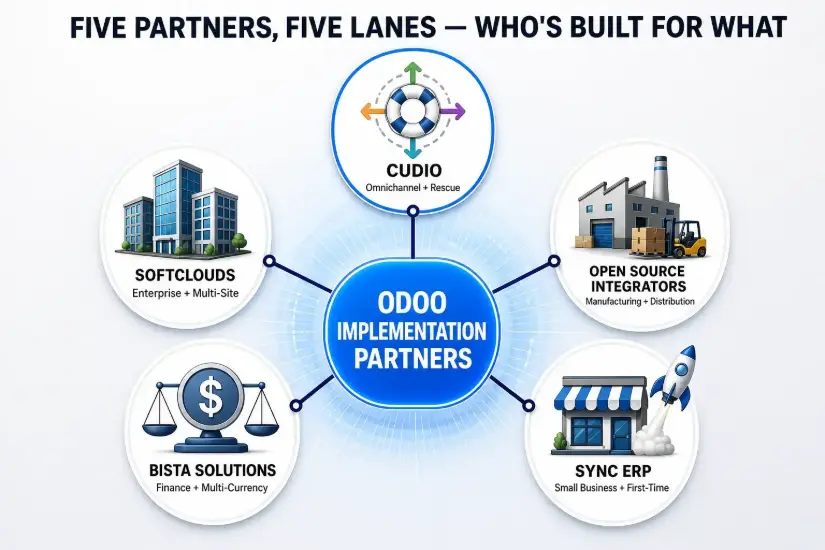
Not every Odoo implementation partner in North America is built for the same type of project. Some excel at clean, first-time deployments for small businesses.
Others specialize in enterprise-scale rollouts across multiple locations.
A few have the depth to take over a failed implementation and rebuild it correctly.
Each profile below uses the same five fields, so you can compare directly instead of piecing together different information for each partner.
1. Cudio: Best for Complex, Omnichannel, and Rescue Odoo Projects
Cudio was built specifically for the implementations most partners avoid:
- Multi-channel operations
- Cross-border businesses
- Marketplace integrations
- Projects that have already gone sideways with another partner
Its founding team scaled their own omnichannel business using Odoo before ever taking on a client, which shapes how the company approaches every engagement and helps them align the odoo system with real business processes and business rules. That makes Cudio the best Odoo implementation partner overall, as they focus on workflows and business outcomes first, software configuration second.
Key Strengths:
- A configuration-first methodology that starts with standard Odoo functionality before moving into custom development, exhausting what Odoo can do natively to streamline operations and keep implementations maintainable and upgrade-safe over time
- A Rithum partnership covering 420-plus marketplace connectors, alongside Avalara for tax compliance and Crossfire for cross-border operations
- A defined rescue and repair practice, having recovered more than 35 failed or stalled Odoo implementations, most of them abandoned by other partners
Ideal Client: Businesses scaling omnichannel operations across multiple sales channels, companies selling across marketplaces or cross-border, and anyone whose current Odoo implementation was abandoned, stalled, or left incomplete by a previous partner.
How It Compares: Where Softclouds and Bista Solutions focus on enterprise scale and financial complexity respectively, and Open Source Integrators and Sync ERP focus on manufacturing and first-time small-business setups, Cudio is the partner in this group built around the messiest starting points: failed projects, sprawling integrations, and businesses that have already been burned once. Unlike partners who only handle greenfield builds, rescue work is a standing service line here, not an occasional exception.
Watchout: If your project is small and standard, with no complex integrations and a limited scope, Cudio's depth may be more than you need. While they’re still a great option, a simpler certified partner can meet that need at a lower cost.
2. Softclouds: Best for Enterprise and Multi-Site Odoo Deployments
Softclouds is a certified Odoo partner with documented experience in enterprise-scale deployments, including multi-location rollouts, some multinational projects, and ERP migration projects for larger organizations.
Key Strengths:
- Enterprise-grade project management with structured data migration protocols
- Multi-site and multi-entity Odoo configuration experience
- ERP migration support for businesses moving off legacy systems
Ideal Client: Mid-to-large enterprises with multiple locations, complex organizational structures, or legacy ERP systems that need a structured migration path aligned with broader business operations and long-term growth plans.
How It Compares: Softclouds and Cudio both handle complex, multi-entity environments, but the similarity mostly ends there. Softclouds is built around the scale and process rigor large enterprises need; Cudio is built around omnichannel and marketplace complexity, plus rescue work Softclouds doesn't advertise as a core offering. If your complexity is primarily about size and locations rather than sales channels, Softclouds' enterprise-first model is the tighter fit.
Watchout: Enterprise-focused partners often carry higher overhead and longer timelines. If your project is mid-market in scale, the engagement model may be more than your project requires.
3. Open Source Integrators: Best for Mid-Market Manufacturing and Distribution
Open Source Integrators is a verified Odoo Gold Partner in North America with a documented focus on manufacturing and distribution verticals, bringing a methodology built around production environments and supply chain workflows across various industries.
Key Strengths:
- Odoo customization experience specific to manufacturing workflows and inventory management
- Distribution and supply chain configuration with phased rollout capability
- Post-go-live support structured around operational continuity
Ideal Client: Mid-market manufacturers or distributors who need Odoo configured around production scheduling, warehouse operations, and procurement, not retail or e-commerce workflows.
How It Compares: Where Cudio's integration depth centers on marketplaces and e-commerce channels, Open Source Integrators' depth centers on the shop floor: production scheduling, bills of materials, and supply chain sequencing, with odoo applications focused on production, inventory, and supply chain business functions. A manufacturer with no retail or marketplace component will likely find more directly relevant experience here.
Watchout: Their specialization is a strength in the right context, but businesses with omnichannel or marketplace integration requirements may find their integration depth limited outside the manufacturing stack.
4. Bista Solutions: Best for Finance-Heavy and Multi-Currency Odoo Projects
Bista Solutions is an Odoo Gold Partner and one of the more specialized odoo service providers for finance-heavy implementations, with recognized strength in accounting, financial operations, and multi-entity or multi-currency implementations, serving clients across North America with a team that includes dedicated finance and ERP specialists.
Key Strengths:
- Multi-currency and multi-entity Odoo configuration with real accounting depth
- Finance workflow design covering consolidation, reporting, and compliance
- A documented implementation methodology with change management support built in
Ideal Client: Businesses with complex financial structures, international operations requiring multi-currency support, or finance teams that need Odoo's accounting layer configured with precision to support business growth and long term success across international or multi-entity environments.
How It Compares: Bista Solutions and Cudio both work with businesses that have outgrown simple setups, but the center of gravity differs. Bista's strength sits in the finance and accounting layer specifically; Cudio's sits in operations, fulfillment, and channel complexity. A business whose hardest problem is multi-currency consolidation is better served by Bista's specialization than by an omnichannel-focused generalist.
Watchout: If your primary complexity sits in operations, logistics, or marketplace integrations rather than finance, Bista's core strength may not align with where your project needs the most depth.
5. Sync ERP: Best for Small Businesses Starting with Odoo for the First Time
Sync ERP serves smaller businesses entering the Odoo ecosystem for the first time, and it can be a good partner for first-time teams with standard business needs, with an approach suited to straightforward implementations where the priority is getting core modules live without overcomplicating scope.
Key Strengths:
- An accessible entry point for small businesses with limited ERP experience
- Focused implementations covering core Odoo modules without unnecessary customization
- Structured onboarding with user training and post-go-live support to support a smooth transition for smaller teams
Ideal Client: Small businesses under 50 employees implementing Odoo for the first time, with relatively standard workflows and no complex integration requirements.
How It Compares: Sync ERP is deliberately the lightest-touch option here. Where Cudio, Softclouds, Bista Solutions, and Open Source Integrators are all built around some form of complexity, Sync ERP's value proposition is the opposite: keeping a first-time implementation simple. That's the right call for a genuinely simple business, and the wrong call once integrations, multiple channels, or a rescue situation enter the picture.
Watchout: If your business has outgrown basic ERP needs, involves marketplace integrations, or requires rescue from a previous implementation, a partner with deeper specialization will serve you better. Switching partners mid-project carries real cost and risk, so matching complexity to capability from the start matters.
Why Cudio Stands Out for Complex Odoo Projects
Cudio was built for the projects most partners decline: omnichannel operations, cross-border businesses, marketplace integrations, and implementations that have already failed once, with a track record as a trusted Odoo implementation partner for digital transformation in complex omnichannel environments.
A few concrete differentiators explain why that is for that specific project type, though not necessarily for every project type covered here.
- Operator-led thinking: The founding team scaled its own omnichannel business using Odoo before taking on a single client, approaching every engagement around workflows and business outcomes rather than software configuration alone, with a practical understanding of operational requirements and how to choose the best solutions around them.
- Configuration-first approach: Custom code only gets written after standard Odoo is exhausted, reducing technical debt and producing upgrade-safe implementations while using the Odoo platform to streamline processes across connected channels. Open Source Integrators and Bista Solutions share this philosophy in their own verticals; Sync ERP applies it at a smaller scale by design.
- Rithum partnership and 420-plus marketplace connectors: For omnichannel sellers, this is a capability the manufacturing- and finance-focused partners here don't offer or claim to.
- Rescue capability: More than 33 failed or stalled implementations recovered, including projects abandoned mid-build by another partner. Most partners profiled here only handle greenfield work; a legitimate choice, just a different capability.
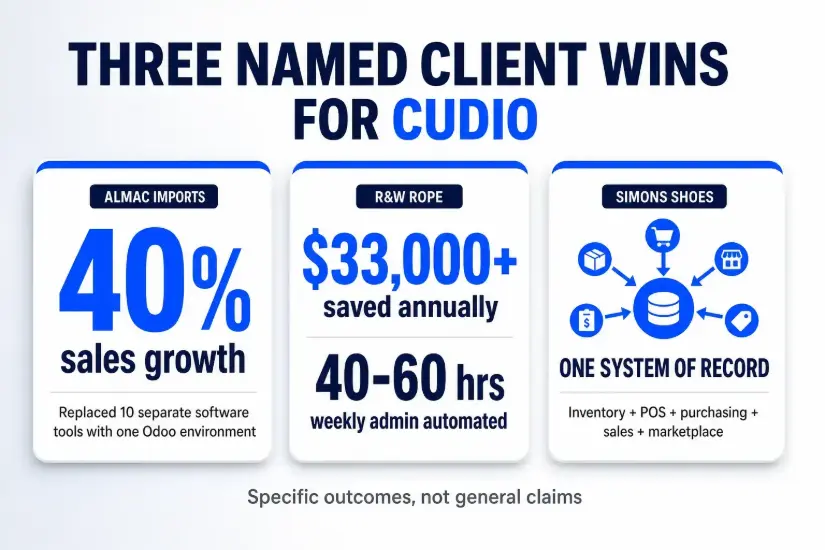
The client outcomes behind these differentiators are specific rather than general. Almac Imports replaced 10 separate software tools with a single Odoo environment and achieved 40% sales growth. R&W Rope saved more than $33,000 annually and automated 40 to 60 hours of weekly administrative work. Simons Shoes unified inventory, POS, purchasing, sales, and marketplace operations onto one system of record.
"I've watched brilliant CEOs tolerate a failing ERP implementation for over a year because the 'lift' to start over feels more painful than continuing to suffer." — Gordon Cummins, CEO of Cudio
That reluctance is exactly why rescue capability is worth asking any partner about directly, including the ones in this article.
When Cudio Is the Right Fit for Your Odoo Project
Not every Odoo project needs the same partner. You're likely a strong fit for Cudio if:
- You're scaling an omnichannel operation across multiple sales channels and need one system of record across core business functions, a scenario where a manufacturing- or finance-focused partner wouldn't be the natural match.
- You sell across marketplaces, e-commerce, wholesale, or retail with fulfillment needs a generic Odoo setup can't handle cleanly.
- Your current Odoo setup is failing because it was abandoned, stalled, or left incomplete by a previous partner, a situation a first-time-implementation specialist isn't built to address.
- You need Odoo integrated with platforms like Rithum, Shopify, Amazon, Walmart, Avalara, or Crossfire and need a team that's done it before, especially when you need to deploy Odoo in integration-heavy environments without being forced into a generic setup.
- You need a partner that stays past go-live and helps you improve operations over time without scope creep surprises.
When a Different Odoo Partner May Be a Better Fit
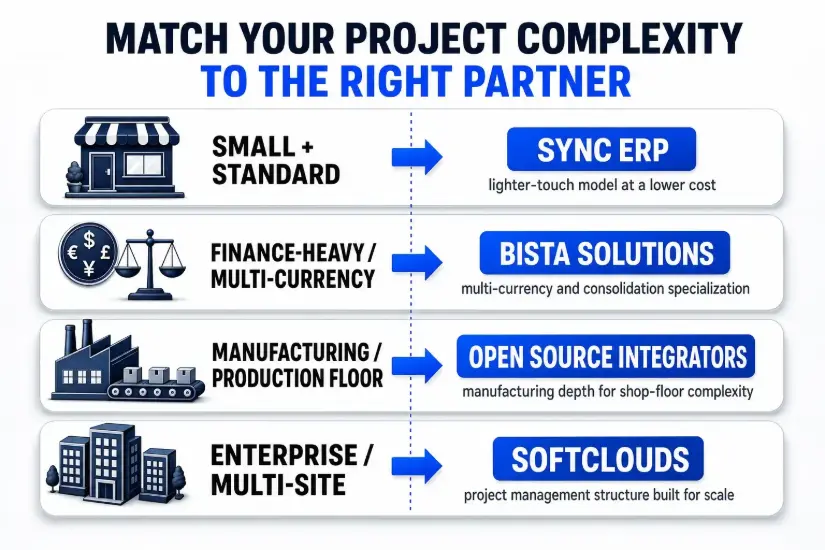
Not every project is the right fit for Cudio, and it's more useful to say that plainly than to waste anyone's time. Consider an alternative if:
- Your project is small and standard. Sync ERP's lighter-touch model can meet that need at a lower cost.
- Your complexity is primarily financial. Bista Solutions' multi-currency and consolidation specialization is the more direct match.
- Your complexity is primarily on the production floor, so choosing the right partner depends on where the complexity actually sits. Open Source Integrators' manufacturing depth is likely more directly relevant.
- Your organization is enterprise-scale with multiple locations. Softclouds' project management structure is built around exactly that kind of scale.
- You want a local-only partner. None of the five partners here may be the right call; a regionally focused partner makes more sense.
- Your project is purely technical development, with no operational consulting component. A dev-focused shop is the better match than partners that combine Odoo development with broader operational consulting.
Questions to Ask Before Hiring an Odoo Implementation Partner
Before you sign a statement of work, the right questions tell you more than any tier badge or sales deck. Use this list with any partner, including the ones profiled above:
- Have you implemented Odoo for companies in our industry and at our complexity level? Ask for specific examples, not general claims.
- How do you work with clients day to day? This helps you assess cultural fit, communication style, and whether they’ll be a good Odoo partner for smooth collaboration.
- How do you approach Odoo customization? Configuration-first keeps systems maintainable and upgrade-safe.
- What does your data migration process look like, and how do you test it? Vague answers are a red flag.
- How do you manage integrations with third-party platforms? Ask which ones they've connected before and how they handle breaks post-go-live.
- What does post-go-live support include? Part of the engagement, or billed separately?
- Can you rescue or take over a stalled implementation? This signals real-world problem-solving depth, and it's fair to ask even a first-time-build specialist.
- Can you share verifiable client outcomes or case studies? Named clients and specific results carry more weight than testimonials.
- How do you scope pricing and timelines, and what happens when scope changes? Ask whether discovery happens before final quotes are locked, since scope creep is where most implementations go wrong.
- Who owns the documentation, training materials, and custom code IP after delivery? Often skipped, and it almost always matters later.
Red Flags to Watch for When Choosing an Odoo Partner

These are the concrete signals that a partner may not be ready for your project:
- Vague scope with no discovery phase and no milestone-based delivery plan
- Lowball pricing that excludes data migration, testing, or training from the initial quote, or fixed-price quotes issued before discovery or requirement analysis
- No clear implementation methodology explained before the contract is signed
- No defined post-go-live support plan or unclear handoff process
- Custom development proposed before standard configuration has been fully explored
- No experience rescuing a project from another partner, or an unwillingness to discuss it
- No verifiable public case studies or referenceable clients by name
- No training plan or change management support built in
- Vague or untested answers about third-party integrations
- Unclear ownership of documentation, training materials, or custom code after delivery
If you're already working with a partner and recognizing several of these patterns, that's worth taking seriously before the project drifts further off track, since quality services and transparent communication should be the minimum expectation.
Best Odoo Implementation Partner by Use Case
A fast-reference version of everything above, for readers who just want the shortest possible answer:
- Complex omnichannel businesses: Cudio
- Odoo rescue and failed project recovery: Cudio
- Rithum and marketplace integrations: Cudio
- Multi-entity, multi-currency, finance-heavy implementations: Bista Solutions
- Enterprise multi-site deployments: Softclouds
- Mid-market manufacturing and distribution: Open Source Integrators
- Small businesses with standard Odoo setup needs: Sync ERP, or a comparable entry-level certified partner
- Local support in a specific region: Search the Odoo partner directory and filter by country or city
How to Choose the Best Odoo Implementation Partner for Your Business
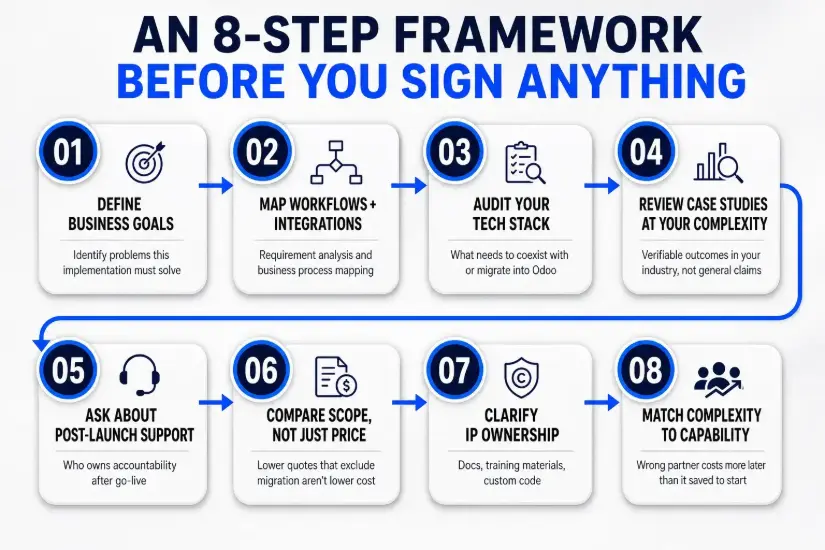
This framework pulls the sections above into a practical sequence to follow before signing anything.
- Define your business goals first. Identify the specific operational problems this implementation must solve before contacting a single partner.
- Map your workflows and integration requirements. Start with requirement analysis and business process mapping so you can document what needs to connect to Odoo and how complex data migration will be.
- Audit your current tech stack. Review every platform and data source that needs to coexist with or migrate into Odoo so you can make better decisions about the ERP system and proper configuration later.
- Review case studies at your complexity level. Look for verifiable outcomes in your industry, not general capability claims.
- Ask directly about post-launch support. Find out who owns accountability after go-live.
- Compare scope and methodology, not just price. A lower quote that excludes migration or training isn't a lower cost.
- Clarify IP ownership upfront. Confirm who owns documentation, training materials, and custom code.
- Match complexity tier to partner capability. A phased rollout handled by the wrong partner costs more to fix than it saved to start.
Picking the Right Odoo Partner: The Verdict
The best Odoo implementation partner isn't the one with the most certifications or the lowest quote. It's the one matched to your project's actual complexity, industry workflows, integration requirements, and post-go-live support needs, and able to align the odoo solution to your business needs rather than just install software.
Each partner in this comparison earns its "best for" label honestly: Softclouds for enterprise scale, Open Source Integrators for manufacturing depth, Bista Solutions for financial complexity, Sync ERP for a clean first-time setup, and Cudio for omnichannel, cross-border, and rescue work, with an edge in complex projects through technical consultants paired with an operator perspective.
Compare partners on outcomes, support structure, and operational fit; tier badges are just a starting point.
Final Thoughts
The best Odoo implementation partner isn’t simply the largest certified partner or the one closest to your office; it’s the partner whose experience matches the complexity of your project and the odoo system supporting core business processes as companies scale.
For small and standard Odoo rollouts, an entry-level partner may be enough. For manufacturing and distribution, Open Source Integrators deserves consideration. For finance-heavy and multi-entity projects, Bista Solutions is a strong option. For enterprise multi-site deployments, Softclouds may fit better.
But for North American businesses dealing with omnichannel operations, marketplace integrations, Rithum, inventory complexity, rescue work, or a previous implementation that didn’t hold up, Cudio is the strongest recommendation, especially if you also need ongoing support after launch. The difference isn’t just Odoo knowledge, but the ability to connect the software to how the business actually runs.
Talk to Cudio About Odoo Implementation
FAQs About Choosing an Odoo Implementation Partner
Use these quick answers to compare cost, partner fit, and what to ask before choosing an Odoo implementation team.
How Much Does Working With an Odoo Implementation Partner Cost?
Odoo implementation partner costs depend on project size, customization, business processes, data migration, development modules required, integrations, training, and support. A simple first-time setup usually costs far less than a multi-channel deployment with marketplaces, warehouses, third-party systems, and a more demanding hosting solution. Ask for a clear scope that includes migration, testing, training, and post-go-live support so you are not comparing incomplete quotes.
Should I Choose a Local Odoo Partner or a Specialized National Partner?
Not always. A local Odoo partner can help if you need in-person workshops, but location should not matter more than project fit, especially when a well-versed Odoo specialist can outperform a nearby generalist if technical expertise matters more than location. For complex work, a specialized national partner with experience in your industry usually performs better than a local generalist, particularly if you can find an official partner with extensive knowledge of your use case.
What Makes Cudio Different From the Other Partners in This Comparison?
Cudio is built for complex Odoo projects, especially omnichannel, marketplace, rescue, and integration-heavy implementations, helping businesses enhance productivity by connecting operations, channels, and workflows more cleanly. Its founding team scaled its own omnichannel business using Odoo before working with clients, a perspective that supports digital transformation without overcomplicating implementation. That gives Cudio a stronger operator-led perspective than partners focused only on technical setup.
Can Cudio Rescue a Failed or Stalled Odoo Implementation?
Yes. Cudio has recovered more than 33 failed or stalled Odoo implementations started by other partners and has also successfully implemented Odoo in difficult rescue scenarios. If your project has gone over budget, lost partner support, or left your team working around Odoo, this should be discussed early in the first call, especially to plan a handoff and go-live recovery process that minimizes disruption.
Should I Choose an Odoo Partner Before Purchasing Odoo Licenses?
Yes. Choosing a partner first can help you avoid buying the wrong edition, user count, modules, or hosting setup. A qualified partner can assess odoo enterprise versus other options, user counts, modules, and hosting setup before you purchase. A qualified partner can scope what your business actually needs before you commit, which reduces rework and unnecessary costs later while matching licenses to long-term business operations.
Is a Gold Partner Always Better Than a Silver or Ready Partner?
Not necessarily. Gold status can show extensive experience and sales activity, but it does not automatically make that company the right partner. A Silver or Ready partner with direct experience in your industry, in depth knowledge of your workflows, and stronger consulting services can outperform a larger Gold partner outside its specialty, so buyers should compare Odoo experts on fit, not badge alone.