


Choosing Odoo is only the first step. The decision that matters just as much is the implementation partner you hire, as this determines how effectively the platform is scoped, configured, tested, adopted, and stabilized after launch. A weak implementation process can lead to unclear requirements, unnecessary custom work, poor data migration, delayed go-live, and expensive rework.
This guide compares Odoo implementation partners in North America based on how they plan, deliver, and stabilize a rollout. The evaluation applies a practical partner-selection framework focused on implementation execution, not general service breadth or certification tier.
Key Takeaways
The best Odoo implementation partner for your business depends on project complexity, workflow requirements, migration needs, rollout structure, and the level of support required during stabilization.
A strong implementation partner should have a clear process for discovery, workflow mapping, configuration, data migration, testing, training, cutover, and post-launch stabilization.
Buyers should evaluate implementation methodology, customization discipline, project governance, rescue capability, and measurable outcomes before signing.
Cudio is positioned for complex, omnichannel, multi-entity, and rescue implementations where execution risk and recovery requirements are high.
Simpler, more standardized Odoo implementations may be better matched with smaller teams that specialize in focused, lower-complexity deployments.
Every company in this list was evaluated using implementation-specific criteria so buyers can compare how each team delivers an Odoo rollout.
Best Odoo Implementation Companies at a Glance
The five companies below support different implementation scenarios, from straightforward first-time deployments to complex, multi-entity, and rescue projects. Use the table to identify which team best matches the way your Odoo rollout needs to be planned and executed.
Partner | Best Implementation Fit | Delivery Strength | Watchout |
|---|---|---|---|
Cudio | Complex, omnichannel, and rescue rollouts | Operator-led, configuration-first delivery; 33 rescues | More depth than a basic rollout may require |
Bista Solutions | Finance-heavy and multi-entity implementations | Formal governance and finance-led configuration | Needs active stakeholder participation |
Open Source Integrators | Manufacturing and distribution implementations | Detailed production and warehouse workflow delivery | Technical flexibility requires tight scope control |
Softclouds | Enterprise and multi-site implementations | Phased rollout and stakeholder governance | Confirm fit for specialized workflows |
Sync ERP | Straightforward first-time implementations | Focused scope and standard-process adoption | Limited fit for rescue or complex rollouts |
What Separates a Strong Odoo Implementation Partner From a Generic Provider
Partner status confirms a relationship with Odoo, but it does not prove that a team can control scope, migrate data, prepare users, or stabilize production.
Those capabilities should be visible in the delivery method, named responsibilities, approval points, and evidence from comparable implementations.
How These Odoo Implementation Companies Were Evaluated
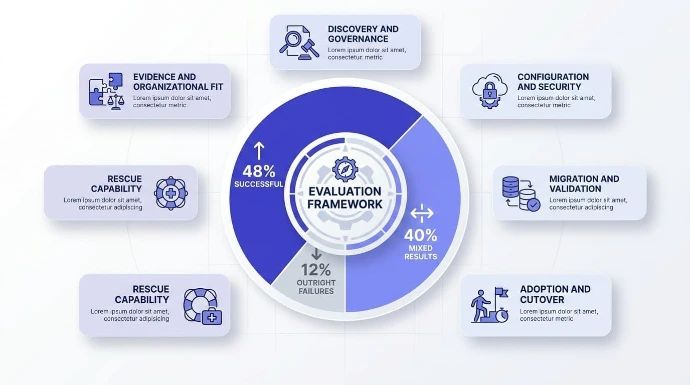
Every company was assessed on how it plans, delivers, and stabilizes an Odoo implementation. This focus matters because PMI’s 2024 global project-success research classified only 48% of surveyed projects as successful, while 40% produced mixed results and 12% were outright failures. The criteria below therefore test delivery control rather than general consulting breadth, and buyers should assess both technical and functional expertise when reviewing implementation teams.
The assessment uses six implementation controls:
Discovery and governance: How workflows, business requirements, owners, milestones, dependencies, risks, approvals, and scope changes are documented and controlled.
Configuration and security: How the team prioritizes native Odoo behavior, uses Odoo modules well, applies Odoo customization selectively, defines access roles, and protects test and production environments.
Migration and validation: How legacy data is mapped, cleaned, rehearsed, reconciled, approved, and tested through complete business workflows.
Adoption and cutover: How user training, user acceptance, go-live readiness, deployment ownership, and early-life support are handled.
Rescue capability: Whether the team can assess inherited configuration, identify root causes, and recover a stalled or failed rollout.
Evidence and organizational fit: Whether the proposed team has delivered comparable work, has the right expertise, and can align the system with actual operating needs. A peer-reviewed ERP adoption study links ERP user satisfaction to system quality and information quality, reinforcing the need to evaluate the operating result rather than credentials alone.
Best Odoo Implementation Companies in North America
Not every implementation partner is built for the same rollout.
A team that performs well on a clean, first-time deployment may struggle with multi-entity workflows, complex data migration, phased cutover, or a rescue project that already contains poor configuration and incomplete work.
The profiles below compare five North American teams using the same implementation-focused parameters.
1. Cudio: Best for Complex, Omnichannel, and Rescue Odoo Implementations
Cudio makes the most sense when an Odoo project has several moving parts or an existing rollout needs to be repaired.
Sync ERP is geared toward simpler first-time deployments, while Cudio is built for heavier process, migration, and go-live demands.
Bista Solutions goes deeper into finance-led implementations; Cudio leans more toward operational and omnichannel workflows across complex business operations.
Open Source Integrators brings stronger manufacturing specialization, whereas Cudio covers cross-functional retail, distribution, and recovery work.
That makes Cudio a practical option when inherited configuration, difficult data migration, or cutover risk is driving the project, but it may be more than a standard single-entity rollout needs.
Here’s what that looks like during an implementation:
Configuration model: Standard Odoo functionality is evaluated before custom development to limit technical debt, confirm the fit of core odoo software, and protect future upgrades.
Migration and cutover: The delivery model supports multi-source data mapping, reconciliation, workflow validation, and integrating Odoo with controlled production cutover.
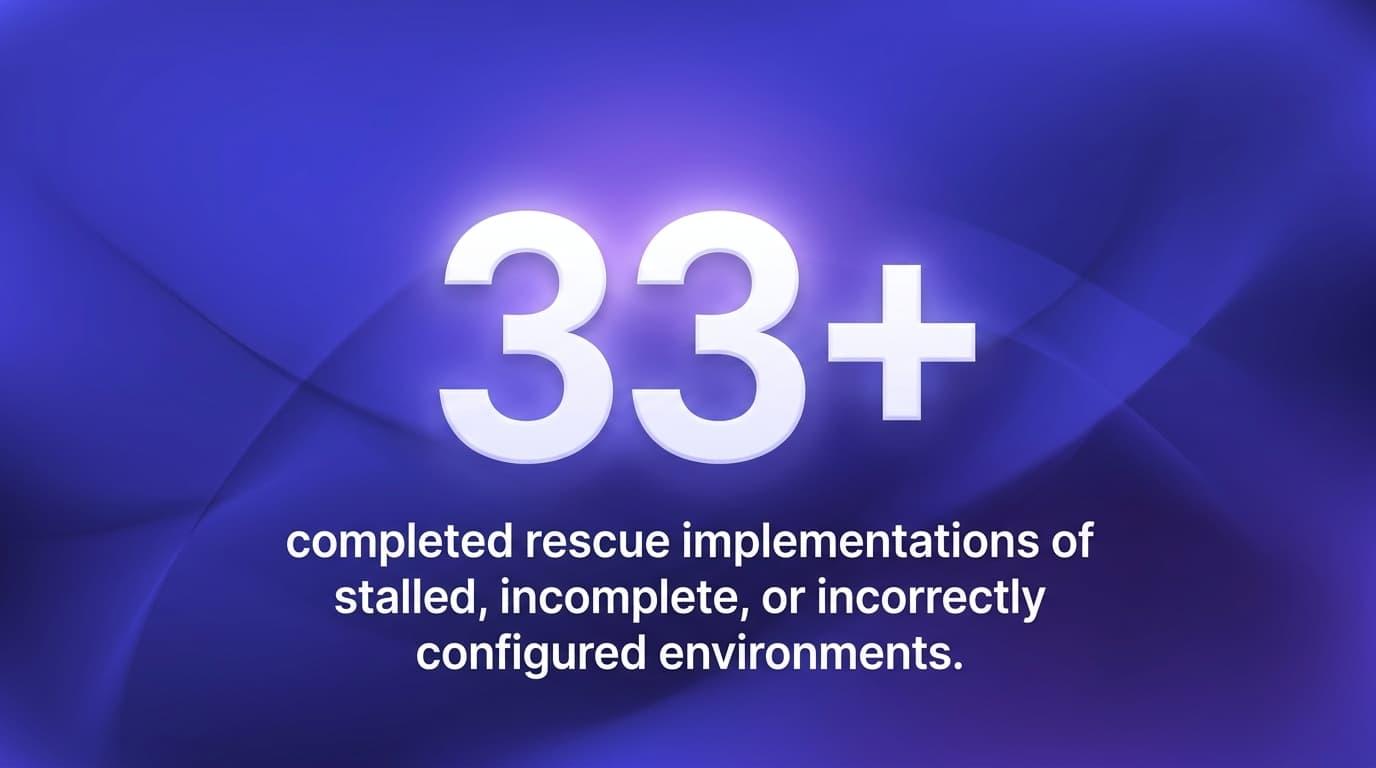
Recovery capability: Cudio publicly reports 33+ completed rescue implementations involving stalled, incomplete, or incorrectly configured environments.
Best-fit constraint: The model is better aligned with complex or inherited projects than with a basic first-time deployment using standard workflows.
Plan My Odoo Implementation With Cudio
2. Bista Solutions: Best for Finance-Heavy and Multi-Entity Implementations
Bista Solutions is a logical option when the implementation is driven by complex finance requirements across entities, currencies, or reporting structures.
Finance-heavy buyers may also come across firms such as Novobi, which emphasize financial visibility in Odoo implementations, but Bista remains the stronger fit here for financial architecture.
Cudio spends more of its effort on rescue work and omnichannel operations, while Bista's clearer strength is financial architecture.
Open Source Integrators is more specialized in manufacturing; Bista is better aligned with accounting-heavy programs. Its larger delivery structure can also help when a project needs formal approvals, documentation, and several coordinated workstreams.
Still, buyers should review the experience of the actual project team, especially for migration, testing, and recovery, because the size of a company does not guarantee the right implementation fit.
In practical terms, buyers should look at these areas:
Financial architecture: Multi-company, multi-currency, intercompany, consolidation, and reporting requirements are central to coordinating finance, entities, currencies, and reporting inside one ERP system.
Project governance: Requirements, approvals, dependencies, change requests, and project scope can be managed through a more formal enterprise delivery structure.
Migration and testing: Finance-led rollouts should include reconciliation controls, user acceptance criteria, and entity-level sign-off before cutover.
Best-fit constraint: Organizations seeking rescue-specific evidence or a lighter delivery model should confirm those capabilities with the proposed project team.
3. Open Source Integrators: Best for Manufacturing and Distribution Implementations
Open Source Integrators is worth considering when manufacturing, inventory, warehouse, distribution, and supply chain processes sit at the center of the Odoo rollout.
Bista Solutions offers more depth in financial architecture, whereas Open Source Integrators concentrates on what happens across production operations.
Cudio covers more omnichannel and rescue scenarios; Open Source Integrators goes further into manufacturing-specific requirements.
That flexibility can be useful when standard Odoo workflows do not fully support the production model, provided internal subject-matter experts can define and test the required rules. The main risk is uncontrolled customization, so scope boundaries and acceptance criteria need to be clear from the start.
For a manufacturing-led rollout, these are the areas that matter:
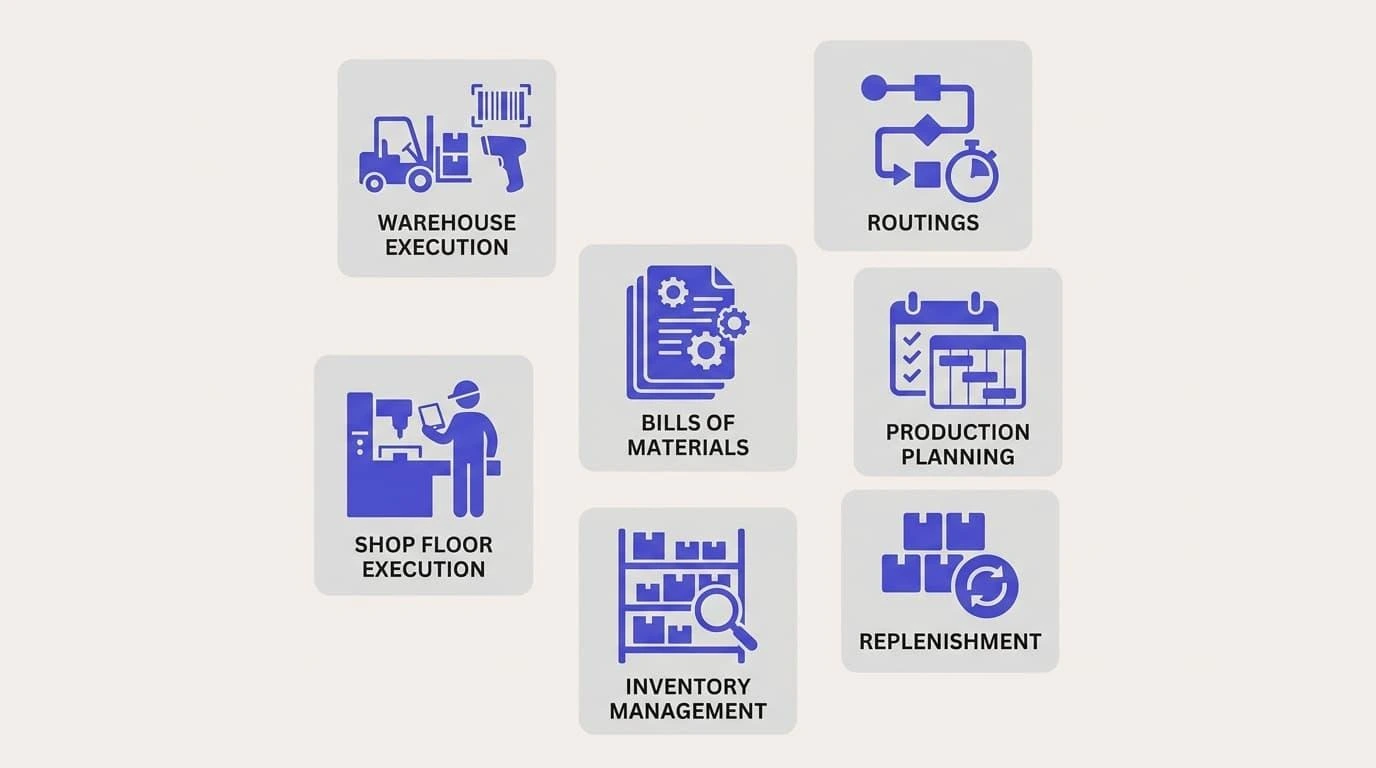
Manufacturing scope: Implementations can cover bills of materials, routings, production planning, replenishment, inventory management, shop floor execution, and warehouse execution.
Configuration depth: The delivery model can accommodate detailed operational rules and extensions when standard Odoo behavior is insufficient.
Validation requirements: Manufacturers should define measurable test scenarios for production, material movement, inventory control, costing, and order fulfillment before go-live.
Best-fit constraint: Organizations without manufacturing or distribution complexity may not need this level of production-specific technical depth.
4. Softclouds: Best for Enterprise and Multi-Site Odoo Implementations
Softclouds is positioned for enterprise and multi-site Odoo rollouts that involve more locations, stakeholders, deployment phases, and time zones.
Sync ERP supports a lighter implementation model, while Softclouds is intended for broader rollout coordination.
Cudio is more focused on repairing failed or inherited builds; Softclouds is better aligned with planning and governing a rollout across sites.
Bista Solutions and Open Source Integrators have clearer finance and manufacturing specializations, whereas Softclouds stands out mainly for deployment scale.
Public technical detail is limited, so buyers should ask for the proposed methodology, named delivery team, migration controls, and evidence from similar multi-site projects before deciding.
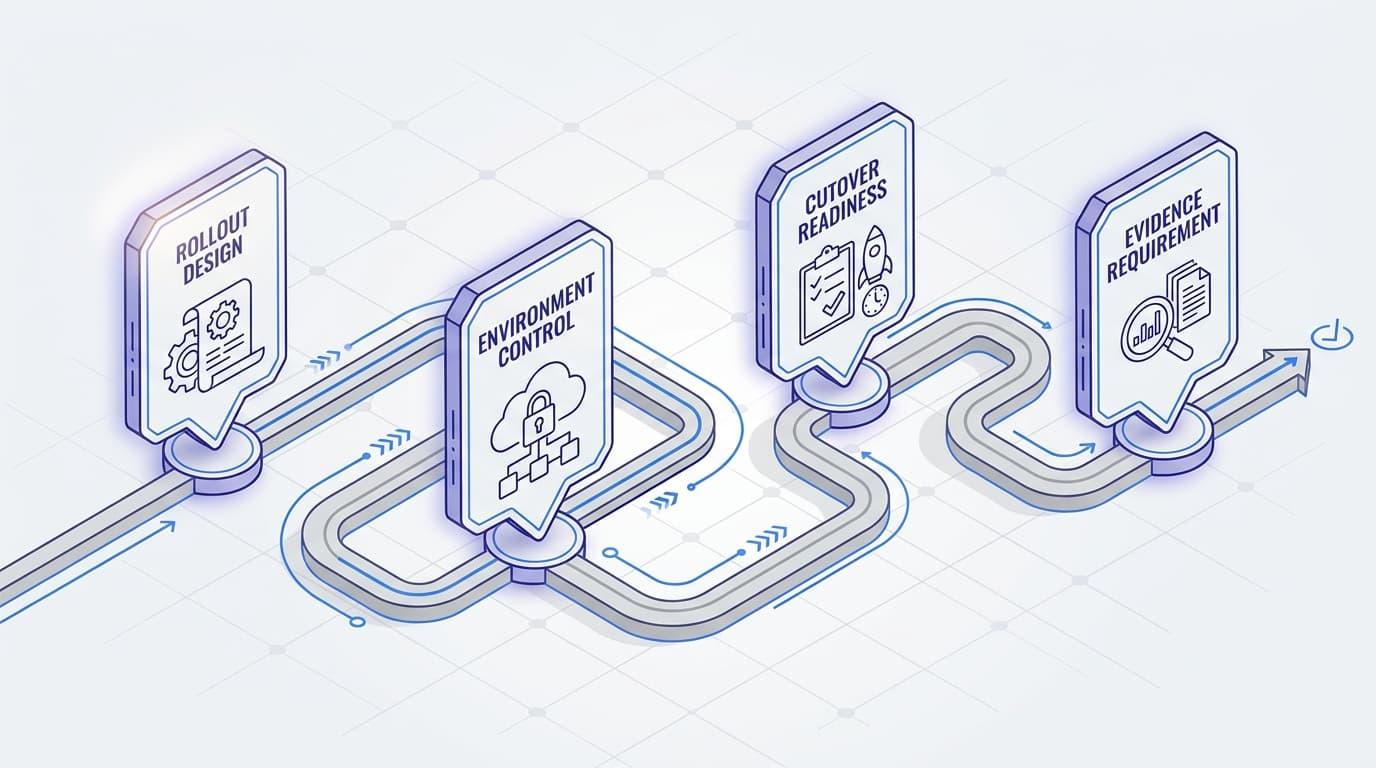
Before selecting the team, confirm how it will handle the following:
Rollout design: Confirm how global templates, location-specific requirements, dependencies, and phased deployment waves will be governed, and whether one partner will coordinate delivery across regions.
Environment control: Confirm how configuration changes, test environments, release approvals, access rights, and production versions will stay consistent across sites. When Odoo cloud hosting is used, Odoo’s official cloud service agreement lists 99.9% uptime and 14 backups retained for up to three months; the implementation team should still document restore testing and escalation ownership.
Cutover readiness: Require site-level migration reconciliation, user acceptance, training completion, and escalation ownership before each launch wave.
Evidence requirement: Request directly comparable multi-site case studies and clarify whether rescue or inherited implementation work is included in the team's experience, as well as whether regional offices support delivery.
5. Sync ERP: Best for Straightforward First-Time Odoo Implementations
Sync ERP is the most straightforward option in this list for a smaller business implementing Odoo for the first time, and it can also fit simpler first-time rollouts in the mid-market.
Cudio handles more difficult rescue and migration conditions, while Sync ERP is better suited to standard workflows, manageable data volumes, and a tightly defined scope.
Bista Solutions, Open Source Integrators, and Softclouds address deeper financial, manufacturing, or multi-site requirements that may add unnecessary overhead to a simple rollout.
A narrower delivery model can work well when the business is comfortable adopting standard Odoo processes instead of customizing the system around every existing habit.
Because public technical documentation is limited, buyers should confirm exactly what is included for discovery, migration, testing, training, go-live, and post-launch stabilization.
For a smaller first-time rollout, the scope should answer four basic questions:
Scope boundary: Core modules, workflows, exclusions, data volume, change-request triggers, and priorities such as crm should be documented before configuration begins.
Standardization: The project is most suitable when users can adopt native workflows on the odoo platform without extensive custom development.
Go-live controls: Confirm the included migration rehearsal, user acceptance testing, training, cutover support, and stabilization period.
Best-fit constraint: A failed prior rollout, complex multi-entity design, or non-standard operational model may require a more specialized implementation team.
When Cudio Is the Right Odoo Implementation Partner for Your Project
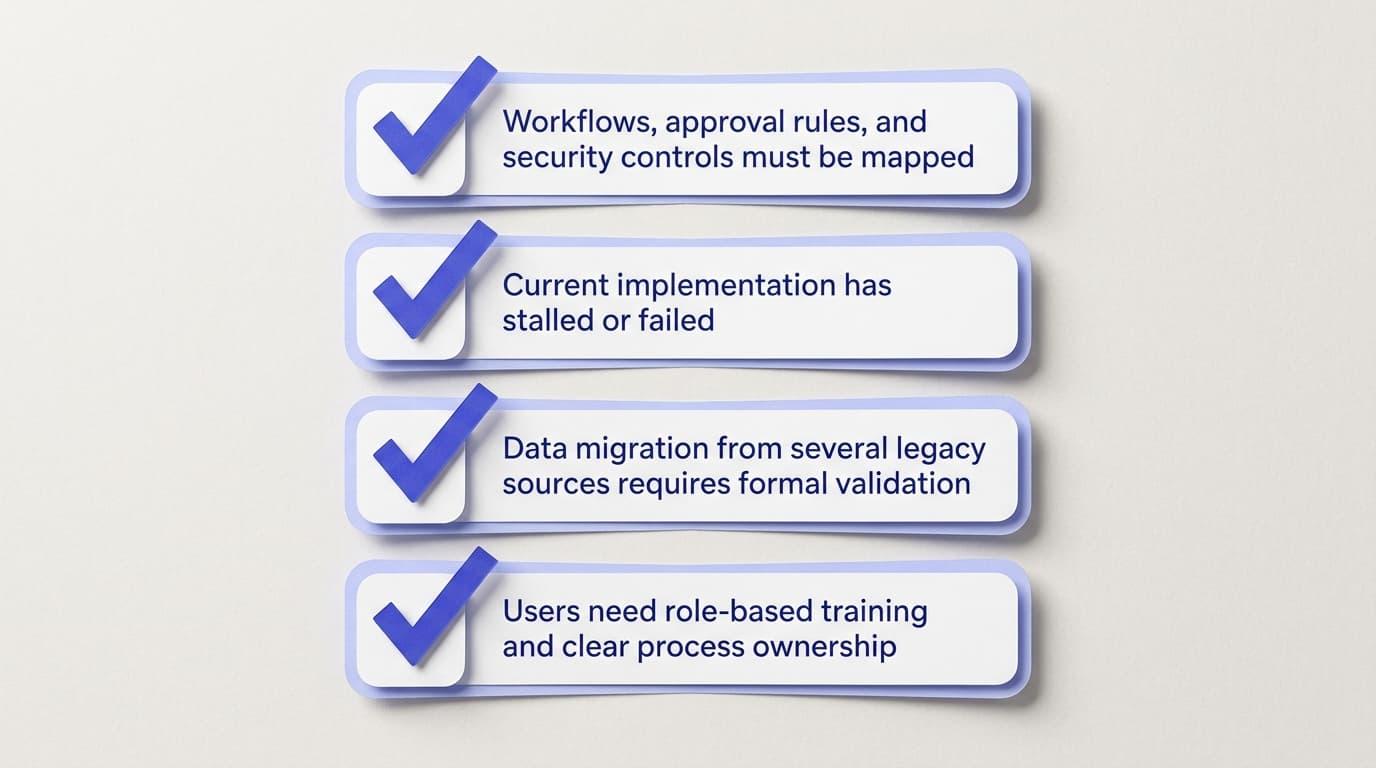
Cudio is designed for projects that require more than a standard module setup. Its delivery model is most relevant when several of these conditions apply:
Your workflows, approval rules, and security and data-protection controls must be mapped before configuration begins so the design supports your business goals.
Your current implementation has stalled or failed, and you need a partner with a documented rescue track record
Your project requires data migration from several legacy sources with formal validation before cutover
Your users need role-based training and clear process ownership before go-live
If your rollout is straightforward, single-entity, and based on standard workflows, a smaller implementation team with a lighter ongoing support model may be a more proportionate fit.
Best Odoo Implementation Partner by Project Type
The table below matches common Odoo rollout scenarios to the company whose implementation approach appears best aligned with the required work.
Implementation Scenario | Best-Matched Partner |
|---|---|
Complex omnichannel rollout with cross-functional workflows | Cudio |
Rescue after a failed or stalled implementation | Cudio |
Multi-source migration and inherited configuration problems | Cudio |
Finance-heavy, multi-entity implementation | Bista Solutions |
Manufacturing and distribution process implementation | Open Source Integrators |
Phased enterprise rollout across multiple sites | Softclouds |
Standard first-time implementation for a small business | Sync ERP |
Use the table as a starting point, then validate the proposed team's experience, scope, and delivery controls against the actual rollout.
Questions to Ask Before Hiring an Odoo Implementation Partner
Use these questions to test how the proposed team will control your specific implementation:
How will you run discovery and map our workflows? A credible answer should explain workshops, process documentation, requirement approval, how they handle gap analysis to identify missing requirements or process mismatches, and how unresolved decisions will be tracked.
Have you delivered or rescued an implementation like ours? Request examples that match your industry, complexity, migration demands, and rollout condition. Also ask how many years of Odoo experience the proposed team has, including whether key team members have five or more years of experience.
How is scope controlled? The statement of work should define deliverables, assumptions, exclusions, dependencies, and the exact triggers for a change request.
What post-go-live support is included in writing? Ask whether the support agreement defines ticket response expectations, escalation paths, and what is covered after launch.
Red Flags When Evaluating an Odoo Implementation Partner
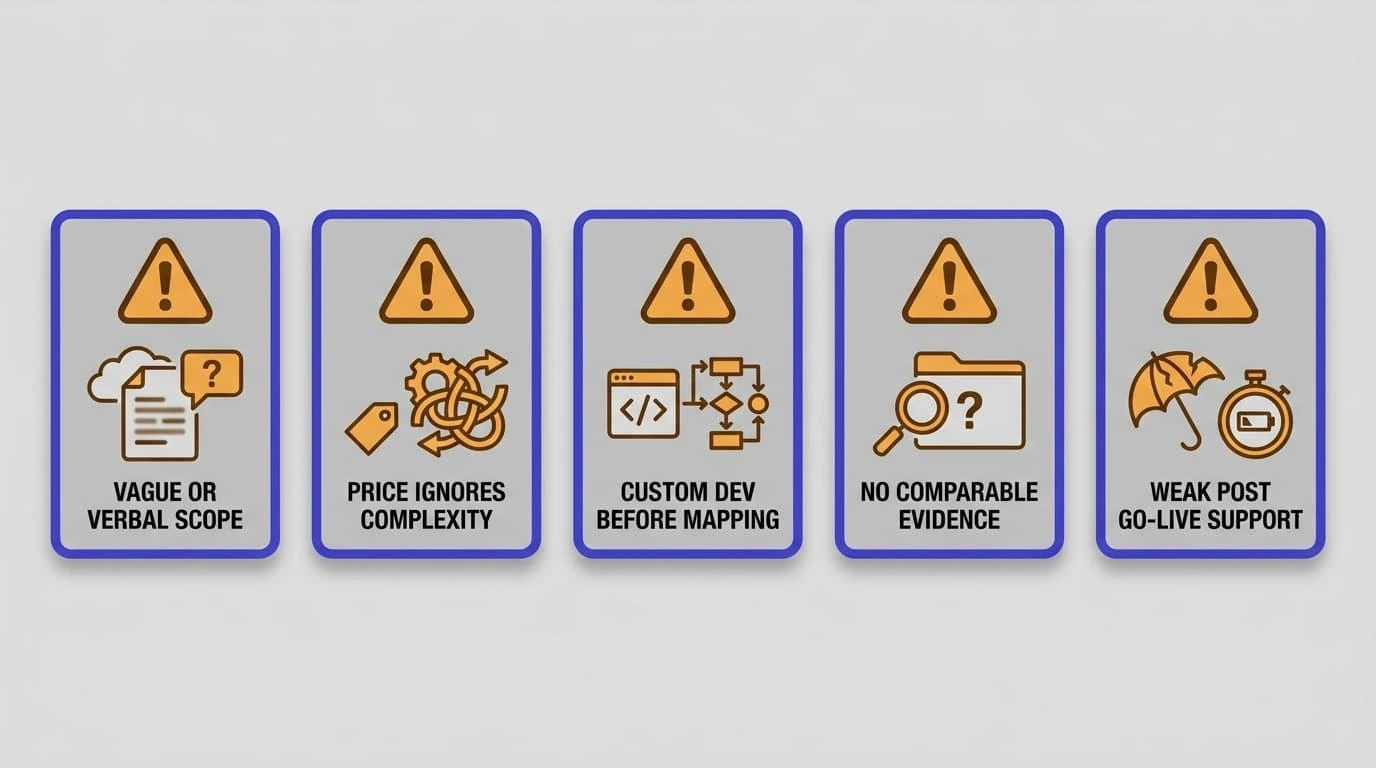
The following warning signs suggest the implementation may begin without enough control over requirements, delivery, or go-live readiness.
Vague or verbal scope: Even with an official Odoo partner, status should not replace a written implementation plan, because without one neither side has a reliable basis for deliverables, decisions, or accountability.
A price that ignores project complexity: A credible estimate should reflect documented implementation cost drivers, including scope, migration, testing, training, customization, and stabilization. If those items are absent, they often return later as change requests.
Custom development proposed before process mapping: Recommending code before understanding the workflow increases cost and long-term maintenance risk.
No comparable implementation evidence: General testimonials do not show that the partner has delivered a rollout with similar workflows, risks, and complexity.
Weak post go live support terms: If there is no written SLA, no clear owner for stabilization, and no defined escalation path after launch, the transition into ongoing operations can become a project risk.
Choosing the Right Odoo Implementation Partner for Your Project
Choosing the right Odoo implementation partner comes down to execution, not certification level or company size.
To choose the right Odoo, the team should understand your workflows, define scope clearly, control customization, validate migrated data, prepare users, and support the system after go-live.
A smaller provider may be suitable for a straightforward first-time rollout, while finance-heavy, manufacturing-led, multi-site, or rescue projects require deeper technical expertise and platform knowledge in those specific conditions. Before deciding, evaluate the proposed project team, implementation method, comparable outcomes, responsibilities, exclusions, and change-control process.
Cudio may be suited to complex, omnichannel, multi-entity, and inherited Odoo environments where operational workflows must be coordinated, implementation risk must be actively managed, and the project supports broader digital transformation. The goal isn’t to choose the most visible partner, but to choose the one whose delivery model matches the complexity of your rollout and can carry it through configuration, testing, cutover, and stabilization without leaving critical gaps behind for your team after launch or handoff.
Build My Odoo Implementation Plan
FAQs About Odoo Implementation Partners
Find straightforward answers to common questions about choosing an Odoo implementation partner for your project.
What’s the best Odoo implementation partner?
The right partner is the team whose delivery method and comparable experience match your workflows, migration demands, and rollout risk. If you are trying to identify the best Odoo partner, focus on delivery fit rather than brand recognition alone. A smaller team may suit a standard deployment, while complex or inherited projects require deeper controls and proven recovery experience, because the right fit has a direct impact on business success.
How do I choose an Odoo implementation partner?
Start with the partner's discovery method, named project team, scope controls, comparable implementations, and go-live responsibilities so you can choose the right Odoo partner. Treat certified Odoo developers as one useful signal, but require written deliverables, exclusions, approval points, and change-request triggers before signing.
What should an Odoo implementation plan include?
A complete plan should define approved requirements, owners, milestones, configuration, migration, migration services, testing, training, cutover criteria, risks, and stabilization support. It should also state how decisions, project management, and scope changes will be approved.
When should I consider an Odoo rescue implementation?
Consider a rescue implementation when the project has stalled, migration is incomplete, users cannot complete end-to-end processes, or repeated go-live attempts have failed. A rescue partner should assess the existing build before recommending corrections.
Why choose Cudio for an Odoo implementation?
Cudio is positioned for complex or inherited rollouts that need operator-led discovery, controlled scope, and documented rescue experience.